CEX AI Arms Race: Entry Point or Infrastructure—Which Solution Fits You Better?
TechFlow Selected TechFlow Selected
CEX AI Arms Race: Entry Point or Infrastructure—Which Solution Fits You Better?
What kind of user you are determines which path is more suitable for you.
 Navigating Web3 tides with focused insights
Author: TechFlow
Introduction
“Scan today’s contracts for potential opportunities.”
An increasing number of traders are issuing this command to AI.
As AI capabilities continue expanding, AI is gradually permeating every stage of trading—analysis, decision-making, and execution. Major trading platforms have likewise launched an AI arms race almost simultaneously.
Yet even when it comes to “AI-assisted trading,” different approaches deliver vastly different experiences.
Take “scanning today’s contract opportunities” as an example:
You can simply open your exchange app and converse with its built-in AI to receive a list of opportunities;
Or you can invoke tools on-demand within Claude Code to generate a comprehensive report—including open interest (OI), funding rates, 70+ technical indicators, smart money flow analysis, and news sentiment—and even schedule it to rerun automatically every morning at 8 a.m.
Beneath this experiential gap lie divergent user needs and habits. Understanding where you fall along this spectrum—and selecting the right tool accordingly—may well be the most critical question you should clarify amid this AI arms race.
Two Paths, Two Experience Logics
AI products from major centralized exchanges (CEXs) have now officially launched.
Binance has introduced Binance AI Pro—a one-stop AI trading assistant accessible directly within its mobile app. Simultaneously, Binance launched the open-source AI Agent skill marketplace, Binance Skills Hub, serving as an AI capability arsenal.
Bitget offers Bitget Agent Hub as its foundational AI infrastructure, already powering multiple agent products including GetAgent, GetClaw, and Gracy AI.
This is one path: “Open the door first.”
In short, it prioritizes the lowest possible entry barrier to attract broader user adoption, then incrementally enhances capabilities over time. Built-in agents serve as the key gateway to this door.
Beyond Binance and Bitget, whether Bybit’s Aurora or Gate.io’s GateClaw, the “open the door first” approach appears to have become the mainstream choice among most CEXs.
Yet alongside “opening the door,” another path exists: “Build the infrastructure first.”
A prime example is OKX. Rather than developing a built-in agent, OKX took a foundational approach: first, launching the open-source AI trading toolkit OKX Agent Trade Kit (ATK), enabling any AI system to invoke OKX’s trading functionality; second, building Onchain OS—a blockchain-native operating system purpose-built for AI—to form a complete AI strategy spanning both CEXs and DEXs.
The logic behind this path is equally clear: develop a comprehensive toolchain covering all AI capabilities users might need—and ensure compatibility with any AI client users already rely on.
These two paths represent distinct strategic bets:
“Open the door first” bets on user habits—most users lack either the patience or technical ability to configure AI themselves, making built-in agents the most direct solution;
“Build infrastructure first” bets on ecosystem openness—the future will feature increasingly diverse AI clients; rather than building a single point of entry, constructing a universal tool layer usable by all AI clients holds greater long-term potential.
One path proceeds “top-down”; the other, “bottom-up.” Their differing trajectories yield clearly distinguishable boundaries of applicability—and noticeably divergent user experiences.
Your profile as a user determines which path suits you best.
Capability Boundaries: First, Clarify What Each Platform Can Do
Selecting an AI tool begins with understanding precisely what each platform’s AI can accomplish.
By aggregating commands across platforms—695 from Binance Skills Hub, 172 from OKX Agent Trade Kit, and 58 from Bitget Agent Hub plus related skills—we map out the functional boundaries of each CEX’s AI offering:
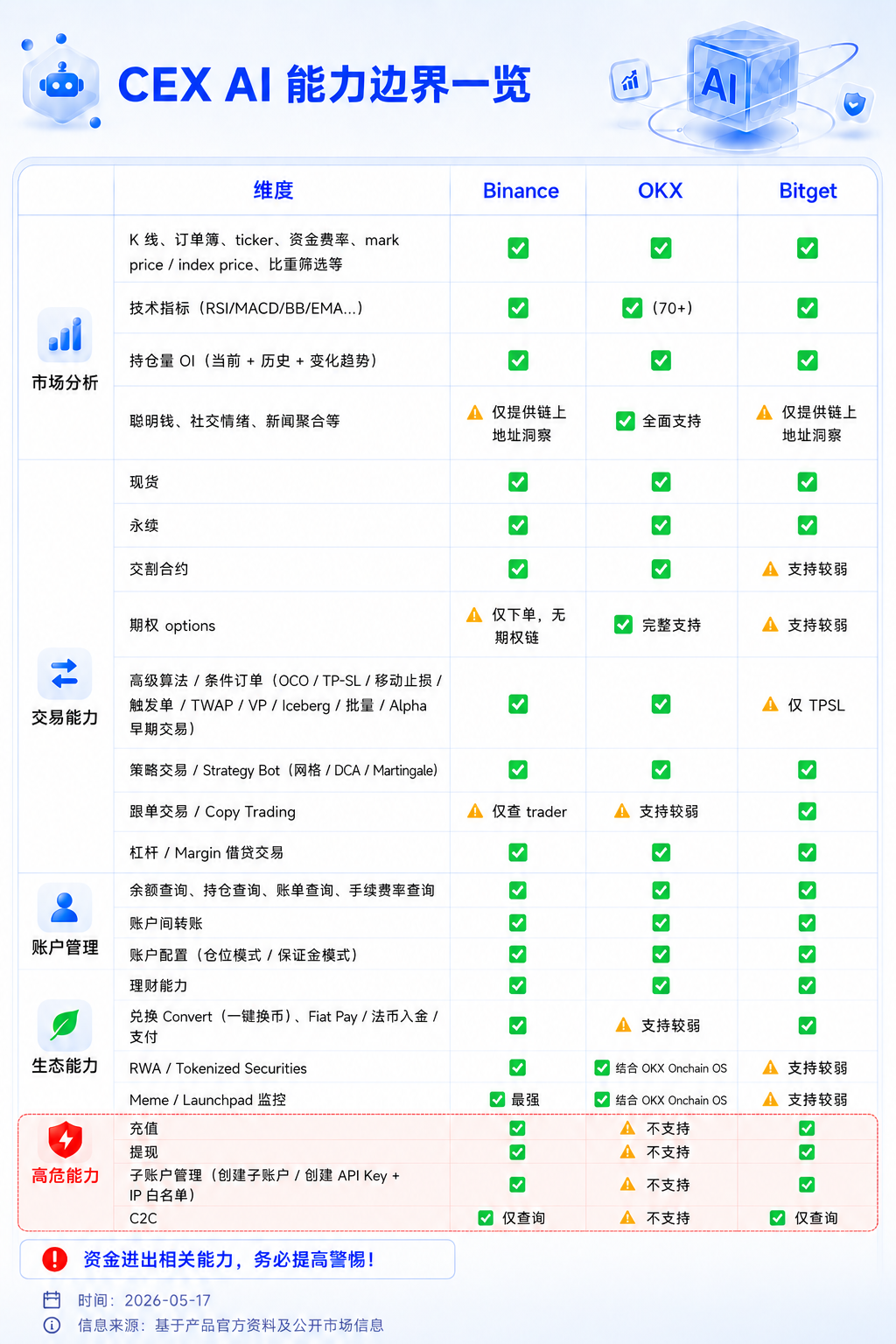
Interestingly, although Binance boasts the largest command count (695), it does not offer the most comprehensive toolset.
The high volume stems from Binance’s underlying design: splitting identical functions into four separate endpoints—for spot, futures, coin-margined, and portfolio-margin trading—resulting in functional duplication.
Yet this doesn’t diminish Binance’s core advantage in ecosystem breadth: In fiat on-ramps, P2P trading, real-world assets (RWA), meme coin launches (Meme Rush), and early-stage alpha trading, Binance stands virtually alone. This “rapidly unrolling its rich ecosystem” strategy makes Binance the only viable option if your needs align with these exclusive services.
When it comes to the most comprehensive toolset, we arrive at OKX’s domain—further reinforcing OKX’s foundational “build a complete toolchain” philosophy.
The 172 commands cover spot, perpetuals, delivery futures, and options—spanning the full cycle from market discovery and analysis to trade execution—with particular strength in derivatives and analytical tools.
Moreover, tools are segmented with exceptional granularity: The options module includes full Greeks (Delta, Gamma, Theta, Vega, IV), currently representing the most complete AI agent options toolkit available; the Market module uniquely embeds 70+ technical indicators—including MA, EMA, RSI, MACD, Bollinger Bands (BB), ATR, and KDJ—paired with market filters, OI history, and sentiment radar to grant agents heightened market sensitivity; OKX also offers rich strategy bots (Grid, DCA).
This meticulous segmentation enables finer-grained trade control—making OKX especially well-suited for professional traders.
Bitget, like Binance, follows the “open the door first” path—but distinguishes itself through its proprietary copy-trading functionality.
Its five dedicated copy-trading tools support automatic elite trader screening, one-click copying, and position tracking—making deep, end-to-end copy-trading capability the most distinctive hallmark of Bitget’s AI strategy.
With command inventories laid bare, each platform’s functional boundaries become clearer—enabling users to match offerings directly against their own requirements.
But raw capability counts matter little unless those features actually work—and work well. Real-world task execution reveals far more.
Running It Live: Which Solution Performs Better on Your Tasks?
Differences between the “open the door first” and “build infrastructure first” paths become even more pronounced during actual task execution—providing users with sharper, more actionable selection criteria.
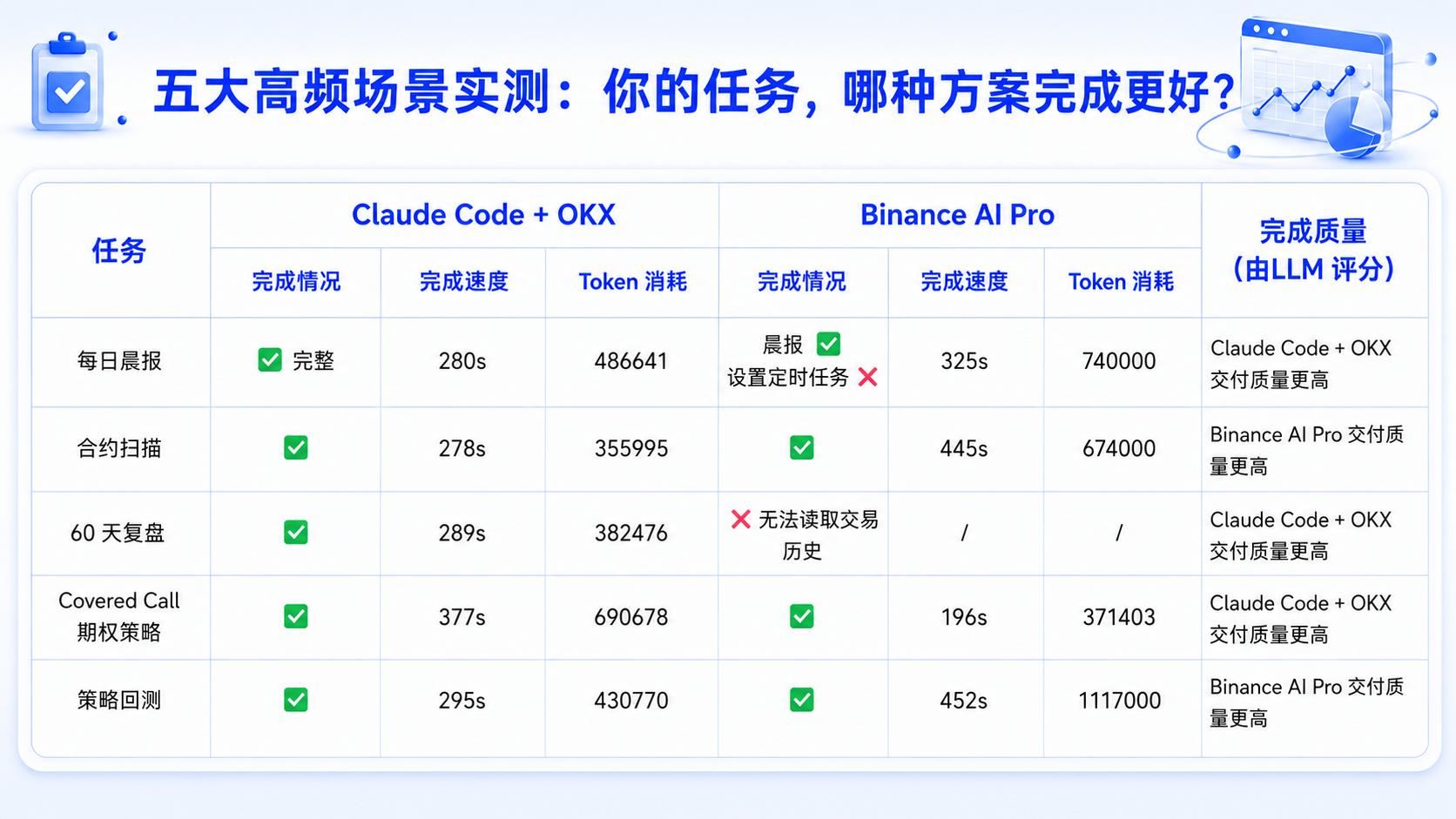
How do Binance AI Pro (representing “open the door first”) and Claude Code integrated with OKX Agent Trade Kit (representing “build infrastructure first”) compare when executing identical tasks using the same prompt?
First, consider the entry barrier:
Binance AI Pro is truly plug-and-play—zero configuration required;
Claude Code + OKX requires manual setup, posing a nontrivial challenge for newcomers. OKX acknowledges this and recently introduced a “one-click quick connection” feature—authorization completes in ~15 seconds—but overall setup remains more complex than using a built-in agent.
Next, assess task completion quality:
For relatively isolated, single-purpose tasks—such as contract scanning and strategy backtesting—Binance AI Pro performs more nimbly;
Claude Code + OKX completed all five test tasks. For multi-module, interdependent tasks, Claude Code leverages OKX ATK’s full toolchain to achieve higher completion rates.
Of course, “usable” isn’t enough—you also need speed and affordability.
Regarding speed, Claude Code + OKX completed all tasks in an average of 311 seconds, versus Binance AI Pro’s 348 seconds—confirming that the “infrastructure-first” path is slightly faster overall.
Specifically, in contract scanning, Claude Code + OKX finished in just 278 seconds—over two-and-a-half minutes faster than Binance AI Pro’s 445 seconds; yet in options strategy scenarios, Binance AI Pro completed in only 196 seconds—outpacing Claude Code + OKX’s 377 seconds.
On cost, while Claude Code + OKX consumed an average of 444K tokens—lower than Binance AI Pro’s 623K—both retain distinct strengths across use cases: In options strategy tasks, Binance AI Pro consumed fewer tokens than Claude Code + OKX; whereas in strategy backtesting, Claude Code + OKX used nearly 2.5× fewer tokens than Binance AI Pro.
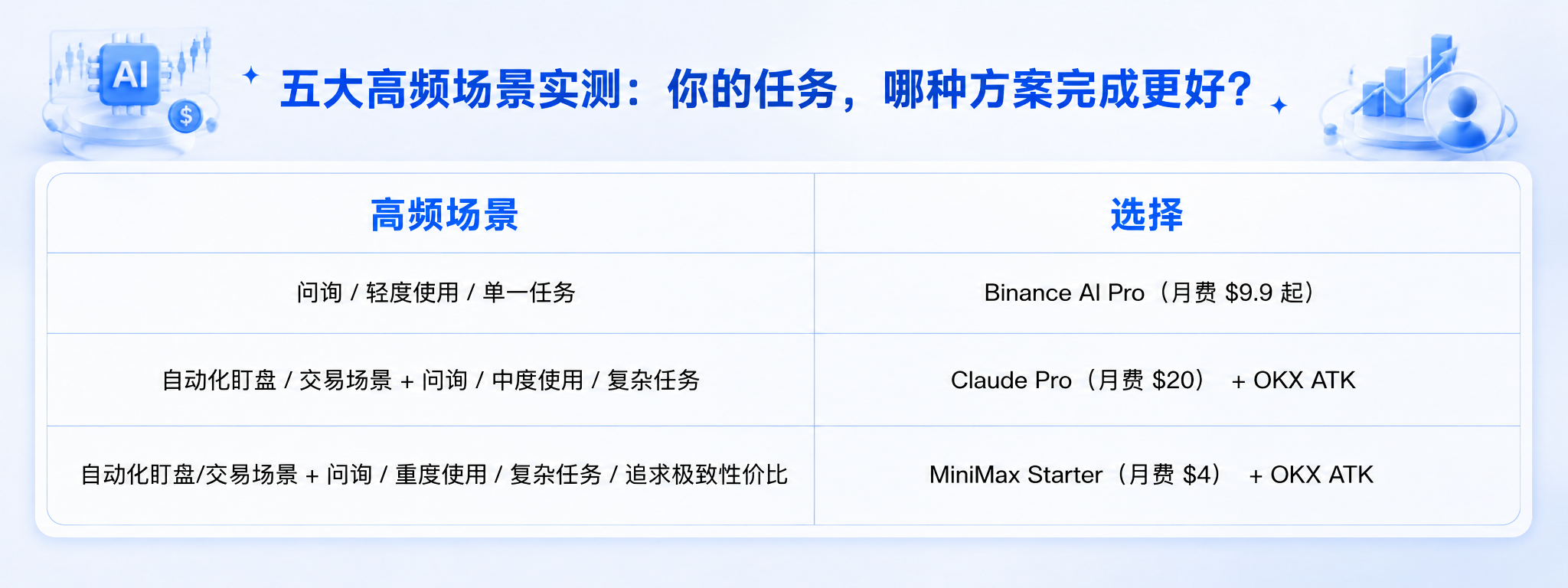
Additionally, Binance AI Pro starts at $9.9/month—but under limited monthly token quotas, its per-complex-task consumption is comparatively high;
OKX ATK integrates seamlessly with multiple agents—including Claude Code, ChatGPT, MiniMax, GLM, and DeepSeek—each with varying monthly fees ($4–$20). Under constrained token budgets, higher frequency of complex-task execution amplifies OKX’s cost-efficiency advantage—especially when opting for the $4/month MiniMax Starter + OKX ATK plan, which delivers extreme cost compression.
Ultimately, these two paths aren’t mutually exclusive—it’s about where your needs land:
Match your use case, and the answer becomes self-evident.
Security & Integration: Two Must-Answer Questions Before Final Selection
Functionality is often the top priority when selecting an AI tool.
Yet after evaluating capabilities, two additional questions demand equal attention.
First: Is this AI safe to operate my account?
After all, beneath trading capability lies the handling of actual funds.
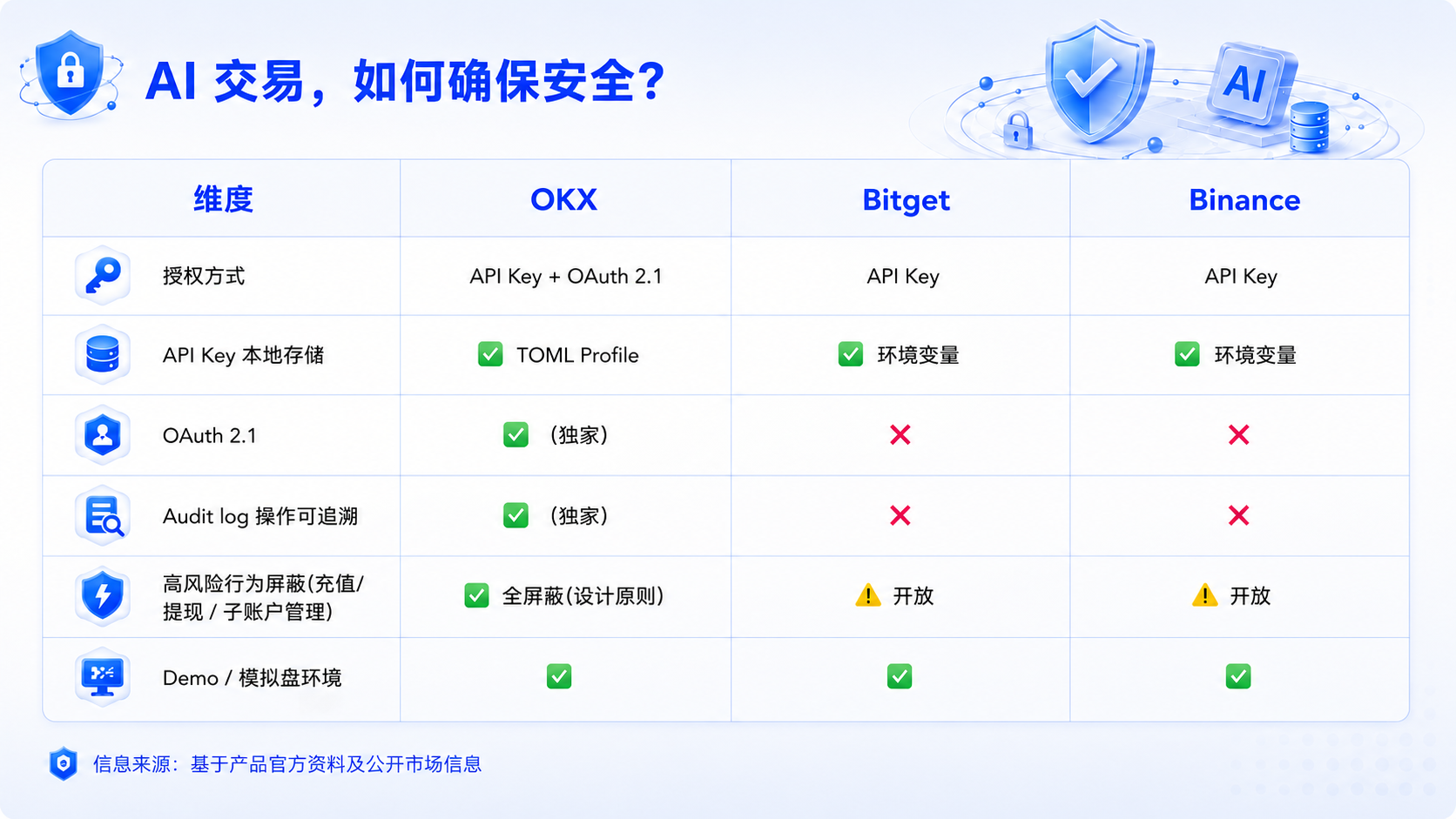
Each platform treats security seriously—but with varying emphases.
Binance’s security model begins at the source: Every skill listed on Binance Skills Hub undergoes official Binance security review to ensure inherent trustworthiness.
At the execution level, Binance employs API key authorization to control account permissions—and strongly recommends users create dedicated virtual sub-accounts, strictly confining all AI operations to those sub-accounts and physically isolating them from main-account assets.
By contrast, OKX is currently the only platform satisfying three critical security criteria simultaneously: key isolation, high-risk operation blocking, and full operational logging.
With API keys stored entirely locally—and AI models never seeing them—OKX Agent Trade Kit further implements OAuth 2.1, adding granular protections via short-lived tokens, scope-based access control, and browser-based flows. Simply put: AI agents never see OKX’s keys; tokens expire automatically upon use; even if an account is compromised, attackers gain only a short-lived, expiring credential.
Meanwhile, as noted earlier in the capability comparison, Binance and Bitget opt to expose permissions for high-risk actions—including deposits, withdrawals, and sub-account management—to maximize flexibility, leaving users to constrain permissions manually via API key settings. OKX Agent Trade Kit takes the opposite stance: It blocks these high-risk endpoints outright at the tool layer. Even if an agent is compromised or malfunctions, fund transfers remain physically impossible.
Worth noting too is OKX Agent Trade Kit’s exclusive Audit Log support—offering fully traceable, immutable records of every action. As of May 2025, OKX remains the sole platform providing complete operational logging. This means every tool invocation and executed action by an AI agent is fully auditable—a critical capability for post-event forensics, compliance reviews, or anomaly investigations.
Bitget, also relying on API key authorization, centers its security philosophy on “isolation”: a four-layered framework encompassing identity isolation, memory isolation, permission isolation, and credential isolation—complemented by sandboxed sub-accounts—to sever AI’s potential impact on main accounts across multiple dimensions.
Which User Are You? The Answer Lies Here
So after all this comparison—what CEX AI is right for you?
The answer is now unmistakably clear.
Building a polished entry point lowers the barrier—allowing larger numbers of users to enter, explore, learn, and grow.
Hence, for users who prefer zero setup—or lack the current capacity to configure agents—built-in exchange agents like Binance AI Pro or Bitget GetClaw provide perfect fit: plug-and-play, rapid onboarding, and superior performance for ad hoc queries, price checks, basic analysis, and simple executions.
Building robust infrastructure raises the ceiling—empowering diverse agents to execute complex, multi-step tasks across varied scenarios using rich toolsets.
Therefore, if you possess basic configuration skills—and your AI trading needs have evolved toward automation, sophisticated strategies, scheduled tasks, or derivatives analysis—then DIY integration leveraging OKX’s comprehensive toolchain becomes the superior choice. It enables construction of more advanced strategies, delivers higher task completion rates, and offers greater cost control. To address the entry barrier, OKX specifically launched its “one-click quick connection” feature—reducing authorization to ~15 seconds—significantly lowering setup friction. This allows OKX to maintain both high-end extensibility and strong usability.
Further, for developers and institutional users requiring enterprise-grade integration, compliance auditing, cloud deployment, or multi-agent orchestration, OKX ATK—with its combination of Remote MCP, OAuth 2.1, Audit Logs, and public evaluation frameworks—is uniquely positioned to meet these demands.
Different stages, different needs, different choices.
Path determines product architecture; product architecture reflects user mindset.
In today’s rapidly evolving AI landscape, user habits remain fluid, and toolchains continue maturing: Today’s “basic support” may become tomorrow’s “full support”; today’s “exclusive capability” may be replicated by competitors next quarter.
Which path will first catalyze a breakthrough leap—and mass-scale adoption—in AI-powered trading execution?
That may well be the most compelling long-term question in this CEX AI arms race.
Join TechFlow official community to stay tuned
Telegram:https://t.me/TechFlowDaily
X (Twitter):https://x.com/TechFlowPost
X (Twitter) EN:https://x.com/BlockFlow_News
 深潮TechFlow