Crypto Morning Brief: Ethereum Foundation unveils new fiscal policy, Circle completes IPO at $31 per share
TechFlow Selected TechFlow Selected
Crypto Morning Brief: Ethereum Foundation unveils new fiscal policy, Circle completes IPO at $31 per share
Binance launches spot small-coin liquidity enhancement program.
 Navigating Web3 tides with focused insights
Author: TechFlow
Yesterday's Market Developments
U.S. May ADP Nonfarm Employment Change: 37,000, Forecast 110,000, Prior 62,000
According to Jin10 News, the U.S. May ADP nonfarm employment change was 37,000, below the forecast of 110,000 and the previous figure of 62,000.
Trump: Powell Must Cut Rates Now, Europe Has Already Done So Nine Times
U.S. President Trump posted on social media that after the release of the ADP data, "Mr. Too Late," Federal Reserve Chair Powell, must now cut interest rates. He said it’s unbelievable—Europe has already cut rates nine times.
U.S. Senate Confirms Michelle Bowman as Vice Chair for Supervision at the Federal Reserve
As disclosed by Eleanor Terrett, the U.S. Senate confirmed Federal Reserve Governor Michelle Bowman as Vice Chair for Supervision with a 48-46 vote, officially succeeding Michael Barr as the Fed’s top banking regulator. Bowman, previously a community banker, has long advocated against excessive government regulation of small lending institutions. She plans to reduce regulatory burdens and streamline leverage requirements and stress testing procedures. Industry insiders note that Bowman is supportive of cryptocurrencies and has previously stated she welcomes discussions on innovation in the financial system.
South Korean Presidential Candidate Lee Jae-myung Pledges Support for Crypto ETFs and KRW-Backed Stablecoin Development
According to The Block, left-wing candidate Lee Jae-myung won South Korea’s presidential election with 49.42% of the vote, defeating right-wing opponent Kim Moon-soo who received 41.15%. Lee pledged to significantly advance the country’s cryptocurrency industry, with key policies including allowing domestic spot crypto ETFs, establishing a Korean won (KRW)-backed stablecoin market, improving the digital asset regulatory framework, and reducing blockchain regulations in designated zones to foster innovation.
South Korea is one of the world’s largest cryptocurrency markets, with 9.7 million active traders—about 20% of its population. Unlike former President Yoon Suk-yeol, whose pro-crypto promises remained unfulfilled, Lee may succeed in implementing his agenda amid a shifting stance from the Financial Services Commission.
CUDIS Airdrop Claim Opens Tomorrow at 20:00, TGE Circulating Supply Represents 24.75% of Total Token Supply
Officially announced, CUDIS has revealed its tokenomics: the total supply of CUDIS tokens is 1 billion, with 24.75% of the total supply entering circulation at TGE. 25% of the tokens will be allocated to the community across multiple seasons, with 5% distributed in Season One.
The first season airdrop claim will open at 20:00 Beijing time on June 5, distributing 50 million CUDIS tokens to over 60,000 active community members.
Binance Launches Spot Small-Cap Liquidity Incentive Program
Per an official announcement, Binance has launched a “Spot Small-Cap Liquidity Incentive Program” aimed at enhancing liquidity and trading efficiency for selected small-cap trading pairs. The initiative aims to provide users with tighter spreads, lower slippage, and improved overall trading experience.
The qualification period for the program begins on June 9, 2025, at 08:00 (UTC+8).
Program details:
-
Market makers will be evaluated weekly based on the performance assessment mechanism.
-
Users who achieve a maker order volume占比 of 0.5% or more in the listed small-cap spot trading pairs will qualify for Tier 1 fee rebate.
-
Users achieving a maker order volume占比 of 1.0% or more will qualify for Tier 2 fee rebate.
-
Tier 1 maker fee rate: -0.005%; Tier 2 maker fee rate: -0.010%.
-
Maker fee rebates will be updated weekly starting from June 17, 2025, at 08:00 (UTC+8).
-
Accounts eligible for both the Spot Market Maker Program and the Small-Cap Liquidity Incentive Program will receive only the more favorable rate between the two.
Participation Requirements:
To apply, users must have either achieved a trading volume of over $20 million in equivalent value on Binance spot and margin trading over the past 30 days, or provided verifiable trading volume records from other platforms (as accepted by Binance), and possess a proven high-quality liquidity provision strategy.
Ethereum Foundation Unveils New Fiscal Policy: Reducing Annual Spending and Increasing DeFi Engagement
On June 4, 2025, the Ethereum Foundation (EF) officially released a new fiscal policy, announcing a gradual reduction in annual operational expenditures—from currently 15% of total assets down to a long-term baseline of 5% over the next five years. The policy identifies 2025–2026 as a critical period for Ethereum’s development and emphasizes increased support for the ecosystem.
The policy outlines EF’s asset management framework, including ETH sales strategy, staking deployment, and fiat asset allocation. EF also introduced the “Defipunk” evaluation framework, prioritizing DeFi projects that meet criteria such as permissionless access, self-custody, open-source code, and privacy protection.
EF stated it will strategically deploy capital to nurture a sovereign, native Ethereum financial ecosystem and encourage existing protocols to enhance decentralization and privacy features. Additionally, EF itself will adopt these principles in treasury management, including solo staking and providing liquidity to mature lending protocols.
The policy was co-developed by key Ethereum contributors, including Vitalik Buterin and Tim Beiko, aiming to balance financial sustainability with long-term ecosystem growth.
Circle Prices IPO at $31 per Share, Raising $1.1 Billion
According to CoinDesk, stablecoin issuer Circle completed its IPO on the New York Stock Exchange at $31 per share—above the initial $24–$26 range—raising $1.1 billion and achieving a $6.2 billion valuation. Trading under the ticker “CRCL,” shares begin trading Thursday. Originally planning to issue 24 million shares, strong demand led to an expansion to over 34 million. Circle issues USDC, the second-largest U.S. dollar-pegged stablecoin. Its public listing comes as U.S. lawmakers push forward stablecoin regulatory legislation.
Crypto Exchange Rails Raises $14 Million, Backed by Kraken, CMCC Global, Slow Ventures, and Others
According to Decrypt, crypto exchange startup Rails has announced a $14 million funding round led by Kraken, CMCC Global, Slow Ventures, Round13 Capital, and Quantstamp.
Rails operates a hybrid model combining centralized execution with on-chain custody. It uses a centralized matching engine for high-performance trading while settling transactions on-chain using cryptographic techniques like zero-knowledge proofs and Merkle trees. The platform aggregates all trades and publishes them on-chain, ensuring transparency and verifiability.
Spanish Coffee Chain Vanadi Plans $1.1 Billion BTC Investment, Aiming to Become a “Bitcoin-First” Company
According to BeInCrypto, Spanish coffee chain Vanadi Coffee announced plans to invest over $1.1 billion to acquire BTC, aiming to transform into a “Bitcoin-first” enterprise.
Salvador Martí, Chairman of Vanadi’s board, said he will seek board approval for this Bitcoin accumulation strategy and intends to finance the plan through stock and convertible bond issuances. The company reportedly purchased 5 BTC approximately two weeks ago for around $500,000.
The Blockchain Group to Seek Shareholder Approval for €10 Billion Fundraise to Accelerate Bitcoin Reserves Strategy
According to Bitcoin News, The Blockchain Group will hold its annual general meeting on June 10, 2025, seeking shareholder approval to raise €10 billion to accelerate its Bitcoin reserves strategy.
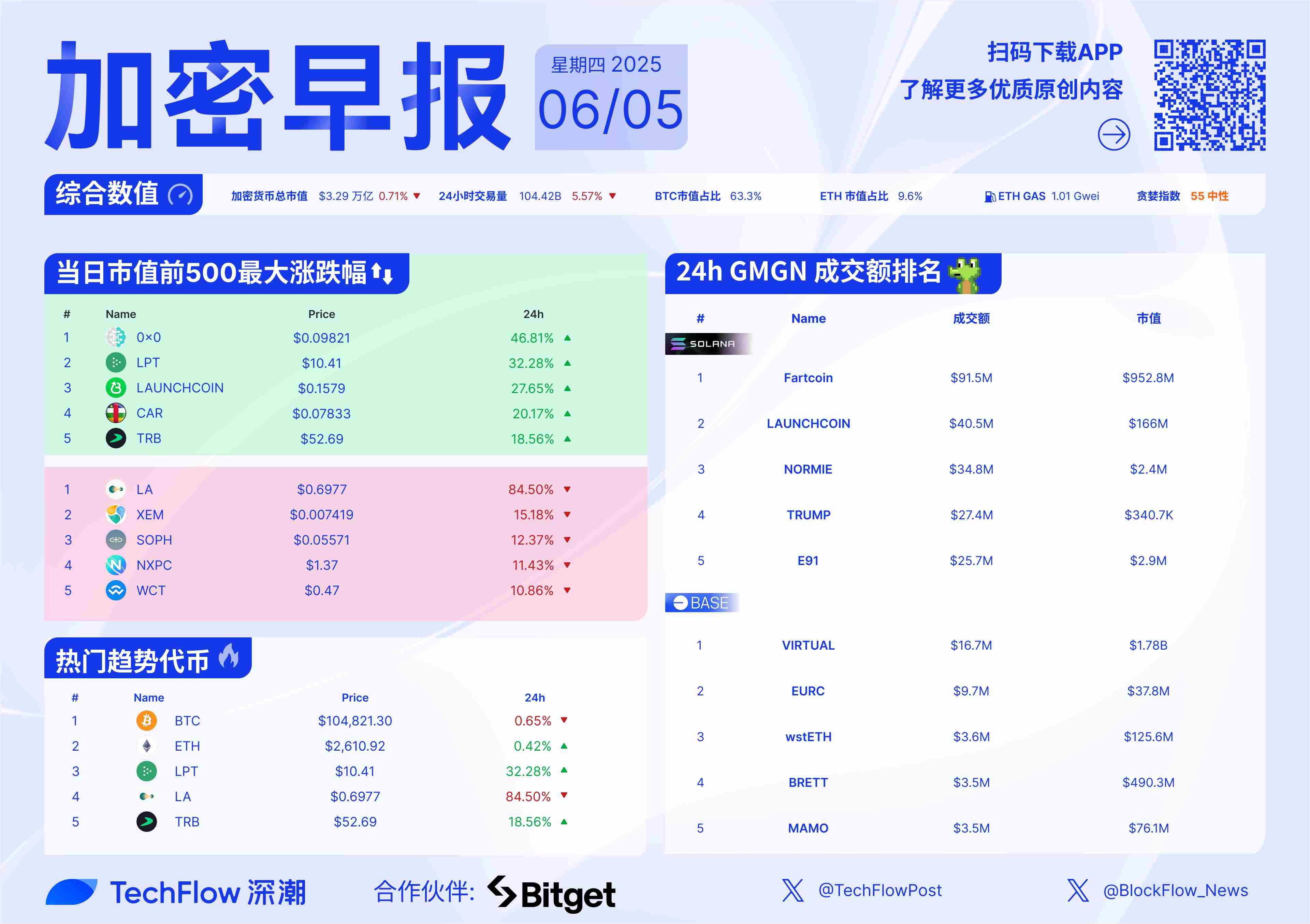
Market Overview
Suggested Reading
Stablecoin’s First Public Company: Circle’s Chinese Connection
This article reviews the historical development of stablecoin issuer Circle, particularly its ties with Chinese capital and markets. From its origins as a digital currency wallet to its current focus on the U.S. dollar-backed stablecoin USDC, Circle has undergone multiple transformations and challenges, emerging as a major player in the stablecoin space. The piece also explores Circle’s business model, the context behind its IPO, and the potential impact of the GENIUS Act on its future trajectory.
Ethereum Foundation Announces Staff Reductions—Are Project Teams Finally Taking Action?
This article discusses the Ethereum Foundation’s recent announcement of layoffs and internal restructuring aimed at improving efficiency and focus. The foundation plans to scale back theoretical research and increase delivery of tangible outcomes, focusing on scaling Ethereum’s base layer, supporting Layer 2 solutions, and enhancing user experience. This strategic shift is seen as a pragmatic response to community dissatisfaction and market pressures. However, past actions—such as ETH selling, lack of transparency, and perceived conflicts of interest—have eroded trust. Moving forward, Ethereum must work on greater transparency and balancing decentralization with centralized management.
Pump.fun Valued at $4 Billion Launches Token—But a Dried-Up Market Waits for a Savior
This article examines meme token launchpad Pump.fun’s plan to issue a token at a $4 billion valuation, sparking debate over its legitimacy and future prospects. Meme market enthusiasm has waned, Pump.fun’s revenue is volatile, and its valuation logic is questioned. Despite continuous innovation attempts, doubts remain about whether its high valuation is justified.
The Poorest Continent, Africa, Becomes the Hottest Player in Crypto
This article explores how Africa, despite being the world’s poorest region, has become a rapidly growing market for stablecoins and digital payments due to high inflation, currency devaluation, and underdeveloped financial infrastructure. Stablecoins, pegged to the U.S. dollar, help Africans hedge against inflation and preserve wealth, while also enabling cross-border payments and digital economy growth. However, the rapid global expansion of stablecoins raises concerns about regulation, illicit use, and the reinforcement of U.S. dollar dominance.
Ray Dalio of Bridgewater Associates: How Do Nations Go Bankrupt?
This article summarizes insights from Ray Dalio, founder of Bridgewater Associates, in his new book *How Countries Go Bankrupt: The Big Cycle*. Dalio analyzes the mechanics of national debt crises and proposes solutions. By examining debt cycle dynamics, he warns that the U.S. and other nations are approaching a debt crisis akin to an economic “heart attack,” and presents his “3% Three-Part Solution” to address the challenge.
Join TechFlow official community to stay tuned
Telegram:https://t.me/TechFlowDaily
X (Twitter):https://x.com/TechFlowPost
X (Twitter) EN:https://x.com/BlockFlow_News
 深潮TechFlow