Will HYPE become the next SOL?
TechFlow Selected TechFlow Selected
Will HYPE become the next SOL?
The opportunity is great, but it's still early.
 Navigating Web3 tides with focused insights
Author: Jack Kubinec
Translation: TechFlow
Next, we will dive into the comparison between Hyperliquid and Solana: Could HYPE become the next SOL?
Will HYPE Be the Next SOL?
Among cryptocurrencies launched after the FTX collapse, very few have made it into the top 15 by market cap. Two exceptions are SUI, which began trading in mid-2023, and HYPE, whose market cap has surged to over $11 billion since its airdrop in November 2024.
As the native token of the Hyperliquid Layer-1, HYPE has more than tripled in price since its local low on April 6, 2024—far outpacing Solana’s roughly 70% gain over the same period. For crypto investors seeking a Layer-1 token that could deliver returns similar to Solana, HYPE has undoubtedly drawn significant attention. Even Galaxy’s Mike Novogratz has joined the hype.
Hyperliquid’s core Layer-1 application chain, HyperCore, is purpose-built for its orderbook exchange, which generates revenue from trading fees used for token buybacks. The product has been immensely popular: according to Artemis data, Hyperliquid accounted for 77% of on-chain perpetual futures volume in April 2024.
In addition, Hyperliquid has launched an Ethereum Virtual Machine (EVM) network called HyperEVM, though its adoption currently lags far behind HyperCore.
There is some market debate around HYPE’s valuation: should it be viewed as a decentralized exchange (DEX) token in a saturated perpetuals market, or as a Layer-1 token capable of competing with Ethereum and Solana?
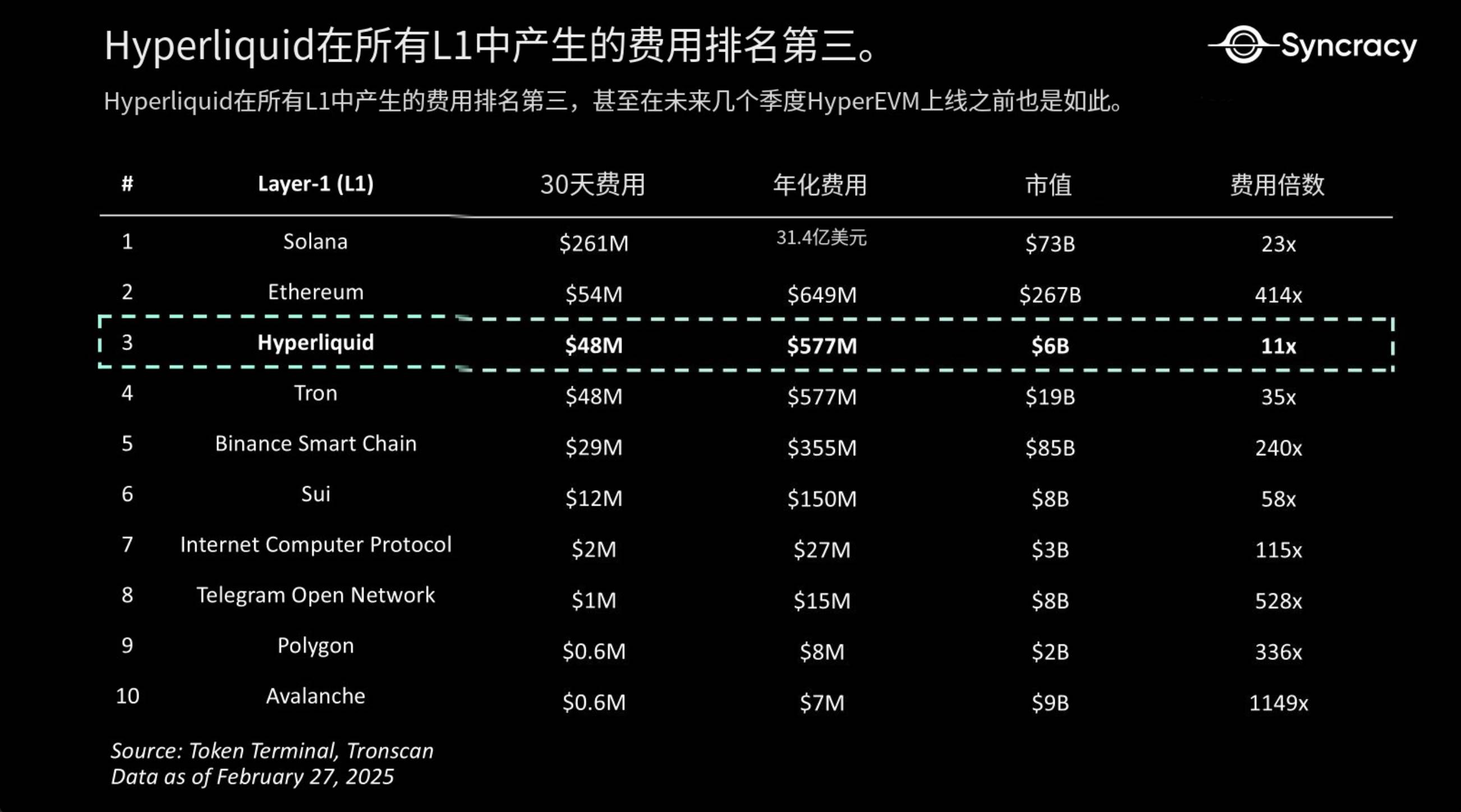
Currently, HYPE is priced somewhere in between. In early March, Ryan Watkins of Syncracy Capital (whose portfolio includes both HYPE and SOL) shared a chart showing that Hyperliquid trades at a lower fee multiple than other Layer-1s, including Solana.
Translation: TechFlow
Blockworks Research analyst Boccaccio noted that Hyperliquid's fully diluted valuation (FDV)-to-fees ratio is higher compared to competitors Drift and dYdX, suggesting its appeal extends beyond being just a simple perpetuals DEX, and is instead assigned greater value.
Danny Nelson, Bitwise Research analyst, said Hyperliquid aims to build a vibrant blockchain economy akin to Solana, but is currently “not quite there yet.”
“Nonetheless, its flagship perpetuals exchange has already become an industry giant. The market pricing of HYPE reflects that, and I believe it also attempts to anticipate future success stories emerging from the Hyperliquid ecosystem,” Nelson added.
Additionally, some unique factors are influencing Hyperliquid’s value proposition: Hyperliquid’s validator set is not highly decentralized compared to other Layer-1 projects. Hyperliquid does not require users to undergo “Know Your Customer” (KYC) verification, unlike most centralized exchanges such as Binance. This feature may appeal to certain traders and is factored into market valuation.
For token investors seeking high-octane opportunities, HYPE appears to be a rare find in recent years. But calling it the next SOL might still be premature.
Join TechFlow official community to stay tuned
Telegram:https://t.me/TechFlowDaily
X (Twitter):https://x.com/TechFlowPost
X (Twitter) EN:https://x.com/BlockFlow_News
 @whosknave