
Chinese and American banking giants are embracing generative AI
TechFlow Selected TechFlow Selected
Chinese and American banking giants are embracing generative AI
North America is leading as expected.
 Navigating Web3 tides with focused insights
Author: Samora Kariuki
Translation: TechFlow
Global AI Wave
How Are Banks Actually Using Generative AI?
If we set aside headlines and hype, the core question remains: how exactly are the world's largest banks using generative AI? Not its future potential, nor vendor promises—but what real, implemented applications exist today?
Over the past two years, the global financial industry has quietly entered the era of generative AI. However, this transition is not uniform, but rather follows a clear inside-out pattern: quiet deployment of internal tools, cautious customer-facing experiments, and a few bold innovations gradually reshaping banking infrastructure.
Start Internally, Then Expand Outward
One common thread in AI adoption: it begins with internal productivity tools.
The primary use of generative AI centers on boosting internal productivity—tools that help employees achieve more with fewer resources. From JPMorgan’s equity research analyst assistant to Morgan Stanley’s GPT-powered tool supporting wealth management advisors, early efforts focus on empowering bankers, not replacing them.
Goldman Sachs is building AI assistants for developers; Citi’s AI summarization tools help staff process memos and draft emails; Standard Chartered’s “SC GPT” is live across its 70,000 employees, used for everything from proposal writing to HR inquiries.
Given the highly regulated environment, deploying internal tools makes perfect sense. It allows banks to experiment and build AI capabilities without crossing regulatory red lines. As seen recently with the Central Bank of Nigeria (CBN) action against Zap, “better safe than sorry” is clearly the smarter approach.
Business Line Observations: Where Is the Value?
AI adoption varies significantly across departments. Different business units are embracing generative AI at different speeds. Retail banking leads in transaction volume. Here, chatbots powered by generative AI such as Wells Fargo’s Fargo and Bank of America’s Erica handle hundreds of millions of interactions annually. In Europe, Commerzbank recently launched its own chatbot Ava.
However, the issue is that some of these tools do not actually use true generative AI, relying instead on traditional machine learning techniques. For example, Bank of America’s Erica operates more like a “mechanical turk”—simulating automation through human intervention. Still, the importance lies in the experimentation itself, not the technical label.
In corporate and investment banking, transformation is more subtle. JPMorgan’s internal tools primarily support research and sales teams, not direct customer engagement. Deutsche Bank uses AI to analyze client communication logs. This isn’t customer service—it’s data empowerment, helping bankers understand and serve clients faster and better.
Wealth management sits between the two. Morgan Stanley’s AI tool doesn’t converse directly with clients, but ensures advisors are fully prepared before every meeting. Deutsche Bank and First Abu Dhabi Bank are piloting assistants for top-tier clients designed to answer complex investment questions in real time.
Regional Differences: Who’s Leading?
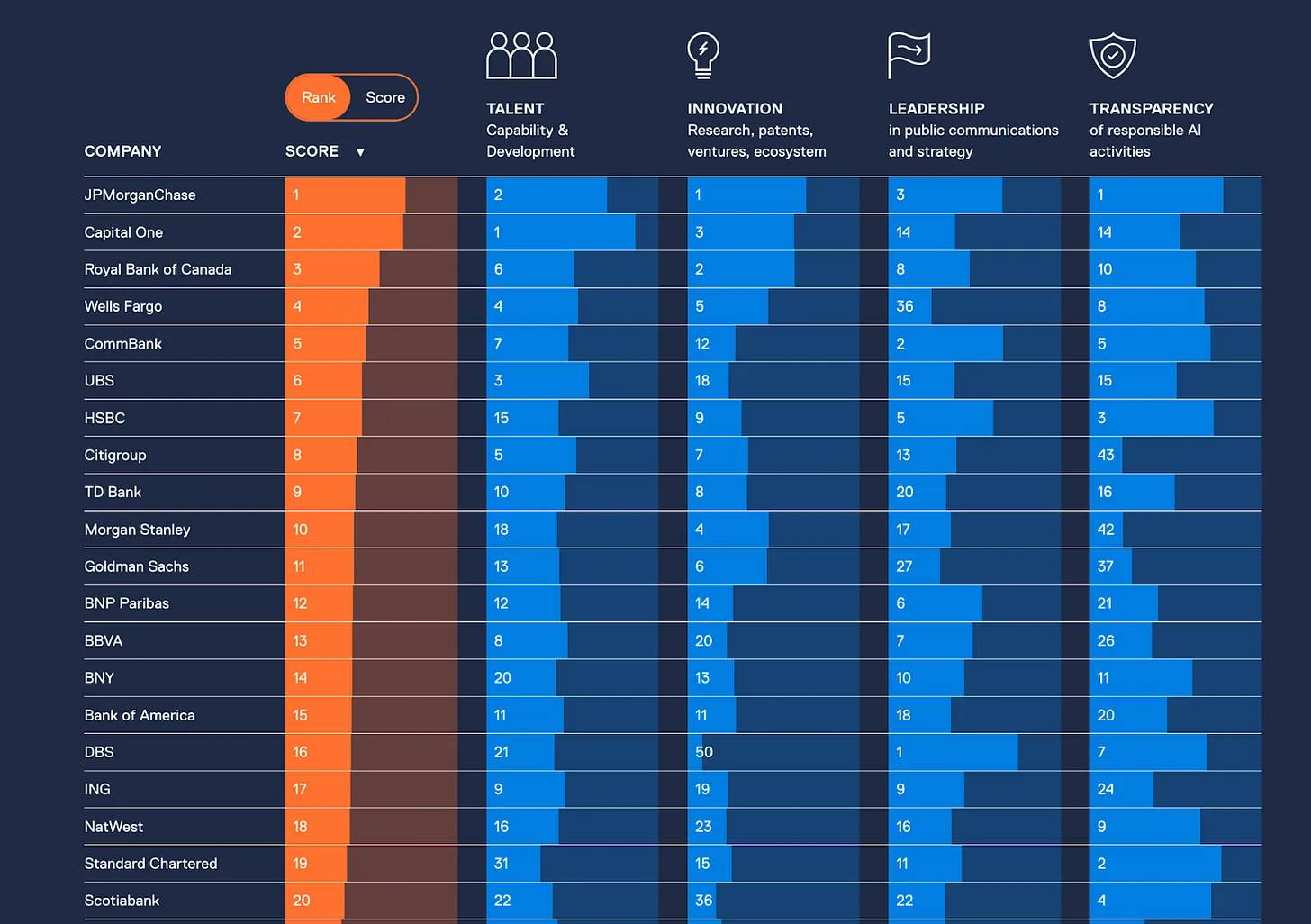
Source: Evident AI Index
North America leads as expected. U.S. banks like JPMorgan, Capital One, Wells Fargo, Citi, and Canada’s RBC have turned AI into productivity engines. Thanks to partnerships with OpenAI and Microsoft, they gain first access to cutting-edge AI models.
Europe proceeds more cautiously. BBVA, Deutsche Bank, and HSBC are testing AI tools internally with stronger safeguards. GDPR exerts deep influence. Once again, Europe prioritizes regulation over technological advancement—a stance that may come at a cost.
Africa and Latin America are still in early stages but moving quickly. Brazil’s Nubank stands out, partnering with OpenAI to deploy AI internally before expanding to customer service. In South Africa, Standard Bank and Nedbank are piloting AI across risk control, support services, and development.
China: Building Independent AI Stacks
Chinese banks aren't just using AI—they're building their own AI stacks.
Industrial and Commercial Bank of China (ICBC) launched “Zhiyong,” a large language model with 100 billion parameters, developed entirely in-house. The model has been invoked over one billion times, supporting 200 business scenarios—from document analysis to marketing automation. This goes beyond internal tools; it represents a foundational shift in how banks operate.
Ant Group has released two large language models for finance—Zhixiaobao 2.0 and Zhixiaozhu 1.0. The former serves general Alipay users by explaining financial products; the latter supports wealth advisors by summarizing market reports and generating portfolio insights.
Ping An Group, a fintech giant integrating insurance, banking, and technology, goes even further. Its generative AI assistant AskBob serves both customers and account managers. For customers, AskBob answers investment and insurance questions in natural Chinese. For advisors, it extracts and summarizes client history, product data, and marketing materials, turning every agent into a digitally enhanced financial expert. Ping An aims to redefine financial advisory through AI—not just answering questions, but anticipating needs.
In China, regulatory frameworks strongly encourage data localization and model transparency, prompting institutions to take a longer path: building customized AI systems adapted to domestic regulations, language, and market conditions. Moreover, China’s high density of technical talent enables banks to develop foundational models independently—an achievement likely unmatched globally.
Who Provides the Technology?
Certain big names appear frequently worldwide: Microsoft, via Azure OpenAI, is currently the most common platform. From Morgan Stanley to Standard Chartered, many banks run their models within Microsoft’s secure sandbox.
Google’s LLMs are also in use—for example, Wells Fargo leverages Flan to power Fargo. In China, reliance is primarily on domestic technologies such as DeepSeek and Hunyuan.
Some banks, including JPMorgan, ICBC, and Ping An Group, are training their own models. But most fine-tune existing ones. The key isn’t owning the model, but controlling the data layer and orchestrating model operations effectively.
Diverse Global Explorations in AI Application
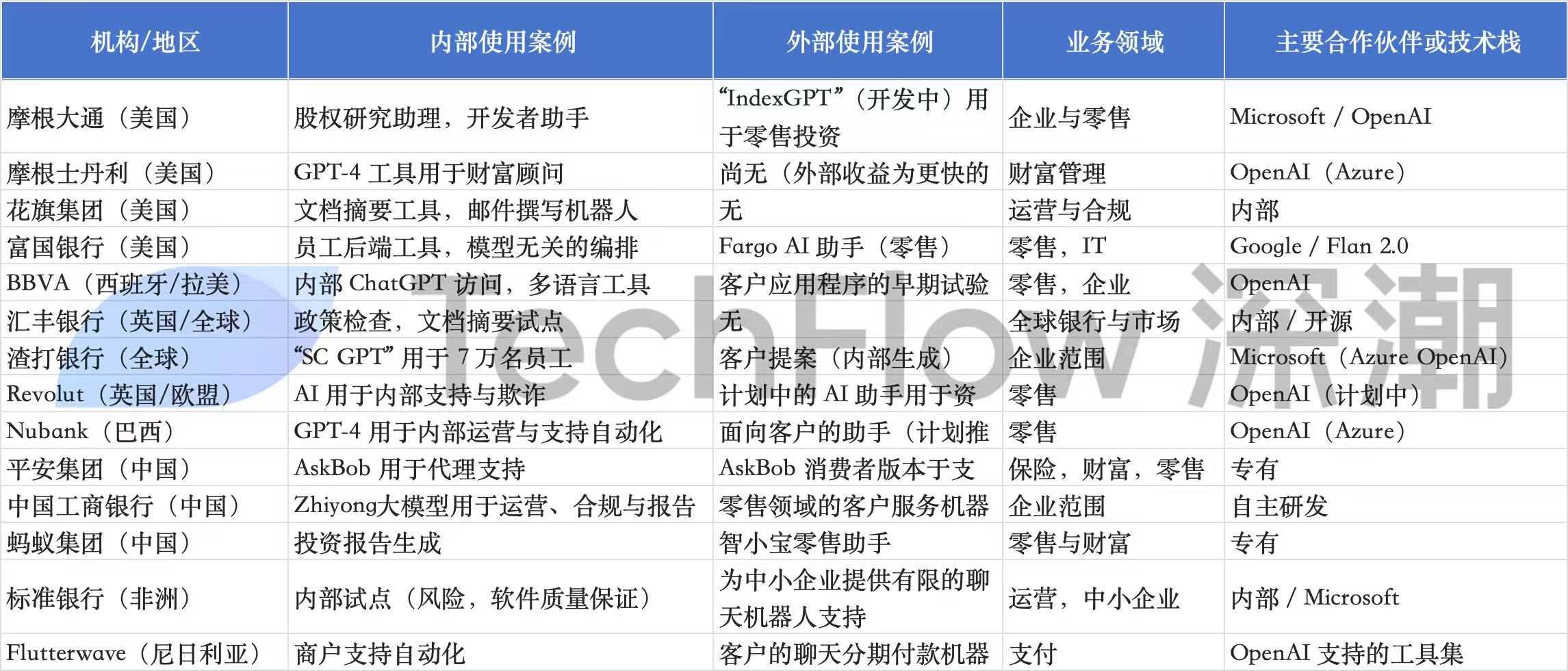
Original image from source, translation: TechFlow
So What?
In a highly regulated industry, caution is essential—which is why banks are letting AI participate behind the scenes, not front and center. Yet, as we’ve seen in other platform shifts, decisive action and rapid experimentation are critical. Regulation will never lead implementation, and waiting for regulators before experimenting with AI is unwise. I recall building agency banking over a decade ago in a country with no relevant regulation. Once we built it, we ended up being the ones explaining it to the central bank. If I were on a bank’s board, I’d ask: “How many experiments are we running? How much insight are we generating?”
To truly measure progress, return to the fundamentals of platform shifts. Your AI strategy must answer these questions:
“Does our AI strategy rebuild core architecture? Does it reduce costs by 100x? Does it unlock new value models? Does it enable ecosystem connectivity? Does it disrupt markets? Does it democratize access?”
The logic is clear—healthy skepticism is necessary, but logic and facts show that AI is a new platform shift. And logic and facts also show that past platform shifts in financial markets often brought revolutionary change. For example, Citi’s technology adoption in the 70s and 80s dramatically expanded its retail operations. Capital One rose from nothing to rank among the top ten banks, gaining strong positions in auto loans and mortgages. In Africa, Equity Bank rode the client-server wave to become East Africa’s most valuable bank. Similarly, Access Bank, GT Bank, and Capitec surfed this same wave in their respective markets.
The AI platform era has arrived, and it will create winners. The focus should not be on losers, but on how winners capture significant market share in specific domains. Stripe’s success in payments is a classic case. Early breakthroughs often lead to expansion into adjacent areas—Nubank, for instance, leveraged credit cards to become a major player in SME and retail banking.
My view is that winners in the AI era will focus on relationship cost. This is no longer just a transaction game. Transactions have already happened. Now it’s about customer experience and relationship management. This is the core insight financial services leaders should prioritize. How can we improve customer experience and relationship banking by 100x at near-zero cost? As a bank, how can we leverage intelligent technology to better help customers manage their finances, businesses, and lives? Those who can answer and execute on these questions will emerge as the ultimate winners.
Join TechFlow official community to stay tuned
Telegram:https://t.me/TechFlowDaily
X (Twitter):https://x.com/TechFlowPost
X (Twitter) EN:https://x.com/BlockFlow_News
 @SamoraKariuki