Interpreting the FBI's "2024 Cryptocurrency Fraud Report": Losses Increase by 66%, Elderly Population Becomes Primary Victims
TechFlow Selected TechFlow Selected
Interpreting the FBI's "2024 Cryptocurrency Fraud Report": Losses Increase by 66%, Elderly Population Becomes Primary Victims
Ordinary users should still remain highly vigilant.
 Navigating Web3 tides with focused insights
Author: Lisa
Editor: Sherry
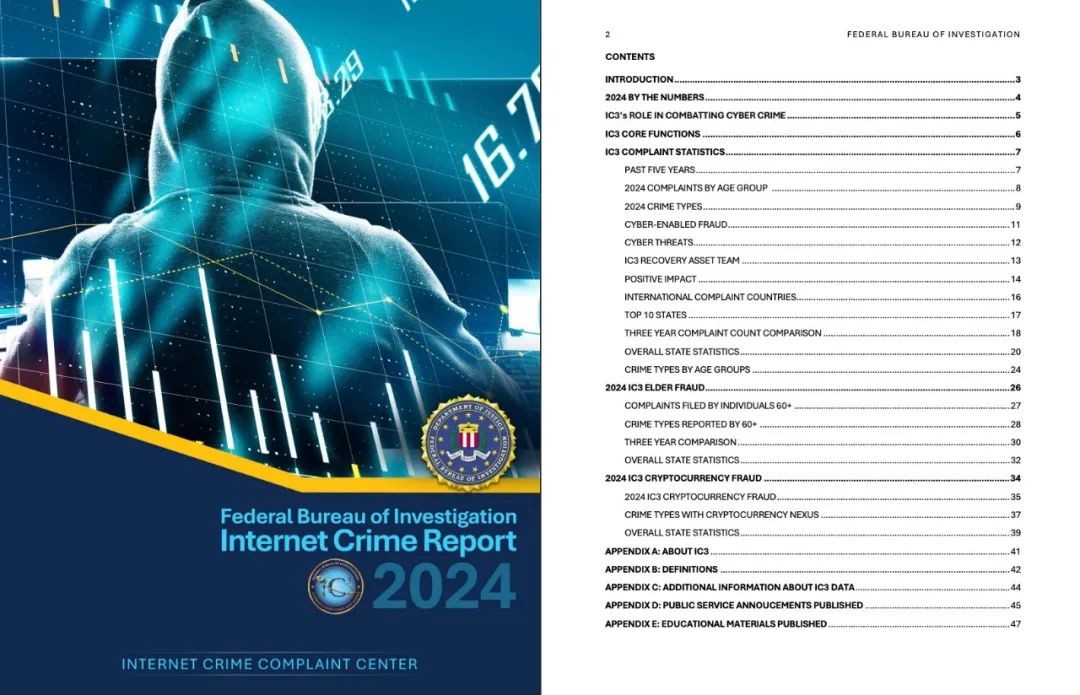
In April 2025, the U.S. Federal Bureau of Investigation (FBI) released the "2024 Cryptocurrency Fraud Report." Based on data collected in 2024 by the FBI's Internet Crime Complaint Center (IC3), the report analyzes the volume of cryptocurrency-related complaints, financial losses, victim profiles, types of crimes, and progress in asset recovery. This article interprets the report’s key findings to help readers quickly understand evolving trends and enhance awareness and defenses against complex cybersecurity threats.
Key Point One: 2024 Complaint Data
1. Overall Situation
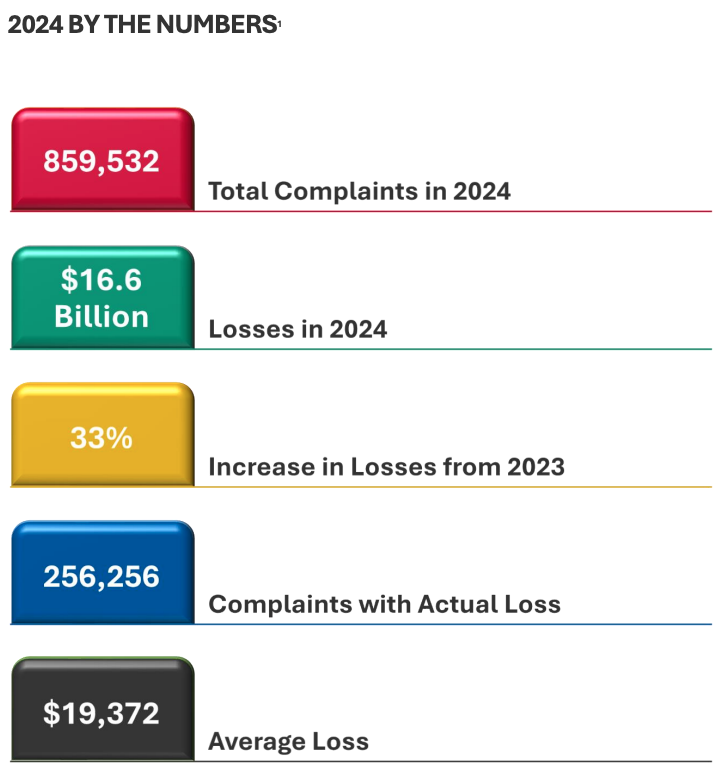
In 2024, IC3 received a total of 859,532 complaints, resulting in actual losses of $16.6 billion—an increase of 33% compared to 2023. Among these, 256,256 complaints involved actual financial loss, with an average loss of approximately $19,372 per incident. About 83% of losses were caused by online scams.
2. Cryptocurrency-Related Cases
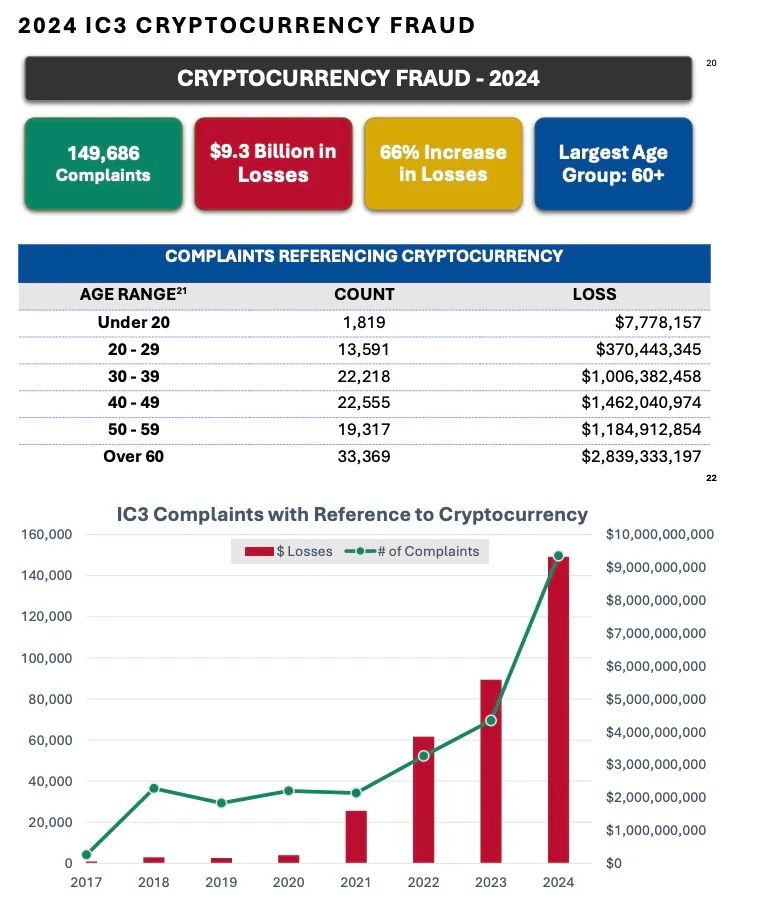
Cryptocurrency-related complaints reached 149,686, causing $9.3 billion in losses—an increase of 66% in loss amount year-on-year. Victims aged 60 and above accounted for the highest proportion.
3. Individuals Aged 60 and Above
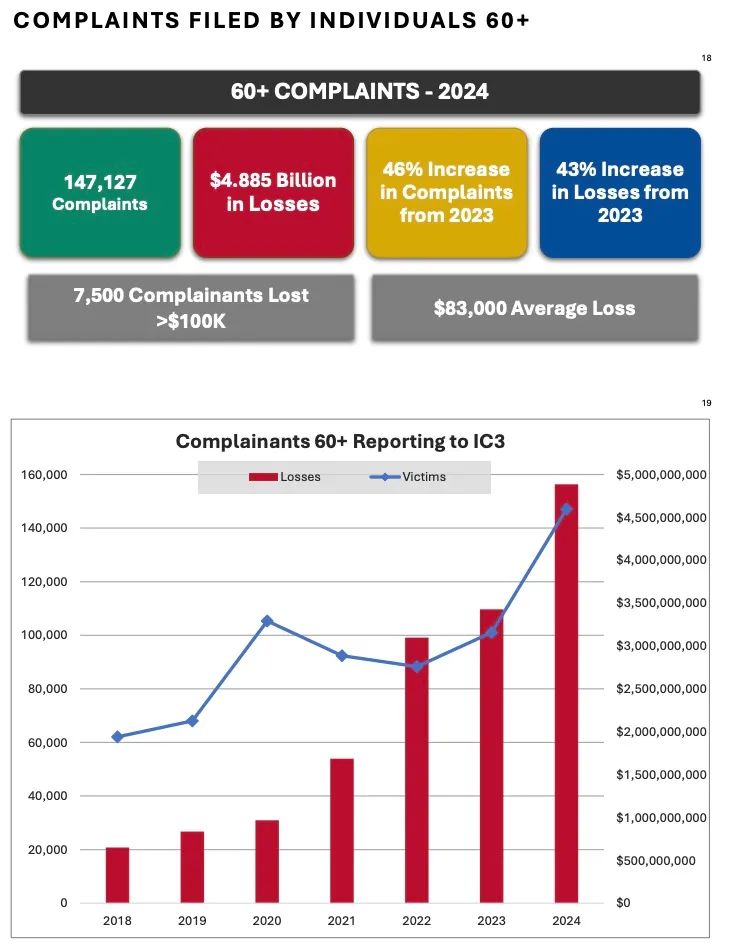
This group filed 147,127 complaints, reporting losses of $4.885 billion. The number of complaints increased by 46% year-on-year, while the loss amount rose by 43%. Among them, 7,500 individuals reported losses exceeding $100,000, with an average loss as high as $83,000.
Key Point Two: Victim Group Analysis
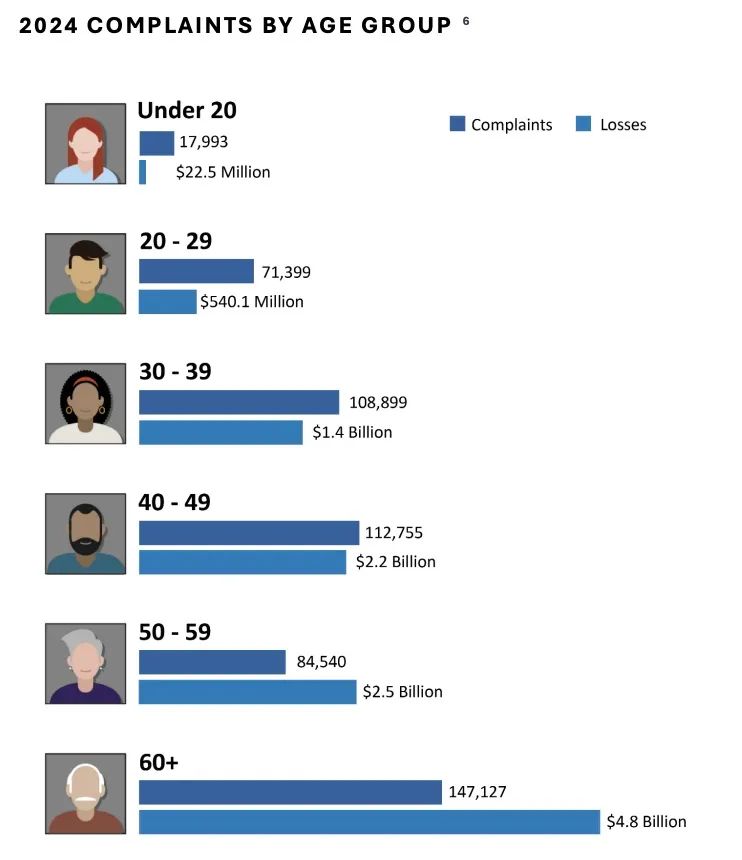
1. Overall Age Distribution
-
Under 20 years old: 17,993 complaints, $22.5 million in losses.
-
20–29 years old: 71,399 complaints, $540.1 million in losses.
-
30–39 years old: 108,899 complaints, $1.4 billion in losses.
-
40–49 years old: 112,755 complaints, $2.2 billion in losses.
-
50–59 years old: 84,540 complaints, $2.5 billion in losses.
-
60 years and above: 147,127 complaints, $4.8 billion in losses.
2. Cryptocurrency Victim Groups
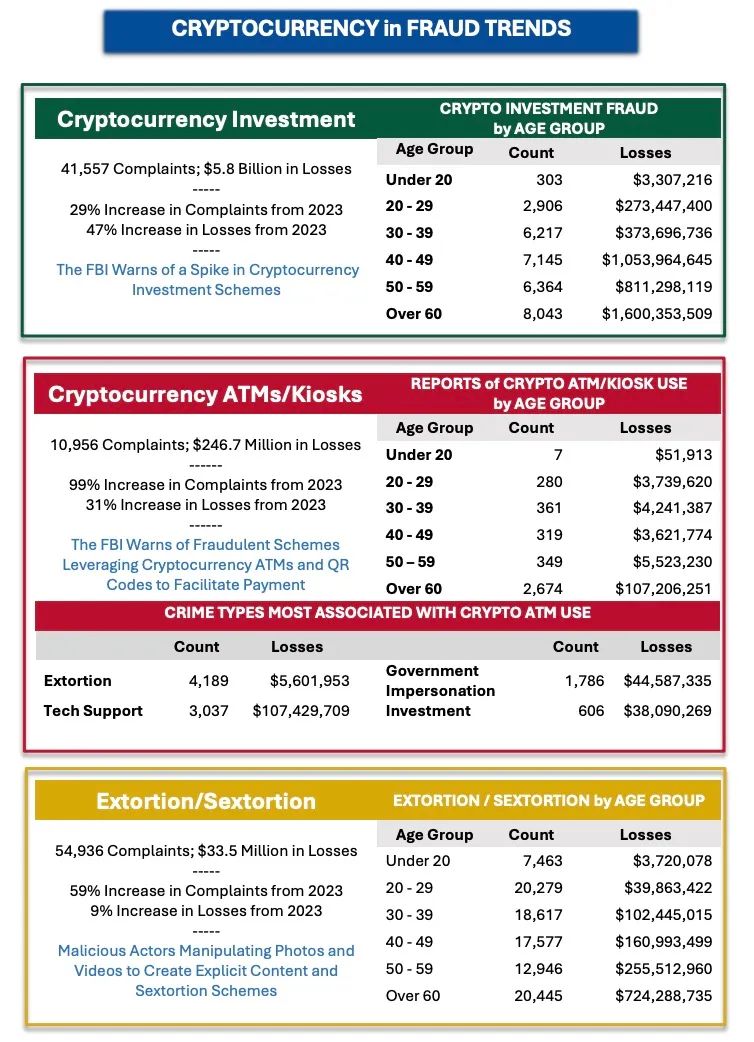
In cryptocurrency investment scams, individuals aged 60 and above filed the most complaints (8,043 cases), with losses reaching $1.6 billion—far exceeding other age groups. Due to lower scam awareness and unfamiliarity with new payment methods like cryptocurrency ATMs, this group has become a prime target for fraudsters (2,674 cases, $107,206,251 in losses), and also reported the highest number of extortion/sextortion cases (20,445 cases, $724,288,735 in losses).
Key Point Three: Crime Type Analysis
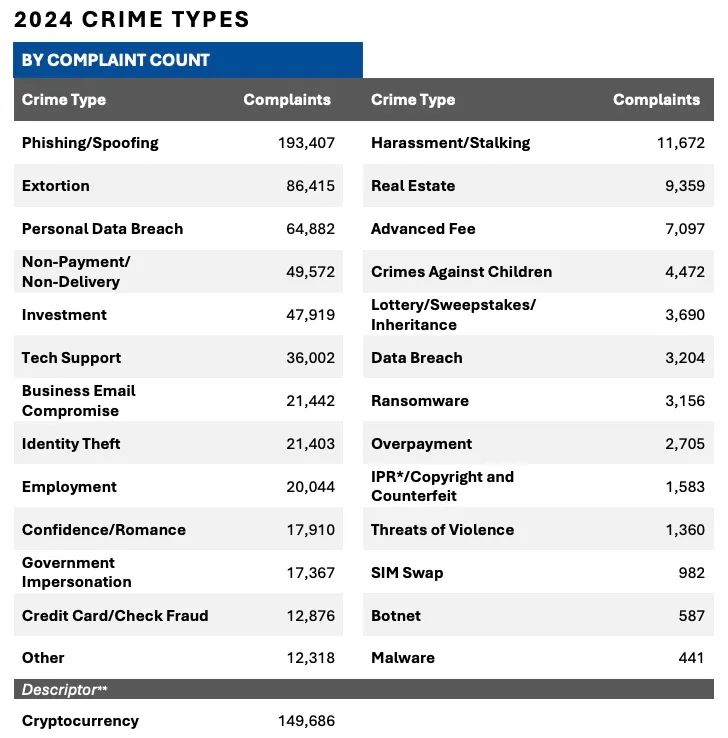
1. By Number of Complaints
-
Phishing/Electronic Deception: 193,407 cases.
-
Extortion: 86,415 cases.
-
Personal Data Breach: 64,882 cases.
-
Chargeback/Fraudulent Transaction Failures: 49,572 cases.
-
Investment Scams: 47,919 cases.
2. By Financial Loss
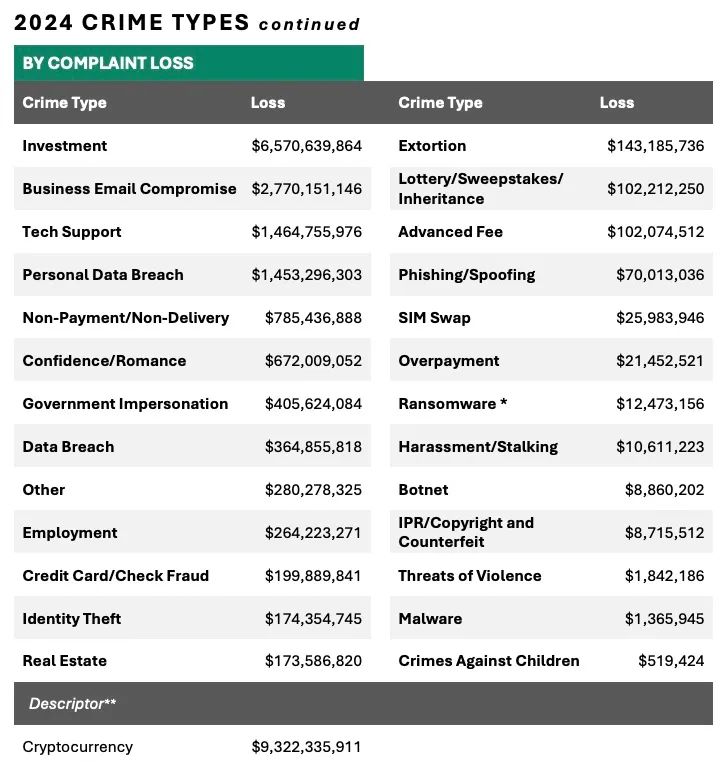
-
Investment Scams: $6.57 billion.
-
Business Email Compromise (BEC): $2.77 billion.
-
Tech Support Scams: $1.46 billion.
-
Personal Data Breach: $1.45 billion.
-
Chargeback/Fraudulent Transaction Failures: $785 million.
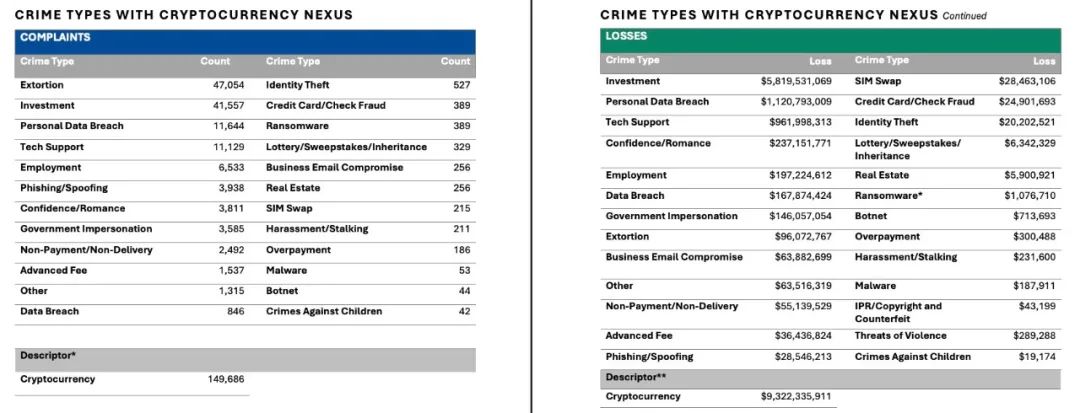
3. Cryptocurrency-Related Crimes
-
Highest number of complaints: Extortion (47,054 cases), Investment Scams (41,557 cases).
-
Largest financial losses: Investment Scams ($5.8 billion), Personal Data Breach ($1.1 billion).
4. Main Scam Types Targeting Individuals Aged 60 and Above
-
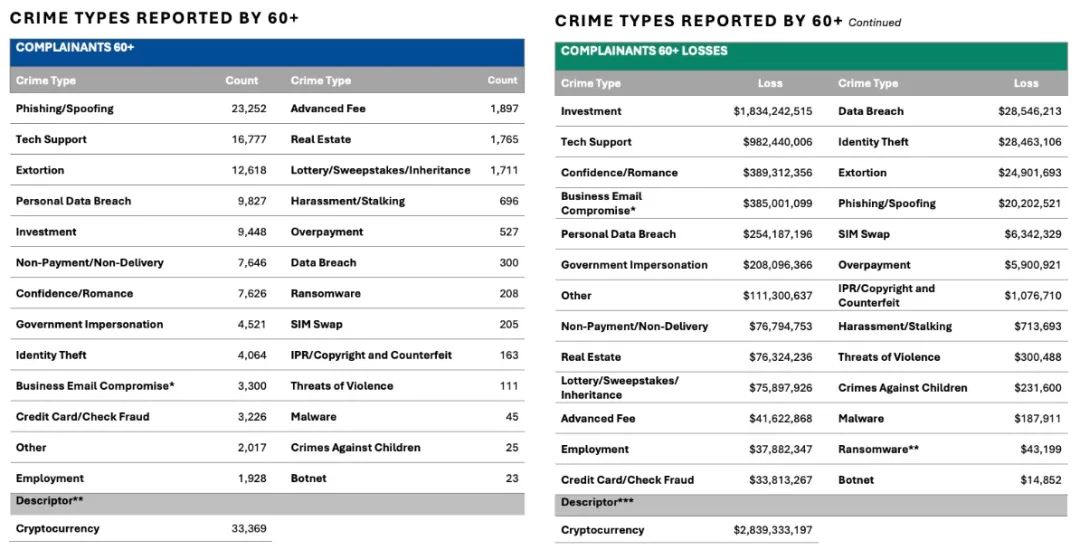
Most frequent complaint types: Phishing, Tech Support, Extortion, Personal Data Breach, Investment Scams.
-
Types causing highest losses: Investment Scams, Tech Support, Romance Scams, Business Email Compromise (BEC), Personal Data Breach.
Key Point Four: Online Scams and Asset Recovery
1. Overall Online Scam Situation
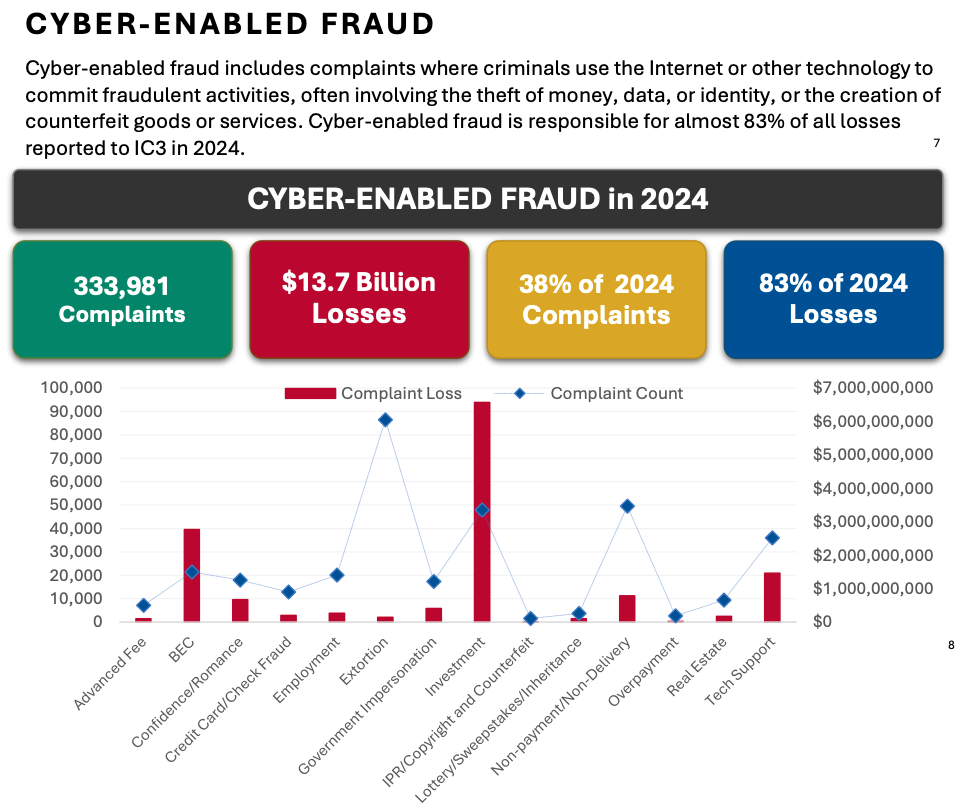
In 2024, IC3 received 333,981 online scam complaints, causing $13.7 billion in losses—accounting for 83% of total annual losses. Major transaction methods included cryptocurrency, wire transfers, and credit card payments.
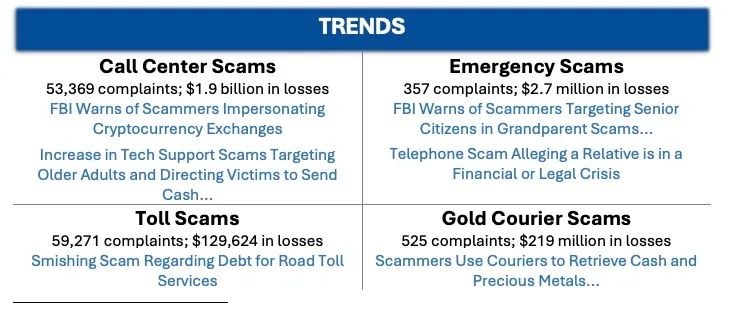
2. Typical Scam Methods
-
Call Center Scams: 53,369 cases, $1.9 billion in losses.
-
Emergency Scams (Impersonating Relatives Seeking Help): 357 cases, $2.7 million in losses.
-
Toll Road Scams (SMS Phishing): 59,271 cases, $129,000 in losses.
-
Gold快递 Scam: 525 cases, $219 million in losses.
3. Cyber Threats
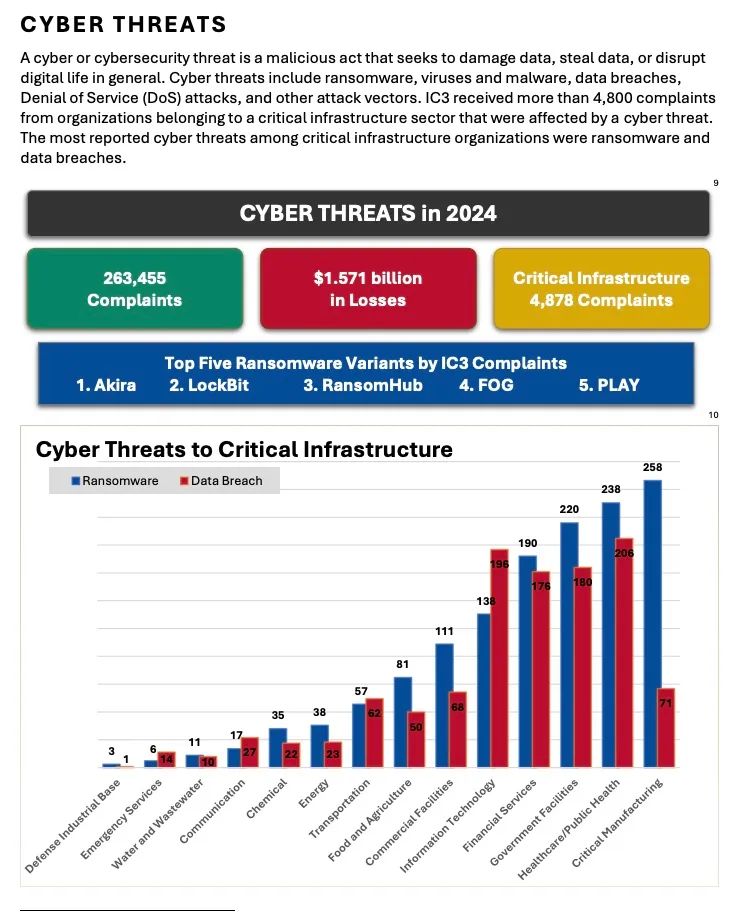
263,455 cyber threat-related complaints resulted in $1.571 billion in losses. Major ransomware variants included Akira, LockBit, RansomHub, FOG, and PLAY.
4. Asset Recovery Achievements
-
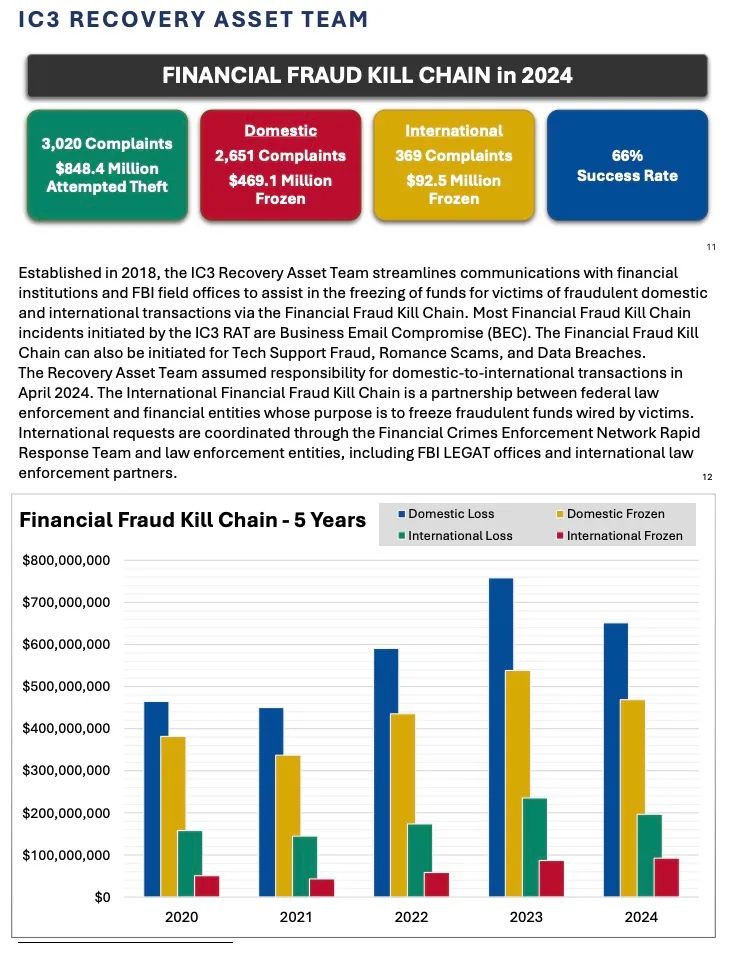
The FFKC team processed 3,020 fund freezing requests, froze $560 million in funds, achieving a 66% success rate.
-
"Operation Level Up" successfully notified 4,323 cryptocurrency scam victims, helping prevent approximately $285 million in potential losses.
-
Collaboration with Indian law enforcement led to actions against call center scams, resulting in 215 arrests—an increase of 700% year-on-year.
-
In financial fraud operations, multiple large-scale fund freezes and recoveries were successfully executed.
Key Point Five: Preventing Cryptocurrency Scams
In response to the high incidence of crypto scams, the FBI has issued the following prevention recommendations:
-
Stay vigilant and avoid high-return temptations: Investments promising high returns with zero risk are often scams.
-
Verify the legitimacy of trading platforms: Use正规, regulated exchanges and avoid clicking unknown links from social media ads.
-
Avoid transferring money to strangers: Do not trust online "investment mentors" or "friends."
-
Be cautious with cryptocurrency ATM transactions: Scammers often demand payments via ATMs—exercise extreme caution.
-
Use two-factor authentication (2FA): Enhance account security to prevent hacking.
Summary
The FBI's "2024 Cryptocurrency Fraud Report" reveals emerging trends in cybercrime within today's cryptocurrency landscape: a significant rise in cryptocurrency-related cases, with individuals aged 60 and above becoming primary victims; increasingly sophisticated and internationalized scam methods; and cryptocurrency solidifying its role as criminals’ preferred tool for money laundering and fund transfers.
Although progress has been made in asset recovery and cross-border law enforcement cooperation, the sheer scale and upward trajectory of losses indicate that ordinary users must remain highly vigilant and strengthen their security awareness to avoid falling into various scams. For governments and financial institutions, continuously enhancing international collaboration, regulatory enforcement, and tracking of fund flows will be critical measures to curb cybercrime and improve打击 efficiency.
Join TechFlow official community to stay tuned
Telegram:https://t.me/TechFlowDaily
X (Twitter):https://x.com/TechFlowPost
X (Twitter) EN:https://x.com/BlockFlow_News