The Dubai Web3 Ecosystem Through the Eyes of a Local
TechFlow Selected TechFlow Selected
The Dubai Web3 Ecosystem Through the Eyes of a Local
A different "crypto ecosystem in the Middle East" through the eyes of locals in Dubai.
 Navigating Web3 tides with focused insights
By Joe Zhou, Foresight News
This is my first time visiting Dubai, and it seems quite different from the image of Dubai I’ve seen on media platforms.
In the first two days after landing, my itinerary included Dubai International Financial Centre (DIFC), Dubai Mall, The Palm resort area, and visits to the offices of three leading exchanges in Dubai—getting a close-up feel for the work and life atmosphere of Dubai’s Web3 community.
Yet, after walking around repeatedly, I didn’t find a single BTC ATM, nor did I see any street vendors holding up USDT payment QR codes for transactions. I haven't even spotted a single roadside advertisement for a crypto company. This stands in stark contrast to the content portrayed in many online articles about "Dubai Web3."
However, when I paused and started simply living like a local, I gradually began to sense how Web3 has integrated into this global financial hub. A friend who was playing sports with us caught a cold and opened a local Dubai online shopping app to buy medicine—there she saw an ad for crypto exchange OKX. Another friend living in Dubai told me there are indeed large-scale offline ads for crypto companies such as XRP around the city, but overall, physical advertising in Dubai is far more restrained compared to many other countries and regions, so they're not as omnipresent as in some other cities.
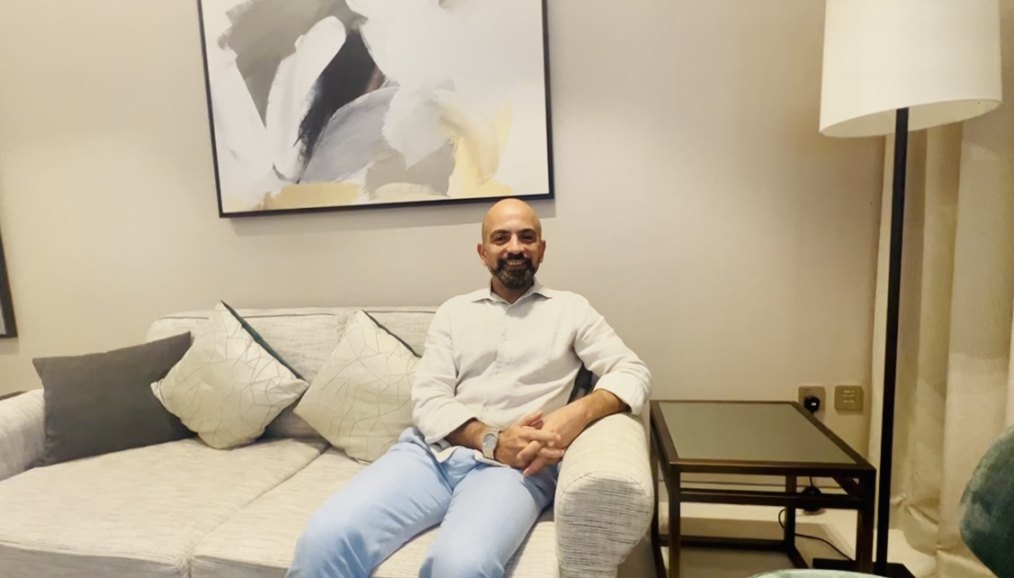
I know that five short days aren’t enough to fully understand how Dubai embraces cryptocurrency and integrates it into daily life. So I invited a “local Dubai native,” Sherif Sanad, for an interview. He is also the Country Manager for the Middle East and North Africa at HashKey, a cryptocurrency exchange. We discussed the state of Dubai’s crypto ecosystem through the eyes of locals.
Joe: Where are you from?
Sherif: I’m from Dubai—I grew up here. I’m also Canadian and hold a Canadian passport. I've previously worked in Hong Kong, the UK, Canada, and Cyprus.
Joe: What does a Country Manager do? What’s your typical work schedule like?
Sherif: It's about complying with local regulations, obtaining and maintaining relevant licenses in Dubai, and delivering the best possible services to users under the rules set by VARA (Dubai’s crypto regulatory authority). These users include VCs, family offices, fund management firms, and others.
In fact, we start working every day at 7 a.m., collaborating with our team on how to best serve potential clients across the Middle East. I believe Dubai has been positioned as a "crypto oasis" for the entire region.
Joe: In Dubai, how do ordinary people typically use cryptocurrency in daily life?
Sherif: They use crypto to buy real estate. The minimum price for housing in Dubai is around $400,000 to $500,000, and people often use stablecoins like USDT and USDC for down payments and installment payments. This has become very normal and widespread. We’re seeing this happen frequently. As you know, Joe, Dubai is a tax-free haven—no taxes, visa-free entry—which attracts many people from China, Singapore, Hong Kong, Russia, and elsewhere.
Many investors come here to invest in specific sectors such as real estate, luxury cars, and high-end goods, and they heavily rely on stablecoins like USDT and USDC as their preferred payment method. We’re seeing strong demand, especially from Hong Kong, Russia, and CIS countries.
Joe: How do your family, friends, and neighbors view Web3?
Sherif: My wife buys crypto. She works in a completely different field, but she makes money while I lose money (laughs). I have three kids—the eldest is nearly 17, and two daughters aged 13 and 11. I gave each of them $3,000 to analyze and research on their own. Right now, they’re deciding which digital assets they want to trade. I’ve set a goal: whoever earns the most profit will get additional funds added to their wallet.
Joe: Which crypto products do your kids use?
Sherif: He hasn’t told me—that’s his secret.
Joe: Do you usually use BTC ATMs in Dubai?
Sherif: Never. There are no BTC ATMs here. I’ve seen some promising ATM projects in Hungary and Budapest, which surprised me—people actually use ATMs for currency exchange. Maybe someday soon we’ll see BTC ATMs in Dubai.
Joe: The UAE consists of multiple emirates. How do the crypto environments differ among them?
Sherif: Currently, the UAE has seven emirates, with three being the most advanced in crypto innovation: Abu Dhabi, Dubai, and Ras Al Khaimah. Many Asian crypto companies have entered these three emirates to obtain licenses, expand operations into the Middle East, and use the region as a bridge to Europe.
Across the broader Middle East, surprisingly, some of the highest Bitcoin adoption rates are found in Morocco, Egypt, Saudi Arabia, Jordan, Lebanon, Syria, and the UAE—these areas have the largest user bases. Among them, the UAE quickly established a licensing framework with support from regulators, positioning itself as a crypto hub. This move has attracted numerous crypto firms to obtain licenses and engage local users.
Joe: In your opinion, what are the three most well-known crypto companies in Dubai?
Sherif: Binance is the top player—they’re extremely prominent in the Middle East. OKX was the first company to receive a license in Dubai and maintains a large team here. The third one I’d highlight is Crypto.com—they were among the earliest exchanges to secure a license in Dubai and also have a significant team operating locally.
Joe: What challenges do you think these companies face when expanding into the Middle East?
Sherif: They assume they can apply the same business strategies used elsewhere, but Middle Eastern culture is entirely different—so is customer understanding and client engagement. For crypto companies looking to enter this region, it’s crucial to understand local culture, learn how to approach customers, and master hospitality practices. This market is completely different from Southeast Asia or other regions.
Joe: As an ordinary person, what do you think is the biggest challenge of living in Dubai?
Sherif: It’s too hot, especially in summer—temperatures are usually over 40°C (laughs).
Joe: Anything else?
Sherif: You need to own a car because public transportation is expensive, and renting is costly too. (Author note: A taxi ride starts at around 100 RMB, and trips beyond 10 km typically cost over 200 RMB.)
Language is another major challenge. I previously founded an organization called the "Arab-China Business Council" to help Chinese and Arab entrepreneurs conduct business. I think this has great potential. Many Chinese people come to Dubai without speaking English, which presents a significant barrier. You don’t need to speak Arabic here, but English proficiency is essential.
Join TechFlow official community to stay tuned
Telegram:https://t.me/TechFlowDaily
X (Twitter):https://x.com/TechFlowPost
X (Twitter) EN:https://x.com/BlockFlow_News
 Foresight News