Detailed Explanation of Dubai DFSA's Release of RWA Regulatory Sandbox Guidelines
TechFlow Selected TechFlow Selected
Detailed Explanation of Dubai DFSA's Release of RWA Regulatory Sandbox Guidelines
The regulatory window has already opened, and the market often leaves little time for actors to act.
 Navigating Web3 tides with focused insights
Authors: Iris, Liu Honglin
Since 2024, RWA (Real-World Assets) has become a hot topic at the intersection of Web3 and traditional finance digitization. From real estate tokens, bills, and supply chain finance to tokenized bonds and fund shares, more and more projects and capital are actively seeking compliant channels for global deployment.
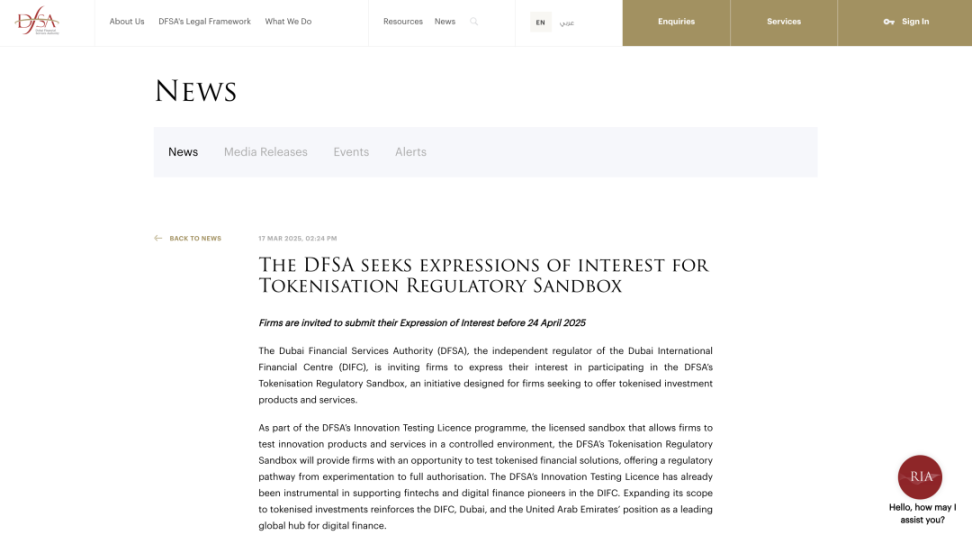
On March 17, 2025, the Dubai Financial Services Authority (DFSA) released its "Tokenisation Regulatory Sandbox Guide," marking the first time it explicitly prioritized tokenisation under regulation and introduced the Innovation Testing Licence (ITL) mechanism—offering a practical, clear, and actionable compliance pathway.
The application window is now open, but only from March 17 to April 24, 2025. For RWA projects planning international expansion, this route represents a critical opportunity that deserves immediate attention and action.
What Signals Does the DFSA Tokenisation Sandbox Send?
The guide clearly states that DFSA will bring Tokenised Investments into its regulatory framework and specifically categorizes tokens into:
-
Security Tokens
-
Derivative Tokens
This move removes tokenized assets from regulatory gray areas. RWA projects within Dubai’s market—especially those involving real estate, supply chain finance, bills, and bond tokenization—will now have clearer compliance foundations and regulatory guidance.
Additionally, DFSA's design of eligible applicants provides practical access for various types of RWA projects. According to the guide, companies eligible to apply include:
-
Firms issuing, trading, holding, or settling tokenized investments (e.g., stocks, bonds, sukuk, and collective investment fund units);
-
Financial institutions already holding a DFSA license intending to expand into tokenization;
-
Company teams with deep understanding of applicable laws and regulatory frameworks.
In other words, both established financial institutions looking to extend into tokenization and early-stage startups focused on RWA digitization can leverage the DFSA sandbox to enter the market with lower barriers and test their models in a compliant environment.
For small and mid-sized RWA startup teams, the phased regulatory exemptions and supportive policies offered within the sandbox offer a cost-effective way to validate business models early on while clarifying future paths to full licensing.
Notably, DFSA has launched an Innovation Testing Licence (ITL) cohort specifically for tokenisation, allowing RWA projects to enter the market even if they do not fully meet capital requirements or risk management obligations. This enables low-barrier testing of products and models in real-world conditions before transitioning to full licensure.
The entire process consists of three stages:
1. Expression of Interest Stage
Project teams must submit an expression of interest form outlining their plans to conduct tokenisation activities in DIFC (Dubai International Financial Centre). DFSA will conduct a preliminary assessment based on background, governance, and technical proposals.
2. ITL Testing Stage
After passing initial evaluation, projects may operate for 6–12 months with partial exemptions from capital, prudential, and reporting requirements. They can access real market environments at low cost to test their business models. However, DFSA emphasizes ongoing supervision: participants must still ensure key risks—including disclosure, DLT system security, and custody arrangements—meet regulatory standards.
3. Full Licensing Transition Stage
Upon completion of the testing period, projects must either apply for a full DFSA license or exit the market per the prescribed wind-down mechanism. DFSA will strictly enforce market exit for projects failing to meet graduation criteria.
It should be noted that this sandbox applies exclusively to traditional financial assets and real-world asset tokenisation. Pure cryptocurrency projects (Crypto Tokens) and fiat-backed stablecoins (Fiat Crypto Tokens) are not eligible.
Why Is the DFSA Tokenisation Sandbox Worth Attention?
Globally, only two markets—Dubai and Hong Kong—currently offer clear regulatory frameworks for RWA or tokenised assets. While both are actively advancing regulatory clarity, there are significant differences in implementation.
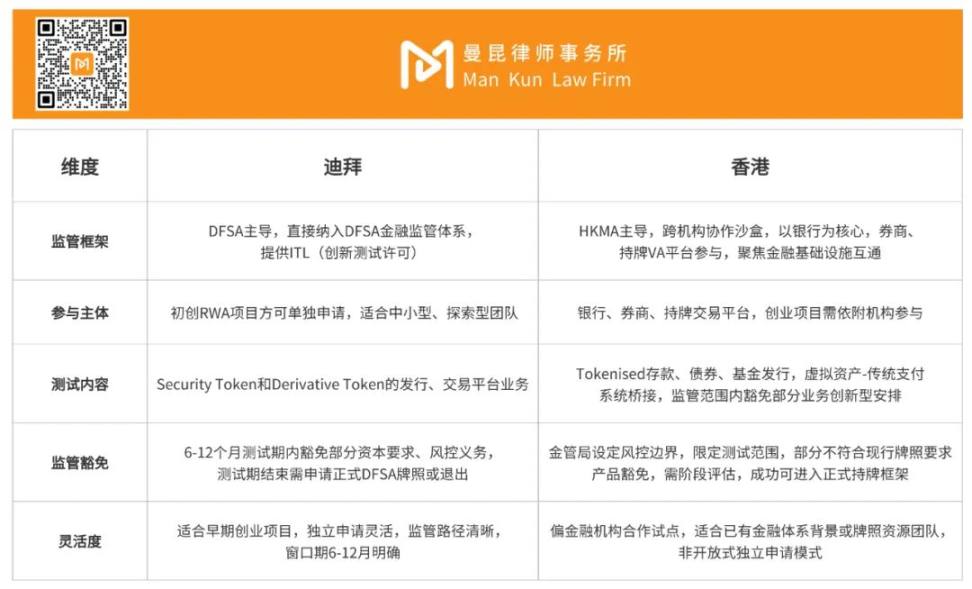
While both DFSA in Dubai and HKMA in Hong Kong are pushing forward tokenisation regulation, their mechanisms differ significantly in terms of entry thresholds and target applicants.
For RWA entrepreneurs, the DFSA’s newly launched ITL sandbox offers several notable practical advantages:
1. Suitable for Startups and Small-to-Mid-Sized Teams, Flexible Independent Applications
Hong Kong’s Ensemble Sandbox is primarily designed for participation by traditional financial institutions such as banks and brokers. Startups often need to join through partnerships, resulting in complex application processes.
In contrast, DFSA’s ITL mechanism allows independent applications without requiring prior affiliation with licensed financial institutions. This offers greater autonomy and operational flexibility, especially valuable for resource-constrained RWA startups in the model exploration phase.
2. Phased Exemptions During Testing Period Reduce Compliance Trial Costs
DFSA offers a defined 6–12 month testing window with temporary relief from capital and prudential requirements. Projects can rapidly validate business models in real market conditions while significantly reducing early compliance costs and operational burdens. As such, the DFSA ITL stands out globally as one of the few comprehensive frameworks offering startups an independent application path, phased exemptions, and a clear transition to full licensing.
Hong Kong’s regulatory path, by comparison, maintains higher compliance barriers—particularly the SFC licensing system, which imposes strict requirements on capital and corporate governance, posing considerable challenges for startups in the short term.
3. Clear Regulatory Framework with Formal Inclusion of RWA Assets
By incorporating Security Tokens and Derivative Tokens into its existing financial regulatory regime, DFSA eliminates previous policy gaps and legal uncertainties surrounding tokenised assets. As long as projects comply with DFSA’s existing financial product regulations, they can legally conduct issuance and trading activities—with strong policy predictability.
In contrast, Hong Kong’s Ensemble Sandbox remains largely in a pilot stage among banks and financial institutions, focusing more on financial infrastructure. Direct regulatory pathways for Web3 projects—especially startups—are still under development.
Clearly, DFSA’s sandbox launch is not merely a regulatory innovation—it reflects Dubai’s strategic ambition to position itself as the Middle East’s fintech hub and gain first-mover advantage in the RWA race.
ManQin Law Firm Recommendations
Whether choosing Hong Kong or Dubai, the key for any RWA project lies in aligning its current stage, resources, and strategic goals to identify the most suitable compliance path.
The DFSA tokenisation sandbox offers a realistic opportunity for early-stage RWA projects aiming to quickly validate their models—an accessible entry point with a clear regulatory framework and manageable costs.
However, this window is not open indefinitely. Project teams must act swiftly and complete necessary compliance preparations in advance to truly seize the opportunity.
ManQin Law Firm recommends focusing on the following:
-
Complete DIFC registration and legal structure setup early. Only entities registered in DIFC can enter the DFSA regulatory system. It is advisable to plan equity structures and tax arrangements ahead of time to avoid missing the application window due to inadequate preparation.
-
Prepare technical solutions and risk control documentation in advance. DFSA has detailed requirements regarding DLT system design, custody mechanisms, and compliance procedures. Engaging a compliance team early to prepare these materials increases chances of success during the ITL application stage.
-
Plan the post-sandbox licensing pathway. The sandbox is only a transitional phase; the ultimate goal should be obtaining a full DFSA license. Teams should simultaneously prepare long-term plans such as capital top-up and governance refinement to prevent operational disruption after the sandbox period ends.
It is expected that the DFSA sandbox will attract a wave of global projects. However, those who successfully launch and graduate will inevitably be the teams that proactively prepared in governance, risk control, and compliance.
The regulatory window is now open—but opportunities favor those who act fast.
Are you ready for what comes next?
Join TechFlow official community to stay tuned
Telegram:https://t.me/TechFlowDaily
X (Twitter):https://x.com/TechFlowPost
X (Twitter) EN:https://x.com/BlockFlow_News