A story even more shocking than Brother Xiang's: earning 200 million from cryptocurrency trading, only to lose everything to fraud
TechFlow Selected TechFlow Selected
A story even more shocking than Brother Xiang's: earning 200 million from cryptocurrency trading, only to lose everything to fraud
A drink, a partnership, a single "Bro, I really admire you"—and just like that, the scam begins.
 Navigating Web3 tides with focused insights
Author: BlockBeats
Imagine this: you've made 2 million trading crypto, hitting your first major life goal. You're ready to diversify, looking for solid investment opportunities.
Then, your girlfriend’s friend shows up at your door.
You met in a cryptocurrency group chat two years ago. At first just casual friends—talking market trends, sharing memes, joking about the absurdity of the industry. Over time, things changed. She started sending good morning and good night messages, selfies, confiding in you about how lonely she felt living alone in Beijing, saying only you made the world feel warm again. Without realizing it, you began falling for her.
She runs an oil business with several gas stations under her name, does freight shipping, has connections to Maotai liquor distribution, and holds a trust fund overseas worth 100 million yuan. Her social media is filled with plane tickets and yachts, check-ins from different countries—her lifestyle feels incredibly alluring to you. Confident, independent, even slightly dominant—you start seeing her not just as a romantic partner, but someone more capable than yourself.
You can't help but feel lucky—amidst the cold, impersonal world of crypto, you found someone who shares your interests and wants to walk through bull and bear markets side by side.
One day, she tells you about a short-term capital turnover deal with Sinopec, promising high returns—10% profit within one month. She says she's almost secured it, doesn’t want to involve outsiders, and would prefer if you were the one to join.
You hesitate, but she sounds absolutely certain. Plus, you’ve known each other for a while now. You know her character—she’s never been someone who casually asks for money. She hasn’t formally requested anything, just mentioned that if you’re interested, you could participate. No pressure.
You have 2 million on hand. Putting in 100,000 seems manageable.
Over the next two months, she transfers interest payments right on schedule—10,000 per month, without delay. Your guard drops completely. You feel like you’ve not only found love, but also a trustworthy business partner. You even begin imagining building projects together, investing together, earning together—the kind of power couple you've always admired.
Then, disaster strikes.
She suddenly tells you her company account has been frozen. There are millions in receivables stuck, business has ground to a halt, employees are demanding wages, suppliers are furious—everything is collapsing. She says she’s raised most of the funds needed, just 300,000 short. Could you help out? She stresses repeatedly: “It’s not a loan. It’s an emergency. As soon as the funds are released, I’ll repay you immediately.”
She sounds devastated, even breaks down in tears, apologizing for burdening you, saying she wouldn’t ask unless she was truly desperate.
You freeze. Images flash through your mind—her kindness, those late-night chats, the reassurance she gave when sending interest: “Don’t worry, I’m reliable.”
Your hand trembles—and you transfer the money…
Another young man in crypto loses 200 million
This is the real story of Brother Tao (Da Tao Ge).
Except, Brother Tao didn’t have 2 million—he had 200 million. The initial “investment” wasn’t 100,000, but 10 million and then 30 million.
And she wasn’t a “girlfriend,” nor a “benefactor.” Her name is Zhang Bai—a professional con artist. Behind her lies a well-organized, clearly分工ed criminal gang specializing in “romance + investment scams,” operating systematically for over two years. They crafted a far more sophisticated scheme than anyone could imagine—from a glamorous, wealthy persona, fake romantic relationship, forged supply contracts, police notices, fake lawyers, fake cops, fake companies, fake seizures—to escalating layers of manufactured crises requiring urgent solutions.
On social media, Brother Tao recorded a 20+ minute video detailing every step of his deception. He could have retired before age thirty, driving supercars and traveling the world. Now he’s left with only a smartphone and suffocating memories.
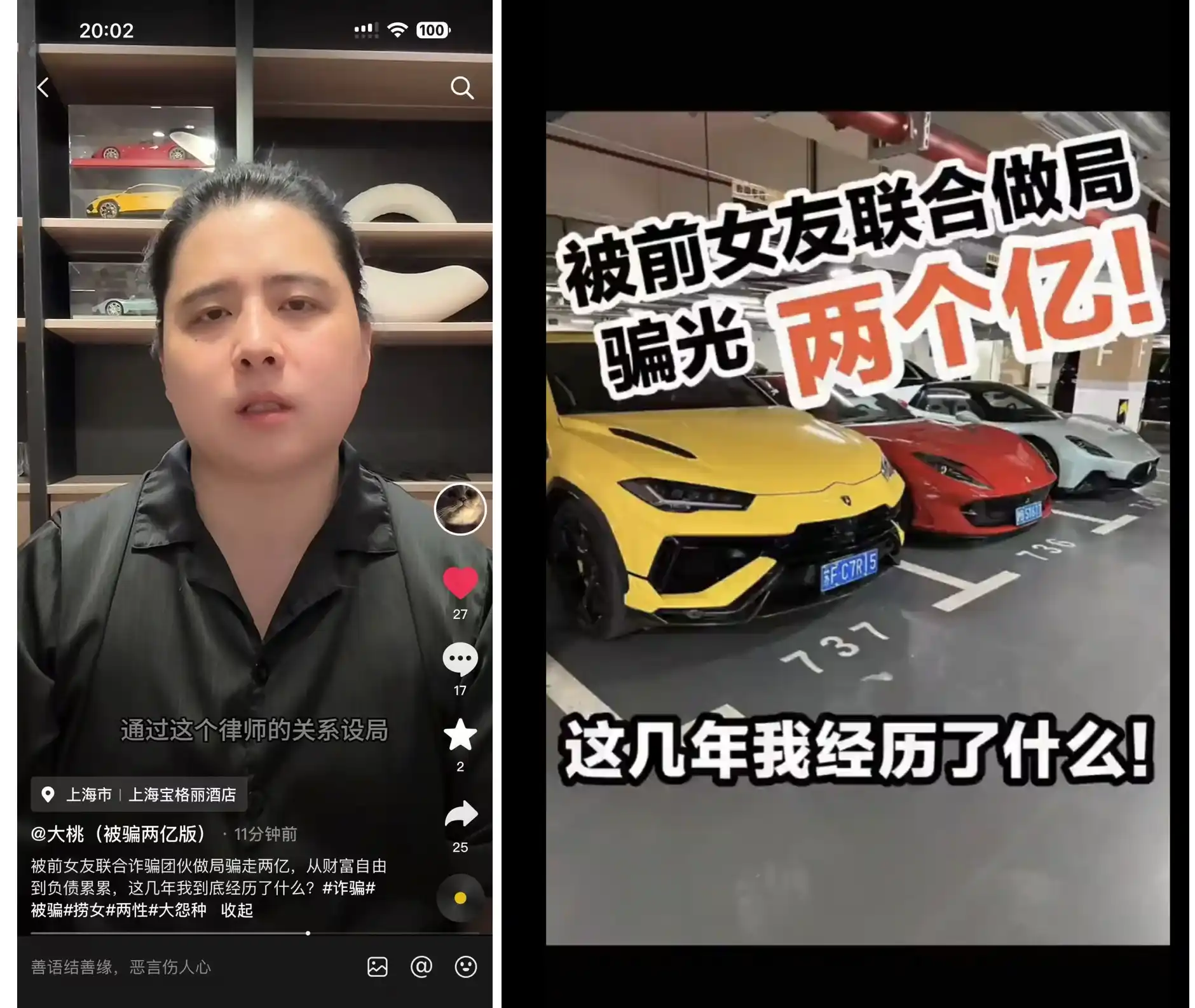
After Brother Tao transferred 30 million to help unfreeze the account, Zhang Bai sent him a Lamborghini Urus as a “gift of gratitude”—a fully loaded model worth over 4 million yuan.
He thought it was a token of love. Later, he learned the car was bought with his own money, registered under a shell company belonging to her accomplice. This was another layer of brilliance in their scam:
Give small rewards and sweeteners—to make everything feel real.
In April 2023, Brother Tao wanted to buy a Ferrari 812 GTS. Zhang Bai said she had the right connections to get it through internal channels at a discount. She suggested purchasing under a “trusted company” to simplify registration and avoid tax scrutiny. Without hesitation, Brother Tao transferred 7 million for the vehicle.
A few days later, she came back, saying the newly registered company lacked sufficient transaction history, triggering tax authorities’ suspicion of “tax evasion and profit laundering.” The car purchase account was now frozen. To proceed legally, they needed to re-route the payment. Brother Tao trusted her once again—and sent another 7 million. Over the following two months, Zhang Bai used excuses like “tax investigation,” “company liability,” and “large fines” to extract over 30 million more from him. By now, half of his 100 million was gone. Yet he still believed.
The cons grew more frequent—almost monthly.
In October, issues arose with earlier mask shipments—now labeled a “major epidemic-related fraud case.” She cried, begging for help. Brother Tao sent over 10 million more.
In November, company staff were taken in by police. During interrogation, Brother Tao’s name surfaced as a “key money laundering suspect.” She proposed spending 10 million to fix it—including paying Liu Yuqiao 3 million to take the fall. After some hesitation, Brother Tao transferred the money.
In December, “sudden audits” erupted nationwide. Accounts frozen here, tax interviews there—crisis after crisis, each requiring hundreds of thousands or millions to “smooth things over.” The pace of transfers matched the speed of script updates.
… …
By July 2024, Brother Tao was broke.
He sold all his supercars. His accounts were nearly empty. Finally, he woke up. He compiled all chat logs, transfer records, travel schedules—and filed a police report.
The most ironic part? He went to the police station *with* Zhang Bai. At the moment he reported the crime, he still didn’t realize the “girlfriend” sitting beside him was one of the masterminds behind the entire scam.
Brother Tao isn’t the only victim
The crypto world is full of myths—but also nightmares. You hear stories of overnight wealth, but rarely see the others—those ruined by margin calls, or caught in dual-layered “love + investment” traps that drain their life savings…
In recent years, the crypto space has become a prime hunting ground.
Crypto attracts young people, massive profits, chaotic dynamics, and deep loneliness. It gathers those who became rich quickly, experience intense emotional swings, and have blurred social boundaries. These individuals are precisely the ideal targets for scammers.
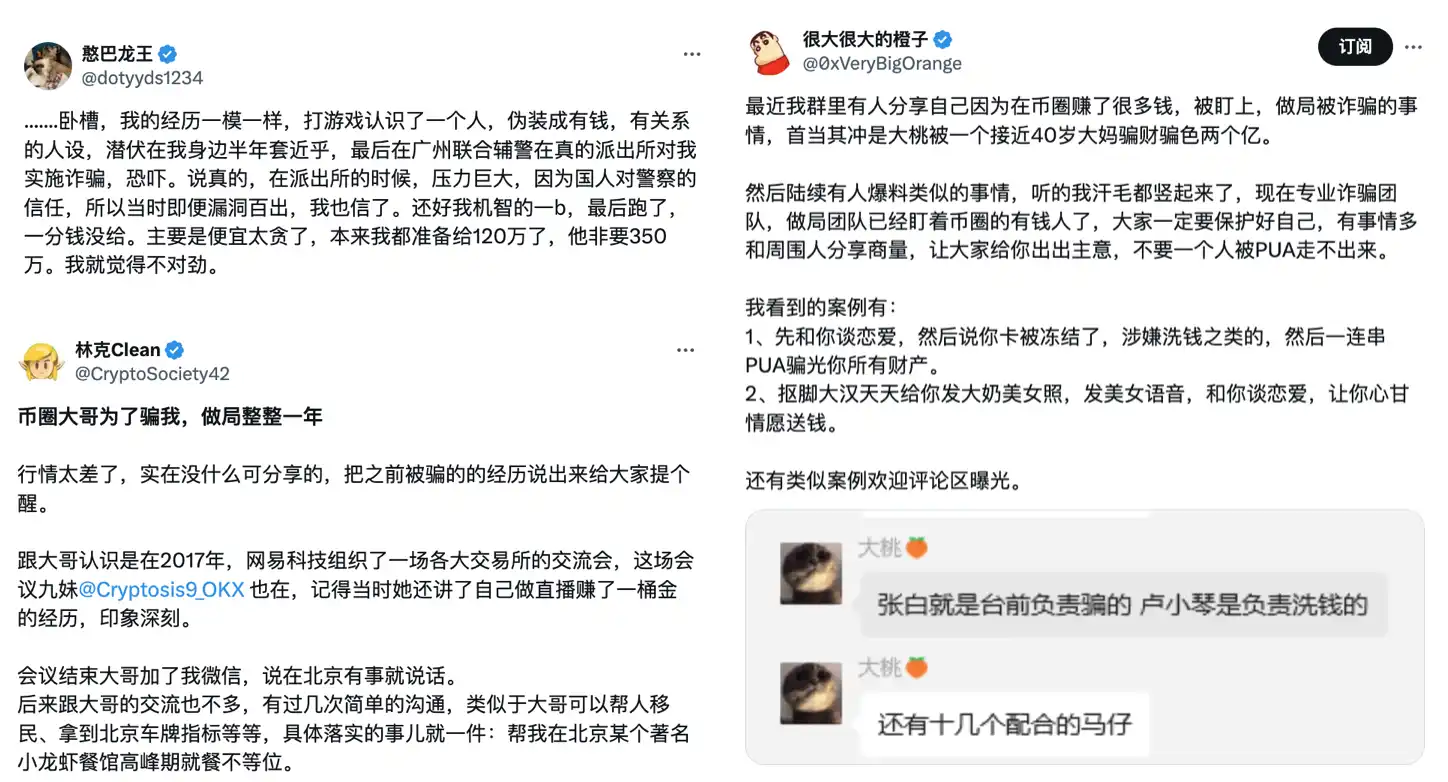
Brother Tao isn’t alone. Victims aren’t limited to crypto traders.
Recently, Da Xiang Ge—a three-time consecutive top 100 Bilibili content creator—publicly shared his own three-year ordeal involving a multi-million-yuan serial scam. It began with a “restaurant investment opportunity.” The perpetrator posed as a successful entrepreneur with high-end dining venues, strong networks, financial power, and extravagant displays—inviting him to taste food, stay overnight, meet influential people, talk about the future. One meal, one car, one luxury home—each seemingly authentic proof piled up until he sent 2.4 million without any doubt.
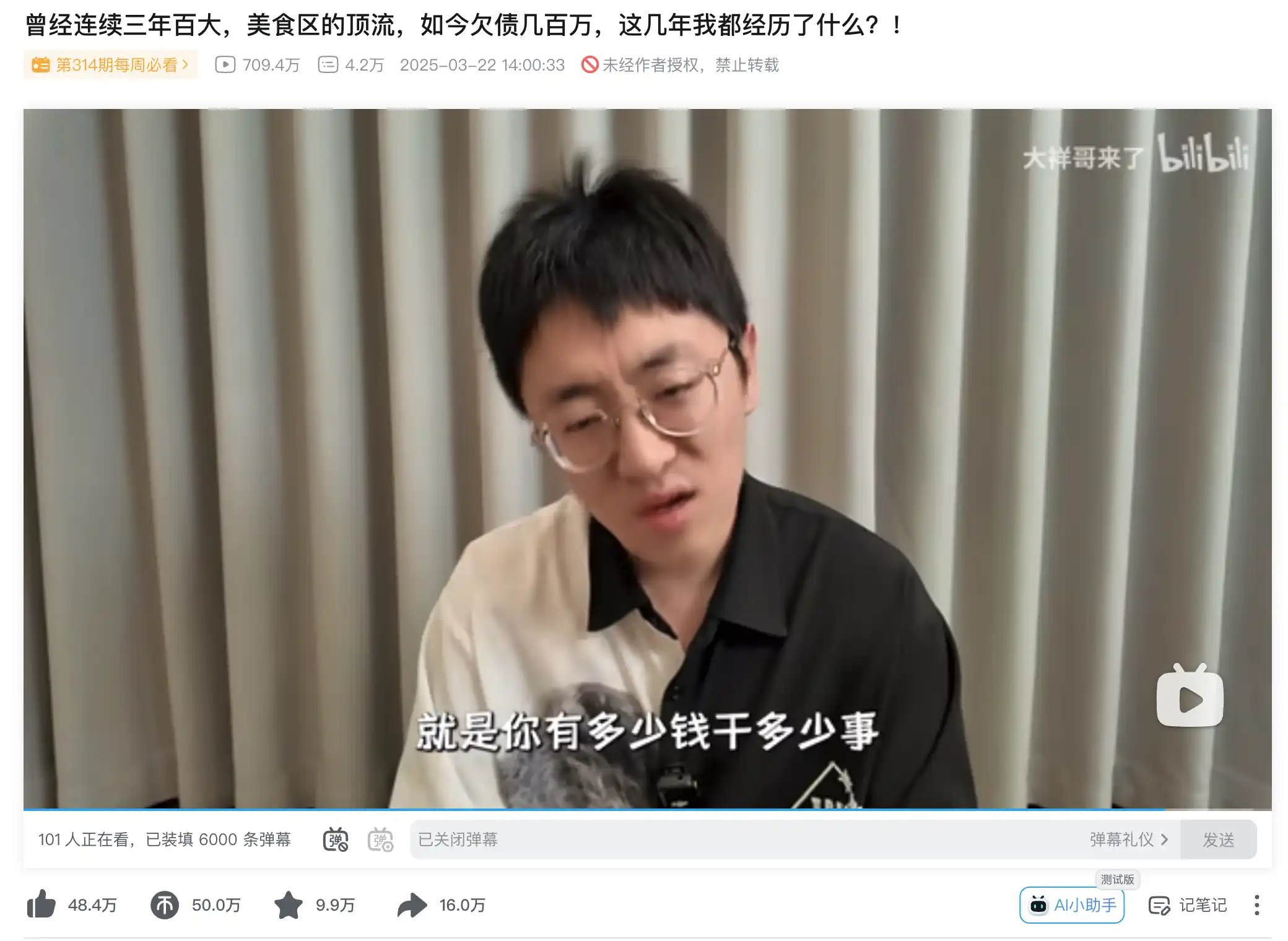
No contract. No agreement. Just the words: “Trust me, I’ll help you make money.”
Then came escalation—opening branches, forming a group, joining bigger projects—until finally pushing him to raise 10 million and bring in six friends. Da Xiang Ge didn’t just invest his life savings; he personally guaranteed the deals, bringing in loyal friends who trusted him to “go all in.”
And then, inevitably—the scammer vanished.
The project collapsed. Da Xiang Ge was left with over 12.49 million yuan in personal and joint liabilities. He sold his Maybach, drained his parents’ and grandmother’s life savings, and still owes relatives 900,000 yuan. He said: “I’m not afraid of losing everything. I’m afraid of letting down the people who trusted me.”
You might not be in crypto. You might not trade derivatives. But if you possess these three traits—quickly earned money, desire for greater breakthroughs, belief in someone who promised to “take you higher”—then you’re already in their target zone.
They appear when you’re making the most money, discussing strategies, praising your insight. They chat with you late into the night, saying they’re lonely too, believe in fate, have their own stories. They seem to understand you perfectly—even better than you understand yourself.
They know how to craft stories—backgrounds more dramatic than screenplays. They know how to manipulate—giving small rewards, then creating the next crisis. They don’t need you to send all your money at once. They only need you to “trust one more time” at every step. This is psychological warfare.
They’re patient. They’ll discuss markets with you for six months, be friends for a year, even walk with you from bull to bear market. When they strike, it’s seamless, silent.
Brother Tao and Brother Xiang were undoubtedly unlucky.
But if, after reading this, you still think “this would never happen to me,” go back to the beginning and read it again—with yourself in the story.
The real danger isn’t being scammed—it’s the confidence that such things could never happen to you. Because without knowing it, they may already be lurking nearby—inside your WeChat contacts, inside your Telegram list, or even among people you’ve already met.
They’re waiting for you to utter the next sentence that reveals trust or greed. Then comes a drink, a partnership, a whisper: “Bro, I truly admire you.” And just like that—the scam begins.
Join TechFlow official community to stay tuned
Telegram:https://t.me/TechFlowDaily
X (Twitter):https://x.com/TechFlowPost
X (Twitter) EN:https://x.com/BlockFlow_News
 BlockBeats