Gracy, CEO of Bitget: “AI is forcing the crypto industry to shed its bubbles, and exchanges are entering an era of all-asset competition.”
TechFlow Selected TechFlow Selected
Gracy, CEO of Bitget: “AI is forcing the crypto industry to shed its bubbles, and exchanges are entering an era of all-asset competition.”
Find the right timing to buy high-quality companies that you truly understand and that are backed by real profits—then leave the rest to time.
 Navigating Web3 tides with focused insights
Throughout June, major exchanges have been intensively rolling out U.S. equity products. As the earliest and most aggressive platform in this space, Bitget launched its proprietary RWA platform Reality and significantly upgraded its U.S. equity offerings. Today, we’re joined by Bitget CEO Gracy to discuss this trend—and other hot industry topics.
Bitget previously integrated stock token solutions such as Ondo. Now, for U.S. Equities 2.0, it has switched to Reality. What’s the biggest difference between the two? And what key problems does this upgrade aim to solve?
Gracy:
We began collaborating with Ondo in Q3 last year and at one point accounted for nearly 90% of its issued stock tokens’ market share. Beyond Ondo, we’ve also partnered with xStocks to launch U.S. equity tokens. Yet throughout this process, the most frequent user feedback we received was: insufficient liquidity, and unclear, non-transparent mechanisms for dividend payouts and stock splits.
So, we decided to step in and solve this ourselves. Reality is our compliant RWA protocol—and its biggest distinction lies in its direct integration with Alpaca, a U.S.-licensed broker-dealer. Orders flow straight to Nasdaq and the NYSE. Put simply: when trading Reality’s U.S. equity rTokens, users get the exact same price for Apple or Tesla as on the U.S. equity markets—and liquidity matches that of traditional brokers.
Moreover, Reality resolves pain points around dividends and stock splits. Cash dividends are automatically converted into USDT and airdropped to users; stock splits are synchronized 1:1—eliminating price divergence between rTokens and underlying equities.
Will users soon be able to use stock tokens—such as NVDA or TSLA—as margin for trading BTC, ETH, or other perpetual contracts?
Gracy:
This feature went live on June 4. It’s precisely why we’re committed to tokenization—not just “broker-direct” models. Users who buy rNVDA (NVIDIA rToken) can directly use it as margin on Bitget—or withdraw it via public blockchains like Arbitrum and Morph for DeFi use cases. Our goal is to truly activate users’ U.S. equity tokens and boost overall capital efficiency.
Recently, multiple exchanges have upgraded their U.S. equity-related products. Compared to competitors’ offerings, what are the core differentiators of Bitget’s latest upgrade?
Gracy:
Indeed, many platforms are now entering the U.S. equity space—but after reviewing them, I found most are still competing on “broker-direct” models: users deposit stablecoins, open accounts with traditional brokers, and trade there. Bitget recently launched U.S. Equities 2.0, with a key upgrade being our choice of a more crypto-native path—RWA-based stock tokens.
The core difference is this: stocks bought via “broker-direct” typically sit idle in users’ U.S. brokerage accounts. On Bitget, however, rTokens issued via Reality are genuine on-chain assets—already integrated with Arbitrum and Morph. This means users can not only use them as margin within Bitget but also withdraw them into self-custody wallets—and eventually deploy them in DeFi protocols for staking, yield generation, and more.
We’ve solved two long-standing industry challenges. First, liquidity: orders route directly to Nasdaq and NYSE—prices, order books, and depth mirror real markets. Second, dividends and corporate actions: cash dividends convert directly to USDT and auto-airdrop; stock splits and reverse splits synchronize 1:1—preventing rToken price drift from underlying equity prices.
More importantly, within the UEX environment, these rTokens deliver higher capital efficiency. For example, holding rNVDA lets users post it directly as margin to trade BTC or ETH perpetuals—enabling the same asset to serve dual purposes across two markets. That’s the truly native on-chain experience—something broker-direct models simply cannot deliver.
A longstanding critique of stock tokens is whether they represent actual equity rights—or merely price-tracking instruments. How will Reality prove to users that underlying shares are real, auditable, and traceable? Will you provide proof-of-reserves, custodian disclosures, audit reports, or broker-dealer structural documentation?
Gracy:
That’s an excellent question. Indeed, if it’s just a synthetic, price-tracking asset—it lacks soul. Reality’s rTokens are backed by real underlying assets. The underlying equities are held in custody by Alpaca, a U.S.-licensed broker-dealer, and placed in a standalone SPV—fully segregated from Bitget’s own assets. We maintain full 1:1 reserve backing.
Additionally, third-party U.S.-licensed auditors conduct daily audits. Reality’s official website already hosts a real-time Proof-of-Reserves dashboard, where users can check reserve ratios anytime. Once CPA-certified audit reports are finalized in August, we’ll integrate them into this dashboard. Combined with Bitget’s $300+ million User Protection Fund, this forms a triple-layered safeguard.
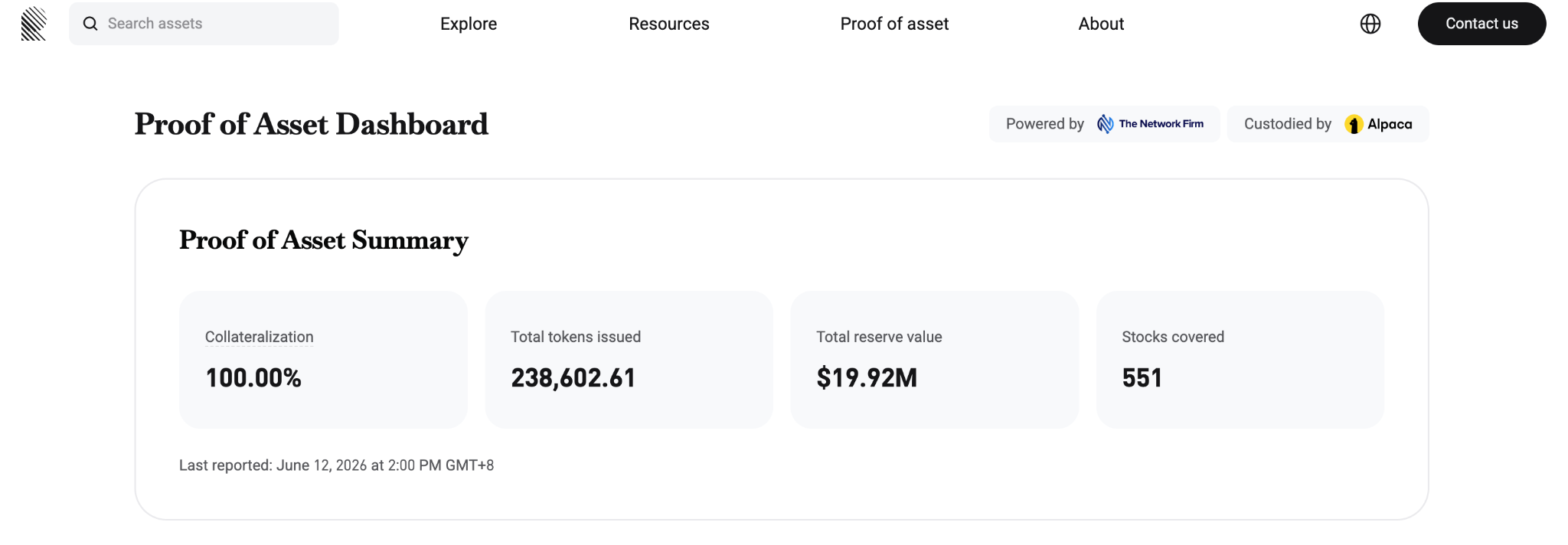
(Source: Reality Proof-of-Reserves Dashboard Snapshot, June 12, 2026, 2:00 PM GMT+8)
How will Reality handle corporate actions—such as stock splits, reverse splits, special dividends, mergers & acquisitions, or delistings—if they occur?
Corporate action handling is another area where Reality stands out versus many market alternatives. Take Netflix’s 1-for-10 stock split last year: some platforms failed to rebase tokens accordingly—causing certain stock tokens’ prices to diverge tenfold from real equity prices, confusing users. On Reality, splits auto-synchronize: 1 token becomes 10, with unit price tracking the real equity—preserving total asset value.
Cash dividends convert directly to USDT and auto-airdrop to Bitget accounts—ensuring clarity and transparency. Whether for retail investors or institutional users—especially those requiring hedging, valuation, liquidation, or portfolio management—this “price-is-price, dividends-are-dividends” structure mirrors traditional finance conventions.
For years, crypto’s dominant narratives centered on BTC, ETH, DeFi, NFTs, memecoins, L2s, and blockchain competition. But recently, AI, U.S. equities, NVIDIA, OpenAI, and SpaceX have drawn massive capital and attention.
Have you observed this migration in your platform data? What share of Bitget’s trading volume comes from non-crypto assets—and how fast is it growing?
Gracy:
Yes—we’ve clearly observed this shift. As early as late 2024 and early 2025, we noticed altcoins weakening while user enthusiasm surged for AI, U.S. equities, gold, silver, and other commodities. That’s why I introduced the UEX (Universal Exchange) vision back in September 2024.
In December 2024, our U.S. equity perpetual contract cumulative volume surpassed $10 billion—ranking second globally. Early this year, our TradFi segment—including gold and forex—hit a daily volume milestone of $2 billion for the first time. Currently, 40% of Bitget’s trading volume originates from non-crypto assets.
The reason is simple: capital follows returns. Wherever growth and wealth effects are more certain, capital flows. U.S. AI giants delivered tangible revenue and profits—while many crypto projects remain stuck in storytelling mode.
Will this reverse? I don’t see it as a zero-sum game. Crypto assets—like BTC as digital gold—and U.S. tech equities can coexist as complementary portfolio components. Our mission is to let users seamlessly access diverse asset classes—all within one account, using stablecoins like USDT or USDC.
Macro-wise, U.S. equities—especially AI-linked assets—have surged over the past six months, with many up tenfold. Many crypto users may only turn to U.S. equities after crypto’s profit engine slows—potentially exposing them to buying high.
What’s your view on current U.S. equity valuations? And what’s the biggest mistake new crypto-to-equities traders should avoid?
Gracy:
Crypto users’ biggest pain points are capital efficiency and asset fragmentation. Funds parked on exchanges earning interest miss equity upside; opening traditional brokerage accounts locks capital away from crypto derivatives. Our rToken product solves exactly this: users hold U.S. equities *and* simultaneously use them as margin—keeping capital perpetually active.
Whether U.S. equities are “expensive” depends on your time horizon. Crypto users entering equities must recognize: U.S. equities—like crypto—are not one-way bets. Hot sectors like AI, semiconductors, and tech have already rallied significantly—requiring careful assessment of short-term volatility and valuation pressure.
Setting aside my CEO role—as a personal investor managing my own account—I recently shared views on Bitcoin’s cycle bottom price on Twitter, drawing criticism: “As an exchange CEO, shouldn’t you be bullish?” But all industries cycle. I’m simply laying out data and logic pointing to potential cyclical shifts. We remain long-term bullish on crypto—and believe tokenized assets will unlock new industry opportunities. Yet “long-term bullish” doesn’t mean “always bullish”: trading opportunities arise from volatility, and for increasingly sophisticated investors, both ups and downs present opportunity.
Technically, the market shows extreme deviation. Bank of America (BofA) reports and charts indicate the Semiconductor Index (SOX) currently trades 62% above its 200-day moving average. Historically, major market bubbles peaked when indices deviated ~35% from their 200-DMA. Current SOX deviation already exceeds the Nasdaq’s 55% deviation before the 2000 dot-com crash.
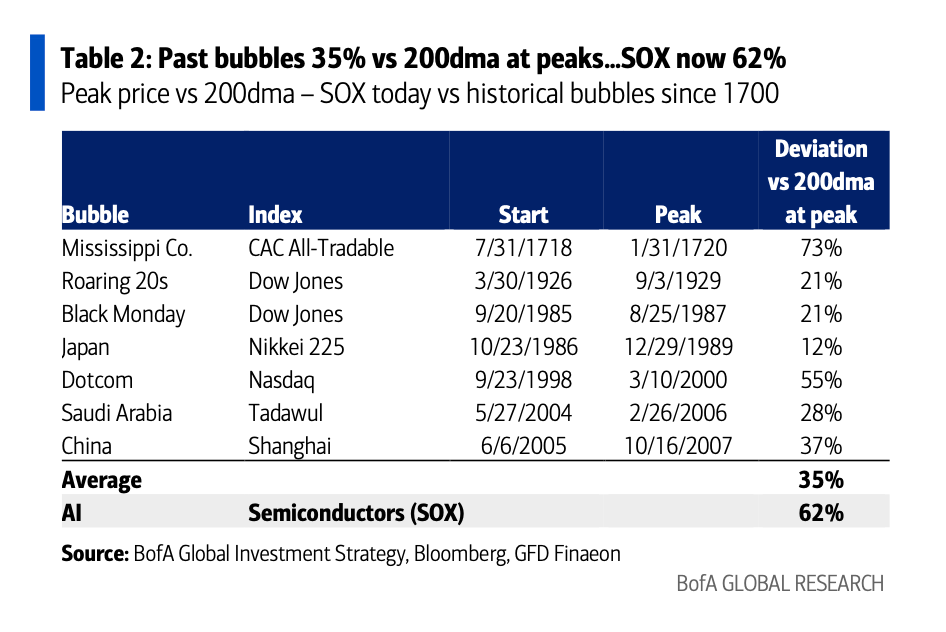
(Source: BofA’s The Flow Show Report, May 14, 2026, 10:45 PM EDT)
Also, today’s U.S. equity rally relies heavily on a handful of tech giants. Upcoming mega-IPOs—like SpaceX or Anthropic—could further drain market liquidity.
Crypto users are accustomed to high volatility, high leverage, and short-term trading. While U.S. equities fluctuate too, they fundamentally prioritize fundamentals, earnings, valuations, interest rates, and macro cycles. What trading habit do they most need to change?
For crypto users newly entering U.S. equities, my top advice is: Don’t treat equities like memes. In crypto, users often chase sentiment, community hype, and high-leverage short-term plays. U.S. equities are highly institutionalized—they reward scrutiny of financial statements, EPS, interest-rate environments, and macro cycles.
Crypto natives must learn to track Treasury yields and inflation data. For instance, when the 10-year U.S. Treasury yield approaches 5%, high-valuation tech stocks face headwinds.
Another habit shift: reduce leverage and lengthen time horizons. Blue-chip equities possess real earnings, cash flows, and durable moats—making them ideal for strategic allocation and long-term dollar-cost averaging—not speculative “pump-and-dump” trades. Be patient. Be friends with time. To help crypto users adapt, Bitget will continue launching educational content on U.S. equities—so stay tuned, and join us in learning to become “premium U.S. equity traders.”
Crypto used to concentrate young talent, venture capital, tech narratives, and speculative capital. Now AI dominates: top talent joins AI firms, VCs fund AI startups, public markets chase AI, and U.S. tech giants deliver real revenue and growth.
How big an impact does AI have on crypto? How is AI used internally at Bitget—and is its adoption mandated or performance-linked? Which AI tools do you use?
Gracy:
Impact is inevitable—but I prefer viewing AI as crypto’s “de-bubbling litmus test.” Crypto money used to flow too easily; now AI siphons capital and talent, forcing crypto to mature—focusing on real-world utility like stablecoin payments and RWA.
At Bitget, AI adoption is mandatory for all employees. “AI-driven innovation” is one of our three core 2026 strategies. We don’t rigidly enforce AI usage as a KPI—because great tools naturally gain traction. Personally, I rely daily on Manus, NotebookLM, and others for research synthesis—and yes, it’s addictive.
Organizationally, we actively support AI use. Bitget has purchased enterprise-tier Claude access for all 2,167 employees—$200 per person monthly. This wasn’t externally imposed; rather, after observing productivity gains from employee AI adoption, we prioritized ensuring no team member falls behind in the AI wave.
Even non-technical design teams now use Google AI Studio—and have built 6–7 internal AI tools automating UI compliance checks for external materials. On the product side, we’ve launched trader-specific AI tools like GetAgent and GetClaw.
We host AI training almost daily. This week, I attended the “Data Team AI Product Deep Dive” and the “Digital Employee Program & BG Agent Platform Introduction.”
AI is a productivity lever. Those who wield it well will sprint faster in the next cycle. The present—and future—is unequivocally an era of silicon and carbon life co-working.
More crypto exchanges now offer U.S. equities, gold, forex, stock tokens, and pre-IPO products. Optimistically, this signals crypto infrastructure expanding into global assets. Pessimistically, it suggests crypto lacks quality native assets—forcing exchanges to import U.S. equities to sustain growth.
How do you view this tension? When crypto exchanges integrate U.S. equities—is it enhancing crypto’s financial infrastructure value—or diverting crypto user traffic to traditional finance, effectively turning crypto into an outsourced liquidity channel for U.S. equities?
Gracy:
I reject binary framing. Integrating U.S. equities, gold, forex, and pre-IPO products isn’t merely “importing traditional finance into crypto”—it’s testing a deeper question: Is crypto just an asset class—or a new financial infrastructure?
My answer hinges on execution. If exchanges merely wrap U.S. equity price exposure as tradable products, they risk becoming distribution channels—or even funnels redirecting crypto users to U.S. equities.
But if they rebuild asset issuance, trading, clearing, custody, and risk management atop stablecoin accounts, on-chain settlement, global accessibility, fractional trading, and 24/7 markets—they’re not just enhancing individual U.S. stocks. They’re elevating crypto’s value as next-generation financial infrastructure.
And anyone familiar with traditional finance knows its user barriers are steep: complex onboarding, high minimums, slow fund movement. Our goal is to use stablecoin settlement and on-chain RWA protocols to bridge underlying assets—letting Bitget’s 120 million users trade world-class assets with just a phone and email.
This isn’t outsourcing—it’s using crypto’s speed and low friction to upgrade legacy brokerage experiences. We’re not losing users; instead, via tokenization solutions like Reality, we’re bringing real-world assets on-chain—making them part of DeFi. This expands crypto’s frontier. We believe crypto’s definition evolves: it started as Bitcoin; then became memecoins; and tomorrow, much of crypto will be RWA. Whatever the underlying asset, blockchain and related technologies remain the foundational engine of this new financial system—and our long-term confidence stems from deep technical conviction.
Bitget’s UEX vision enables users to trade crypto, equities, gold, forex, and ETFs within one account. This sounds like exchange capability expansion—but could also imply crypto alone no longer satisfies user needs, forcing exchanges to become multi-asset platforms.
How do you view this tension? Is UEX a natural evolution—or does it signal the ceiling for “crypto-only” exchanges? How should the world define Bitget?
Gracy:
If we view blockchain—the backbone of crypto—as a foundational value-transfer network, the ceiling remains distant.
UEX is a natural exchange evolution. Amazon started selling books—then everything. The iPhone began as a touchscreen phone—then became a digital lifestyle hub. Users don’t just want to “trade crypto”—they want to earn and allocate capital. Since stablecoins are among the world’s most efficient settlement rails, why not let users buy the world’s best assets with them?
We announced the UEX vision in H2 2025—and will steadfastly pursue this transformation for at least the next three years. Let me elaborate on WHY and HOW.
WHY—Why Commit to UEX Transformation?
From a systemic perspective, today’s financial architecture remains built on “walls.”
Asset fragmentation: Buy stocks via brokers, crypto via CEXs, forex via banks or IBs.
Geographic & temporal fragmentation: U.S., European, and Asian equities close at different times—capital can’t flow 24/7.
Account & technology fragmentation: Traditional finance and Web3 operate like parallel universes—users juggle countless accounts and margin balances.
This suppresses capital efficiency, complicates UX, and hinders unified risk management. Thus, universal asset platforms meet both user demand and macro trends.
Over the past 4–5 years, exchange landscapes barely shifted—homogenized competition favors incumbents. But crypto is becoming financial infrastructure—and the inflection point has arrived. Platforms with stronger teams and decisive execution can leapfrog. Future rivals won’t just be peers—traditional finance is accelerating too. Whoever establishes first-mover mindshare wins.
HOW—How Do We Build the UEX Universal Exchange?
One account. One interface. One-stop trading for all assets. Crypto remains our core—but tokens diversify. Bitcoin is a token. So are Tesla, NVIDIA, and SpaceX. Gold and crude oil can be tokens too. RWA is a direction Wall Street and crypto alike recognize—and where we intend to lead.
To realize this, we’ve built five core modules:
A unified account enabling cross-asset margin maximizes capital efficiency. A unified risk engine upgrades single-asset risk management to portfolio-level oversight. A unified liquidity router integrates CEXs, DEXs, and external markets—making Bitget a liquidity orchestration hub. A unified execution layer evolves user entry—from manual trading to APIs to AI Agents. An asset standardization layer turns crypto, stock ETFs, forex, commodities, and RWAs into programmable trading objects.
Three years from now, I hope the world sees Bitget not merely as a crypto exchange—but as a universal exchange: where users instantly trade global core assets, enjoy seamless AI-enhanced UX, and trust security deeply.
Recent regulatory moves targeting cross-border brokers like Futu, Tiger Brokers, and Changqiao have sparked market debate. Bitget’s U.S. Equities 2.0 differs from traditional internet brokers—but still involves users transacting in traditional financial assets across borders.
How do you view these regulatory shifts? Could they influence users’ choices for U.S. equity access?
Gracy:
Compliance is irreversible—and why “Compliance First” is our 2026 core strategy.
Regulation exists to protect user assets, prevent money laundering, and mitigate systemic risk. For Reality and U.S. Equities 2.0, we set compliance standards at maximum rigor—avoiding gray zones entirely. We partnered directly with Alpaca, a U.S.-licensed broker-dealer, placing underlying assets squarely within U.S. financial regulation.
Regulatory changes bring short-term friction—but long-term, they drive market consolidation, eliminating non-compliant operators. For users, superior product experience—24/7 trading, reduced FX friction, on-chain composability—combined with transparent compliance and asset safety—like Reality’s daily audit dashboard—will guide rational decisions.
Many crypto users encounter U.S. equities for the first time—and instinctively apply crypto habits: chasing hype, momentum, leverage, sentiment, and short-term trades. Yet U.S. equities operate under distinct valuation frameworks, earnings cycles, interest-rate dynamics, regulatory rules, and fundamental analysis.
If you could give these users just one piece of advice—what would it be?
Gracy:
If only one sentence: Find the right moment to buy high-quality companies you genuinely understand—and whose profits are real. Then entrust the rest to time. In crypto, many trades feel like speculation. In equities, strive to invest.
Join TechFlow official community to stay tuned
Telegram:https://t.me/TechFlowDaily
X (Twitter):https://x.com/TechFlowPost
X (Twitter) EN:https://x.com/BlockFlow_News
 吴说区块链
吴说区块链