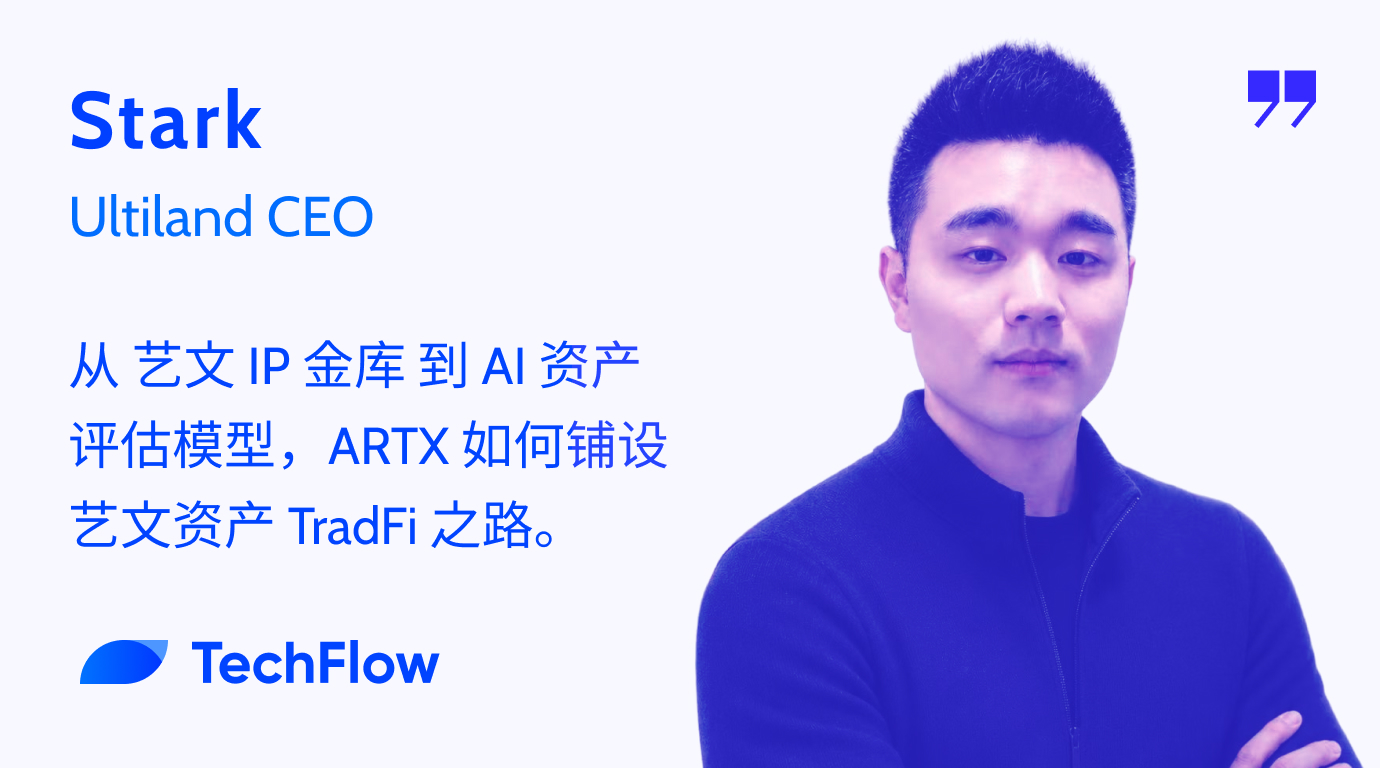
Exclusive Interview with Ultiland CEO Stark: From Art & Culture IP Vault to AI Asset Valuation Model, How ARTX Paves the TradFi Path for Art & Culture Assets
TechFlow Selected TechFlow Selected
Exclusive Interview with Ultiland CEO Stark: From Art & Culture IP Vault to AI Asset Valuation Model, How ARTX Paves the TradFi Path for Art & Culture Assets
Art is just our starting point, not the boundary.
 Navigating Web3 tides with focused insights
Author: TechFlow
Introduction
Artistic assets used to belong to a room for the few; what Ultiland aims to do is open this door.
But this door cannot be opened simply by sticking on-chain labels onto artworks.
Over the past few years, the Web3 market has seen many art, trendy IP, celebrity resource, and collectible projects: they had heat, had stories, and had short-term trading sentiment. But after the heat dissipated, many projects encountered the same problem: assets were not truly understood, rights boundaries were not clarified, there was a lack of continuous liquidity after issuance, and the secondary market lacked a stable supporting structure.
Artistic assets never lack value; what is lacking is a structure that can be verified, traded, supported, and continuously operated by the market.
This is exactly the problem Ultiland is attempting to solve.
Among UltiLens AI Valuation and Rights Readiness Engine, IP Vault Asset Organization Framework, ARToken Single Asset Issuance Unit, UltiGallery Structured Exit and On-chain Liquidity Protocol, and ARTX Platform Sovereign Asset, Ultiland is committed to gradually building a complete market chain for art and cultural assets.
At the same time, this path is being chosen by more and more influential cultural creators:
On July 7, 2026, at 20:00, Simon Yam's frameless limited edition art print work "3025 #3 Art Print" will launch on Ultiland. This versatile best actor, who shaped countless classic roles during the golden age of Hong Kong films, chose to join hands with Ultiland, becoming a new pioneer pushing art and cultural assets from being viewed and collected towards a new stage of being rights-confirmed, issued, and participated in.
On the occasion of the launch of "3025 #3 Art Print", we had an in-depth conversation with Ultiland CEO Stark, talking about how Ultiland moves from "artworks on-chain" to "art and cultural asset capitalization infrastructure", and how ARTX undertakes long-term platform value in this system.
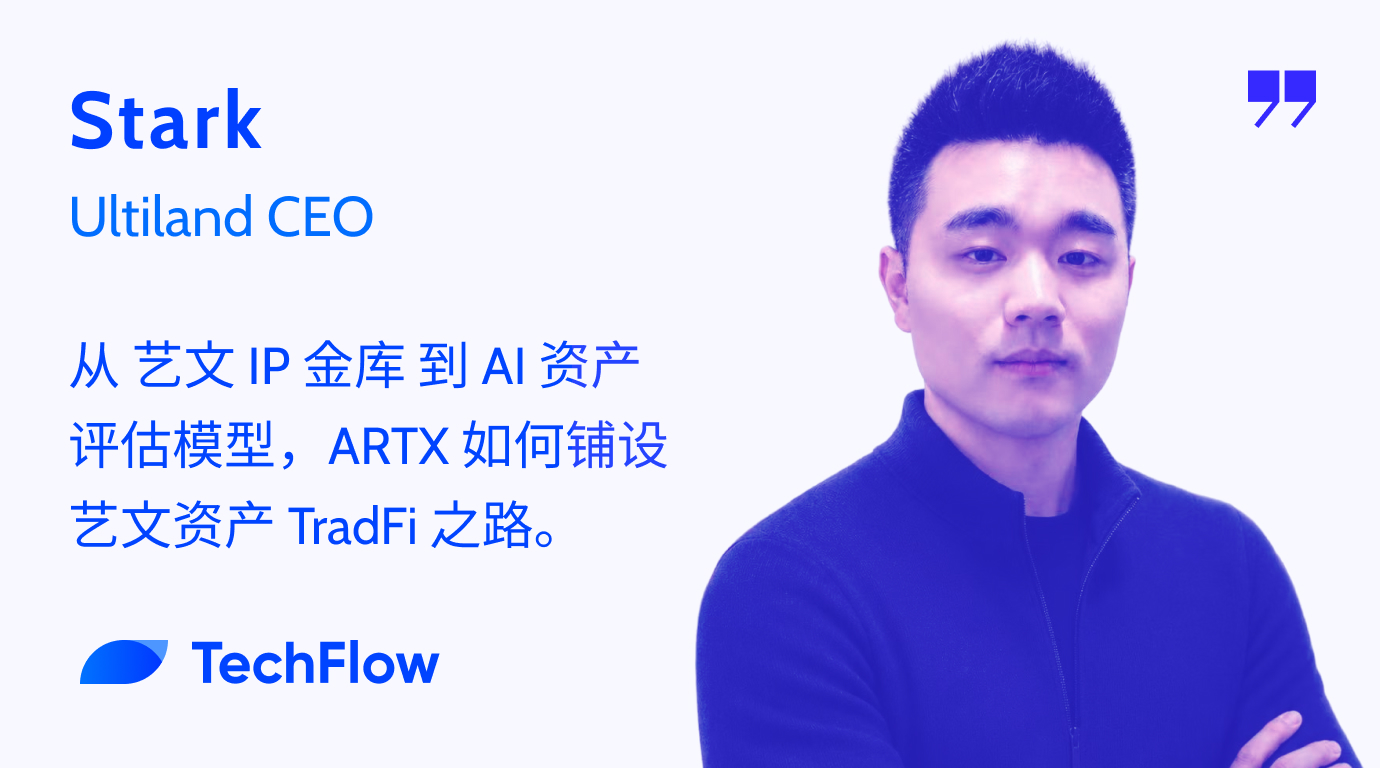
Art is Just the Starting Point: Building a Complete Market Chain for Art and Cultural Assets
TechFlow: Outsiders easily understand Ultiland as a Web3 art platform, or an art RWA LaunchPad. But from the business you are currently advancing, Ultiland seems to be not just "artworks on-chain". If redefined from the CEO's perspective, what exactly is Ultiland?
Stark:
If we only say Ultiland is an art platform, this definition is too narrow. Art is just our starting point, not the boundary.
I prefer to define Ultiland as a set of art and cultural asset capitalization infrastructure. What it needs to solve is not "how to move a piece of work on-chain to sell", but how non-standard art and cultural assets are understood, verified, issued, traded, operated, and沉淀 (沉淀 -> accumulate/preserve) value in the long-term market. -> accumulate value in the long-term market.
There are several layers of structure here.
The first layer is UltiLens AI. It is not simply estimating a price, but helping the platform complete asset value identification, evidence organization, rights readiness judgment, and risk explicitization.
The second layer is IP Vault. It is responsible for organizing celebrities, artists, trendy IPs, cultural content, authorization boundaries, and commercialization paths into an asset reserve that is manageable, reviewable, and可持续 (sustainable) operable. -> sustainable operable.
The third layer is ARToken. It is the on-chain issuance and trading unit formed by a single asset or a single group of IPs after meeting rights, valuation, risk control, and disclosure conditions.
The fourth layer is UltiGallery and ART Curve. They handle market order after issuance, including liquidity, pricing ranges, asset payments, and holder exit paths.
The fifth layer is ARTX. It is Ultiland's platform sovereign asset, undertaking platform services, ecosystem settlement, governance coordination, liquidity coordination, and long-term value capture.
So Ultiland is not sticking Web3 labels on artworks, nor is it doing a short-term co-branding for a certain IP. What we want to do is a complete asset market chain: asset entry, AI valuation, rights confirmation, on-chain issuance, secondary trading, continuous operation, asset payments, value undertaking.
This is also why I always emphasize that Ultiland's competitiveness lies not in single-point issuance, but in the system. A single project can have heat, but only a system can undertake long-term assets.
TechFlow: The market will pay close attention to Ultiland's cooperation intentions with some top art and cultural asset parties, IP resource parties, and offline industry resource parties, including artist resources, trendy IPs, curation capabilities, and commercialization channels. How to understand the impact of this series of cooperation intentions on Ultiland ecosystem construction?
Stark:
Such cooperation intentions are important, but they are not the whole protagonist. More accurately, it represents the verification Ultiland has obtained on the asset supply side.
There are a large number of high-quality art and cultural assets in the real world. They may come from artists, curation institutions, trendy IPs, celebrity content, brand authorizations, collectibles, and cultural commercialization scenarios. They have real value, real consensus, and also potential cash flow and communication capabilities. But for a long time, these assets have been difficult to enter the on-chain market in a standardized way.
If a platform only talks about mechanisms without high-quality assets entering, the mechanisms will appear empty; but if there are only high-quality assets without valuation, issuance, trading, exit, and value undertaking mechanisms, it is also difficult for assets to truly form an on-chain market.
The value of Ultiland lies in connecting these two ends: one end is the art and cultural asset entrance in the real world, and the other end is the on-chain capital market, community participation, and global liquidity.
But we will not describe our core competitiveness as "who we know". Resources are the starting point, the system is the barrier. What Ultiland really wants to do is to digest different types of art and cultural resources into a standardized chain: use UltiLens AI for value identification and risk judgment, use IP Vault for asset management, use ARToken for issuance and trading, use UltiGallery for liquidity and exit, and use ARTX to undertake platform growth.
So the significance of these cooperations is not just bringing materials or exposure to Ultiland, but proving that real assets are looking for a new path to enter the on-chain market, and Ultiland is providing this path.
This primary-secondary relationship must be made clear: top art and cultural asset parties provide the real asset entrance, Ultiland provides the system that allows these assets to enter the on-chain capital market.
TechFlow: The traditional art market does not lack good works, nor does it lack collection value. The real problems are slow price discovery, long trading cycles, and high participation thresholds; ordinary users and on-chain capital are difficult to enter. How does Ultiland aim to solve the core contradictions of the traditional art market?
Stark:
The problem with art assets has never been whether there is value, but that value has long been locked in a few channels.
A piece of artwork, a celebrity IP, or a set of limited collectibles may have strong market recognition and collection circles. But in the traditional model, their trading frequency is low, the valuation process is opaque, rights boundaries are complex, and exit cycles are long. For asset holders, value is difficult to be continuously operated; for ordinary users, the participation threshold is too high; for institutional capital, there is a lack of standardized identification mechanisms and liquidity supporting means.
Ultiland's solution is not simply lowering the threshold, but reconstructing the chain.
First, assets must be understood first. UltiLens AI will help the platform identify the asset's value source, evidence quality, rights boundaries, market depth, and risk factors. Without this step, subsequent issuance can easily become story packaging.
Second, assets must be organized. IP Vault is not a material library, but an asset management structure. It puts ownership, authorization, commercialization paths, communication capabilities, issuance parameters, and operation events into the same framework.
Third, assets must be issued and traded. ARToken is the on-chain issuance unit for single assets, ART Curve and UltiGallery handle market order, liquidity parameters, payments, and exits after issuance.
Finally, platform growth must have undertaking. ARTX is not a token that exists in isolation, but the external circulation asset of Ultiland's entire business system. Valuation, issuance, trading, liquidity, IP management, and ecosystem governance ultimately all need a platform-level undertaking layer.
So Ultiland solves not the single-point problem of "artworks on-chain", but how art and cultural assets can have a complete market structure.
From AI to Vault: From Value Trust Foundation to Asset Management System
TechFlow: You just mentioned UltiLens AI. One of the biggest challenges for art RWA is valuation and trust. The traditional art market relies on experts, galleries, auction records, and circle consensus, but these judgments are difficult to directly enter the on-chain market. Is UltiLens AI actually an AI valuation tool, or Ultiland's underlying infrastructure?
Stark:
UltiLens AI is not a simple AI valuation tool; it is more like an evidenced valuation and rights readiness engine within the Ultiland art and cultural RWA system.
The biggest difficulty in the financialization of art assets is not letting AI give a price, but making the judgment process behind this price able to be verified, questioned, safely displayed, and finally calibrated by real market results.
It is not difficult for a model to say "how much this asset is worth". The difficulty is letting the asset party, users, funds, partner institutions, and the future capital market all see: what evidence this judgment comes from, what inquiries it has undergone, what risks are exposed, and within what boundaries it can be used.
UltiLens AI will split a valuation into several responsibility aspects, including valuation, market data, rights, source media, risks, and opposing inquiries. Each responsibility aspect will form a structured judgment, and the system will then form a deliverable ValuationProofPackage through evidence citation, divergence attribution, risk marking, and manual review.
This means what Ultiland delivers to the market is not an isolated price number, but a set of value proofs that can be displayed, verified, and enter issuance judgment.
More importantly, UltiLens AI defaults to serving independent valuation reports and asset readiness judgments first, and will not be directly equivalent to coin issuance approval. Only when ownership, data, risk control, and manual review meet conditions is it possible for valuation results to enter the RWA LaunchPad, ART Curve, IProtocol, or subsequent issuance support processes.
This boundary is very important. Ultiland will not confuse "can value" with "issue immediately". The deeper asset financialization goes, the less it can rely on a beautiful narrative to advance; it must rely on evidence, processes, audits, and market feedback to advance.
TechFlow: There are many AI tools on the market now, and many projects will say they can do AI valuation. Where is the barrier for UltiLens AI? Why is it not simply calling several models and generating a report?
Stark:
Calling several general large models is not a barrier. The real barrier lies in how data enters, how evidence is bound, how divergences are handled, how reports are delivered, how results flow back, and how system upgrades are governed.
The core of UltiLens AI is not "letting AI give answers", but building a valuation runtime carrying proofs. One run not only generates a report but also leaves asset intake, Evidence, ContextSelectionManifest, AgentSubmission of different responsibility aspects, ConsensusResult, ValuationProofPackage, and a safe display layer for dApps and public reports.
This structure solves two problems.
First, it can be verified internally. The platform knows a judgment comes from which materials, which tools, which models, which manual reviews, which risks, and which divergences.
Second, it can be displayed externally. Asset parties, users, funds, and partner institutions can see public safe proof summaries, but will not see contract originals, contact information, provider raw output, or internal sensitive materials.
In the long run, the moat of UltiLens AI comes from DATA Fabric and small model governance. Every real valuation, every supplementary evidence, every manual review, and every post-issuance outcome will precipitate into platform private data assets. Small models do not take over valuation at the beginning, but first do classification, completeness scoring, evidence reliability, case rerank, risk prediction, divergence classification, and agent weight suggestions.
This will form a flywheel: more real assets enter, bringing more evidence and divergences; more audits and outcomes bring better training and evaluation samples; better samples bring more stable model routing and report quality; higher quality reports will attract more assets and institutions into the system.
So the barrier of UltiLens AI is not "AI can speak", but that it can make value judgments be recorded, questioned, calibrated, and delivered. For art RWA, this is very critical infrastructure.
TechFlow: Celebrities, trendy IPs, and artist resources are often used for co-branding, exposure, and events in the traditional market. But if traffic cannot be precipitated into assets, it will pass quickly. Ultiland is going to do IP Vault next; what is the difference between it and ordinary IP cooperation?
Stark:
If traffic does not have asset structure undertaking, it is often just a gust of wind; if IP does not have a standardized digital financial structure, it is also difficult to cross circles to achieve global flow.
IP Vault is not an ordinary material library, nor is it making celebrity avatars or IP images into NFTs. It is an asset management system built around intellectual property legal boundaries, authorization structures, commercialization paths, AI risk control identification, on-chain issuance, and continuous operation.
When a high-quality IP enters Ultiland, it is not just doing a co-branding once, but entering a complete asset lifecycle: rights confirmation, valuation, issuance, trading, communication, secondary creation, offline events, authorization income, secondary market liquidity, and subsequent payment events can all be included in a manageable structure.
Here UltiLens AI will be very critical. Before each IP enters the Vault, it needs to undergo multi-dimensional assessment, including commercial extensibility, communication capabilities, authorization boundaries, rights materials, market liquidity, and risk factors. Only in this way will IP Vault not be a concept warehouse, but an asset system that can be continuously reviewed, continuously issued, and continuously operated.
Hong Kong plays a very critical role here. It connects both the Asian entertainment and art industries, and also international capital, family offices, funds, and Web3 communities. Ultiland choosing Hong Kong as the core is not just a geographical choice, but a market structure choice.
What future users contact will not be a picture, nor a event heat, but an early stage of a batch of global cultural IPs entering the on-chain asset market. A celebrity, a character, an artist, or a trendy symbol, if it can be continuously operated, continuously traded, and continuously generate commercial events, it is not just traffic, but an asset.
This is the biggest difference between IP Vault and ordinary IP cooperation: ordinary cooperation consumes heat once, IP Vault wants to precipitate long-term assets.
Art RWA Moves into Deep Waters, Institutional Participation is the Watershed for Maturity
TechFlow: Many projects talk about RWA, only talking about "assets on-chain". But if after assets are on-chain, they cannot be understood by industrial capital, public markets, and institutional funds, it is still just small circle trading. Will Ultiland push art RWA to higher-level capital cooperation next?
Stark:
This is a very important step for Ultiland next.
RWA cannot stay at the display level of smart contracts. Truly vital digitalization of real-world assets must be able to be identified, valued, custodied, disclosed, traded, and also understood by the capital market in a more mature language.
The launch of UltiLens AI is precisely to make this process no longer rely only on narratives, but to have a set of verifiable asset judgments and value proofs. Only when value sources, rights boundaries, custody arrangements, risk control discounts, and information disclosure can all be seen can art RWA possibly move from the small circle inside Web3 into a larger capital collaboration space.
Currently, we are also discussing long-term synergy possibilities within compliance frameworks with qualified industrial capital, professional funds, and public capital market-related subjects. The focus of such exploration is not borrowing a capital market concept for short-term narratives, but letting the on-chain market and traditional capital market form clearer language alignment around the same set of art and cultural asset systems.
The on-chain market provides global liquidity, community consensus, asset issuance efficiency, and ARTX value undertaking; the traditional capital market provides more mature disclosure, custody, financing, auditing, and institutional entrances. When the two sets of markets can understand Ultiland with a more consistent asset language, art RWA will no longer be just an on-chain asset experiment, but have the opportunity to become a new asset class understood by a wider capital system.
Of course, such cooperations must be subject to formal announcements and compliance disclosures. Ultiland will not package capital synergies still under exploration into deterministic commitments. We value long-term structure more than short-term sentiment.
TechFlow: If art RWA relies only on short-term sentiment, it is easy to become one-time speculation. But if there is professional capital participating in asset subscription, liquidity construction, long-term allocation, and exit design, the market structure will be completely different. How does Ultiland view the role of institutional funds?
Stark:
The rational intervention of institutional funds is an important watershed for art RWA moving from the story stage to an asset class.
But what is talked about here is not "having funds come in is definitely better". The key is the nature, cycle, and discipline of the funds.
What art RWA needs is not fast-in fast-out sentiment funds, but professional funds that understand assets better, understand risk control better, understand custody better, and understand exit paths better. What they focus on is not just the heat at issuance, but asset sources, ownership proofs, valuation basis, risk discounts, liquidity budgets, custody arrangements, information disclosure, and extreme scenario handling.
In this matter, the valuation reports, Proof Package, rights boundaries, and risk prompts output by UltiLens AI will become important materials for institutions to understand assets. IP Vault can let institutions see that assets are not entering sporadically, but are being continuously managed, continuously audited, and continuously operated.
What institutional funds truly bring should not be packaged as price commitments, but the improvement of issuance discipline, risk control standards, information disclosure, liquidity budgets, and market trust.
RWA credit is not shouted out. It is built together by the asset side, data side, custody layer, fund layer, and risk control execution layer.
Let Everyone Who Truly Cares About the Art and Cultural Asset Market Be Clearly Seen
TechFlow: Many users may see concepts like ARToken, ART Curve, UltiGallery, ARTX, but may not necessarily distinguish their respective positions. Which segment of problems do ARToken and UltiGallery actually solve in the Ultiland asset lifecycle?
Stark:
These concepts must be distinguished, otherwise it is easy to misread Ultiland as an ordinary coin issuance platform.
ARToken is the on-chain issuance and trading unit for single assets. A piece of artwork, an IP, a collectible, or a set of cultural assets, if meeting rights, valuation, risk control, and disclosure conditions, can form an on-chain transferable asset expression through ARToken. It corresponds to specific assets, not platform sovereign assets.
UltiGallery solves the problems after issuance.
Many projects only care about how to issue out, but do not care about how to operate after issuance. Ultiland cares about: after assets generate payments, how do funds enter on-chain? How do holders exit? How does the secondary market undertake? How are price fluctuations absorbed by liquidity structures? These problems cannot be solved by slogans, but must rely on mechanism design.
UltiGallery is a structured exit and on-chain liquidity protocol serving ARToken. It is not a yield commitment tool, but puts asset payments, on-chain fund allocation, secondary trading undertaking, and risk buffering into a set of executable protocols.
If speaking more intuitively, UltiGallery is not a "display gallery", but after ARToken issuance, draws a liquidity and exit corridor for this asset market. Above there is growth imagination, in the middle there is trading breathing, at the bottom there is layered undertaking, and after payments enter there are rules to follow.
It does not promise price increases, nor does it replace market pricing. But it can make assets after issuance not remain only with sentiment fluctuations, but have a clearer market order.
ARTX is the platform layer. It does not correspond to single assets, but undertakes service demands, governance demands, settlement demands, and long-term value flowback generated by Ultiland as infrastructure.
Simply put, ARToken solves single asset issuance, UltiGallery solves market order after issuance, ARTX undertakes platform growth. These three layers cannot be mixed.
TechFlow: In the past, many Web3 incentives stayed at check-ins, referrals, and airdrops. But art and IP growth is not just trading, it also includes creation, communication, curation, secondary creation, and community consensus. How will Ultiland design user contribution mechanisms?
Stark:
Ultiland users should not just be buyers, but should also be participants in asset growth.
The value growth of art and IP originally comes from multi-party participation. A work being seen, explained, communicated, secondary created, collected, and traded, these behaviors are all forming value. The advantage of Web3 is that it can record these behaviors and convert them into a measurable contribution system.
So next we will form a set of Inspiration Power around behaviors such as creation, communication, curation, invitations, trading, and community building, that is, an inspiration computing power system.
Inspiration computing power accumulated by users through real contributions will be mapped to ecosystem incentives like miniARTX within rules. miniARTX is not a negative locking asset, nor a simple airdrop voucher. It is closer to a contribution-type, custody-type, internal circulation asset, used to record users' real historical contributions in the ecosystem, and establish relationships with ARTX's linear release or accelerated release paths under clear rules.
The core of this mechanism is to let Ultiland upgrade from a "buyer community" to a "contributor network". People who truly push IP to break circles, people who truly help assets be understood by the market, people who truly participate in curation, communication, secondary creation, and liquidity maintenance should be seen by the system and should also be incentivized by the system.
In the traditional art market, many value contributors are invisible. Communicators, curators, content creators, community organizers, early supporters are all helping assets form consensus, but they are difficult to be recorded. What Ultiland wants to do is to make these contributions become on-chain behaviors that are recordable, calculable, and incentivizable.
This is not a simple airdrop activity, but lets users become part of asset growth.
TechFlow: The market will eventually ask a very direct question: Ultiland has various IPs, celebrity cooperations, has UltiLens AI, has IP Vault, has fund cooperations, has capital actions at the listed company level, and also has new user incentives, so what is the relationship between these growth and ARTX finally?
Stark:
ARTX is Ultiland's platform sovereign asset, and is also the core undertaking asset for the entire ecosystem's external circulation.
Here we must first see three layers of relationships: ARToken is the on-chain issuance and trading unit for single assets; miniARTX is a contribution-type, custody-type, internal circulation asset; ARTX is the core asset for platform services, ecosystem settlement, governance coordination, liquidity coordination, and long-term value capture.
In the future, whether it is various high-quality asset entrances, or UltiLens AI's valuation reports and issuance support being called, or IP Vault's asset management and authorization operations, or ARToken's issuance and trading, or UltiGallery's liquidity and exit mechanism demands, it will ultimately increase Ultiland ecosystem's asset supply, service calls, trading demands, information disclosure demands, and market attention.
These growths need a unified undertaking layer. This undertaking layer is ARTX.
ARTX's value capture will not be completed by a slogan, but gradually formed through real business systems: issuance services, AI valuation services, IP Vault management services, trading-related fees, ecosystem governance, liquidity coordination, treasury mechanisms, buyback and burn, or value flowback under other compliance rules.
Here it must be made clear that any flowback, locking, consumption, buyback, or burn mechanisms should be premised on rule design, governance processes, and compliance disclosures. It is not a secondary market price commitment, nor a yield guarantee.
We hope the market sees a clear path: Ultiland's asset growth must have somewhere to precipitate; Ultiland's service calls must have core assets to undertake; Ultiland's market expansion must be able to return to platform long-term value.
The true value of a platform Token is not spoken out, but the business system continuously brings demands, income, governance, and liquidity back to it over the long term. What Ultiland wants to do is to let ARTX become the core undertaking layer of this set of art and cultural asset capitalization systems.
Four Structural Changes After the Hong Kong Summit
TechFlow: Hong Kong has always been the intersection of Asian art, finance, and Web3. If the ArtX Web3 Art Finance Summit is just an event, its impact is limited; but if it releases a new market structure, the significance is completely different. After the summit, which keyword of Ultiland do you hope the market remembers?
Stark:
I hope the market remembers four changes.
First, supply side change. Art and cultural digitalization can no longer stay at the stage of waiting for single artists or single projects to go on-chain. Ultiland is organizing high-quality art assets, trendy IPs, celebrity content, offline commercialization resources, and cultural assets into asset supply that can continuously enter the on-chain market through multi-party cooperation.
Second, trust side change. UltiLens AI will let art and cultural assets be understood, verified, valued, and reviewed before issuance. Art RWA is not writing stories more beautifully, but making value sources, rights materials, risk control discounts, and proof processes verifiable.
Third, capital side change. Art RWA cannot stay only inside Web3 communities; it must enter the language system that funds, industrial capital, and public markets can understand. Valuation, custody, disclosure, liquidity, and exit are the infrastructure that must be completed on this path.
Fourth, user side change. Users are not just buyers and sellers, but can also become communicators, curators, creators, and co-builders. Future Ultiland growth is not just the growth of the number of assets on-chain, but also the growth of the contributor network.
The significance of the Hong Kong Summit is not to create an emotional climax once, but to release a signal to the market: art and cultural assets are moving from the collection market and IP authorization market into a more open, more verifiable, and more tradable on-chain capitalization market.
If using only one keyword, I would say "complete market chain". Because what art assets truly need is not single-point issuance, but a complete system from asset entry to value undertaking.
TechFlow: Finally, if you were only allowed to use one sentence to explain what Ultiland is going to do next, how would you say it?
Stark:
What Ultiland wants to do is not to stick on-chain labels on artworks to resell, but to transform global art and cultural assets into a new asset system that is verifiable, issuable, tradable, operable, disclosable, exitable, and can be jointly understood by ordinary users, industrial capital, and public markets.
Artistic assets used to belong to a room for the few.
What Ultiland wants to do is open this door, and let ARTX become the core value undertaking layer of this new market.
Join TechFlow official community to stay tuned
Telegram:https://t.me/TechFlowDaily
X (Twitter):https://x.com/TechFlowPost
X (Twitter) EN:https://x.com/BlockFlow_News
 深潮TechFlow