








Greenspan’s Passing: The Market Rules He Wrote Are Being Rewritten by Waller
TechFlow Selected TechFlow Selected
Greenspan’s Passing: The Market Rules He Wrote Are Being Rewritten by Waller
Alan Greenspan, aged 100, has passed away; his legendary “sell the rip” strategy and the doctrine of “don’t fight the Fed” have dominated markets for three decades.
 Navigating Web3 tides with focused insights
By: Yan Wai Zhi Yi
Source: WallStreetCN
On June 22, 2026, NBC reported an unsurprising piece of news: Alan Greenspan, former Chair of the U.S. Federal Reserve, passed away at age 100 due to complications from Parkinson’s disease.
He had long since faded from public view—but what he left behind has never left the markets.
More than half of today’s global financial markets’ pricing logic still bears his fingerprints. The statement “The Fed will provide liquidity” issued after the 1987 “Black Monday,” the rhetorical question about “irrational exuberance” in 1996 that triggered global equity market tremors, and the creed traders have recited for 30 years—“Don’t Fight the Fed.” These are not history—they are live-running code.
And just days before Greenspan’s death, current Fed Chair Kevin Warsh launched a comprehensive review of the Federal Reserve’s operational framework. This chronological coincidence feels almost like a deliberately arranged metaphor: one figure exits the stage, while another begins dismantling and rebuilding the very rules he authored.
The Birth of the “Greenspan Put”
To understand what Warsh is changing, we must first grasp the system he inherited—one shaped almost entirely by Greenspan himself.
On August 11, 1987, 61-year-old Alan Greenspan assumed the role of Federal Reserve Chair, succeeding Paul Volcker, following a nomination by President Reagan. It was a somewhat unexpected appointment. Greenspan was not an academic economist by training; his doctoral dissertation took decades to complete—he finally received his Ph.D. from New York University in 1977 at age 51. His roots lay on Wall Street as a consulting economist: In 1954, he co-founded Townsend-Greenspan & Co. with attorney Nathan Wolff, providing economic forecasting services to corporations and financial institutions. His instinct for data and business cycles was honed in the process of helping clients make money—not derived from chalkboard derivations.
This background profoundly shaped his subsequent 19-year tenure at the Fed.
Just 69 days into his term, on October 19, 1987, “Black Monday” struck. The Dow Jones Industrial Average plunged 22.6% in a single day—the steepest one-day drop ever recorded in U.S. capital markets. A cascade of program trading triggered a liquidity black hole, and no one knew where the bottom lay.
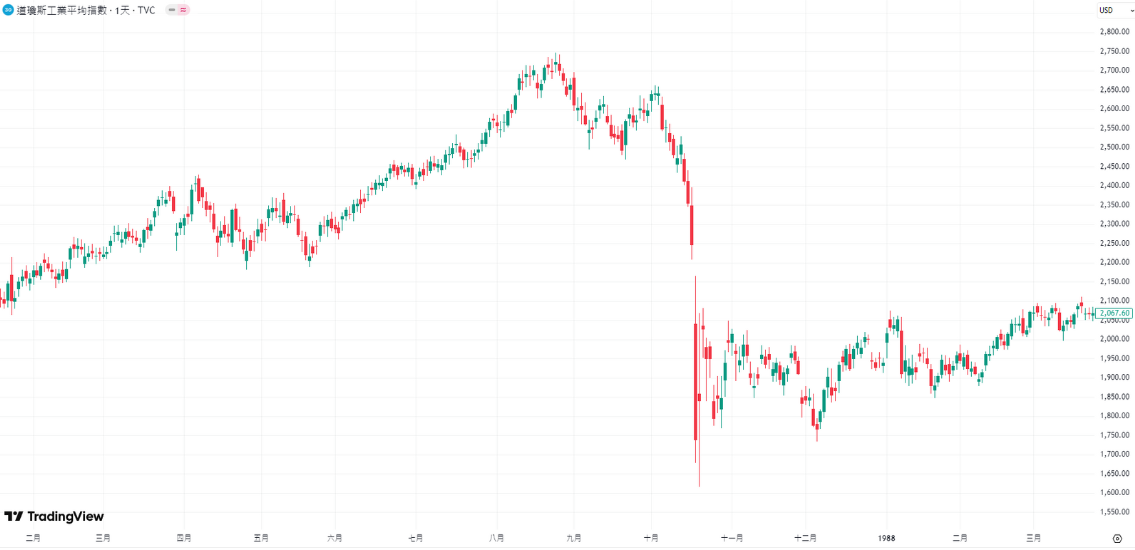
Greenspan’s response defined the Fed’s behavioral paradigm for the next three decades. Rather than wait for markets to clear themselves—a textbook answer drawn from classical economics—he swiftly issued a statement: the Fed would “provide liquidity to support the economy and financial system,” tacitly permitting banks to expand loans to brokers. That sentence steadied the markets.
The market later distilled this logic into a single term—the “Greenspan Put.” It meant: whenever markets fell far enough, the Fed would inevitably step in to prop them up—effectively granting all market participants a free put option. Once this expectation took hold, it could never be undone.
“Irrational Exuberance” and the Power of Language
Greenspan shaped markets not only through action—but also through language.
On December 5, 1996, during a speech at the American Enterprise Institute (AEI), he casually posed a seemingly offhand rhetorical question: “How do we know when irrational exuberance has unduly escalated asset values…?”
The statement itself was merely a question—carrying no explicit policy signal. Yet the market’s reaction was nearly instantaneous: Tokyo’s stock market opened down 3% the next day, triggering global declines.
This was the power of “Greenspeak”—the distinctive Fed-speak style Greenspan cultivated. He later proudly described his own linguistic approach as “deliberate ambiguity”: using four or five increasingly obscure sentences to sidestep questions he didn’t wish to answer—leaving questioning lawmakers convinced they’d received answers, then contentedly moving on.
But “irrational exuberance” was no ambiguous phrase—it was precise as a scalpel. It conveyed one clear signal: “I think the stock market is overvalued.” That alone was sufficient to trigger global shockwaves. Markets quickly realized the phrase itself changed no policy—interest rates remained unchanged, liquidity wasn’t tightened. After a brief dip, equities resumed their ascent, peaking in March 2000 at the height of the dot-com bubble.
This paradoxically reinforced the credibility of the “Greenspan Put”: if even verbal warnings weren’t followed by actual monetary tightening, he must clearly be on the side of bulls.
1994: The Forgotten “Hard Hand”
Today, people remember Greenspan mostly for the “Put”—assuming he always stood with markets. But events in 1994 tell a radically different story.
In early 1994, Greenspan judged inflationary pressures mounting and opted for preemptive action. Defying market expectations of gradualism, he raised the federal funds rate from 3% to 6% within a year—an unannounced move the market branded a “surprise.”
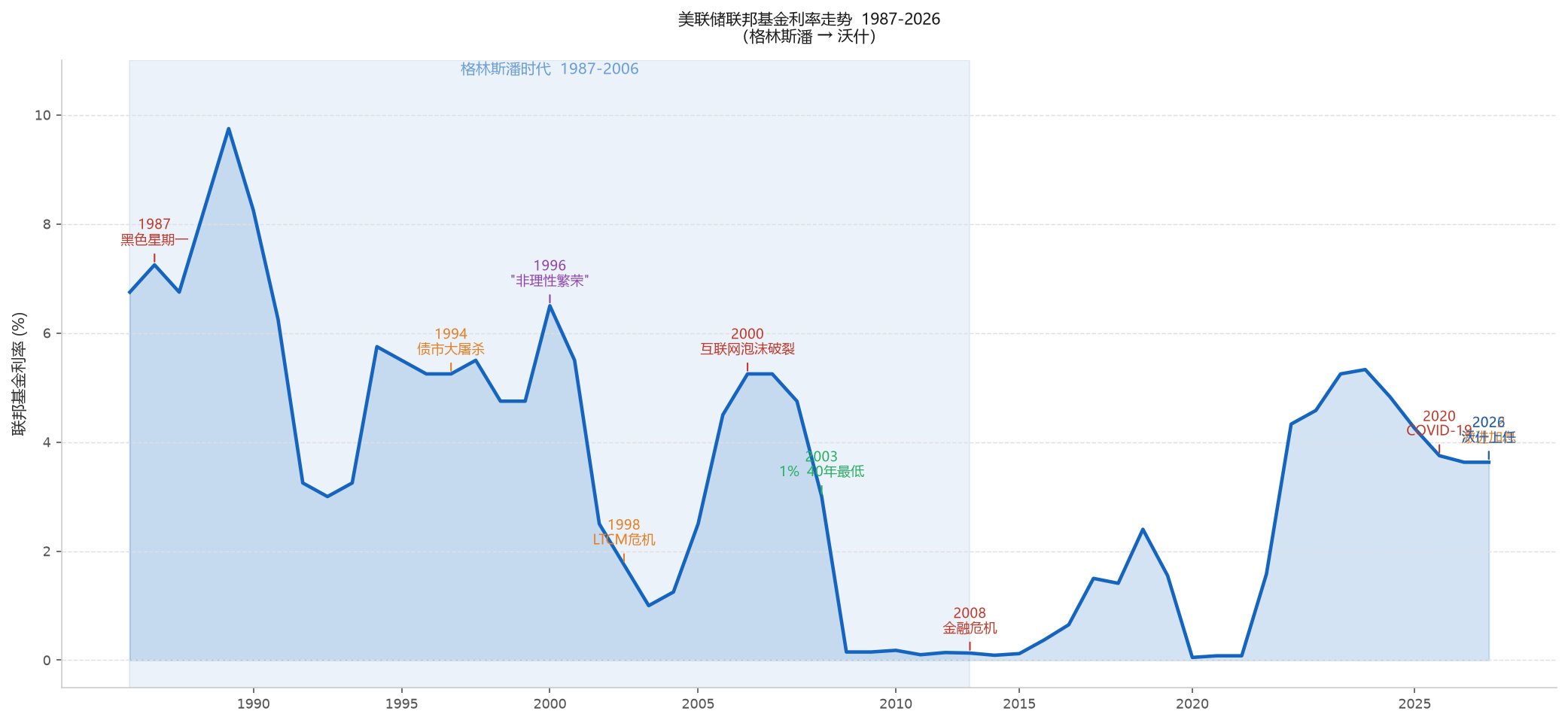
The result was disastrous—the bond market suffered a “massacre,” bond investment portfolios lost up to $1.5 trillion, and Orange County, California, declared bankruptcy due to massive losses on bond derivatives. Greenspan’s approval rating among financial market participants plummeted to rock bottom.
Yet the aftermath ultimately strengthened Greenspan’s market credibility. He proved he wasn’t afraid to antagonize markets. His true priority was controlling inflation—not appeasing Wall Street. This credibility enabled him to sustain low interest rates in the late 1990s without triggering runaway inflation expectations—because markets trusted him, trusted he’d act decisively when necessary.
This was the foundational prerequisite for the “Greenspan Put”: markets believed Greenspan possessed the ability to rein in inflation, and therefore believed he’d intervene to stabilize markets during crises. These two facets were two sides of the same coin.
1998: LTCM and the Precedent of “Too Big to Fail”
In 1998, two crises erupted almost simultaneously: Russia’s sovereign debt default—and the near-collapse of Long-Term Capital Management (LTCM), a hedge fund helmed by Nobel Prize-winning economists.
Greenspan’s response again shaped market expectations. He cut interest rates decisively—and personally spearheaded a private-sector rescue effort by Wall Street investment banks (the Fed did not contribute funds directly but coordinated private-sector intervention).
The historical significance of this episode is often underestimated. It stands as one key origin of modern finance’s “Too Big to Fail” doctrine—if an institution’s failure threatens systemic collapse, whether it’s a bank, investment bank, or hedge fund, authorities (central banks or governments) will organize a bailout.
Thus, the “Greenspan Put” expanded beyond equities to encompass the entire financial system. Markets began systematically expecting that risks borne by systemically important institutions would ultimately be backstopped by monetary authorities.
Greenspan himself was not adverse to this role. In his memoir, he wrote: “A central banker’s duty is not to prevent every bubble from forming, but to ensure the financial system does not collapse when bubbles burst.” This sounded prudent—but markets interpreted it as: “So I can stay in the bubble a little longer—after all, the Fed will clean up when it bursts.”
The Dark Side of the Legacy: 1% Rates and the 2008 Reckoning
After the dot-com bubble burst in 2000—and following the September 11, 2001 terrorist attacks—Greenspan responded by slashing the federal funds rate from 6.5% in mid-2000 down to 1% by mid-2003—the lowest level in over 40 years in the United States—and held it there for a full year.
Cheap capital flooded into the housing market. Between 2000 and 2006, U.S. home prices surged over 80%. Subprime mortgages—loans extended to borrowers with extremely weak repayment capacity—expanded explosively during this period. Wall Street packaged these subprime loans into CDOs (collateralized debt obligations), then used complex mathematical models to convince itself these products were “safe.”
In 2008, it all collapsed.
Critics pointed directly at Greenspan: “By pushing rates to 1% in 2003 and holding them there for a year, you inflated the housing bubble with cheap money. You’re responsible for the 2008 financial crisis.”
Greenspan’s defense was equally forceful. In a 2007 interview with USA Today, he declared: “This one, I’m innocent.” In his memoir, The Age of Turbulence, he shifted blame to the “Global Savings Glut”—emerging markets like China investing massive trade surpluses into dollar-denominated assets, thereby suppressing long-term interest rates. That, he argued, was the fundamental source of loose monetary conditions—not the Fed’s short-term rate policy.
This debate remains unresolved. A 2016 working paper by the Bank for International Settlements (BIS), using econometric analysis, concluded that Greenspan’s maintenance of excessively low rates in his final years significantly inflated housing prices. Yet other economists note that U.S. inflation levels between 2003–2005 were actually quite low, and the “neutral rate” itself was declining—making Greenspan’s rate cuts less indefensible.
Regardless, the 2008 crisis fundamentally challenged the logic of the “Greenspan Put”: when markets become certain the central bank will bail them out at every downturn, moral hazard accumulates to systemic danger. This became the enduring legacy confronting Ben Bernanke, Janet Yellen, and Jerome Powell—the challenge of delivering crisis support without further reinforcing market expectations of moral hazard.
Later Years: From “Economic Emperor” to Controversial Figure
On January 31, 2006, Greenspan concluded his 19-year tenure as Fed Chair. At departure, his public standing was at its zenith—the U.S. economy had undergone one of the longest expansionary periods in history, inflation remained subdued, and the 1990s saw an epic bull market.
But the financial crisis arrived two years later—and Greenspan’s reputation crumbled. In October 2008, testifying before Congress, he admitted he was “shocked, stunned” that free markets could fail so catastrophically. The media framed this as “Greenspan’s public renunciation of faith in free markets”—a defining moment marking the reversal of his public image.
Post-retirement, Greenspan did not fully withdraw from public life. He founded Greenspan Associates, continuing to advise financial institutions. He occasionally spoke publicly—in 2018, he warned investors on CNBC to “run for cover” amid an inverted U.S. Treasury yield curve, which he viewed as a strong recession signal. In 2024, he joined other former Fed and Treasury officials in condemning criminal investigations targeting Fed Chair Powell, calling them “an unprecedented attempt to undermine the Fed’s independence through prosecutorial assault.”
His private life also attracted attention. His first marriage—to painter Joan Mitchell—lasted less than a year. In 1997, at age 71, Greenspan married NBC’s chief foreign affairs correspondent Andrea Mitchell, with Supreme Court Justice Ruth Bader Ginsburg officiating. The marriage lasted until his death.
Greenspan also held a lesser-known early identity: jazz saxophonist. As a youth, he studied at Juilliard, and later performed in Woody Herman’s jazz band. This experience may explain his natural affinity for “improvisation” and “ambiguity”—whether applied to monetary policy or responses to reporters’ questions.
What Is Warsh Changing After Greenspan’s Death?
When news of Greenspan’s death broke, current Fed Chair Kevin Warsh’s five newly established Task Forces had been operating for less than one week.
Warsh is no outsider to the Fed. From 2006 to 2011, he served as a Fed Governor—witnessing both Greenspan’s departure and the early Bernanke era. After leaving the Fed, he joined Stanford University’s Hoover Institution and began systematically criticizing the Fed’s post-crisis drift toward “ultra-accommodative monetary policy”—especially the expansion of its balance sheet from under $900 billion pre-2008 to a peak exceeding $9 trillion. He argued that asset purchases of this scale distorted asset pricing and fostered pathological market dependence on central bank intervention.
That is precisely his first priority upon assuming office.
On June 17, 2026, Warsh presided over his inaugural FOMC meeting. Holding rates steady was expected—but the change in post-meeting statement format drew attention: Warsh placed the “rate decision” at the top of the statement, departing from the convention since 2009 of leading with economic assessments before announcing the decision. This subtle shift signals alignment with the statement structure used in Greenspan’s later years.
A larger initiative was the formation of five dedicated Task Forces: re-examining the Fed’s communication strategy, data framework, inflation theory, balance sheet size, and the impact of new technologies—including artificial intelligence—on monetary policy transmission mechanisms. Warsh instructed these groups to proceed “from first principles”—in other words, to treat no existing framework as self-evident.
Most intriguing among these is the potential weakening—or even elimination—of “forward guidance.” For the past 15 years, the Fed’s communication norm has been explicitly telling markets what its next steps will be. Warsh rejects this practice outright. In his first post-meeting statement, he removed all forward-looking language regarding future policy paths. Former Cleveland Fed President Loretta Mester offered a precise analogy: the Fed has long suffered from a “Hotel California problem”—once a phrase enters a statement, it can never be deleted. Warsh is now executing a long-overdue “reckoning.”
If this indeed occurs, the “Greenspan Put” will lose its most vital transmission channel. For the past 15 years, markets have relied primarily on FOMC statements and chair press conferences—specifically forward guidance—to price “when the Fed will rescue me.” If such information is deliberately obscured—or eliminated—the meaning of “Don’t Fight the Fed” will undergo a fundamental transformation: the Fed may not appear when markets expect it—or may not intervene in the manner markets anticipate.
Conclusion: The End of a Paradigm
Greenspan lived to 100—long enough to witness his legacy questioned by the 2008 crisis, amplified by quantitative easing, and distorted by average inflation targeting.
He embodied an era of confident belief: “The Fed can manage the markets.”
During his 19-year tenure, the U.S. experienced one of its longest economic expansions, inflation remained anchored at low levels, and “Don’t Fight the Fed” became every trader’s mantra. Fortune magazine dubbed him “In Greenspan We Trust”; Bob Woodward’s biography hailed him as “The Maestro.”
Warsh, by contrast, confronts an era of doubt: “Can the Fed still anchor inflation expectations?” Disrupted global supply chains, geopolitical fragmentation, and challenges to the dollar’s credibility—all lie far beyond the scope of monetary policy alone. His chosen response is nothing less than rewriting the Fed’s DNA.
On June 22, 2026, Alan Greenspan died. The playbook he left behind—the “Greenspan Put,” his artful yet powerful linguistic ambiguity, and the expectation management built on central bank credit propping up markets—has officially become history. And the Federal Reserve, now navigating a world far more complex than 1987’s—without a “Maestro” to guide it—is doing so on its own.
Join TechFlow official community to stay tuned
Telegram:https://t.me/TechFlowDaily
X (Twitter):https://x.com/TechFlowPost
X (Twitter) EN:https://x.com/BlockFlow_News


