Solana Validators Face Turning Point: Foundation Aims for Decentralization, Half of Validators Confront Survival Challenges
TechFlow Selected TechFlow Selected
Solana Validators Face Turning Point: Foundation Aims for Decentralization, Half of Validators Confront Survival Challenges
The Solana Foundation has introduced a new policy aimed at enhancing validator independence by reducing validators' reliance on the Foundation.
 Navigating Web3 tides with focused insights
Author: Frank, PANews
As SOL ETFs are being placed on institutional agendas, the Solana ecosystem appears to be accelerating its decentralization governance reforms. On April 23, the Solana Foundation introduced a new policy: for every new validator added to the Solana Foundation Delegation Program (SFDP), three existing validators will be removed if they have received Solana Foundation delegation for at least 18 months on mainnet and have less than 1,000 SOL in stake outside of Foundation delegation. Behind these measures lies an effort to reduce validators' reliance on the Foundation and enhance their independence. However, the ultimate outcome may still involve the optimization—effectively phasing out—of numerous small and medium-sized nodes.
"One In, Three Out" Validator Restructuring
The most striking aspect of the new policy is its "one in, three out" replacement rule. Specifically, for every new validator added to the Solana Foundation Delegation Program (SFDP), three current validators will be removed.
The criteria for removal are clearly defined and consist of two key conditions. First, the validator must have been eligible for Foundation delegation for at least 18 months. Second, the validator must hold less than 1,000 SOL in external stake—i.e., stake originating from sources outside the Solana Foundation’s delegation. Together, these conditions precisely target validators who have long participated in the delegation program but have failed to demonstrate independent sustainability by attracting community-backed stake.
Notably, this policy took effect immediately upon announcement, signaling the Solana Foundation’s urgency in advancing network decentralization.
Potential Impact on Half of All Validators
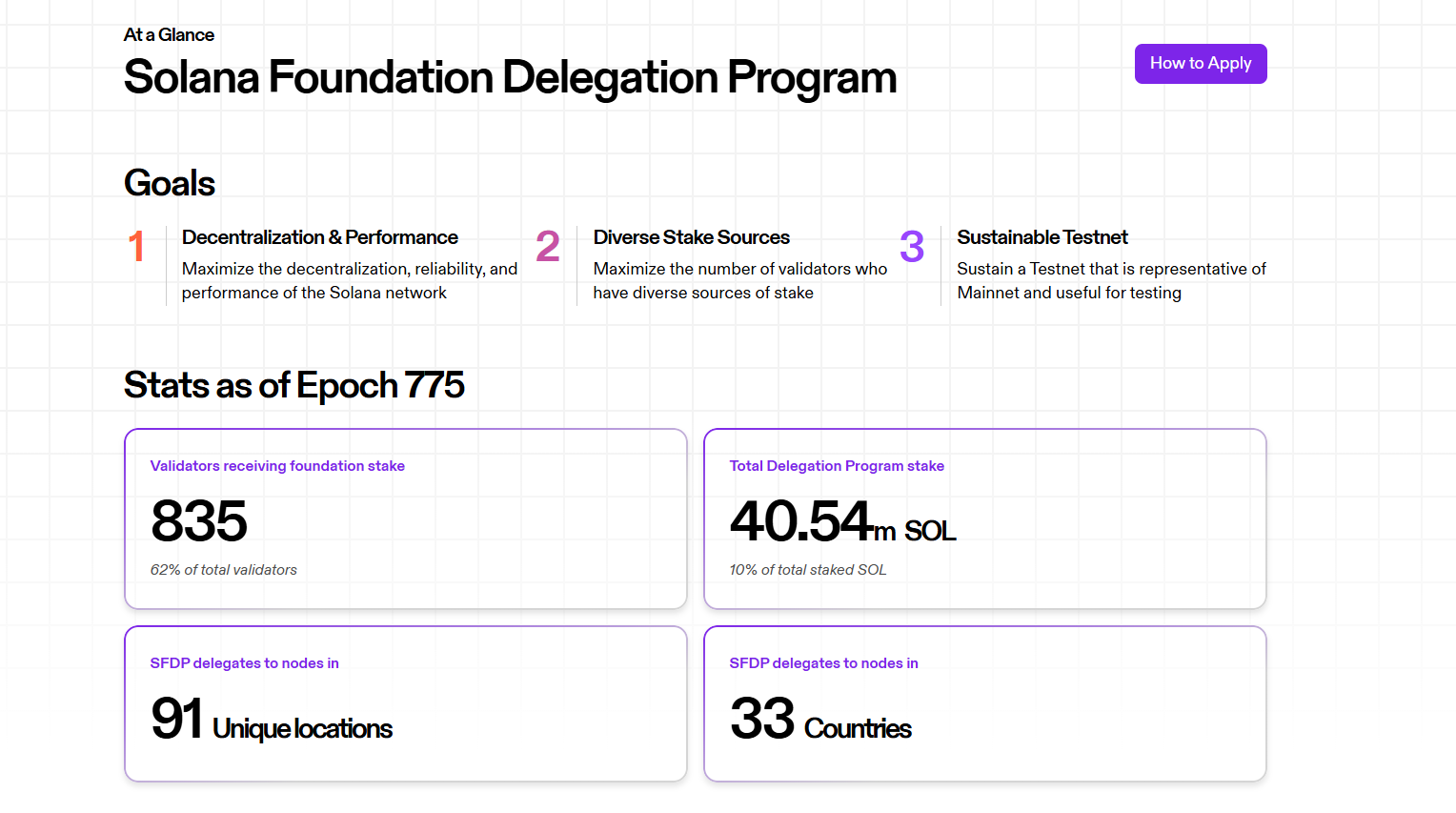
Official data shows that as of April 24, 835 validators are receiving stake through SFDP, accounting for 62% of all validators on the Solana network. The total amount of SOL delegated via the program stands at approximately 40.5 million SOL, representing about 10% of the network's total staked SOL.
According to a report by Helius from late August 2024, roughly 51% of validators hold less than 1,000 SOL in external stake. If this proportion remains stable, around 686 validators currently meet the removal criteria. Under this new policy, unless they attract significantly more stake, these validators could be forced to exit the validator set. The reason this impact is so substantial is that many validators rely heavily on the Solana Foundation’s SFDP to remain operational.
To understand why Foundation support is so critical to validator survival, let’s revisit the SFDP. The Solana Foundation Delegation Program (SFDP) is a core mechanism within the Solana ecosystem designed to support the development of the validator network. Its original purpose was to drive early-stage growth by lowering entry barriers—particularly through providing foundational stake—to enable validators with limited capital to participate in consensus and earn rewards, thereby increasing validator count and overall network security.
SFDP supports validators in several ways:
1. Stake Matching: This is a key incentive to encourage validators to attract external stake. The Foundation matches external stake received by a validator at a 1:1 ratio, up to a maximum of 100,000 SOL. However, this matching is not unlimited. Once a validator accumulates over 1 million SOL in external stake, the Foundation ceases all delegation—including both matching and residual delegations—to that validator.
2. Residual Delegation: After all eligible validators receive their matched stake, any remaining SOL in the SFDP pool is evenly distributed among other qualified validators. According to Helius analysis, this currently amounts to approximately 30,000 SOL per validator. However, the Foundation has indicated that this residual delegation is expected to gradually decrease as it shifts more resources toward community-run stake pools.
3. Voting Cost Assistance: Running a Solana validator incurs ongoing voting transaction fees, which can be significant—around 1.1 SOL per day—for newer or smaller validators. To ease this initial burden, SFDP offers a time-limited voting cost subsidy. For newly onboarded mainnet validators, the Foundation covers 100% of voting costs during the first 45 epochs (about three months), then reduces support by 25% every 45 epochs until fully phased out after 180 epochs (approximately one year).
Is Solana Trapped in a Cycle of Centralization Despite Reform?
According to estimates by Laine in 2024, a validator needs at least 3,500 SOL in stake to cover voting expenses—not including server costs exceeding $45,000 annually. Therefore, removal from the SFDP would likely force many small validators to shut down.
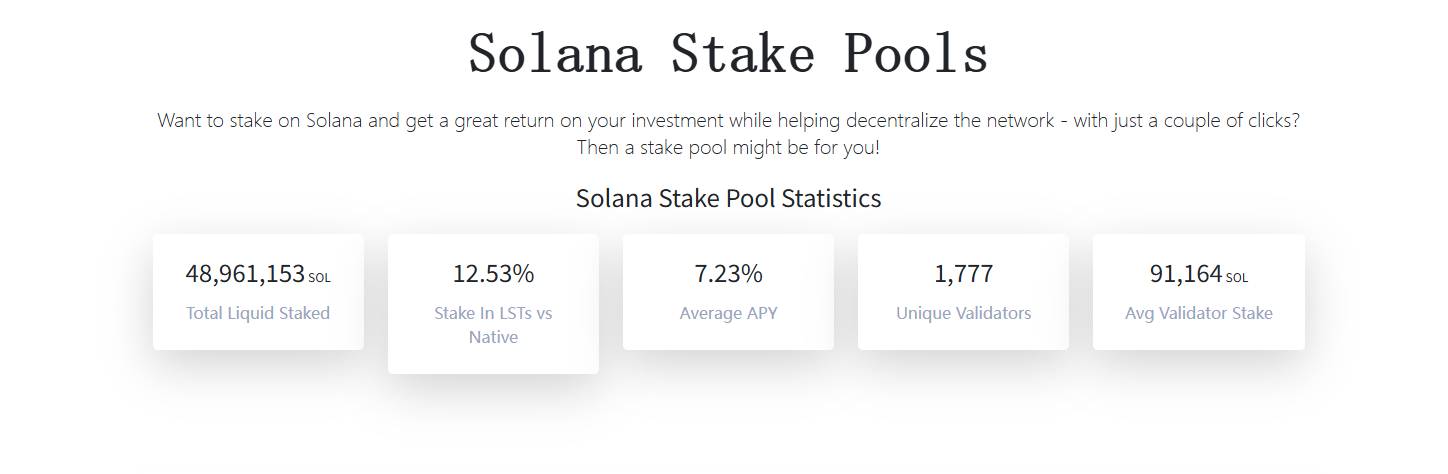
Luckily, the policy includes two mitigating factors: it only applies to validators who have been in SFDP for at least 18 months, and removals only occur when a new validator is added. This provides some buffer period for affected validators.
In intent, the policy aims to reduce validators’ dependence on the Solana Foundation, strengthen validator independence and community backing, and counter perceptions of excessive Foundation influence over the ecosystem. But in practice, if removed validators exit without sufficient high-quality replacements entering promptly—or if new entrants struggle to survive in a competitive environment—the total number of validators could decline, undermining decentralization rather than improving it.
On April 22, Paul Atkins, the SEC’s newly appointed chair known for his crypto-friendly stance, was sworn in. His tenure begins with 72 crypto-related ETF applications awaiting review. While many may not pass, SOL—ranked among the top contenders—is one of the most likely candidates for approval. Key decision deadlines for SOL ETFs are clustered around October 2025. Yet, like Ethereum before it, Solana faces a major hurdle: insufficient decentralization, which risks leading regulators to classify SOL as a security. This regulatory pressure is likely a primary driver behind Solana’s urgent push toward greater decentralization.
Meanwhile, growing institutional interest suggests that large-scale validators may increasingly join the network. On April 23, SOL Strategies, a company listed on the Canadian Securities Exchange, announced securing up to $500 million in convertible note financing, dedicated specifically to purchasing SOL and staking it through its own validator node. On the same day, U.S.-based DeFi Development Corporation announced increasing its total SOL holdings to 317,000 tokens, with plans to hold long-term and participate in staking for yield.
In the end, whether it’s the previously rejected SIMD-0228 proposal, the Foundation’s latest “new policy,” or the rising influx of institutions, the direct consequence appears consistently negative for small and medium validators—with entry barriers seemingly rising higher. And such outcomes inherently conflict with genuine decentralization goals. For Solana, truly lowering the barrier to becoming a validator may be the only authentic path forward toward meaningful decentralization.
Join TechFlow official community to stay tuned
Telegram:https://t.me/TechFlowDaily
X (Twitter):https://x.com/TechFlowPost
X (Twitter) EN:https://x.com/BlockFlow_News
 PANews