








Interview with Backpack CEO: Everything is a Meme, Bitcoin Remains the Ultimate Value Cap
TechFlow Selected TechFlow Selected
Interview with Backpack CEO: Everything is a Meme, Bitcoin Remains the Ultimate Value Cap
Bitcoin is the first and only true meme, in the purest sense.
 Navigating Web3 tides with focused insights
Compiled & Translated: TechFlow
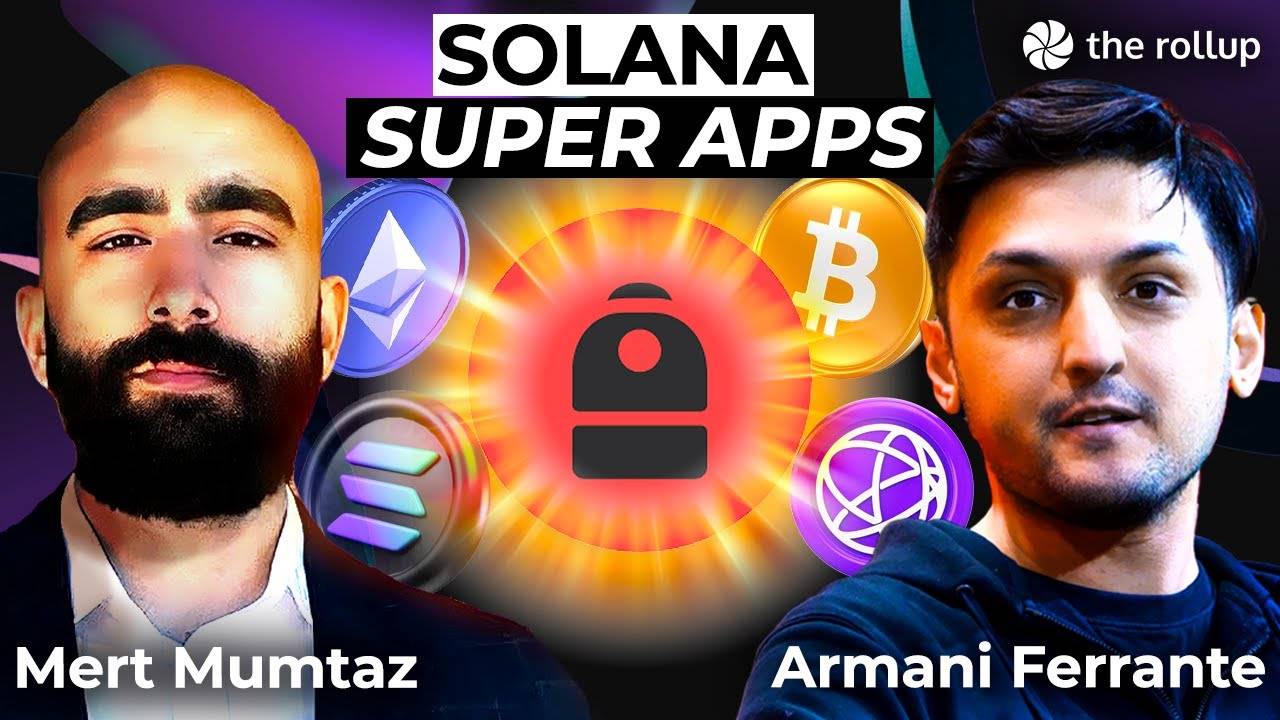
Guests: Mert Mumtaz, CEO of Helius; Armani Ferrante, CEO of Backpack
Hosts: Robbie & Andy
Podcast Source: The Rollup
Original Title: The Truth Behind Crypto's Super Apps With Mert Mumtaz & Armani Ferrante
Release Date: April 21, 2025
Key Takeaways
The race to build crypto’s ultimate super app is heating up. Who will master the user experience?
In this episode, we speak with Mert Mumtaz, CEO of Helius, and Armani Ferrante, CEO of Backpack. Armani shares his journey from Apple to Alameda Research, and how that path led him to build one of Solana’s fastest-growing platforms.
While markets react to tariff tensions, institutional adoption of crypto is quietly accelerating. We dive into the “Fat Wallet” theory, Bitcoin’s evolving role in smart contract ecosystems, and the opportunities at the intersection of finance and crypto.
This podcast also explores how Backpack balances censorship resistance with compliance—a key challenge for crypto’s mainstream adoption.
Highlights Summary
- Bitcoin is the first and only true Meme, in the purest sense.
- As long as everything is a Meme, Bitcoin will always be the value ceiling for all these crypto tokens.
- Everything starts with an exchange, with liquidity.
- I always felt Alameda and FTX had a loose culture—this kind of engineering environment wasn’t something I wanted to be part of.
- Backpack is built more like a traditional engineering-driven company. Our culture deeply values product excellence and building great things for users.
- I think now is an excellent time to reinvest in building.
- One of the most valuable things in the industry today is bringing more value on-chain.
- Finance itself has no direct utility—it’s just an accounting system for transferring representative assets. What truly matters are real-world goods and services.
- As the real world gradually merges with and embraces crypto, cryptocurrencies will truly upgrade financial systems. This can only happen by integrating real-world assets and rules.
- We all believe crypto technology will become a critical pillar of the global financial system—but we still have a long way to go.
- A bridge between DeFi and traditional finance is forming. Bitcoin is that bridge, and its dominance is rising.
- Institutions may give Ethereum a big boost, potentially driving a price rebound.
- The entire crypto market cap is still less than Nvidia’s market cap. We all agree this won’t last.
- Crypto, finance, and tech will deeply penetrate the financial sector, connecting tightly with every major global financial institution.
- You must have one of two properties: either censorship-resistant or compliant. Anything in between has no future—I firmly believe this.
- So many RWA companies have been created—why hasn’t one succeeded? Why aren’t we all using tokenized securities on-chain yet? Because no one has the distribution element. No one has done for RWA what Coinbase did for Circle.
- Backpack is a very special product positioned between two economies: traditional finance (the legacy banking system) and crypto economics.
Introduction to Armani and Backpack
Andy:
Welcome back to The Rollup. Today we’re joined by Mert and Armani to discuss Backpack’s explosive growth, the story behind the Fat Wallet theory, macro updates on Solana, and dynamics in the space. I’d love to hear about your backgrounds—especially your experiences working with some fascinating figures—and how those shaped your decision to create Backpack.
Armani:
My journey is both ordinary and unusual. I entered crypto in 2017, during Ethereum’s bull run when prices were soaring. While working at Apple, I saw colleagues trading. I read the Ethereum whitepaper, then quit—what followed became history. My original goal was to work on Ethereum smart contracts in 2017–2018, but I ended up joining Alameda Research, a small trading firm in Berkeley, California—before FTX existed. I worked there about three months, quickly realized it wasn’t for me, and left. This was pre-FTX, when Sam and others from Jane Street were doing heavy trading, mainly in Korea and early exchanges.
Through Ethereum work, I got involved in L2 development—state channels and other L1s. I became deeply interested in scalability, as many were at the time. Later, I took a winding path through open-source tech. In 2020, when FTX and Alameda started investing in Solana, they reached out again, asking if I’d work on Solana. I started researching it, met many people, got excited—it felt like the coolest crypto project at the time, finally realizing the “world computer” dream that drew us all here.
Mert:
By the way, I created Anchor. Do you know what Anchor is? Is there an equivalent tool on EVM, Armani?
Armani:
Not directly. There are tools similar to Solidity and Foundry—even going back to early Truffle. If you want to understand early Solana development, I was involved in many early projects: wallet tools, DeFi, developer tooling, etc.
Armani’s Departure from FTX
Robbie:
We won’t dwell on FTX, but earlier you mentioned a feeling that made you not want to stay. What was it?
Armani:
Sam is a trader; I’m an engineer. In a trader-led company, traders naturally center everything around trading—maximizing profit is their focus, which isn’t my goal. I left Apple to work on open source—I think from an engineering perspective. Backpack is built more like a traditional engineering-driven company. Our culture deeply values product and building great things for users.
I always felt Alameda and FTX had a loose culture—this kind of engineering environment wasn’t something I wanted to be part of.
Solana’s Technical Vision
Robbie:
Crypto has two sides: finance and technology. Let’s talk tech. You joined Solana because of its “world computer” mission—I thought that was Ethereum’s goal. What changed?
Armani:
This can be viewed from multiple angles. Back in 2018–2019, I was deep into state channels and L2s. At the time, Ethereum was pushing hard on sharding and Serenity design. I quickly realized it wouldn’t work—it was a bad idea.
Sharding isn’t horizontal scaling in the traditional sense. What you really need is linear, horizontal scalability relative to resources. Like traditional databases—DynamoDB or Cassandra—these innovative NoSQL databases scale infinitely just by adding more machines.
This was knowledge from advanced database research, and Solana was actually the first project to achieve this with machine resources. By adding more cores, leveraging Moore’s Law, as machines get stronger and faster, throughput increases. You can use parallel processing, pipelining, etc. As engineers, I believe Mert agrees: clearly, single-threaded VMs don’t work. Ask any engineer in San Francisco—they’ll tell you the same.
This was the goal during the 2017–2018 bull market—many academic projects got funded. Many smart people sought to solve scalability. Then came Sui, Aptos, now SEI and Monad. But really, it’s applying relatively mature, modern systems tech within blockchain context. Honestly, this was obvious at the time—it came down to execution and who had the engineering capability. Solana was the first team to achieve this at scale. Ethereum clearly suffers from path dependency and technical debt, unable to rebuild the entire system from scratch. So there are nuances, but overall, Solana was the first team to pull this off—this excites me.
Current Market Analysis
Andy:
The market has favored composable Web3 ideas—we’ve seen fast, cheap, well-designed blockchains succeed. We remain excited about expanding this ecosystem to thousands of chains (whether rollups, network extensions, or independent L1s).
Mert, what’s happening in the market? Will Solana hit $500?
Mert:
The situation is clear. Prices may look irrational, but the direction is obvious. Trump wants other countries to pay more; they respond: “No, we’re strong too, so you pay more.” So tariffs rise globally, businesses suffer, people pull money from markets.
Recent macro factors are indeed notable. Solana, Ethereum, and Bitcoin prices are all falling. While the market movement isn’t fully predictable, people attribute it to seemingly absurd reasons—like Pump.fun dumping tokens instead of holding them. I often say: whenever the economy dips, thank Pump.fun or Nvidia.
The Meme comparison is fascinating. Someone just tweeted that Trump claimed he’d stop tariffs on other countries but keep them on China. Within four to five minutes, market cap increased by ~$2.5 trillion—more than the entire crypto market cap. But the tweet was fake—five minutes later, it crashed back down. To me, this is basically a Meme in a suit. Twitter movements are unpredictable—random posts can trigger massive reactions.
As for crypto impact, I think it’s completely different from past cycles. Past crypto events were almost entirely due to internal collapses. Initially, lack of use cases, seen as Ponzi schemes; later, exchange bankruptcies or scam exposures. Take FTX—I wasn’t worried, but others were. Because if you look at reality, nothing before truly scaled or worked well like Solana—especially two and a half years ago. Now there are viable alternatives, but back then, none.
But now, I just returned from New York—the sentiment is totally different. That’s why combining your thinking with too much historical data is a mistake. We’ve gone through three cycles—crypto is still early. Not just crypto, but smart contract platforms are also extremely early—maybe three years in. Institutions move slowly, sales cycles are long—they started months ago, now they’re going full speed. The number of inbound inquiries we’re getting from institutions, exchanges, fintech firms is the highest we’ve seen even during bull markets.
So even though screens show red, charts look terrible, the reality is these companies are actually moving on-chain. Even if Trump causes short-term disruption, he’s still done many good things for crypto—lawsuits against exchanges are starting to get dismissed. Overall, I think now is an excellent time to reinvest in building.
Andy:
Yes, this seems like the biggest divergence I’ve ever seen between fundamentals and price action. The lifting of investigations is especially encouraging. ETF news is wild—I’ve never seen so many applications from legitimate companies, like PENGU filing for an ETF. Now we’ll see how this unfolds. Institutional pressure keeps building. I flew from Brazil to New York today, heading there next week. I want to embrace that atmosphere, that mindset, because I feel what happens on Twitter vs. the market is vastly different, and institutions think differently. I feel that after seven years in crypto, we’ve finally neutralized career risk. After the 2017 bear market, I seriously worried whether the industry would recover, whether I’d need another job. I did some online marketing, then returned in 2018–2019. Even in the last bear market, I wondered—can we survive? Now, career risk feels alleviated. Long-term thinkers will win.
Armani:
You raised a key point: convergence. Native crypto builders are creating incredible fintech—that’s core to Bitcoin and many DeFi projects. Despite new market structures everywhere, nowhere has full control.
But finance is strange—it has no direct utility. Before the “institutions are coming” sentiment, DeFi was in a slump—what’s its purpose? Why do these trades, build yield farming, do circular, meaningless operations? Because it’s fintech, and finance itself has no direct utility—it’s just an accounting system for transferring representative assets. What truly matters are real-world goods and services.
We all know how to build markets. I think one of the most valuable things in the industry today is bringing more value on-chain. The stat Mert mentioned is staggering—a single tweet moved more value than the entire crypto market cap. But I’ll add: the entire crypto market cap is still less than Nvidia’s. We all agree this won’t last. We all believe crypto tech will become a critical pillar of global finance—but we still have a long way to go.
To achieve this, it’s not just solving blockchain scalability or building DEXs—it’s bringing assets on-chain. Stablecoins are a great example. I think this is core to our decisions at Backpack—we can’t pretend the world doesn’t exist, with different rules, regulations, assets—US stocks, municipal bonds, retirement accounts, global currencies, real estate. We need to bring this value on-chain to power all the amazing things we’ve built over the past few years.
This convergence is the trend we’re starting to see—and why “institutions are coming” is exciting. As the real world gradually merges with and embraces crypto, cryptocurrencies will truly upgrade financial systems. Only by combining real-world assets and rules can we achieve this. This is exactly what’s happening now—and what excites me.
Dynamics Between Bitcoin and Altcoin Seasons
Robbie:
I think you’re absolutely right. The reason we want value on-chain isn’t just because we built these systems. Yes, we built them and want people to use them, but more importantly, they’re actually better than traditional systems.
I often say blockchain is the best coordination tool we have. It applies to robots, AI-driven economies, and human-driven economies. Coordination usually involves risk management, staking, allocation of scarce resources—all of which can be made more efficient, transparent, and visible via blockchain.
Currently, we see a macro-level safe-haven phenomenon—capital flows to cash, bonds, gold, then digital gold: Bitcoin. On the other hand, tech stocks represent our industry’s other side—this is Ethereum, Solana. So Bitcoin acts as a bridge between these two worlds. We see crypto maturing, integrating with traditional finance—a bridge between DeFi and traditional finance is forming. Bitcoin is that bridge, and its dominance is rising.
Previously, cycles always started with Bitcoin, then expanded to other cryptos and blockchains. Will this cycle be different? As institutions adopt on-chain tech and value-on-chain, will we bypass Bitcoin and see capital flow directly to tech platforms—Ethereum, Solana, Monad, all L1s and L2s?
Andy:
When will the alt season come?
Mert:
This is complex. Do alts like Solana need Bitcoin to lead the rebound, or can they move independently? Personally, I think they can act independently—several angles to consider.
Historically, over the past eight years, Bitcoin was supposed to be digital cash and P2P payments. While features like Lightning Network in the whitepaper didn’t fully materialize, Bitcoin became a solid digital gold alternative. Even the Treasury Secretary mentioned two days ago that Bitcoin found some market fit. Though Bitcoin remains a risk asset—not fully decoupled from markets. Recently everyone asked why Bitcoin and crypto decoupled from markets, but ten minutes later, it crashed.
My view: crypto’s main use case has always been value storage—somewhat decoupled from existing market cash flows, maybe ~20%. But if you look at emerging trends—stablecoins, payment integrations, even on-chain listings—these don’t require Bitcoin. They work directly with underlying tech companies.
In this case, I think this is their best chance yet to decouple somewhat. I don’t think it’ll happen this cycle—I believe consensus will take a long time. For example, I was just in New York—people know what Bitcoin is, but they ask: why invest in Solana instead of Bitcoin or Ethereum? In their minds, Bitcoin is one thing, Ethereum and Solana another.
This seems to already be happening. By market cap, Solana is ~$55B—not huge. So it only takes relatively strong institutional moves on these chains, holding capital, to drive a rebound. So I don’t think Bitcoin needs to lead anymore—because they’re not the same thing. They’re all blockchains, but Bitcoin is fundamentally different.
Of course, new L2s are emerging on Bitcoin—true. But I’m not sure how much these L2s benefit more than Bitcoin itself. With Ethereum, it’s the opposite—L2s may benefit slightly more than Ethereum itself.
Institutional Adoption of Crypto
Andy:
This is a fascinating paradox. Indeed, when institutions consider Solana, crypto natives may see its advantages clearly—one reason Ethereum underperformed over the past 18 months.
If investing in Bitcoin, it’s clearly the lowest-risk, best risk-reward choice—especially for allocation purposes. But if allocating to a smart contract platform, buying Ethereum in past bull runs may not have been optimal—its market cap is high, while Solana is faster, better, cheaper, with more use cases in current crypto iterations. For “Memes,” DeFi, and fast trading, Solana wins.
Ethereum has faced a dilemma over the past 18 months, trying to find its place. However, institutions may give Ethereum a big boost, potentially driving a price rebound.
Last night we spoke with Arthur Hayes about Ethereum and all L1s and smart contract platforms. Ethereum sentiment is currently very low—he predicts after Bitcoin finishes its run-up, Ethereum will lead the next rebound. Institutions may recognize Ethereum’s potential and drive adoption.
Long-term, institutions might find it difficult for Ethereum to reach a $1.5T market cap, while Solana, Celestia, Hyperliquid, etc., reaching higher caps seem more feasible. This reflects differing market views on the potential and value of various blockchain projects.
Robbie:
Technically speaking, helping institutions realize they’re still in the early stages of technology, but that the tech is resilient. If they adopt an L1, they actually gain access to the entire ecosystem. Mert, I think you highlighted the dynamic between networks and their rollups—for example, Bitcoin’s rollups currently capture more value than they return to Bitcoin. Same with Ethereum’s rollups. Ultimately, these natural symbiotic relationships exist in reality. I’m not a fisherman, but the only fish I caught was that small fish swimming with sharks, eating parasites off the shark—shark benefits, fish gets food. A very symbiotic relationship—I think this can happen on-chain.
About L1s and L2s, but we seem to overlook this dynamic. Andy, your question—why is this still a valuable investment for institutions? I think because they get the whole package. If someone buys Ethereum, they think they get Ethereum and all its rollups, possibly overlooking that rollups have their own governance tokens.
From what I gather on institutional sentiment, when someone thinks of Ethereum, they think of all Ethereum and its rollups. Completely different from Bitcoin. I’m curious about your views on Solana and its network extensions. I think it’s more similar to how people view Ethereum and its ecosystem, rather than like Bitcoin—because when someone thinks of Solana, they think of Solana and all its network extensions.
I have two questions: what’s the sentiment around Solana and its network extensions? How do these extensions and Solana’s L1 ensure their symbiotic relationship?
Armani:
I want to go back to the core of this question—related to whether Bitcoin leads the rebound or if others can self-substitute. I think it’s simple. Anyone can lead any rebound—it just depends on who achieves product-market fit in a specific area.
The reality is, every project today is a Meme. Bitcoin is the first and only true Meme, in the purest sense. So it’s the store of value. As long as everything is a Meme, Bitcoin will always be the value ceiling for all these crypto tokens.
When analyzing relative value between Ethereum and Solana, Ethereum is already high, while Solana, Celestia, and others are relatively low. Clearly, investing in lower-cap projects is more attractive—they have more room to grow relative to Bitcoin. The question is, how to bypass Bitcoin and tell the story of massive growth potential for Ethereum or other chains? The answer is simple: product-market fit and real use cases. I think this must be the narrative for any smart contract platform. Really, you just need one company, one use case, one protocol to escape velocity. That’s why I’m optimistic about any founder daring to build an L1—you just need one app, one “Instagram moment” or “Uniswap moment,” to create the necessary growth. We can say we’re still early, but realistically, if you want breakout growth, I think it hinges on having global-scale use cases, widely adopted—by institutions, DeFi, stablecoins, anything. But ultimately, it’s all about product-market fit—no surprise there.
Recommending Solana to Institutions
Andy:
I feel the concept of network extension might not be highly relevant to our current discussion. I think the main reason to recommend Solana to institutions is its advantage in global data synchronization and high-speed transmission. Mert, have you recently had deep conversations with institutions about Solana and Helius? What aspects of your message particularly interest them—or confuse them? What’s their reaction?
Mert:
Of course, several angles. First, it depends on the institution’s capabilities, but fundamentally, they want to efficiently move funds from point A to B, or enable certain functions. If it’s a fintech platform like Robinhood, they may want to attract new user segments or expand into markets like prediction markets. So they typically express interest in working with stablecoins or real-world assets (RWA), or they’re more innovative fintech firms—like Klarna or Robinhood, or a fintech in the US or Brazil.
In asset issuance, they typically adopt a multi-chain strategy. From what I’ve seen—take BlackRock, for example—they clearly don’t rely solely on Ethereum, choosing a multi-chain approach. The issuer Securitize just announced expansion to Solana—not the first time. Companies like Visa, PayPal, Mastercard, Stripe, Google—they basically refuse to risk betting everything on one chain—it’s too risky for them. So they usually focus on the top two or three chains, typically Solana and Ethereum. You can see institutional investors like Evan Echo, Franklin Templeton—their portfolios usually include Bitcoin, then Solana and Ethereum, maybe some niche projects.
For these institutions, product functionality is key. They need compliance controls, predictable and stable fees, and security. These are usually their main concerns. Also, there are more “Web 2.5” companies—mainly concerned with who can attract them. In my view, with a strong B2B sales team, you can successfully partner with them. You see Ripple, Stellar—many such deals. Look at their team structure—often 60 business developers and 1 engineer.
It’s a mix, but ultimately tech is key. If the product isn’t good, users simply won’t use it. So for these institutions, I think there’s asymmetric upside—which is why Base is important for Ethereum, because they have a strong B2B team. They know how to sell—that’s why Solana has teams like Helius, doing much policy governance work, recently hiring a Chief Commercial Officer from Jane Street.
When I say business development, I mean actual talent. But Armani’s point is indeed interesting. In a world where everything is a Meme, Bitcoin is clearly the ceiling. While not purely a Meme, making it work requires significant social elements.
If we accept that these chains are more like tech stocks—L1s or others—people will start focusing on traditional metrics, like how much revenue a chain generates. As a shareholder—if I’m a token holder—can I earn returns? For example, if I stake on Ethereum or Solana, what happens? Can I really make money? These questions become crucial.
The discussion around Solana’s proposal SIMD-228 is also a good example. The proposal essentially says we’ll drastically reduce on-chain issuance. But opposition from the Solana Foundation and some institutions is that they actually like high staking yields—even if from issuance, like 8%–9% returns.
This is why I like Rev. Some dislike it, but it’s at least a relatively solid metric—especially compared to easily faked ones. Rev is harder to fake, especially when sustained. It’s not just a proxy for demand, but also for economic value flowing to users in the network. So you can start looking at fundamentals. This may take time—perhaps related to network extension.
In my view, when people launch L2s on Solana, though not much difference, implementation varies due to architecture. Maybe for storage, or so-called ephemeral rollups—you launch it just for a specific task, execute, then roll back.
The biggest difference is Solana’s L1 isn’t shared. It’s essentially increasing BMS, reducing latency. We don’t care what you do on this blockspace—we care about maximizing operations on this platform, because there are clear economic and technical incentives for users in the network. So this design makes perfect sense.
In some use cases, imperfect tech is fine—develop an algorithm leveraging assets on L1. The main advantage of L2 is expanding on the value ecosystem already on L1—this is Bitcoin L2’s appeal, because Bitcoin itself is highly useful. Same with Ethereum—huge assets on L1, not just extending L1. Ethereum actually adjusts L1 to support L2 development, forming a rollup-centric model. But note—even rollup-centric, rollups still need to work with L1, can’t ignore L1—this may be one root of many issues. If L1 is well-maintained, other problems solve themselves long-term. Even with Ethereum, after enough time, viable alternatives emerge—those unwilling to use Celestia can opt for sovereign rollups or similar. Then incentives and economic foundations may blur. About network extension, I think Solana’s biggest difference from other ecosystems is Solana core focuses on its own development, while others may adjust solutions so rollups benefit. So Solana stands firmer on its position.
Backpack Theory
Andy:
I think we largely agree on “unbiased design.” When I think about BTC dynamics, I see the technical design also directly focused on a single trade-off, maximizing it. Markets have consistently seen this as enhancing user experience and overall SOL token appeal, while using and building on Solana. Though I’m a bit tired of .fun—feels overdone—we can discuss that later.
Interestingly, this combines with what Armani’s doing at Backpack and what Mert mentioned—Solana’s ecosystem seems to be growing in a super-app-like way. When thinking about best-in-class products in crypto, many think of wallets, exchanges, stablecoins, or some combination—on their own chain or fast, cheap chains like Solana. Jupiter is clearly Solana’s main trading venue, but recently Pump actually migrated from Radium to Pump Swap. Jupiter added diverse product suites, Camino just added an aggregator on their platform.
So we’re entering a world of Solana ecosystem—feels like many competitors want to be the super app. I’m curious—what’s Backpack’s theory? Why build this platform to own end-user distribution? At the wallet layer, you can route users to exchanges where they trade, generate fees, which fund buybacks and other financial incentives. How do you see this flywheel accelerating?
Armani:
Backpack theory is somewhat counterintuitive—especially for deep crypto natives. Earlier I said: the entire crypto market cap is still less than Nvidia’s. I think the industry’s future has two possibilities.
One possibility: we remain stuck where we are—an unregulated offshore speculative gambling scene. Main use case is trading worthless assets on-chain—could be a decent business. Gambling as consumption brings joy or sorrow depending on one’s view. But gambling is real—this could be where we’re capped.
I don’t think any of us believes this. If so, all four of us might shift to AI or elsewhere. Personally, crypto, finance, and tech will deeply penetrate finance, tightly linking with every major global financial institution. No matter your country, religion, politics—ultimately we can use these trust-minimized computers for global transactions and value exchange.
Next question: in a world where trillions in traditional finance are tokenized and traded on-chain, what companies and protocols do you build? I think there will ultimately be two types of attributes.
Either fully decentralized, fully censorship-resistant—representing the best of this space, like Uniswap, Ethereum, Solana. Geographically distributed, attracting massive participation. Everyone uses them, no one owns them—so compliance is undefined, like division by zero—meaningless. For example, how can the US impose compliance on servers running in China, when Chinese rules oppose US rules—or in UAE, Africa, South America?
This is censorship resistance. I compare it to the Pacific Ocean: a powerful medium of exchange. The US can send ships and containers to Japan, Taiwan can ship to the US, China can trade with Japan—no one thinks a country would suddenly destroy a ship because it controls certain waters. The Pacific works because no one controls it. This uncontrolled state enables astonishing human coordination.
So I see blockchains as new natural mediums in our financial transaction environment. Censorship resistance is a clear, critical property. For this industry to be truly meaningful in daily life, compliance is also critical.
If you’re centralized, control something, can shut down a system, control people’s funds, reorder transactions, disable matching engines—you must have a physical entity in a country with government, laws, military. You must follow that country’s rules and regulations.
This may sound simplistic—especially to outsiders. Laws and rules exist, but I think most don’t truly grasp this—especially deep crypto natives, because we grew up in an industry without clear rules. So professionally, we’re trained counterproductively to think rules don’t matter, everything is fake.
But in reality, there are consequences. Serve North Korea, you go to jail—real outcomes. So I believe compliance is another critical factor. If you want trillions in value running on-chain, rooted in real life—like Apple in California—it must follow local rules. Therefore, you must have one of two properties: either censorship-resistant or compliant. Anything in between has no future. I firmly believe this.
Thus, Backpack’s theory is: very few native crypto builders choose the compliance path. Many excellent builders—like Uniswap, Jupiter—are creating great censorship-resistant tech. Few truly care about building a crypto-native version of finance. That’s our positioning—we aim to contribute great products to the broader crypto ecosystem. I think this is the moral foundation for building our company this way.
Backpack’s Super App Strategy
Andy:
In practical terms, what’s your strategy for executing the compliance vision or effectively opening tech to new audiences?
Armani:
Several key points. For us, the most important thing is liquidity, because once you have liquidity, everything else follows. Exchanges are liquidity hubs—you connect not just to one chain, but every chain. And not just every chain, but fiat on/off ramps in every country. Actually, this is a very special product positioned between two economies: traditional finance (legacy banking) and crypto economics. So if you want to achieve our goals, the primary objective is climbing this mountain of liquidity. Because once you can build and leverage this pool of liquidity—whether trading contracts, holding spot assets, or doing fiat on/off ramps—you can use this position to build outstanding products.
You might ask—how to build a stablecoin? Undoubtedly, all major stablecoins have a centralized exchange: USDC on Coinbase, USDT on Bitfinex—no surprise. Stablecoins are the first example of real-world assets—even if Circle doesn’t call itself a centralized exchange, practically, it is. You deposit tokens on a chain—Solana or Ethereum—then withdraw to fiat or other assets. You’re converting one currency to another. Wrapping assets—that’s an exchange. This liquidity gave them USDC distribution, creating one of the industry’s most important products today.
I think we’ll see more real-world assets (RWA) play out over time. You might ask: so many RWA companies created—why hasn’t one succeeded? Why aren’t we all using tokenized securities on-chain now? Because no one has the distribution element. No one has done for RWA what Coinbase did for Circle.
Therefore, the primary goal is pushing this liquidity pool, building a very deep exchange. Because from there, everything follows. Then you can discuss wallet tech, real-world assets, remittances, payments, and many other compelling use cases. But everything starts with an exchange, with liquidity.
Join TechFlow official community to stay tuned
Telegram:https://t.me/TechFlowDaily
X (Twitter):https://x.com/TechFlowPost
X (Twitter) EN:https://x.com/BlockFlow_News
 深潮TechFlow






