Three-Minute Guide to Understanding Converge, Soon to Launch on Testnet
TechFlow Selected TechFlow Selected
Three-Minute Guide to Understanding Converge, Soon to Launch on Testnet
Converge will launch its mainnet before the end of the second quarter this year.
 Navigating Web3 tides with focused insights
By 1912212.eth, Foresight News
On April 17, the crypto project Converge jointly released preliminary technical specifications and a development roadmap with Ethena Labs and Securitize. Positioned as an innovative platform bridging traditional finance (TradFi) and DeFi, Converge focuses on high performance, institutional-grade security, and user-friendliness, aiming to launch its mainnet this year and drive large-scale financial applications. This article provides a detailed analysis of Converge's technical specs, roadmap highlights, and potential impact.
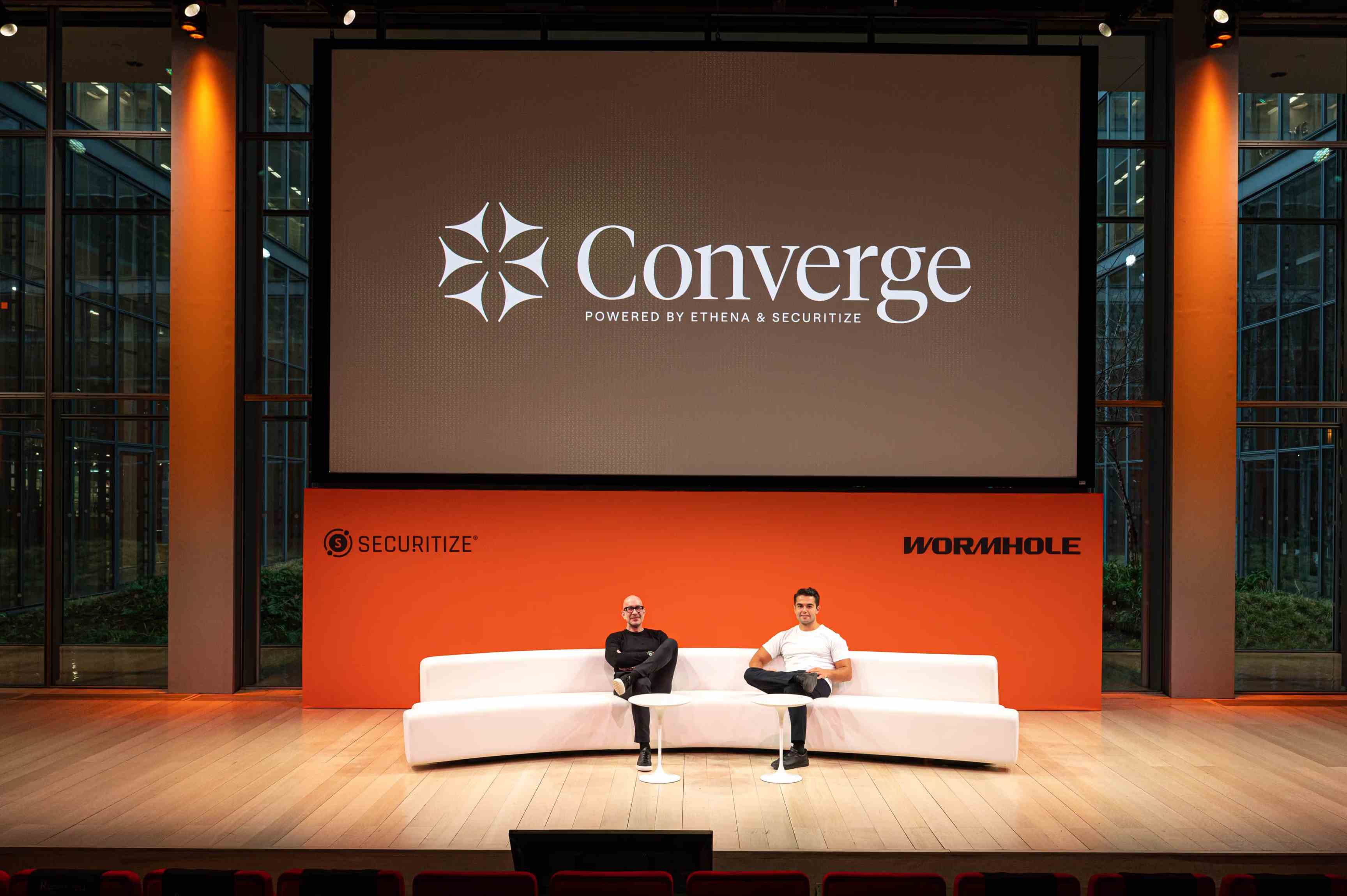
(Left: Securitize CEO, Right: Ethena Labs CEO)
1. Jointly Built by Ethena Labs and Financial Technology Firm Securitize
Converge is co-developed by Ethena Labs and financial technology company Securitize, positioned as a high-throughput blockchain network focused on supporting tokenized real-world assets and DeFi applications. The project aims to attract institutional capital into the crypto ecosystem through technological innovation and compliance-by-design, while delivering efficient DeFi experiences for retail users. Its core vision is to break down barriers between traditional finance and crypto finance, promoting capital mobility and global integration of interest rate markets.
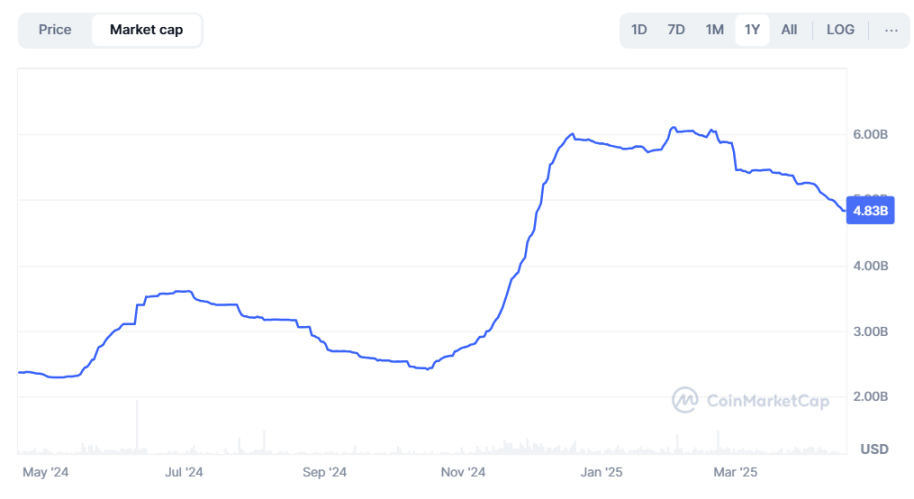
Ethena Labs brings extensive DeFi experience from the rapid growth of USDe—once surpassing $6 billion in market cap, making it the third-largest stablecoin—while Securitize possesses deep expertise in asset tokenization, compliance, and infrastructure. Their collaboration gives Converge a unique edge: meeting institutions’ stringent demands for security and compliance, while preserving the openness and innovation of DeFi.
2. High-Performance EVM Chain with USDe and USDtb as Gas Fees
Converge will support both permissionless DeFi applications and permissioned institutional products, enabling the convergence of traditional finance and crypto infrastructure on a single chain. Designed around three pillars—performance, security, and user experience—here’s a breakdown of its core technical specifications:
High-Performance EVM
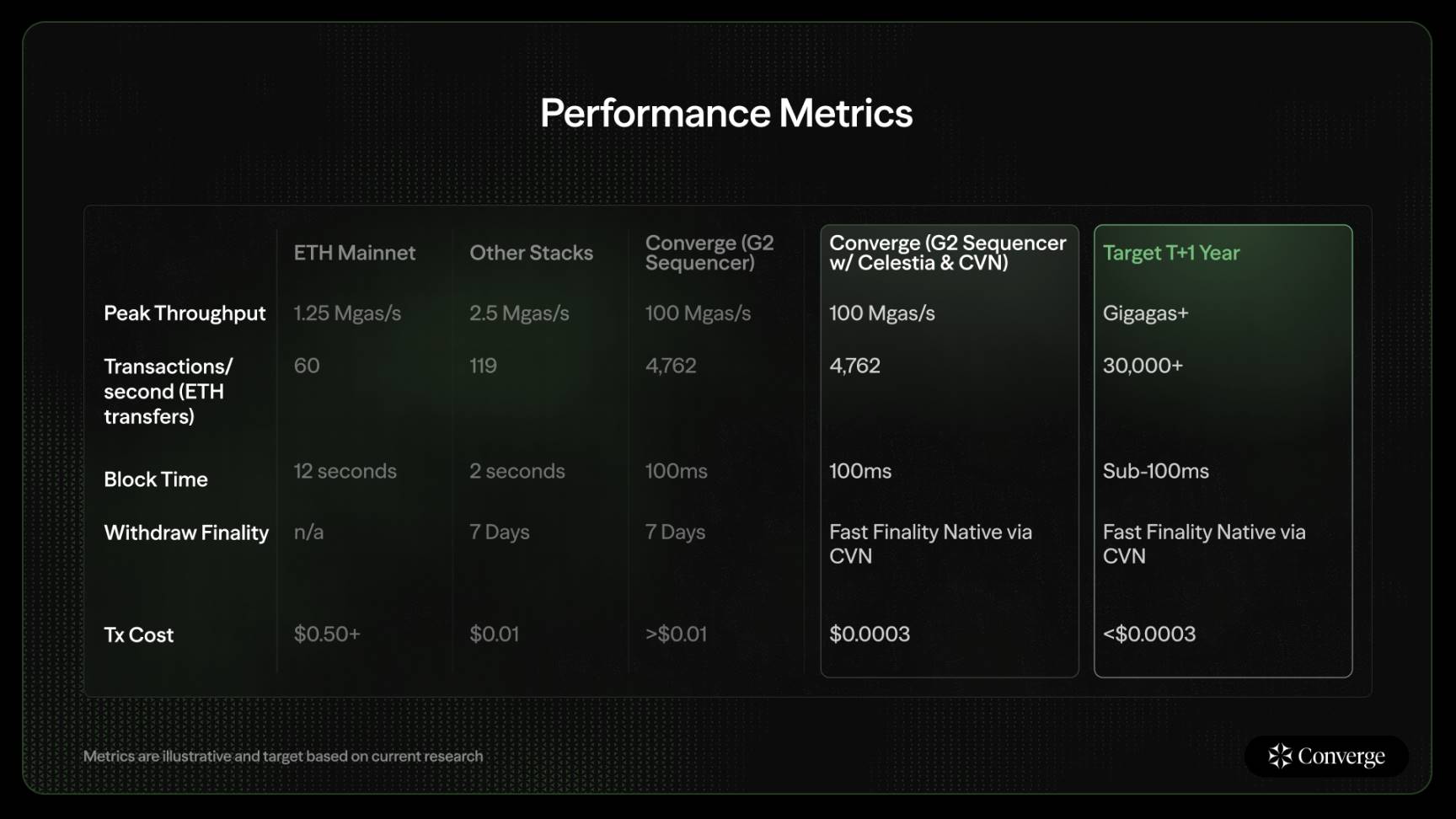
Converge adopts an Ethereum Virtual Machine (EVM)-based architecture to ensure compatibility with the existing DeFi ecosystem, enhanced through custom optimizations for ultra-high performance. At launch, it will achieve a native block time of 100 milliseconds and a maximum throughput of 100 million gas per second (Mgas/s). The roadmap indicates that by Q4 2025, block times will be reduced to 50 milliseconds, with throughput scaling up to 1 billion gas per second (Gigagas/s). These metrics significantly outperform most existing Layer 1 and Layer 2 networks, enabling support for large-scale financial transactions and complex smart contract execution.
Integration with Arbitrum and Celestia
Converge leverages Arbitrum’s rollup technology and Celestia’s data availability layer to achieve low latency and high scalability. Arbitrum enables efficient transaction processing and smart contract execution, while Celestia reduces network costs by decoupling data storage, ensuring stable and predictable transaction fees. This modular design allows Converge to balance performance and cost efficiency—ideal for institutional-grade applications.
Stablecoins as Gas Fees
To enhance user experience, Converge uses stablecoins such as USDe and USDtb as gas fee tokens instead of volatile native cryptocurrencies. This allows users to estimate and pay transaction fees in dollar-denominated units, eliminating uncertainty caused by crypto price fluctuations. Additionally, the network supports the ERC-7702 account abstraction standard, simplifying wallet operations and removing pain points like ERC-20 pre-approvals and complex gas management.
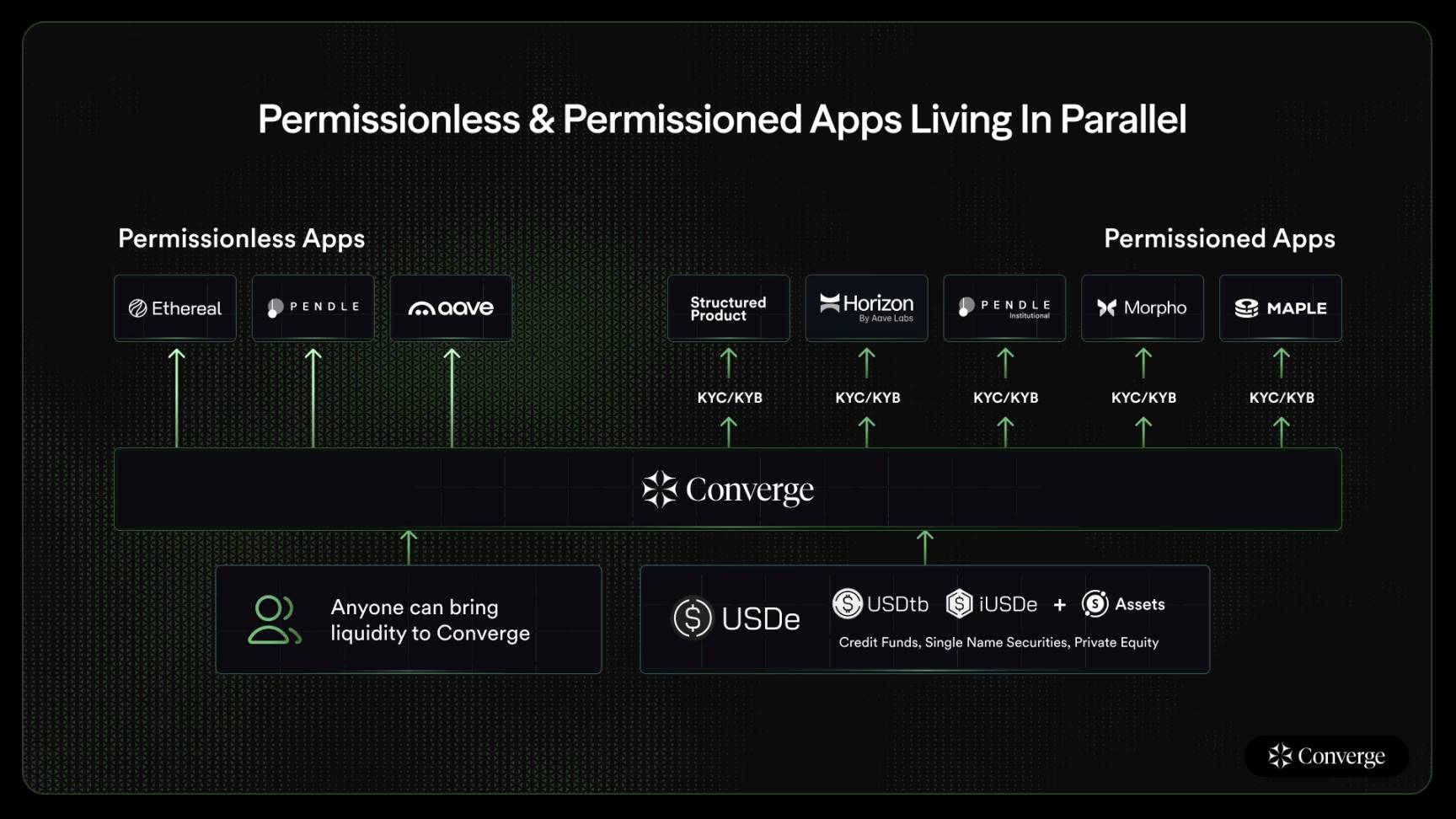
Converge Validator Network (CVN)
Converge introduces a unique validator network (CVN), secured by staking Ethena’s ENA token. CVN employs a permissioned proof-of-stake (PoS) model combined with KYC/KYB (Know Your Customer/Business) requirements to ensure validators meet regulatory standards. This design specifically targets institutional users, addressing their risk management and compliance needs. The network features a two-layer architecture: a tightly controlled core network and an application layer offering optional permissionless interfaces for developer flexibility. Validators must stake Ethena’s governance token ENA to participate. The team stated that CVN will go live shortly after mainnet launch.
Custom G2 Sequencer
Converge utilizes a G2 sequencer customized by Conduit, integrated with the Arbitrum tech stack, to enable fast transaction ordering and confirmation. This component is key to achieving 100ms block times and ultra-high throughput, ensuring stability under high-load conditions.
3. Testnet Launch in Coming Weeks, Mainnet Targeted for End of Q2
Converge has also unveiled its 2025 roadmap, outlining key milestones from testnet deployment to mainnet launch:
Q2 2025: Testnet Launch
The testnet is expected to go live in the coming weeks, offering developers early access to test network performance, deploy smart contracts, and evaluate user interactions. Key focus areas include validating 100ms block times and stablecoin-based gas fees in real-world scenarios.
Q2 2025: Mainnet Launch
In an interview, Securitize CEO Carlos Domingo confirmed that Converge plans to launch its mainnet by the end of Q2. The mainnet will support both institutional and retail users, initially focusing on institutional distribution of USDe—such as via special purpose vehicles (SPVs)—and fostering DeFi application development.
Q4 2025: Performance Upgrade
By the end of 2025, Converge aims to reduce block times to 50ms and scale throughput to 1 Gigagas/s to better support tokenized assets and real-time financial transactions. The network will also introduce additional developer tools, including enhanced account abstraction features and smart contract templates, to lower development barriers.
4. Summary
Converge arrives at a pivotal moment in the convergence of TradFi and DeFi. Its high-performance architecture and compliance-oriented design give it a competitive advantage in attracting institutional adoption. For instance, Franklin Templeton CEO Jenny Johnson noted in January 2025 that clear regulatory frameworks would accelerate TradFi-DeFi integration—a trend directly addressed by Converge’s KYC/KYB enforcement and permissioned validator model.
However, challenges remain. The permissioned validator model may raise community concerns about centralization risks. Although the application layer supports permissionless access, control over the core network remains concentrated among a limited set of validators. Moreover, achieving its ambitious performance goals depends heavily on the stability of Arbitrum and Celestia; any technical bottlenecks could delay progress.
Converge represents a compelling opportunity combining technological innovation with real-world applicability. Yet, its ultimate success will depend on factors such as regulatory clarity, technical resilience, and competition within the broader ecosystem. Over the next year, Converge’s trajectory will undoubtedly warrant close attention.
Join TechFlow official community to stay tuned
Telegram:https://t.me/TechFlowDaily
X (Twitter):https://x.com/TechFlowPost
X (Twitter) EN:https://x.com/BlockFlow_News
 Foresight News