








BNB, BGB, and OKB: A Comprehensive Comparison — Whose Turn Will It Be in the Next Round?
TechFlow Selected TechFlow Selected
BNB, BGB, and OKB: A Comprehensive Comparison — Whose Turn Will It Be in the Next Round?
The next round of value revaluation for platform tokens will no longer depend on narratives, but on actual delivery. Platform tokens with genuine long-term value must simultaneously excel across four dimensions: clear mechanisms, clean supply, real-world use cases, and continuous platform expansion. Recent token burn initiatives completed by BNB and BGB have once again brought the value proposition of platform tokens into focus.
 Navigating Web3 tides with focused insights
Author: OneShotBug

Since the last cycle, platform tokens are no longer just "fee discount vouchers." From token burn mechanisms and revenue sharing to on-chain staking and governance attributes, major centralized exchanges (CEXs) are continuously redefining the value foundation of their native tokens.
As the industry enters a new adjustment phase, user expectations around platform tokens have also shifted significantly—from “how much it will rise” to “what drives its growth.” Simple marketing-driven narratives are no longer sustainable. Instead, attention has turned toward deeper fundamentals: whether deflationary mechanisms are genuinely effective, if use cases remain active, and whether the platform itself is growing healthily.
Recently, both Binance and Bitget announced completion of their latest token burns. BNB completed its 31st burn, removing approximately 1.579 million tokens—about 1.1% of total supply—while BGB conducted its first quarterly burn, eliminating 30 million tokens, or roughly 2.5% of total supply. The platform token sector is transitioning from having mechanisms in place to actually delivering on them, with increasingly divergent deflationary strategies emerging between established and newer platforms.
This article analyzes and compares the structural design and real-world performance of current mainstream platform tokens across five core dimensions:
● Actual strength of deflationary mechanisms
● Supply structure and release risks
● Real-world use cases and ecosystem integration
● Growth capacity of the underlying exchange
● Market performance and value anchoring logic
Through cross-sectional data, structural charts, and qualitative insights, we aim to clarify the differences and relative advantages among leading platform tokens in terms of mechanism design and execution efficacy.
1. Deflationary Strength Comparison: Who’s Truly Burning? Who’s Still Just Talking?
A platform token’s deflationary design is the primary factor users consider for long-term value. However, having a burn mechanism does not equate to actual deflation. Two key questions matter most:
● Is the burn frequency consistent?
● Is the burn ratio substantial enough to create meaningful pressure?
There are clear differences today in how major platform tokens implement and execute their deflationary models. Below is an overview of verifiable mechanisms and execution rhythms:

BGB achieved a 2.5% burn in Q1 2025—the highest single-quarter rate among major platforms, surpassing BNB’s historical records.
Following this latest burn, BNB has cumulatively removed 1,579,207 tokens (~$916 million), representing about 1.13% of total supply. This continues Binance’s mature deflationary model and reflects its ongoing commitment to managing BNB’s long-term value.
However, when analyzing “burn amount vs. current market cap,” BGB demonstrates even greater relative market impact:

Although BNB’s latest burn was worth ~$900 million—approximately 6.9 times that of BGB—BNB’s market cap is 16.5 times larger than BGB’s.
This means that in terms of “relative deflationary pressure” (burn size relative to market cap), BGB exerts significantly more force than BNB.
This structural asymmetry sends a critical signal: BGB remains undervalued, with its market capitalization yet to fully reflect Bitget’s platform growth, burn execution strength, and ecosystem integration achievements.
In other words, deflationary actions of similar scale have a far more direct price impact and higher revaluation elasticity on earlier-stage assets like BGB. This makes the recent BGB burn not only a milestone in mechanism delivery but potentially the starting point of a structural upward shift in valuation.
Comparative Analysis:
● BNB operates a well-established deflationary system using a dual-track approach: BEP-95 automatic burns combined with quarterly manual burns. Its rhythm is predictable and stable. With a $916 million burn this quarter, BNB maintains one of the strongest deflationary executions among major platform tokens. However, its per-cycle burn rate hovers around 1%, and due to its large market cap, marginal price pressure is diluted. It functions more as “steady compression” rather than a catalyst for price surges.
● BGB exhibits a “low market cap, high deflationary pressure” structure. Its inaugural quarterly burn reached 2.5%, and while the dollar amount is much smaller than BNB’s, it represents nearly three times the proportion of its market cap, resulting in stronger supply reduction effects. Combined with its on-chain usage linkage and its currently undervalued status, BGB shows typical characteristics of a high-growth platform token—where each burn has a pronounced marginal impact on price.
● OKB remains in a state of “promised burns without transparent execution.” While its whitepaper outlines a deflationary mechanism, actual burn schedules lack transparency, amounts are undisclosed, and the path cannot be independently verified. Users struggle to form stable expectations, leading to muted price support and weak market response.
2. Supply Structure & Release Pressure: Whose Supply Is More Transparent?
Evaluating a platform token’s deflation potential requires looking beyond burn rates to examine supply clarity:
● Is the total supply capped?
● Are there still large unvested allocations held by the team or foundation?
● What percentage is already in circulation? Any risk of future sell-offs?
Below is a comparison of supply structures among major platform tokens (based on official whitepapers, on-chain data, and public disclosures):

Comparative Analysis:
● BNB targets a fixed supply of 200 million and continuously reduces circulating supply via automated burns. However, minor legacy allocations remain locked and subject to future release. While relatively stable, full supply closure will take time.
● BGB stands out as one of the few platform tokens that has already achieved “full release.” At the end of 2024, Bitget officially burned 800 million tokens originally allocated to the team, reducing total supply from 2 billion to 1.2 billion and declaring a 100% fully-circulating status—eliminating any future unlock shocks or distribution risks.
● OKB’s supply structure carries some uncertainty, including possible team holdings and undisclosed vesting plans. Such “future supply elasticity” undermines confidence in the sustainability of its deflation, making long-term value assessment difficult.
In platform token valuation, a capped supply combined with full circulation forms the foundation for “scarcity expectation.” By permanently locking down total supply and eliminating future unlocks, BGB shifts market focus squarely onto “value driven by real usage”—a crucial strategic move.
3. Real-World Use Cases: It’s Not About Quantity, But Frequency of Use
Theoretically, more use cases strengthen a platform token’s value proposition. But in practice, “available” ≠ “actively used,” and “listed” ≠ “user-adopted.”
What truly matters is which tokens frequently appear at product access points and sustainably drive a positive feedback loop of “staking → deflation → value accrual.”
Below is a comparison of current usage coverage across CeFi (within the exchange) and DeFi (on-chain) environments:
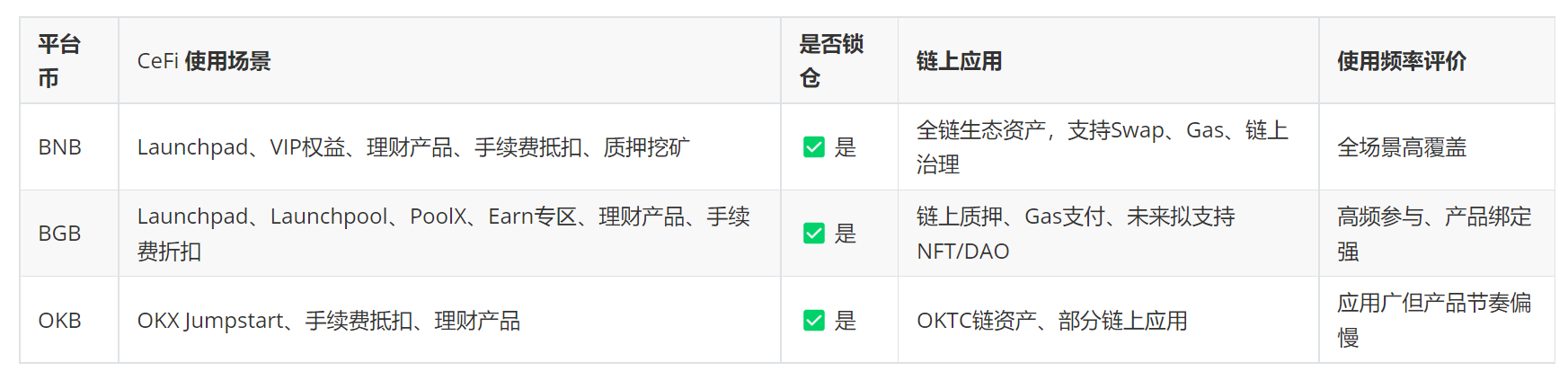
Comparative Analysis:
● BNB leads in breadth of adoption and ecosystem maturity. As the native gas asset of BSC (now BNB Chain), it is deeply embedded in numerous DeFi applications. However, due to its massive user base, average individual returns have diminished, slightly weakening user incentives to actively hold and use BNB.
● BGB has rapidly expanded its utility footprint. Beyond being essential in core Bitget products such as Launchpool, Launchpad, and PoolX, it is integrated into savings zones, Earn strategy bundles, and fee discounts. Most importantly, these features require BGB staking or locking, creating a robust “hold → stake → earn” cycle in daily operations.
● OKB supports participation in project launches and fee rebates, but lacks strong on-chain functionality and lags in launching new products, resulting in low usage frequency and weak user stickiness.
Take Bitget’s Launch series: BGB acts as the de facto ticket currency for nearly all new projects, regularly attracting hundreds of thousands of participants. Moreover, within the Bitget Wallet ecosystem, BGB enables gas fee payment, on-chain staking, and plans to extend into NFT minting and DAO voting—key Web3 use cases. These developments indicate that BGB isn’t just frequently used within CeFi; it’s actively building an on-chain application loop, enhancing its potential as an ecosystem “central asset.”
In contrast, BNB has entered a stable phase—broadly functional but with declining marginal benefits per user. Meanwhile, BGB remains in the early stages of “feature unlocking + user expansion.” As functionalities like DAO governance and NFT rights roll out, its usage loop could expand significantly.
4. Platform Strength: A Stronger Exchange Creates a Stronger Token
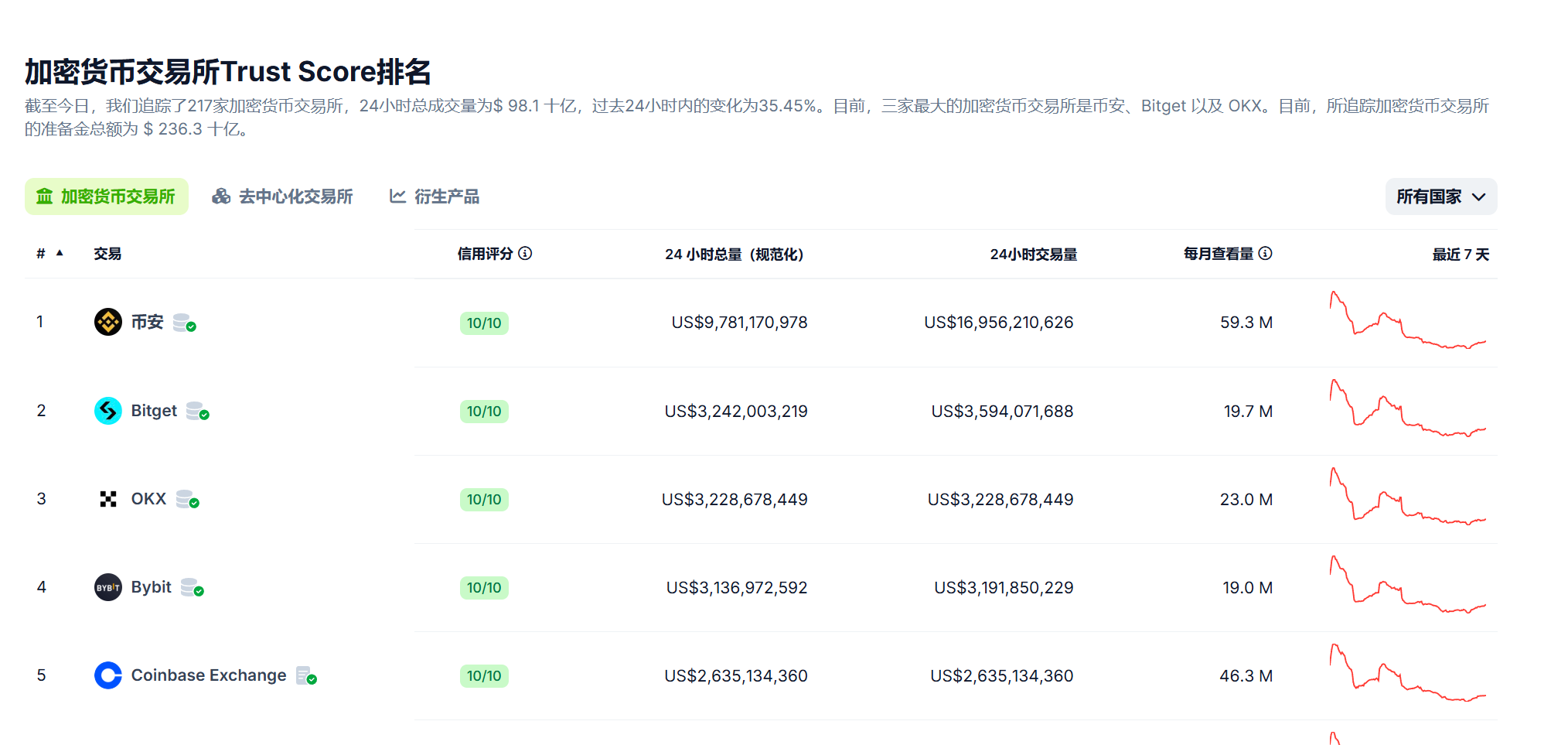
Data source: CoinGecko, April 14, 2025
At its core, a platform token’s value reflects the credibility of its underlying exchange. Deflation determines scarcity, use cases determine demand intensity—but the ultimate valuation anchor lies in the exchange’s actual scale, ecosystem development, and growth trajectory.
In short: long-term value stems from real platform growth, not speculative hype.
Key metrics comparison (source: CoinGecko, April 14, 2025):

Based on TokenInsight’s Crypto Exchange 2024 Annual Report, here’s a comparative analysis of the three exchanges’ 2024 performance:
● Binance: Market leader, but growth slowing. As the world’s most influential crypto exchange, Binance remains #1 in spot trading, derivatives, and user numbers. By 2024, it held 48.2% spot market share, giving BNB unparalleled user reach and ecosystem depth. However, its overall market share dropped from 42.2% to 32.7%, signaling a slowdown in user growth and market stability.
● Bitget: High-growth outlier with impressive momentum. Bitget emerged as the standout performer among second-tier players over the past year. In 2024, its spot share grew by 8.06%, total market share increased by 5.2 percentage points, and derivatives share approached 12%. Trading volumes for BTC and ETH remain strong, with 24-hour volume exceeding $3.6 billion. Crucially, Bitget’s growth isn’t driven by a single feature but through coordinated advances in contracts, copy trading, wealth management, and wallet ecosystems—forming a solid “exchange + wallet + product platform” triad that underpins BGB’s value.
● OKX: Stable share, deep product suite, limited breakthroughs. OKX remains a traditional powerhouse, especially in derivatives (15% share). However, under pressure from rising competitors, its spot market share declined from 16.6% to 11.8% in 2024. Liquidity indicators for BTC/ETH trail behind Bitget. OKB’s internal utility remains conservative, and its ecosystem integration lags behind BNB and BGB—capping its valuation ceiling.
Platform strength is the foundational anchor for any platform token. In today’s landscape:
● Binance represents “asset security” and “liquidity breadth”;
● Bitget embodies “growth potential” and “mechanism evolution”;
● OKX appears relatively conservative, with room to enhance its platform token support.
From this perspective, BGB’s current pricing still reflects a “discounted valuation” for a high-growth platform token—creating fertile ground for repricing.
5. Market Performance Review: One-Year Trends, Liquidity, and Valuation Elasticity
While structural design matters, market sentiment ultimately reveals itself through three key indicators:
● Price trend (does it reflect structural value?)
● Trading activity (daily liquidity and engagement)
● Valuation reasonableness (current price vs. potential upside)
Below is a one-year market performance comparison (April 14, 2024 – April 13, 2025) for the three major platform tokens (data source: CoinMarketCap):

Note: V/MC = Daily trading volume ÷ Market cap, measuring liquidity and turnover.
Comparative Analysis:
● BNB showed steady, modest gains, maintaining its status as a blue-chip crypto asset. Its relatively low turnover reflects its role as a “store of value.”
● BGB surged over 260% in the past year—one of the best-performing platform tokens. Its higher V/MC ratio suggests it may still be undervalued, with significant upside potential.
● OKB delivered neutral results in both market cap and volume, lacking strong drivers.
6. Which Tokens Hold Long-Term Value Logic?
The role of platform tokens is evolving—from “utility tools” to “investment-grade assets.”
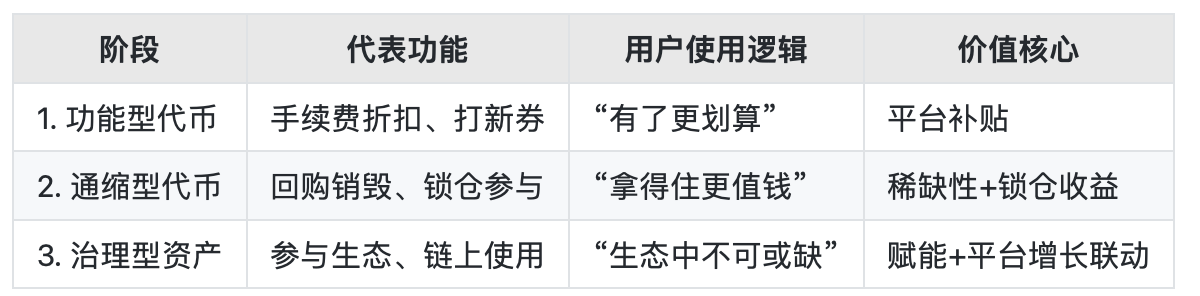
In the early days, most platform tokens served simple purposes: fee discounts, launchpad access, small yield arbitrage. Essentially, they were “user incentive tokens” without scarcity or independent value logic. Their market pricing relied heavily on sentiment and short-term trends.
But since 2021, especially as top platforms built their own ecosystems and expanded on-chain, platform tokens have gradually taken on three deeper roles:
1. Deflationary Anchors: Tied to Business Growth
● BNB: Links burns to on-chain transaction fees via BEP-95;
● BGB: Implements dual-path burns based on on-chain usage fees plus fixed quarterly burns.
This creates a closed loop: richer use cases → more burns → higher token value.
2. Ecosystem Access Keys: Becoming “Product Tickets”
● Staking BGB / BNB grants access to Launchpad, Launchpool, etc.;
● Locking platform tokens unlocks higher yields, priority access, whitelists.
Holders aren’t just speculating—they must hold to participate. Platform tokens become gatekeepers to ecosystem access.
3. On-Chain Governance Assets: Expanding Beyond the CEX
● BNB participates in chain governance, gas payments, and staking;
● BGB supports on-chain staking in Bitget Wallet, with plans for DAO and NFT voting;
● OKB has proposed governance initiatives but has yet to fully deploy them.
Platform tokens are attempting a “value breakout” from CeFi incentives to DeFi empowerment, aiming to become foundational governance assets.
Currently, BNB sits between stages 2.5 and 3, BGB is transitioning from stage 2 to 3, while OKB remains stuck between 1.5 and 2.
From our comparative analysis of deflation mechanics, supply structure, use cases, platform strength, and market performance, it's clear that although platform tokens belong to the same category, their underlying logics are now diverging into two distinct types:
● One group features clear mechanisms, tight supply structures, and positive platform growth—exemplified by BGB and BNB;
● The other suffers from vague mechanisms, unclear circulation, and weak user engagement, lacking long-term value support.
Based on current data, we can summarize the long-term potential of major platform tokens across key dimensions:
As shown in the comparison:
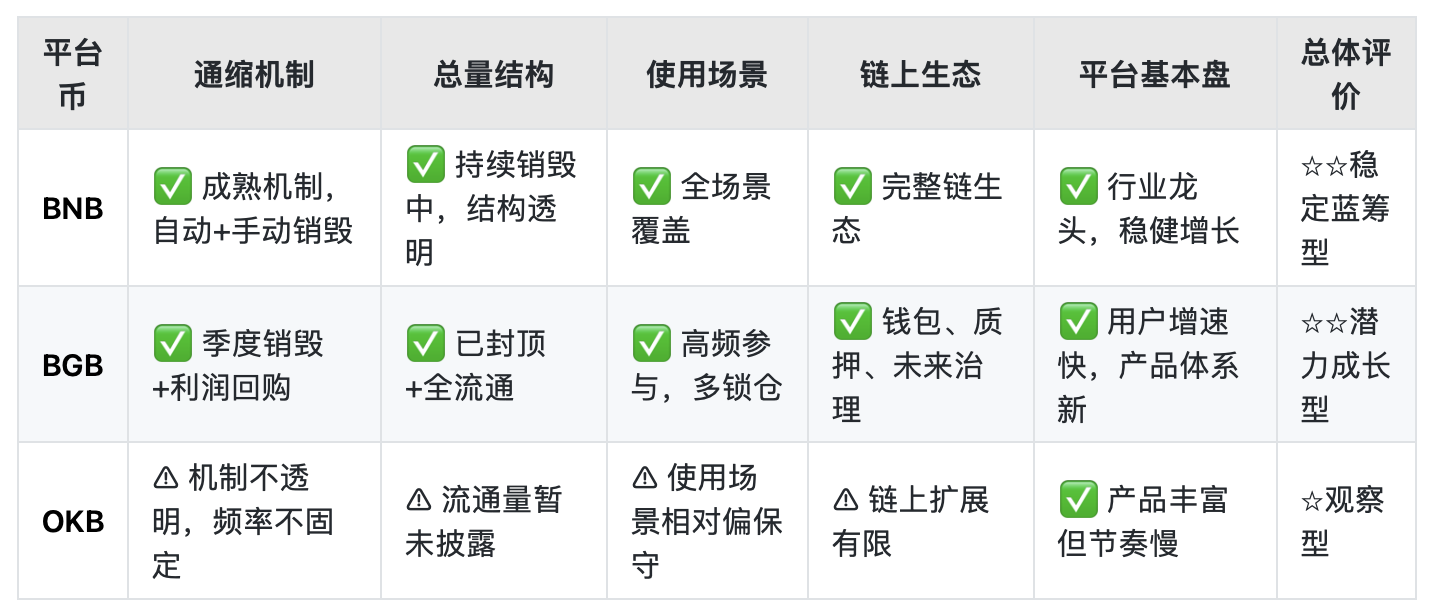
● For users seeking strong deflationary pressure, a clear usage loop, and backing from a fast-growing platform, BGB represents the most structurally complete and high-potential “new-generation utility token” available today.
● For those prioritizing stability and safety margins, BNB remains the most fundamentally sound asset in the crypto space.
● OKB may offer tactical trading opportunities, but due to structural ambiguity and insufficient ecosystem integration, holding it requires higher speculative tolerance and precise timing.
So, who should pay attention to platform tokens—and when might they consider allocating?
● Active users of exchange products and frequent Launchpad participants will benefit directly from holding BGB or BNB;
● Mid-to-long-term investors seeking “low valuation + high growth potential” should view BGB favorably—it’s still in an early, high-elasticity phase;
● Traders comfortable with volatility and short-term speculation can monitor OKB and similar tokens.
The next wave of value re-rating for platform tokens won’t come from stories—but from execution. Truly valuable platform tokens will be those that simultaneously excel across four criteria: clear mechanisms, clean supply, real use cases, and sustained platform expansion.
The future competition isn’t just about “who can go up”—but “who can keep going up.”
Join TechFlow official community to stay tuned
Telegram:https://t.me/TechFlowDaily
X (Twitter):https://x.com/TechFlowPost
X (Twitter) EN:https://x.com/BlockFlow_News












