Gold hits consecutive new highs—how to invest in gold-related assets in the crypto market?
TechFlow Selected TechFlow Selected
Gold hits consecutive new highs—how to invest in gold-related assets in the crypto market?
As Bitcoin faces a "value winter," real-world gold is reshaping the iron curtain of value on the blockchain.
 Navigating Web3 tides with focused insights
Author: Frank, PANews
As Bitcoin faces a "value winter," real-world gold is forging a new iron curtain of value on the blockchain.
Recently, crypto market volatility has grown increasingly uncertain amid shifts in global financial markets. Prices of major crypto assets—including Bitcoin, Ethereum, and SOL—have entered a slump. Market sentiment appears to be shifting from optimism to bearishness. In stark contrast, international gold prices have surged past $3,240 per ounce, repeatedly hitting record highs and reaffirming gold’s status as a premier safe-haven asset.
Within the crypto ecosystem, the market capitalization of gold-linked assets has also risen steadily. On April 11, the market cap of tokenized gold assets surpassed $2 billion. From a risk hedging perspective, gold-related crypto assets are emerging as a compelling new option. PANews reviews the current mainstream avenues for gaining exposure to gold within the crypto market.
Currently, gold-related investment options in the crypto market fall into two main categories: tokenized gold such as TetherGold (XAUT) or PAXGold (PAXG), where tokens represent digital proof of ownership of physical gold; and derivative products that use these tokenized gold assets in trading pairs with stablecoins. These include spot or futures trading pairs for XAUT or PAXG offered by exchanges. Additionally, some online precious metals dealers accept cryptocurrencies as payment when buying physical gold. Each method varies in terms of risk appetite and capital flexibility.
XAUT and PAXG: Leading Projects in Tokenized Gold
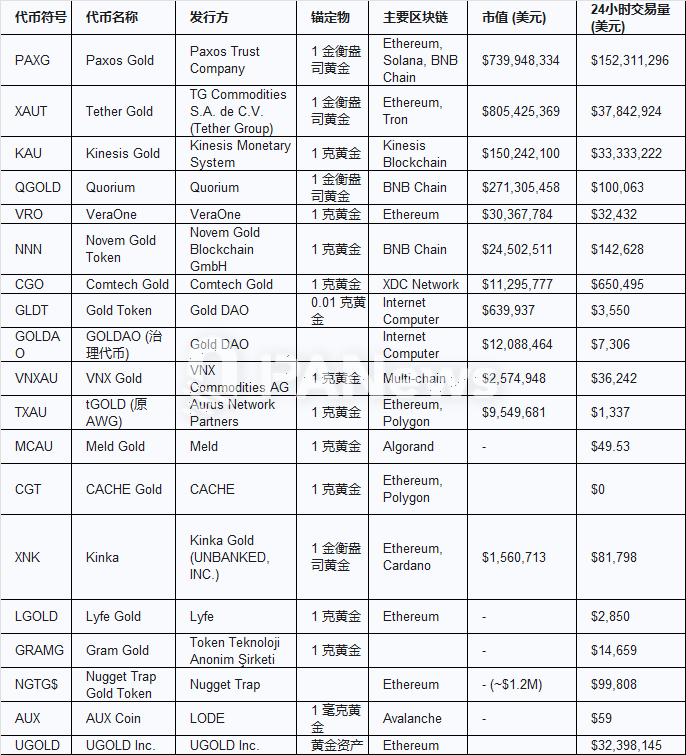
TetherGold (XAUT) and PAXGold (PAXG) are currently the two largest tokenized gold projects by market cap. XAUT is issued by Tether, the company behind USDT. Each XAUT represents ownership of one troy ounce of gold held in a specific LBMA (London Bullion Market Association)-accredited “good delivery” gold bar. The gold is allocated, and holders can verify the unique serial number, purity, and weight of their associated bar via Tether’s website. Tether claims its reserves fully back all issued tokens, with XAUT backed by physical gold held in reserve. As of April 12, the total gold backing XAUT amounted to 7,667.7 kilograms, distributed across 644 bars, with a market cap of approximately $797 million.
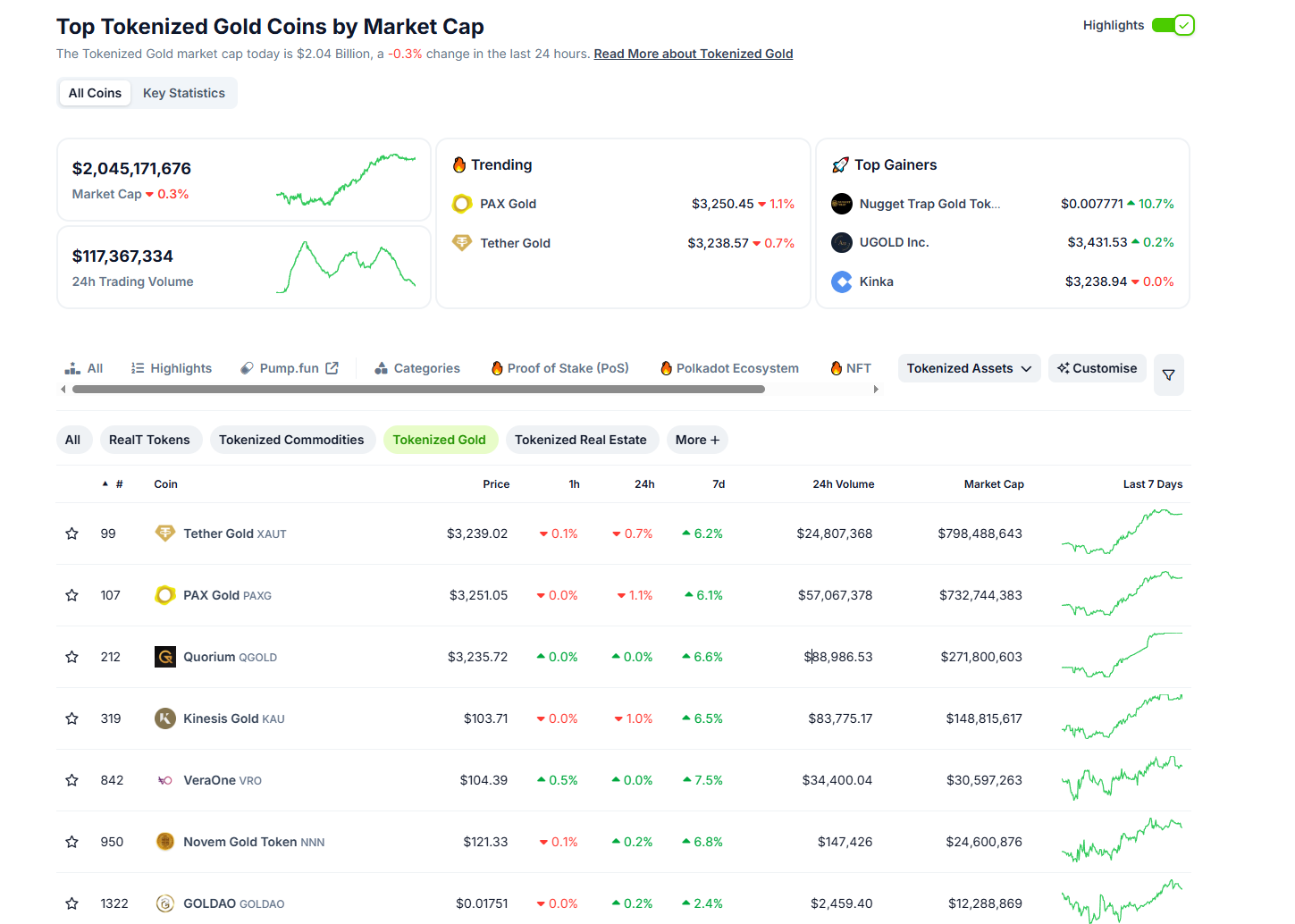 PAXG is issued by Paxos Trust Company, a trust and custodian regulated by the New York State Department of Financial Services (NYDFS). Like XAUT, each PAXG token represents one troy ounce of London good delivery gold. Monthly issuance reports for PAXG are audited by third-party firms. The report as of February 28 indicated holdings of 209,160 ounces of gold (approximately 5,929 kilograms).
Compared to traditional gold ETFs or futures, both XAUT and PAXG eliminate custody fees and offer significantly lower minimum purchase thresholds.
However, their fee structures differ. Creating or redeeming PAXG directly through the Paxos platform incurs volume-based tiered fees, while on-chain transfers are subject to a 0.02% Paxos fee. In contrast, XAUT claims no custody fees but charges a 0.25% fee on direct purchases or redemptions. For small investors, trading PAXG on secondary exchanges may be more cost-effective than using the Paxos platform, avoiding creation/redemption costs. However, frequent on-chain transfers will incur additional fees with PAXG.
Mint-Backed Kinesis and the Gold Mine Model of Quorium
Other tokenized gold products with market caps exceeding $100 million include Quorium (QGLOD) and Kinesis Gold (KAU). QGLOD operates under a unique model—the gold it holds consists primarily of mining reserves rather than physical bullion. Although the project claims to publish regular reserve reports, PANews found these web pages inaccessible. Consequently, the actual reserve status of QGLOD remains unclear. Information surrounding the project is ambiguous and contradictory, lacking key details verified independently. Notably, the concept of “undeveloped reserves” raises unresolved questions about how they support liquidity tokens, along with issues related to auditing and valuation—posing significant uncertainty and risk to investors.
Moreover, QGLOD’s market data shows warning signs. Despite a relatively high market cap (around $270 million), its daily trading volume is abnormally low (about $100,000) and concentrated on a few lesser-known exchanges. This severe mismatch between market cap, trading volume, and exchange liquidity—combined with poor transparency—undermines confidence in QGLOD’s security.
Kinesis Gold (KAU) differs from PAXG and XAUT in denomination—one KAU represents one gram of gold. Its key innovation lies in a unique revenue-sharing model. Unlike PAXG or XAUT, which merely track gold prices, KAU distributes a portion of the platform’s transaction fees back to holders in the form of gold (KAU). However, this yield is neither fixed nor risk-free—it depends entirely on the overall trading volume and fee income generated by the Kinesis platform. Additionally, Kinesis offers a virtual card allowing users to spend KAU directly in everyday transactions, further differentiating it from other gold tokens. On transparency, Kinesis conducts audits semi-annually and supports physical redemption for every 100 grams. According to official materials, Kinesis operates Kinesis Mint, a 5,600-square-meter minting and refining facility producing premium gold and silver ingots.
In terms of market liquidity, XAUT and PAXG remain the most widely traded tokenized gold assets, available on numerous major centralized exchanges and DEXs. KAU is listed on its native Kinesis Exchange, as well as BitMart and Emirex, but suffers from relatively limited liquidity.
Payment-Based Physical Exposure Is Common, But Gold Tokens Struggle to Break Into DeFi
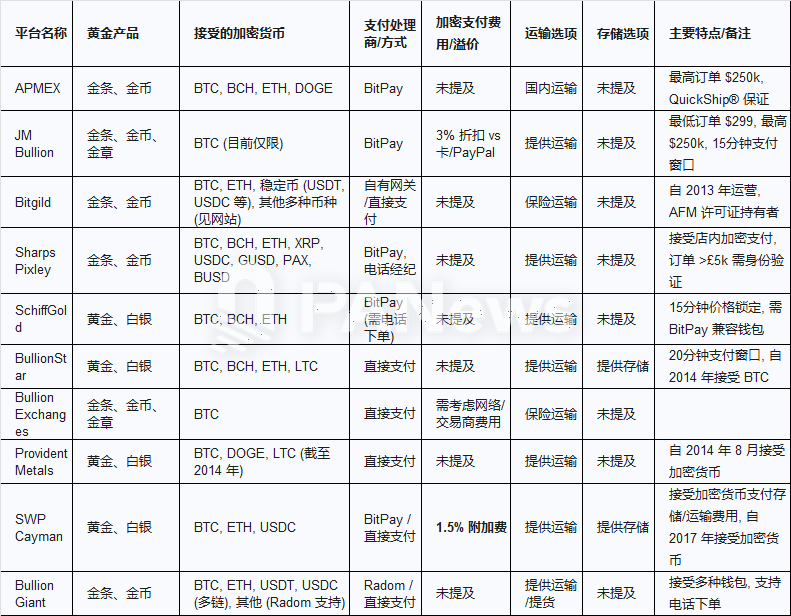
Beyond tokenized gold, many traditional precious metals dealers accept cryptocurrency payments. This type of gold exposure mainly applies to physical transactions, where crypto serves only as a payment method—not a fundamental shift in business model. Moreover, such transactions often require higher minimum investments, and many platforms sell coins or medallions, meaning buyers must assess product authenticity and potential premiums beyond the intrinsic gold value.
Besides trading tokenized gold like PAXG or XAUT, some centralized exchanges offer alternative gold trading instruments. For example, Bybit provides gold Contracts for Difference (CFDs), which allow traders to speculate on gold price movements without owning the underlying asset. Similar to index contracts in traditional finance, CFDs let users open leveraged positions tracking gold prices, though no physical delivery occurs. Among major crypto exchanges, Bybit stands out in offering such products. However, several traditional XAU/USD CFD brokers—including FP Markets, Fusion Markets, and easyMarkets—now accept crypto deposits. This approach better suits professional traders familiar with forex and commodities rather than typical crypto investors.
Despite possessing RWA (Real World Asset) characteristics, gold tokens see limited adoption on leading DeFi lending platforms. Aside from PAXG being usable as collateral on Morpho, major protocols like Aave and Compound do not accept gold tokens as native collateral. Several factors likely contribute: challenges in establishing reliable, decentralized price oracles critical for liquidations; regulatory uncertainty; and relatively lower demand for gold tokens as collateral compared to ETH or major stablecoins.
Overall, the most mainstream way to gain gold exposure in the crypto market remains holding highly liquid, established gold tokens like PAXG or XAUT. While numerous similar tokenized gold products exist, due diligence around issuer credibility and transparency is crucial given varying levels of risk. Purchasing physical gold through traditional dealers that accept crypto offers direct ownership but comes with higher entry barriers and potential product markups. In DeFi, participation options for gold-backed assets remain limited—reflecting a broader challenge for RWA integration into on-chain finance.
As Bitcoin holders in this downturn turn their gaze toward real gold, it marks not only a sign of maturation in the crypto market but perhaps a counteroffensive of digital gold reclaiming value from the real world.
Join TechFlow official community to stay tuned
Telegram:https://t.me/TechFlowDaily
X (Twitter):https://x.com/TechFlowPost
X (Twitter) EN:https://x.com/BlockFlow_News
 PANews