Opportunity or Hidden Risk? CertiK's Chief Security Officer Breaks Down the Dual Nature of AI in Web3.0
TechFlow Selected TechFlow Selected
Opportunity or Hidden Risk? CertiK's Chief Security Officer Breaks Down the Dual Nature of AI in Web3.0
From real-time threat detection to automated auditing, AI can enhance the Web3.0 ecosystem by providing powerful security solutions. However, it is not without risks.
 Navigating Web3 tides with focused insights
By: Wang Tielei, Wang Tielei
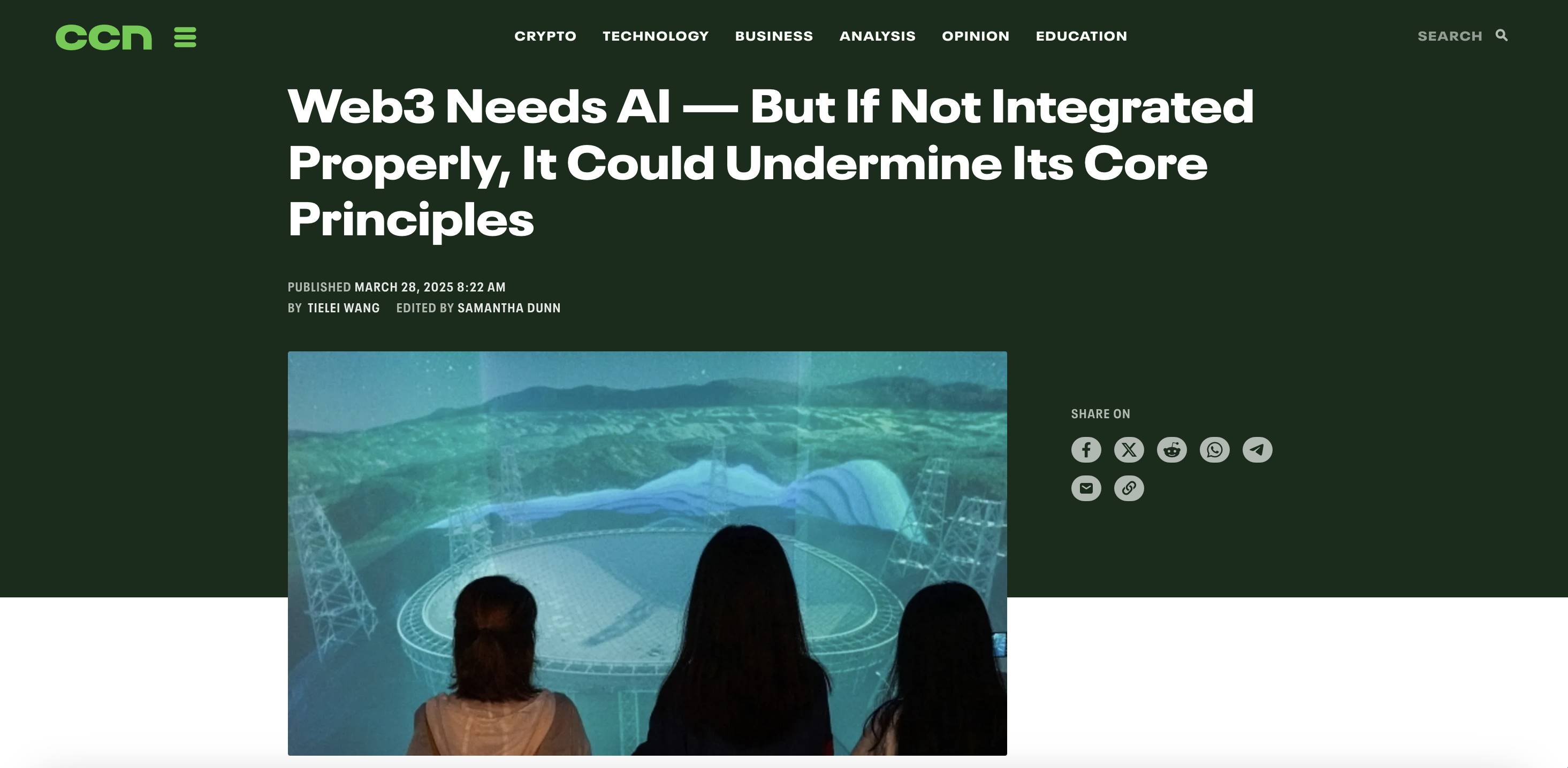
Recently, blockchain media CCN published an article by Dr. Wang Tielei, Chief Security Officer at CertiK, offering an in-depth analysis of AI’s dual role in Web3.0 security. The article highlights that while AI excels in threat detection and smart contract auditing—significantly enhancing blockchain network security—overreliance or improper integration may contradict Web3.0's decentralization principles and create exploitable openings for hackers.
Dr. Wang emphasizes that AI is not a "silver bullet" to replace human judgment, but rather a vital tool to work in tandem with human intelligence. AI must be applied alongside human oversight, through transparent and auditable methods, to balance security needs with the core tenets of decentralization. CertiK will continue leading in this direction, contributing to a more secure, transparent, and decentralized Web3.0 world.
Below is the full article:
Web3.0 Needs AI—But Poor Integration Could Undermine Its Core Principles
Key Takeaways:
-
AI significantly enhances Web3.0 security through real-time threat detection and automated smart contract audits.
-
Risks include overreliance on AI and the possibility that hackers could exploit the same technologies.
-
A balanced approach combining AI with human oversight is essential to ensure security measures align with Web3.0’s decentralization principles.
Web3.0 technologies are reshaping the digital landscape, advancing decentralized finance, smart contracts, and blockchain-based identity systems. Yet these innovations bring complex security and operational challenges.
Security concerns in the digital asset space have long been a pressing issue. As cyberattacks grow increasingly sophisticated, this pain point has become even more urgent.
AI undoubtedly holds great promise in cybersecurity. Machine learning algorithms and deep learning models excel at pattern recognition, anomaly detection, and predictive analytics—capabilities crucial for safeguarding blockchain networks.
AI-powered solutions are already improving security by detecting malicious activities faster and more accurately than human teams.
For example, AI can identify potential vulnerabilities by analyzing blockchain data and transaction patterns, and predict attacks by spotting early warning signals.
This proactive defense approach offers significant advantages over traditional reactive measures, which typically respond only after breaches have occurred.
Moreover, AI-driven auditing is becoming a cornerstone of Web3.0 security protocols. Decentralized applications (dApps) and smart contracts are two pillars of Web3.0, yet they are highly susceptible to bugs and vulnerabilities.
AI tools are being used to automate the audit process, identifying flaws that human auditors might miss.
These systems can rapidly scan complex, large-scale smart contract and dApp codebases, ensuring projects launch with higher security standards.
The Risks of AI in Web3.0 Security
Despite its many benefits, applying AI to Web3.0 security has drawbacks. While AI’s anomaly detection capabilities are valuable, there is a risk of overrelying on automated systems that may not always capture the subtleties of cyberattacks.
After all, AI performance depends entirely on its training data.
If malicious actors can manipulate or deceive AI models, they could exploit such weaknesses to bypass security measures. For instance, hackers could use AI to launch highly sophisticated phishing attacks or alter the behavior of smart contracts.
This could trigger a dangerous “cat-and-mouse game,” where hackers and security teams wield the same cutting-edge technologies, leading to unpredictable shifts in power.
The decentralized nature of Web3.0 also presents unique challenges for integrating AI into security frameworks. In decentralized networks, control is distributed across multiple nodes and participants, making it difficult to ensure the uniformity required for AI systems to function effectively.
Web3.0 is inherently fragmented, while AI tends to be centralized—often relying on cloud servers and large datasets—which may conflict with Web3.0’s emphasis on decentralization.
If AI tools fail to integrate seamlessly into decentralized networks, they could undermine Web3.0’s foundational principles.
Human Oversight vs. Machine Learning
Another concern lies in the ethical dimensions of using AI in Web3.0 security. The more we rely on AI to manage cybersecurity, the less human oversight exists over critical decisions. Machine learning algorithms can detect vulnerabilities, but they may lack the moral or contextual awareness needed when making decisions that impact user assets or privacy.
In the context of Web3.0’s anonymous and irreversible financial transactions, this could have far-reaching consequences. For example, if AI incorrectly flags a legitimate transaction as suspicious, it could lead to unjustified asset freezes. As AI systems play an increasingly central role in Web3.0 security, maintaining human oversight is essential to correct errors or interpret ambiguous situations.
Integrating AI with Decentralization
Where do we go from here? Integrating AI with decentralization requires balance. AI can undoubtedly enhance Web3.0 security, but its application must be combined with human expertise.
The focus should be on developing AI systems that both strengthen security and respect decentralization principles. For example, blockchain-based AI solutions could be built using decentralized nodes, ensuring no single party controls or manipulates the security protocol.
This would preserve the integrity of Web3.0 while leveraging AI’s strengths in anomaly detection and threat prevention.
Furthermore, ongoing transparency and public auditing of AI systems are crucial. By opening development processes to the broader Web3.0 community, developers can ensure AI security measures meet standards and remain resistant to malicious tampering.
Integrating AI into security requires multi-party collaboration—developers, users, and security experts must work together to build trust and ensure accountability.
AI Is a Tool, Not a Panacea
The role of AI in Web3.0 security is undeniably promising. From real-time threat detection to automated auditing, AI can enhance the Web3.0 ecosystem with powerful security solutions. However, it is not without risks.
Overreliance on AI and the potential for malicious exploitation demand caution.
In the end, AI should not be seen as a cure-all, but as a powerful tool working in concert with human intelligence—together safeguarding the future of Web3.0.
Join TechFlow official community to stay tuned
Telegram:https://t.me/TechFlowDaily
X (Twitter):https://x.com/TechFlowPost
X (Twitter) EN:https://x.com/BlockFlow_News
 CertiK