With Zhao Changpeng entering the scene and a demographic dividend of 240 million people, is Pakistan's crypto industry embarking on a new journey?
TechFlow Selected TechFlow Selected
With Zhao Changpeng entering the scene and a demographic dividend of 240 million people, is Pakistan's crypto industry embarking on a new journey?
From Ban to Embrace: Pakistan's "Ice and Fire" Journey with Cryptocurrency
 Navigating Web3 tides with focused insights
By KarenZ, Foresight News
In the northwest of the South Asian subcontinent, Pakistan—a nation with a population of 241 million and an exceptionally young demographic—is quietly nurturing a transformation around cryptocurrency.
Although Pakistan's crypto market currently operates in a "gray area," growing user adoption and an increasingly clear regulatory framework suggest this country could emerge as a key hub for the crypto economy in South Asia.
On April 7, Changpeng Zhao (CZ) announced he would join the Pakistan Crypto Council (PCC) as a strategic advisor. This move not only highlights CZ’s global influence within the cryptocurrency industry but also signals a milestone step for Pakistan in its journey toward embracing digital assets. As the official strategic advisor to PCC, CZ will provide guidance on regulatory frameworks, infrastructure development, education, and application promotion, working closely with both government bodies and private sectors to build a compliant, inclusive, and globally competitive crypto ecosystem.
Taking this opportunity, let's take a closer look at the structure of the Pakistan Crypto Council, along with the country's current regulatory landscape and crypto adoption trends.
Structure of the Pakistan Crypto Council
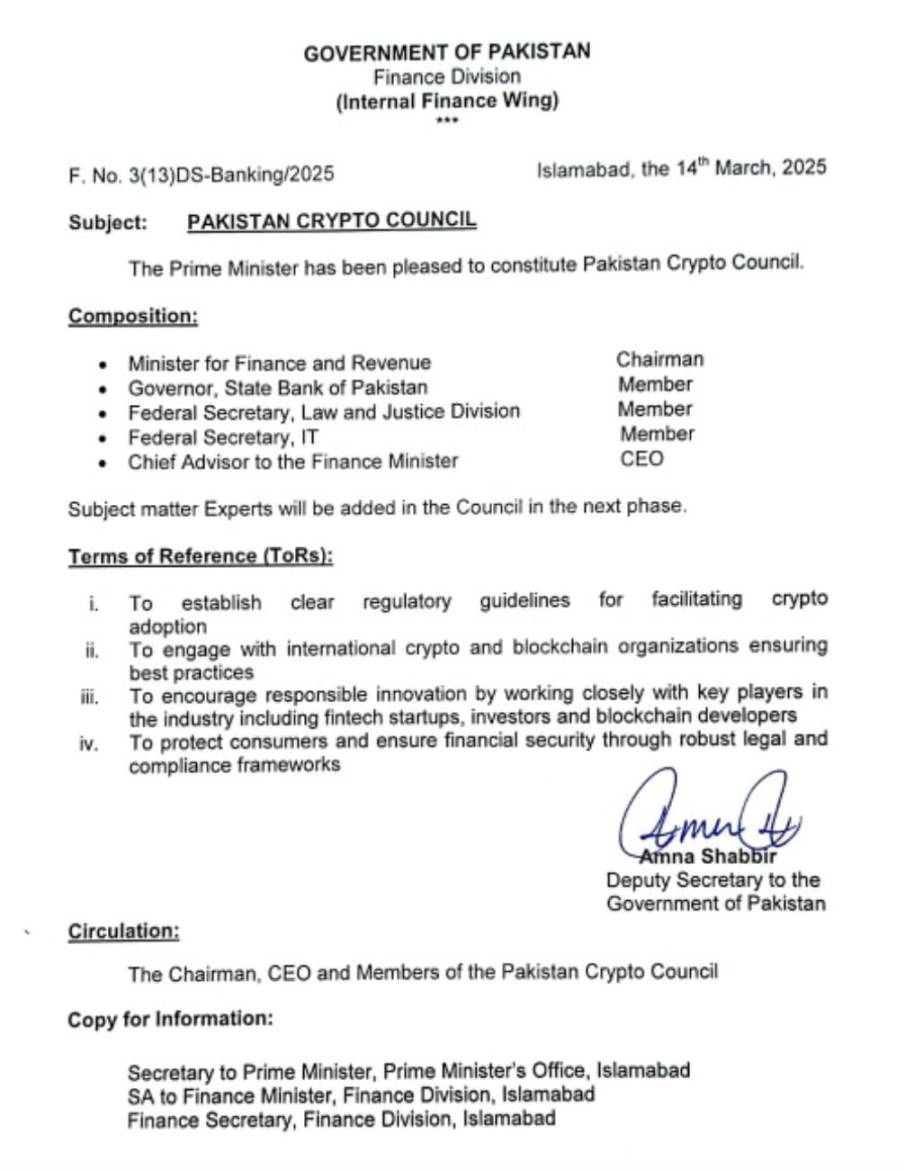
The Pakistan Crypto Council (PCC) was proposed by the Ministry of Finance in February 2025 and officially announced in March. Operating under the Ministry of Finance, the council is primarily responsible for overseeing the integration and adoption of blockchain technology and digital assets in the country’s financial sector.
The PCC’s mandate extends beyond regulation—it aims to create an environment where blockchain and digital finance can thrive, avoiding market chaos caused by regulatory gaps. Additionally, the PCC is committed to promoting responsible innovation, advancing the use of crypto technologies in Pakistan while safeguarding consumers and ensuring financial security. The organizational structure of the PCC is as follows:
Muhammad Aurangzeb, Minister of Finance, serves as Chairman of the council, signaling the Pakistani government’s commitment to the evolving digital economy. Bilal bin Saqib, who also acts as Chief Advisor to the Finance Minister, is the CEO of the PCC. Bilal bin Saqib is a London-based entrepreneur holding a Master’s degree in Social Innovation and Entrepreneurship from the London School of Economics (LSE), and has been featured on Forbes’ 30 Under 30 list. In the Web3 space, he founded Web3 Pak, Pakistan’s leading Web3 community, served as a growth advisor at African digital asset platform Busha, and frequently speaks at crypto events about blockchain’s societal impact. Beyond fintech, Bilal co-founded Tayaba, a nonprofit providing clean water solutions to water-scarce communities in Pakistan, and launched the H2O Wheel—an innovative device to ease water transportation burdens in rural areas. He received the Points of Light award (awarded by the UK Prime Minister for outstanding community contributions) and was honored with an MBE in 2023 for his humanitarian efforts during the pandemic.
Direct board members of the PCC include the Governor of the State Bank of Pakistan, the Chairperson of the Securities and Exchange Commission of Pakistan (SECP), the Federal Law Minister, and the Federal Minister for Information Technology. This diverse composition ensures alignment across regulatory oversight, financial stability, legal frameworks, and technological advancement with Pakistan’s emerging crypto ecosystem.
Pakistan’s Finance Minister and PCC Chairman Muhammad Aurangzeb stated, “We are sending a clear message to the world: Pakistan is open for innovation. With CZ joining us, we will accelerate our vision of making Pakistan a regional powerhouse in Web3, digital finance, and blockchain-driven development.”
Pakistan Overview
Located in the northwest of the South Asian subcontinent, Pakistan borders the Arabian Sea to the south, the Karakoram and Himalayan mountain ranges to the north, and shares land borders with India, China, Afghanistan, and Iran to the east, north, and west respectively—making it a critical junction connecting South Asia, the Middle East, and Central Asia.
Pakistan covers a land area of 796,000 square kilometers. Demographically, it enjoys a significant demographic dividend, ranking as the fifth most populous country globally. Over 60% of its population is under the age of 30, placing it among the top nations in terms of labor force size.
According to the Seventh National Population Census Report released by Pakistan’s Bureau of Statistics in July 2024, the total population has reached approximately 241 million—an increase of 15.87% compared to the 2021 census, with an average annual growth rate of 2.55%. Around 79% of the population is under 40 years old, with children aged 15 or younger accounting for 40.56% of the total, and youth aged 15–29 making up 26%.
Economically, Pakistan faces multiple challenges including high inflation, foreign debt crises, and currency depreciation. However, the government is seeking breakthroughs through international aid, structural reforms, and digital transformation initiatives.
In education, although free primary and secondary education is provided, insufficient school infrastructure and socioeconomic barriers have hindered progress. According to UNICEF data, Pakistan has the second-highest number of out-of-school children worldwide—approximately 25 million children aged 5–16, representing 44% of that age group. This issue is particularly severe in rural areas and among girls.
Infrastructure-wise, electricity shortages and low internet penetration (around 50%) constrain technological development. It should be noted that Islam is the state religion, with Muslims comprising 97% of the population.
Three-Stage Evolution of Crypto Regulation in Pakistan
Pakistan’s crypto regulation is currently transitioning from prohibition toward exploratory oversight. While legal clarity remains pending, shifting government attitudes, the establishment of the national crypto council, international cooperation, and strong grassroots adoption indicate that clearer policy frameworks may be introduced soon.
Prohibition Phase (2018–2021): In April 2018, the State Bank of Pakistan (SBP) issued a ban stating: "Virtual currencies are not legal tender issued or guaranteed by the Government of Pakistan. All banks, development financial institutions, microfinance banks/public service organizations/service providers are advised not to deal in, use, trade, hold, transfer value, promote, or invest in virtual currencies." The directive also required financial institutions not to assist clients in cryptocurrency or ICO token transactions and mandated reporting such activities as suspicious transactions to the Financial Monitoring Unit (FMU). While the ban urged the public to avoid involvement in mining, trading, exchanging, transferring, promoting, or investing in virtual currencies to prevent financial loss and legal consequences, it did not explicitly prohibit personal holdings or peer-to-peer (P2P) trading—leaving crypto in a legal gray zone. Shortly afterward, Pakistan’s Bitcoin exchange Urdubit shut down completely.
Exploration Phase (2022–2024): As the scale of cryptocurrency expanded globally, central banks and regulators began studying the crypto ecosystem. In 2022, the State Bank of Pakistan published a report titled *Crypto Assets – Potential Risks and Opportunities and Global Regulatory Approaches*. While reiterating the earlier ban on virtual currencies, the report acknowledged their growing popularity due to convenience, anonymity, and speculative appeal. It outlined several risks, including impacts on monetary policy, foreign exchange systems, capital flight, financial stability, money laundering, terrorist financing, and tax evasion.
In February 2022, former SBP Governor Reza Baqir delivered a speech titled *The Rise of Digital Currency and the Path Forward*, noting Pakistan’s rapid shift from cash to digital payments, supported by a large mobile user base (189 million telecom users, 108 million 3G/4G users). He emphasized digital transformation as a major opportunity for financial system development but expressed caution toward private digital currencies, asserting that their risks outweigh benefits. At the same time, Baqir expressed optimism about central bank digital currencies (CBDCs), suggesting they could enhance financial inclusion, drive innovation, and improve cross-border payments. He called on regulators not only to set rules but also to proactively innovate and foster financial ecosystem growth.
However, in March 2023, the Pakistani government proposed suspending online services related to cryptocurrencies to curb illegal transactions. Former Minister of State for Finance Aisha Ghaus Pasha stated that Pakistan “will never legalize cryptocurrencies.”
In June 2023, the State Bank of Pakistan announced plans to launch its own central bank digital currency. In November 2024, the federal government proposed amending the State Bank of Pakistan Act to legalize CBDCs. The proposed amendment also introduced penalties for unauthorized issuance of digital currencies—any individual found guilty would face fines equal to twice the value of the illegally issued currency.
Breakthrough Phase (2025): In 2025, Pakistan’s stance on digital assets underwent a substantive shift, with plans to establish a legal framework for crypto trading to attract international investment. In March, Pakistan formally established the Pakistan Crypto Council (PCC). PCC CEO Bilal Bin Saqib proposed utilizing surplus energy resources in the country to support Bitcoin mining operations.
Notably, Pakistan was placed on the Financial Action Task Force (FATF) “Jurisdictions Under Increased Monitoring” list (commonly known as the gray list) in 2018, which prompted heightened scrutiny over the legality and risks of cryptocurrencies. After being removed from the FATF gray list in 2022 and amid the global crypto market boom, improved international financial conditions may present new opportunities—but also bring expectations for stricter compliance. Bilal bin Saqib stated that the PCC is exploring initiatives such as real-world asset (RWA) tokenization and regulatory sandboxes, while ensuring adherence to FATF standards. The PCC’s top priority is establishing a robust and transparent regulatory framework requiring all crypto activities to comply with KYC and AML regulations.
Crypto Adoption in Pakistan
In recent years, crypto adoption in Pakistan has grown significantly, driven by economic instability, currency depreciation, capital controls, and a highly digital-savvy youth population.
Bilal bin Saqib, CEO of the Pakistan Crypto Council, noted that Pakistan ranks among the top ten countries globally in crypto adoption, with an estimated 25 million active users. The country is optimistic about Bitcoin mining, tokenization, and crypto regulation. He added that Pakistan is exploring blockchain technology to streamline remittance processes.
A report by Chainalysis also ranked Pakistan ninth globally in crypto adoption, behind India, Nigeria, and Indonesia.
Additionally, Pakistan is the fifth-largest recipient of remittances globally (approximately $33 billion in 2024). High fees associated with traditional channels have made crypto-based cross-border remittance tools increasingly popular.
According to a compilation by BeInCrypto, the five most popular crypto trading platforms in Pakistan are Binance, Bitget, Bisq, OKX, and Paxful—all supporting P2P transactions. Due to banking restrictions on direct crypto trading, Pakistani users often rely on alternative payment methods widely accepted on P2P platforms, including mobile wallets and fintech solutions like JazzCash, Easypaisa, and Redot Pay.
Conclusion: Opportunities and Challenges Ahead
Cryptocurrency has the potential to become a powerful tool for Pakistan to combat inflation and optimize cross-border payments. Moreover, the country’s young, digitally inclined population offers a natural advantage for the adoption of crypto and Web3 technologies. The establishment of the crypto council may accelerate this process through education and infrastructure development.
Notably, Changpeng Zhao mentioned that his Web3 education platform, Giggle Academy, could offer learning opportunities to out-of-school children in Pakistan. Furthermore, the formation of the Pakistan Crypto Council may drive local Web3 talent training through blockchain and crypto education programs, enhancing public awareness and acceptance, and potentially cultivating a new generation of digital economy professionals.
Additionally, CZ’s deep experience in navigating global regulatory challenges could help shape clearer policies for the PCC—one that balances risk management with foreign investment attraction. His involvement itself sends a strong signal to the global crypto community: Pakistan is actively embracing Web3 and digital finance, potentially drawing international capital and stimulating the growth of local Web3 startups.
Nevertheless, a large portion of Pakistan’s population resides in rural areas, where internet access and financial literacy remain low. An outdated power grid and frequent blackouts may also hinder broader crypto adoption.
In summary, Pakistan stands at a pivotal moment in its crypto journey. Positive government signals suggest that an initial regulatory framework may be rolled out soon. If successful, this could unlock massive market potential, especially in remittances and financial inclusion. However, infrastructure upgrades and international compliance remain key hurdles. Moreover, if Pakistan successfully builds a compliant crypto ecosystem, it could influence policy directions in similar economies such as Bangladesh and Iran.
Join TechFlow official community to stay tuned
Telegram:https://t.me/TechFlowDaily
X (Twitter):https://x.com/TechFlowPost
X (Twitter) EN:https://x.com/BlockFlow_News
 Foresight News