








From Binance Launchpool Data, Observing the Current Market's "Holding Anxiety"
TechFlow Selected TechFlow Selected
From Binance Launchpool Data, Observing the Current Market's "Holding Anxiety"
Currently, the amount of idle funds in the market has not decreased compared to 2024, but has actually increased.
 Navigating Web3 tides with focused insights
Author: Murphy, On-chain Data Analyst
You might subconsciously believe that only paid data is valuable, but in fact, many free data sources are also highly useful. For example, Binance publishes related statistics after each LaunchPool event. Within these figures lie clues about market sentiment, capital flows, and the tug-of-war between large holders and retail investors.
We all know Binance currently offers the best on-exchange liquidity, aggregating massive users and capital. While we can't directly access their backend data, we can still spot meaningful signals from limited public information.
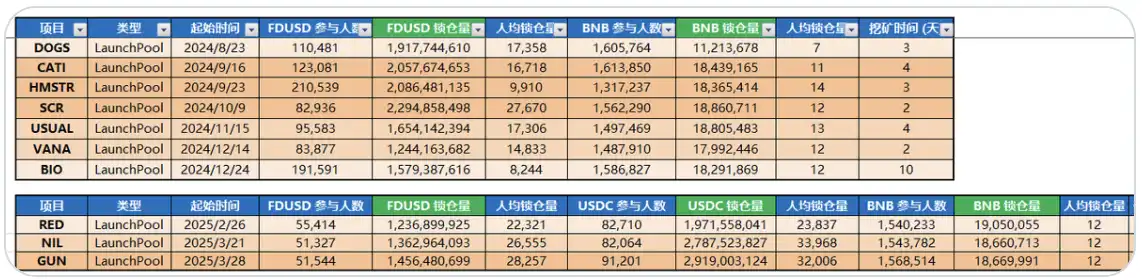
(Figure 1)
Figure 1 summarizes all LaunchPool data from August 2024 to present. In 2024, only FDUSD and BNB were eligible for LaunchPool participation; in 2025, USDC was added. Therefore, we can divide the data into two periods for comparison.
From RED (Session 64) to GUN (Session 66), the number of participants remained relatively stable, but the locked amounts of FDUSD and USDC increased steadily over time. Since stablecoin swaps on Binance are fee-free, in theory, all idle stablecoins—including USDT—would have an incentive to "farm yield." The more stablecoins participating, the greater the amount of idle purchasing power within Binance.
We also note that during the first three 2025 events, the combined scale of FDUSD + USDC was roughly $3–4 billion, while during the August–December 2024 events, FDUSD alone totaled around $1.5–2 billion—indicating significantly larger capital availability in Q1 2025 compared to 2024. You might think this increase is simply due to USDC’s addition in 2025, but I have a different interpretation.
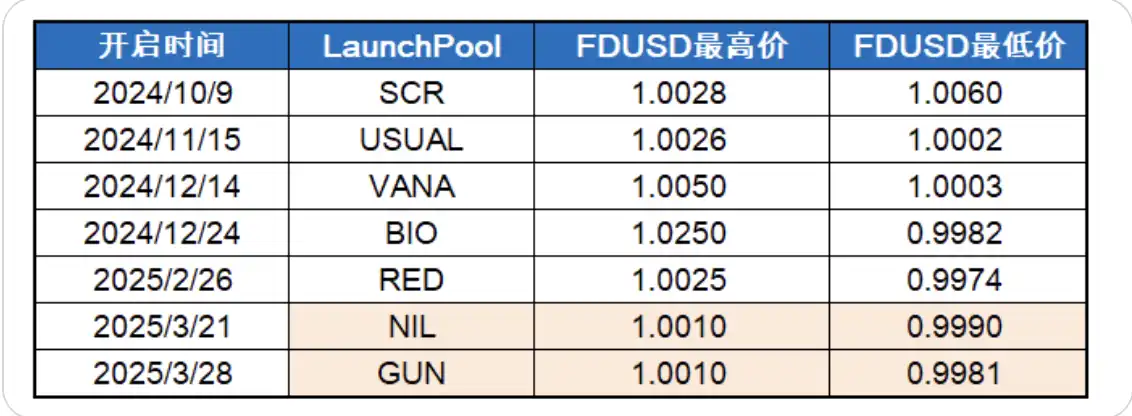
(Figure 2)
Observe one key detail: as shown in Figure 2, during every 2024 LaunchPool event, FDUSD exhibited a very high premium at launch. This indicates strong demand for FDUSD—for instance, holders of USDT and USDC rushed to convert into FDUSD for mining rewards, temporarily pushing up FDUSD's exchange rate.
By contrast, in 2025, FDUSD's premium at launch began to decline, suggesting reduced demand. The fundamental reason? USDC分流 (diverted) part of the demand previously directed solely at FDUSD. USDC holders no longer needed to swap into FDUSD, and some USDT holders switched to USDC instead (since USDC holds its value better than FDUSD post-mining).
In other words, most idle funds tend to join LaunchPool. The combined FDUSD+USDC capital in 2025 and the standalone FDUSD capital in 2024 both represent the vast majority of dormant funds within Binance. The surge in total capital isn’t entirely because Binance opened a new channel for USDC in 2025.
Moreover, the average locked amount per user in Q1 2025 exceeds that of November–December 2024, signaling a shift toward whale dominance. That is, the group holding idle purchasing power has become increasingly concentrated among large accounts.
This seems to reflect a real transformation: during November–December 2024, more whales held crypto ("coins"), whereas by February–March 2025, they shifted to holding stablecoins ("U"). Thus, a round of wealth transfer has been completed, with whales successfully consolidating gains from retail investors. Now, they hold substantial idle capital and patiently await the next opportunity.
· Based on the above observations, we can draw several conclusions:
1. Idle capital within exchanges today hasn't decreased compared to 2024—in fact, it has grown substantially. However, overall sentiment remains cautious, and this capital has yet to translate into effective buying pressure.
2. Rising participation in LaunchPool suggests more users have taken profits, but kept their funds inside the exchange rather than exiting the market. This implies caution—but not despair.
3. Higher average locked amounts indicate that idle purchasing power is now concentrated among larger players. After a round of wealth redistribution, buying power has returned to the hands of whales. They generally believe the bull market isn't over and remain positioned, waiting for the right moment.
Join TechFlow official community to stay tuned
Telegram:https://t.me/TechFlowDaily
X (Twitter):https://x.com/TechFlowPost
X (Twitter) EN:https://x.com/BlockFlow_News
 @Murphychen888











