Meme stock GameStop joins BTC reserve camp—could this signal a new strategy in the gaming sector?
TechFlow Selected TechFlow Selected
Meme stock GameStop joins BTC reserve camp—could this signal a new strategy in the gaming sector?
Over $6 billion in potential buying demand as "US stocks × tokens" takes another step forward.
 Navigating Web3 tides with focused insights
Author: Wenser, Odaily Planet Daily
On March 26, GameStop announced the establishment of a strategic Bitcoin (BTC) reserve, triggering an immediate surge in its stock price—after-hours trading rose 5.5% from the closing price, reaching $26.80; as of writing (March 27), the share price had climbed to $28.36, marking a single-day gain of 11.65%. After U.S. and Japanese-listed firms such as Strategy and Metaplanet successfully built their own "dual flywheel" of crypto and equities through BTC treasury strategies, GameStop—the former "meme stock beloved by retail investors"—is now joining the ranks of companies adopting strategic BTC reserves. In many ways, this marks an inevitable trend driven by market sentiment.
With the official announcement, a months-long speculation has finally come to an end. This article by Odaily Planet Daily will review GameStop’s move into BTC reserves and explore the broader implications for the interplay between cryptocurrency and the U.S. stock market.
Hidden Threads, Long-Term Vision: GameStop's Own "Crypto Hero Dream"
A History of Failed Crypto Ventures: Wallets, NFT Marketplaces, and Meme Coins
Notably, as a well-known video game retailer, this isn't GameStop’s first foray into cryptocurrency. In late 2022, near the peak of the NFT bull market, GameStop launched its own wallet and NFT marketplace. The platform surpassed $22 million in trading volume within about one month of launch. However, with the subsequent cooling of the NFT market and tightening regulatory pressure in the U.S., GameStop downsized its crypto team at the end of 2022, suspended operations of the GameStop Wallet in August 2023, and fully shut down its NFT marketplace in February 2024.
Clearly, traditional public companies don’t always enjoy smooth sailing in the crypto space like Strategy or Metaplanet. Particularly under the Biden administration, regulators adopted a strict stance toward crypto-related businesses. Combined with unstable business models and volatile market performance, GameStop’s early crypto ventures were far from successful.
Later, GameStop regained significant public attention when Roaring Kitty—the iconic figure who led retail investors in the battle against Wall Street short-sellers—made a comeback in May 2024. At that time, fueled by a nationwide meme coin frenzy, a namesake meme token briefly surged in popularity alongside a spike in GameStop’s stock price. Yet, it ultimately suffered the same fate as most meme coins.
In October last year, GameStop sparked another wave of “zoo-themed meme coin” speculation after posting a picture of a smiling finless porpoise on X (formerly Twitter), causing the related meme token miharu to briefly exceed $0.01.
Despite demonstrating strong cultural resonance in the crypto world and mastering the art of memes, GameStop continues to face structural challenges to its core retail gaming business due to industry shifts toward digital downloads and cloud gaming. Additionally, GameStop CEO Ryan Cohen was previously fined $1 million by the U.S. Federal Trade Commission for violating antitrust laws.
According to GameStop’s latest financial report, the company generated $3.823 billion in net sales in 2024, down approximately 27.5% from $5.273 billion the previous fiscal year. However, net profit increased from $6.7 million to $131.3 million year-on-year. As of February 1, 2025, GameStop held approximately $4.77 billion in cash and cash equivalents, a substantial increase from $921.7 million the prior year. This growth is primarily attributed to cost-cutting measures and asset divestitures, including the completion of its exit from the Italian market and closure of German store operations.
In other words, GameStop urgently needs new growth drivers beyond cost reduction and efficiency improvements—making BTC treasury strategy an attractive option.
A New Chapter: BTC Treasury as a Lifeline – Meeting Titans, Seeking Solutions
As early as February 2021, CNBC host Jim Cramer suggested that GameStop should buy Bitcoin. He proposed that GME issue $1 billion in stock to purchase $1 billion worth of Bitcoin, predicting the stock could then rise to $430.
It turns out the blueprint was revealed long ago—but back then, GameStop hadn’t yet grasped it.
On February 7 this year, GameStop CEO Ryan Cohen met with Michael Saylor, founder and executive chairman of MicroStrategy, sparking market speculation that GameStop might be preparing to adopt a BTC treasury strategy.
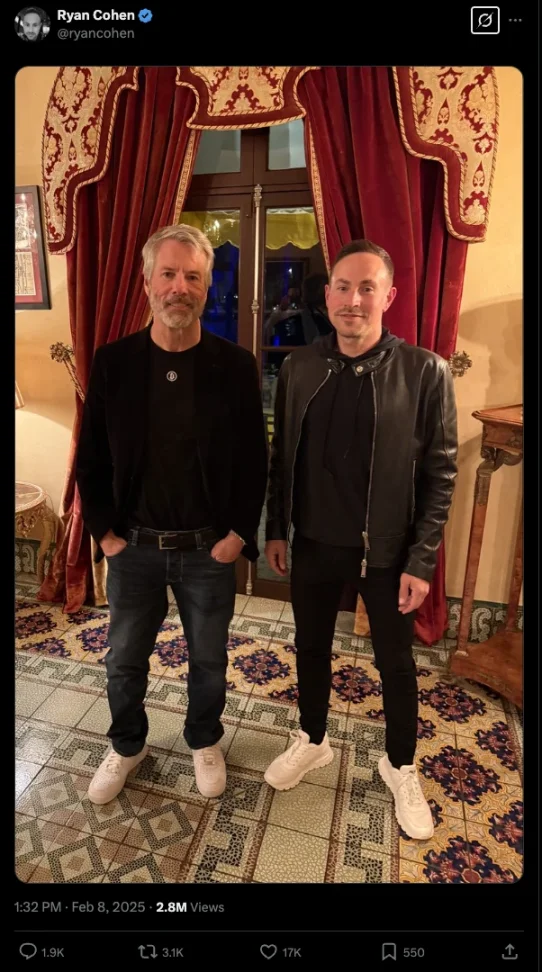
Interestingly, Cohen entered GameStop’s board after buying shares in the company
The subsequent developments confirmed these speculations, and GameStop’s move brought significant potential buying pressure to the BTC market.
GameStop’s Potential Buying Power: $4.77 Billion + $1.3 Billion
Beyond its existing $4.77 billion in cash and cash equivalents, GameStop recently announced plans to conduct a private placement of $1.3 billion in convertible senior notes maturing in 2030, allowing initial purchasers to acquire up to an additional $200 million in notes. The company stated: "The net proceeds from this offering are expected to be used for general corporate purposes, including the acquisition of bitcoin in accordance with GameStop’s investment policy."
Worth noting, in December 2023, GameStop’s board authorized CEO Ryan Cohen, along with two independent directors and relevant staff, to manage the company’s investment portfolio. The decision to establish a BTC treasury was unanimously approved by the board.
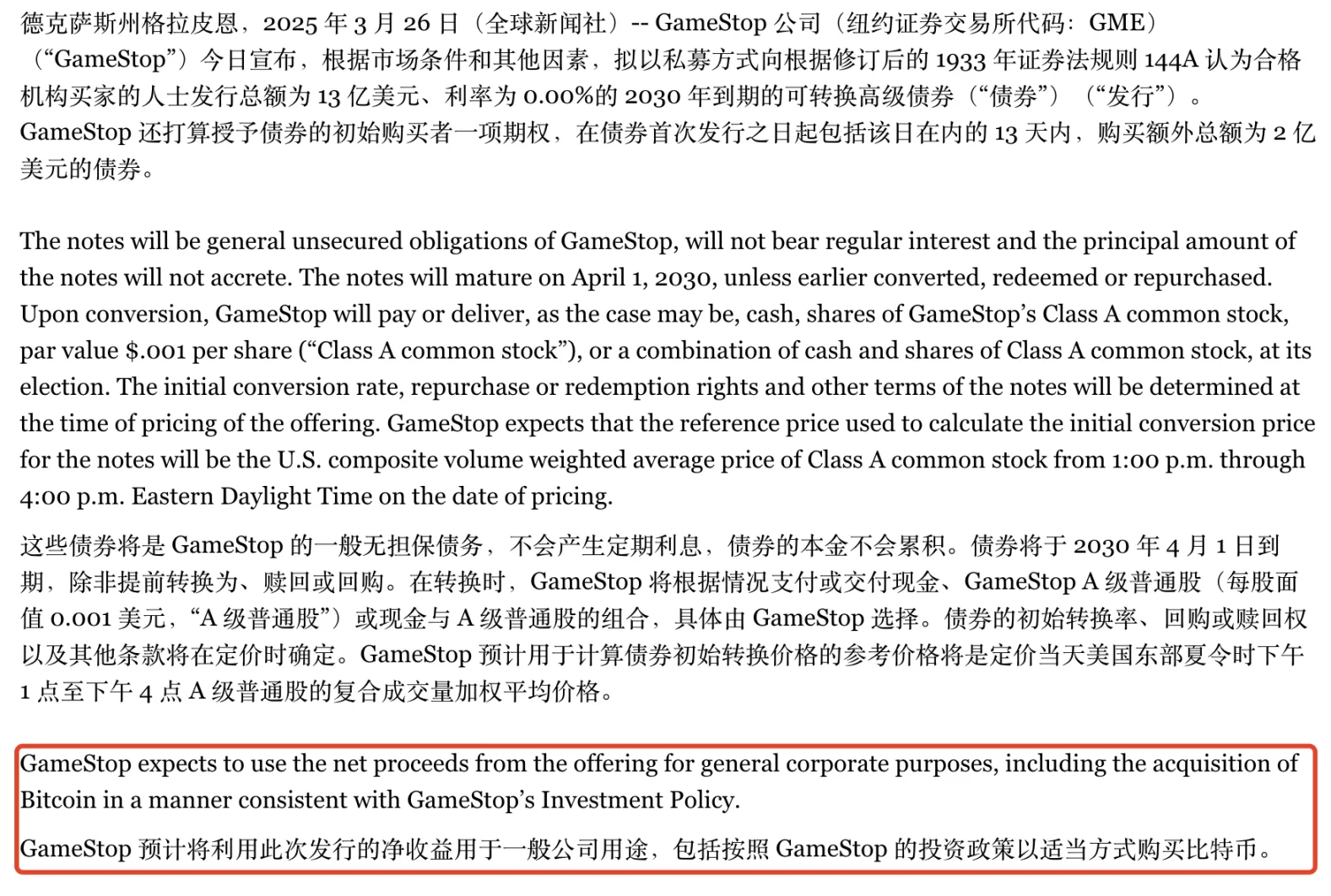
GameStop explicitly indicates new proceeds may be used to purchase BTC
Reactions: Criticism and Support, But No Commitment to Holding Forever
On March 26, shortly after GameStop officially announced its BTC treasury plan, Strategy CEO Michael Saylor commented: "A step in the right direction," later adding: "Welcome to Team Bitcoin."
Earlier, on February 24, Matt Cole, CEO of ETF issuer Strive, sent an open letter to GameStop Chairman and CEO Ryan Cohen, urging the company to allocate its nearly $5 billion in cash reserves to Bitcoin and transform itself into the "premier Bitcoin treasury company in the gaming industry." Cole noted that over the past two years, GameStop had significantly reduced operating losses and generated interest income from cash raised via equity financing to offset deficits. However, the fundamental challenge remains: physical retail is declining, and consumer preferences are shifting toward digital game downloads. As an asset manager holding GameStop shares through exchange-traded funds, Strive believes GameStop has an "incredible opportunity" to reshape its financial future by becoming a leading Bitcoin treasury firm in gaming.
Saul Rejwan, managing partner at early-stage crypto venture firm Masterkey, also argued that Bitcoin’s role as a corporate reserve asset is no longer marginal—it is increasingly seen as a viable option for companies seeking inflation resistance.
Still, critics remain. Jason Calacanis, early investor in Uber and Robinhood, questioned GameStop’s BTC treasury strategy, calling it potentially nothing more than a gimmick lacking a sustainable business model. He remarked: "If you’re a public company that can’t figure out a business model, just go buy Bitcoin. Maybe if Michael Saylor from Strategy wants to buy $1 trillion worth of Bitcoin, that would be great advice." The comment sarcastically implies that Strategy lacks any real business beyond accumulating BTC. To many traditional investors, using BTC purchases to inflate stock prices remains a radical and questionable tactic.
Importantly, GameStop did not fully replicate Strategy’s "buy and never sell" approach. In its 10-K filing, GameStop disclosed: "We have not set a cap on our Bitcoin holdings and may sell some or all of our Bitcoin positions."
The Symbiotic Effect: Cryptocurrency and U.S. Equities Growing Together
With GameStop joining the BTC treasury movement, signs of a counter-trend to BTC ETFs and ETH ETFs are emerging—what could be called the "tokenization of U.S. equities."
Looking at precedents among publicly traded companies, it's clear that many firms benefit both by using BTC as an inflation-resistant asset to preserve and grow corporate value, and by boosting market expectations to drive up stock prices.
A New Path Between TradFi and DeFi: FundFi
Another manifestation of equity tokenization is the tokenization of investment funds.
Previously, TokenFi reported that Cathie Wood, founder of Ark Invest, expressed interest in tokenizing her funds. Speaking at a digital assets summit in New York, she said: "We believe tokenization will be huge. We hope to tokenize our actively managed fund (ARKVX) or our Digital Asset Revolution Fund."
However, despite a more favorable regulatory climate following Trump’s return to power, such initiatives still face hurdles under current U.S. regulations regarding securities and asset tokenization.
The Post-Crypto IPO Era After Coinbase: Kraken, eToro Ready to Go Public
Given recent developments—including confirmed IPO plans for major U.S. crypto exchanges like Kraken and Israeli platform eToro, as well as multiple pending applications for crypto-related ETFs—it’s conceivable that one day, native crypto projects themselves may list directly on U.S. stock exchanges. When that day comes, the era of ICOs may be reborn in the form of crypto IPOs.
Of course, once that happens, the decentralized nature of the crypto ecosystem may face further centralization pressures. Whether this is a blessing or a curse remains to be seen.
Join TechFlow official community to stay tuned
Telegram:https://t.me/TechFlowDaily
X (Twitter):https://x.com/TechFlowPost
X (Twitter) EN:https://x.com/BlockFlow_News
 Odaily