Analyzing Walrus Token Economics: PoS Innovation and Pricing Mechanism in Storage Protocols
TechFlow Selected TechFlow Selected
Analyzing Walrus Token Economics: PoS Innovation and Pricing Mechanism in Storage Protocols
The key reason Walrus was able to secure substantial funding while allocating only a small portion of tokens to investors likely lies in the fact that the protocol was almost entirely built using Mysten Labs' own resources, further demonstrating Mysten Labs' strong internal capabilities.
 Navigating Web3 tides with focused insights
Author: @Steve_4P
Key Takeaways
1️⃣ On March 20, 2025, the Walrus Foundation announced a successful funding round of approximately $140 million from institutions including Standard Crypto and a16z. Walrus currently has a valuation of around $2 billion, with 7% of token supply allocated to investors and 10% reserved for initial community airdrops—reflecting a community-centric distribution strategy.
2️⃣ The reason Walrus was able to secure significant funding while allocating only a small portion of tokens to investors likely lies in the fact that the protocol was almost entirely built using Mysten Labs' own resources—an achievement that further demonstrates the strength of Mysten Labs’ internal capabilities.
3️⃣ Unlike existing storage protocols, Walrus adopts a Proof-of-Stake (PoS) mechanism, meaning the $WAL token will play a critical role in ensuring long-term trust in the Walrus protocol. As such, $WAL is considered an asset with high potential value.
01 Background: Why Is Walrus’ Funding So Surprising?
1.1 What does raising $140M at a $2B FDV mean?
Source: Walrus
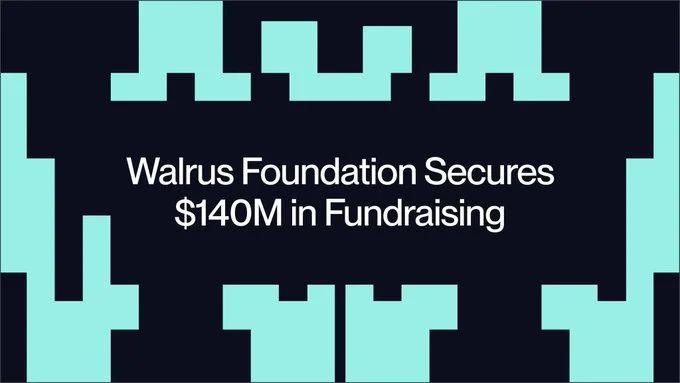
On March 20, 2025, Mysten Labs unveiled details about its next-generation decentralized storage protocol Walrus, including funding amount, valuation at investment, and investor list.
-
Total funding raised: $140 million
-
Valuation: ~$2 billion
-
Investors: Includes well-known crypto funds such as Standard Crypto, a16z crypto, and Electric Capital.
-
Mysten Labs CEO Evan stated that demand for Walrus during fundraising was "extremely strong."
The funding amount and valuation of Walrus shocked me. While a $2 billion valuation and $140 million raise are not unprecedented in the blockchain industry (projects like Story, Berachain, and Monad have achieved similar valuations), such figures are extremely rare within the highly specialized field of “decentralized storage.”
Walrus Valuation Comparison
To better illustrate Walrus’ unique position in the decentralized storage space, consider this comparison:
🔹 Filecoin, currently the highest-market-cap storage network in the blockchain market, has a market cap of about $2 billion and an FDV of around $6 billion.
🔹 Walrus, which hasn’t even launched its mainnet yet, already reaches one-third of Filecoin’s valuation—making it the second-highest valued decentralized storage protocol in the blockchain market.
🔹 This means Walrus is writing a new chapter in the history of decentralized storage.
Uniqueness of Investors
Another notable aspect of this funding round is that nearly all institutions participating in the token sale were early investors in Mysten Labs.
For example:
✅ Standard Crypto (lead investor in this round) also invested in Mysten Labs’ Series A.
✅ a16z (Andreessen Horowitz) participated in both Series A and B.
✅ Electric Capital joined in Series A.
✅ Franklin Templeton took part in Series B.
This mirrors the philosophy behind the $WAL airdrop, reinforcing alignment between Walrus and long-term supporters of the Sui ecosystem.
Given the relationship between Walrus and Sui (see my previous article), this investment structure represents an ideal model—because as Walrus grows, the Sui ecosystem benefits too.
Walrus May Have Created a First in Blockchain
To my knowledge, this might be the first case where a protocol incubated by an L1 team has successfully raised such a large sum. This makes Walrus’ fundraising a major highlight in the crypto market.
1.2 How Much Did Investors Get?
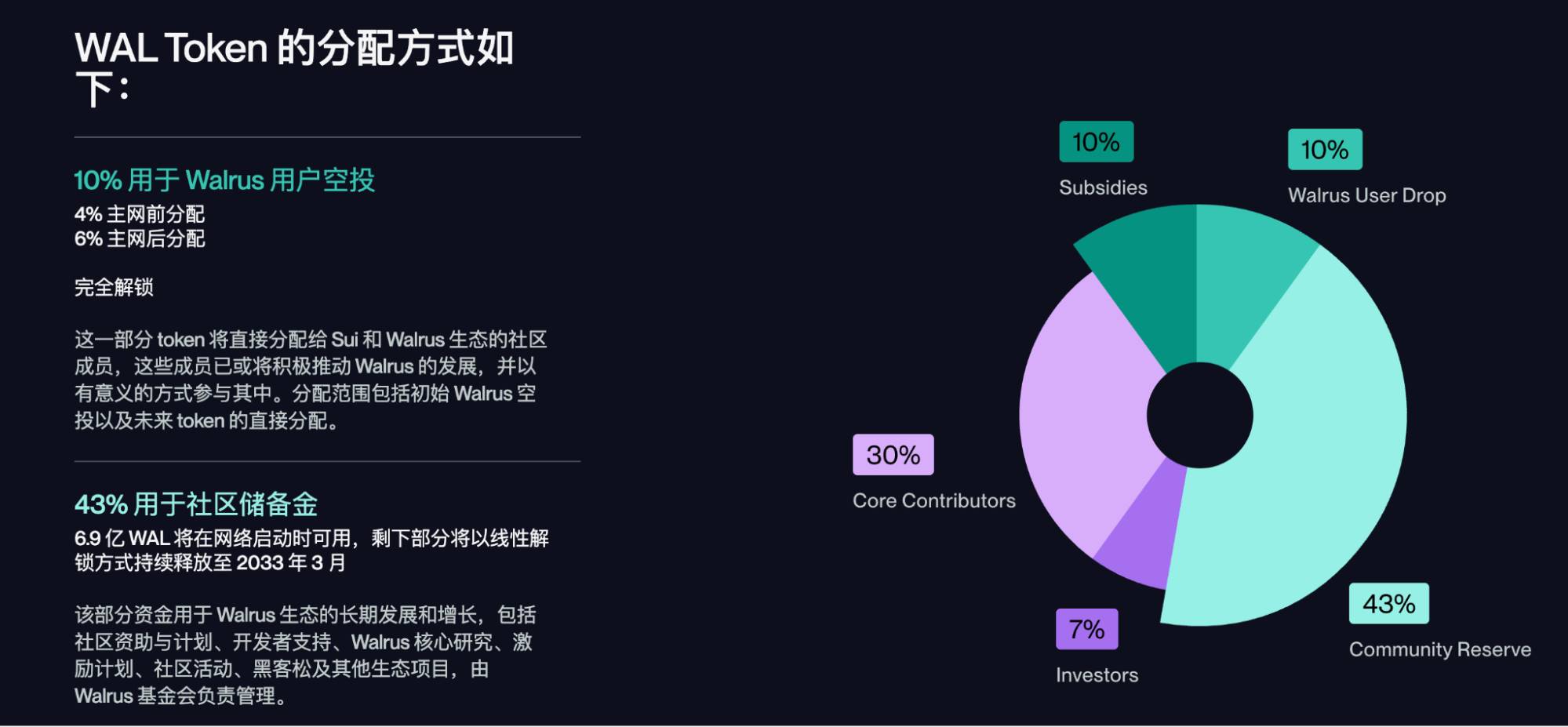
Source: Walrus Token Economics
1.2.1 Airdrop Size > Investor Allocation
One advantage of Walrus is that after testnet validation, the protocol is already well-prepared for mainnet launch. Typically, many blockchain infrastructure projects require 1–2 years—or even 3–4—to become ready, necessitating staged fundraising rounds at progressively higher valuations. Naturally, earlier-stage investments come with lower valuations, requiring more token allocation to investors.
Walrus took the opposite approach—since the protocol is nearly complete, they secured a high valuation in their first funding round. As a result, despite receiving substantial investment, they allocated relatively few tokens to investors.
According to Walrus’ token economics, only 7% of $WAL is allocated to investors—less than the 10% set aside for user airdrops. This shows the team is acutely aware of community backlash against excessive investor allocations.
I believe this strategy was feasible because Mysten Labs had sufficient internal resources to develop and evolve Walrus without relying on external funding. With fewer tokens going to investors and more incentives directed toward the community, Walrus’ tokenomics, investment strategy, and valuation model appear particularly attractive and ideal in today’s market.
1.2.2 How Will the Remaining 6% Airdrop Be Distributed?

Source: Adeniyi
After reviewing Walrus’ token distribution chart, many retail investors’ top question is: “Who will receive the remaining 6% of the 10% airdrop?”
At first glance, 6% may seem small, but based on Walrus’ $2 billion valuation, this portion is worth approximately $120 million—an enormous incentive pool.
Currently, no official information has been released about how this 6% will be distributed, so I cannot make definitive conclusions. However, drawing from my research into various airdrop strategies across the industry, I speculate this allocation may relate to the earlier 4% airdrop.
When distributing the initial 4%, Walrus appears to have carefully evaluated whether users held Sui ecosystem tokens (like $DEEP or $NS) and whether they immediately sold after receiving the airdrop. This makes sense—since $DEEP and $NS were themselves distributed via airdrop, users who continue holding them are more likely to have long-term confidence in the entire Sui ecosystem.
Therefore, I suspect the remaining 6% may also consider users’ initial $WAL holdings. For instance, if a user stakes their $WAL immediately after receiving the 4% airdrop, they might qualify for additional rewards. Of course, only those inside Mysten Labs know the final answer—but if you’re bullish on Walrus long-term, holding and staking could be a smart strategy.
1.3 Deep Dive Into Walrus Tokenomics
Now that we understand Walrus’ valuation and token allocation strategy, let’s delve deeper into its tokenomics. The most important point about Walrus’ design is that it is not just a decentralized storage protocol—it also implements a PoS (Proof-of-Stake) mechanism.
In this section, we’ll explore why Walrus chose PoS, how Walrus nodes determine storage pricing, and its governance mechanisms.
1.3.1 Why Did Walrus Choose PoS?
While closely following Walrus and writing comparative analyses with existing storage protocols, I overlooked a key differentiator: Walrus uses a PoS mechanism.
From a user perspective, the most critical question when using a storage protocol is: “How does Walrus ensure my storage contract will be honored?” At its core, Walrus must guarantee that nodes store specific data for a defined period. However, storing data incurs real costs, and nodes may stop fulfilling their obligations over time.
In the worst-case scenario, nodes could leverage access to stored data to demand higher rewards—or even hold user data hostage for ransom. Additionally, as a decentralized protocol, Walrus risks falling into a “tragedy of the commons” situation.
To mitigate these risks, Walrus introduced a PoS mechanism. PoS acts as a minimal safeguard system to penalize malicious behavior and protect user rights.
PoS System Functions:
✅ Rewards honest nodes (those storing data per contract)
✅ Punishes malicious nodes (those violating contracts)
In essence, PoS ensures continuity and reliability of storage services.
1.3.2 How Does Walrus Determine Storage Fees?
First, Walrus’ costs mainly consist of storage cost and write cost. Storage cost refers to the rental fee required to store data over a certain period, while write cost is a one-time fee paid when registering new data. In other words, users incur write costs upon uploading data, followed by ongoing storage costs. But how does Walrus calculate these costs?
Broadly speaking, in the Walrus ecosystem, both storage and write costs are determined by nodes—not through consensus, but by each node submitting what they believe is an appropriate price. These prices are then sorted, and the price proposed by the node at the 66.67th percentile (by stake-weighted ranking—the lower two-thirds by stake) is adopted. Sui already uses this pricing mechanism for transaction fees. If this sounds complex, here’s an example:
Each node proposes a “price”:
-
Node A: $0.9
-
Node B: $1.0
-
Node C: $0.5
-
Node D: $1.2
Sort nodes by price from low to high:
Node C → Node A → Node B → Node D
Stake amounts per node:
-
Node A: 10
-
Node B: 20
-
Node C: 15
-
Node D: 5
Total stake = 50; 2/3 of total = 33.3. When cumulatively adding up stakes in price order, the cumulative stake reaches 33.3 at Node B (since Nodes C and A together only reach 25). Therefore, Node B’s proposed price of $1 becomes the final cost in the Walrus ecosystem.
Both storage and write costs use this method, but write cost includes an additional Hardcoded Factor—a fixed deposit users must pay when uploading data. This mechanism incentivizes users to replicate their data across as many nodes as possible.
In the Walrus ecosystem, users don’t need to upload data to every node—as long as data is stored on at least (f+1) to (2f+1) nodes, it can be considered uploaded on-chain. However, if another node later needs to access the data, additional recovery or data transfer operations may occur, increasing overall network costs.
To address this, Walrus collects an extra deposit upfront when users upload data, which is refunded if users proactively replicate the data across more nodes—thereby encouraging widespread data replication. The Hardcoded Factor is a fixed value but can be adjusted via token governance.
Summary:
-
Storage Cost: Determined directly from node-submitted prices, final price selected at 66.67th percentile based on stake-weighted ranking.
-
Write Cost: Calculated the same way, but users also pay an additional deposit via the Hardcoded Factor to incentivize broader data replication.
1.3.3 Token Governance Mechanism
Walrus employs a governance model similar to other PoS networks. Although the mainnet hasn’t launched yet, and exact implementation details aren’t public, according to the whitepaper, Walrus governance will adjust several key parameters, such as:
-
Punishment mechanisms for nodes
-
Compensation for affected nodes
-
Adjustments to key protocol parameters
Walrus governance follows a 2f+1 storage node approval principle, with voting power proportional to the number of $WAL tokens held and delegated.
02 Conclusion: No Airdrop, No Community
2.1 Only Mysten Labs Could Pull This Off
Walrus’ token distribution is truly impressive. Raising $140 million while allocating only 7% of total supply to investors is surprising. But one must ask: besides Mysten Labs, how many teams could execute such a strategy?
From the start, Mysten Labs has been a company deeply thoughtful about blockchain infrastructure. Though young, their roots in blockchain research trace back to the Diem era—a remarkably long timeline. This allowed them to build Walrus: a product clearly distinct from existing storage protocols and highly efficient. Because the product is already so mature, they were able to raise funds successfully with minimal token dilution.
I don’t know how many more protocols or products Mysten Labs will launch in the future, but with their current resources, they’re already uniquely positioned to stand out in the blockchain industry.
2.2 Which Ecosystem Truly Cares About Its Community Today?

Source: Adeniyi
Whether people remember or not, Sui gained attention as a Layer 1 blockchain that launched its mainnet without an initial airdrop. At the time, many mocked Sui as a “scam,” criticizing Sui and Mysten Labs with the phrase “no airdrop, no community.” Yet now, approaching its second anniversary since mainnet launch, negative sentiment around Sui has completely faded.
In fact, Sui may be the Layer 1 that has rewarded its community the most. From $DEEP and $NS to $WAL, Deepbook airdropped 10% of its $1 billion FDV ($100 million), and Sui Naming Service airdropped 10% of its $100 million FDV ($10 million). In other words, users who stayed active and contributed to the Sui ecosystem likely earned substantial economic returns.
Returning to Walrus, Adeniyi once said, “Walrus will be one of the largest airdrops in crypto history”—and that claim now seems accurate. With a $2 billion FDV, a 10% airdrop means roughly $200 million worth of tokens will go directly to the community.
Upon reflection, Mysten Labs’ “post-mainnet airdrop” strategy appears more effective at cultivating a genuinely passionate community. If airdrops happen at mainnet launch, it’s hard to distinguish true loyalists from short-term bounty hunters. But by waiting until after mainnet operation to observe user behavior before distributing airdrops, teams can better identify and reward deserving participants.
Moreover, by airdropping multiple ecosystem tokens, users are continuously engaged and anticipate new “rewards”—not only attracting new users but also strengthening loyalty among existing ones.
Recently, the Sui community, alongside Hyperliquid, has been described as one of the “most enthusiastic communities” in crypto—demonstrating why some projects manage to build such vibrant ecosystems.
So, which project today truly cares about its community?
Join TechFlow official community to stay tuned
Telegram:https://t.me/TechFlowDaily
X (Twitter):https://x.com/TechFlowPost
X (Twitter) EN:https://x.com/BlockFlow_News
 Four Pillars