Traffic Secrets: Unlocking X's Recommendation Algorithm and Efficient Operations Strategies
TechFlow Selected TechFlow Selected
Traffic Secrets: Unlocking X's Recommendation Algorithm and Efficient Operations Strategies
Maintain stable and high-quality output, adept at capturing short-term trends, and utilize diverse interactive techniques.
 Navigating Web3 tides with focused insights
Author: murmurphy.eth
In the Web3 space, X (formerly Twitter) is undoubtedly the core platform for project operations and market expansion. For practitioners and investors alike, X is not only an excellent platform to enhance personal influence but also a prime venue to uncover new opportunities. This article will unveil the recommendation algorithm and share practical operational strategies to help you rapidly boost content visibility and engagement.
This article takes a deep dive into X's official recommendation algorithm, breaking down its logic and offering simple yet effective strategies to help you quickly gain traction.
Quick tip: Don't want to read through the algorithm details? Skip directly to "Tweet Engagement Strategy & Rhythm Management" and "Efficient Traffic Acquisition & Leverage Strategies" for actionable insights.
X (Twitter) Recommendation Algorithm Workflow
The core of Twitter’s "For You" timeline recommendation system is predicting user interest in each tweet based on vast interaction data. The specific process is illustrated below:
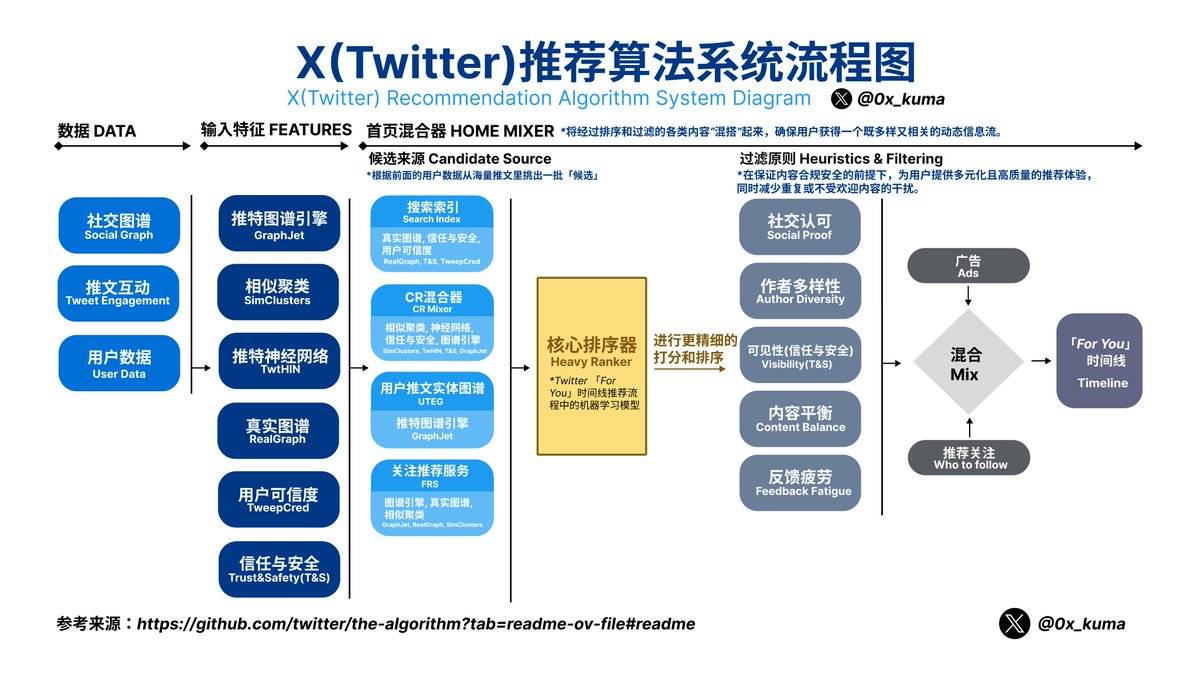
Step 1. Data Collection (Data) These data collectively form the "raw material" for the recommendation system, providing a solid foundation for subsequent feature extraction and model training, ensuring the algorithm can accurately capture user interests and behavioral patterns.
-
Social Graph: Captures user follow relationships and interaction patterns, helping build social networks and identify users' circles of influence and active connections.
-
Tweet Engagement: Tracks user interactions with tweets—likes, replies, reposts, etc.—reflecting content popularity and intensity of user interest, providing key data for assessing tweet quality and relevance.
-
User Data: Gathers personal preferences, usage habits, and historical behavior to help models more precisely identify and predict user interests and behavioral patterns.
Step 2. Feature Extraction (Features) After acquiring raw data, the system uses various tools to deeply process this information into structured features usable by machine learning models.
-
GraphJet: A real-time graph engine analyzing bidirectional interactions between users and tweets.
-
RealGraph: Captures authentic social relationships and interaction patterns.
-
SimClusters: Uses clustering algorithms to group users or tweets with similar interests, uncovering latent associations.
-
TwtNN: A deep learning model capable of extracting multidimensional features to more accurately capture user interests.
-
TweepCred: Measures a user’s credibility and influence on the platform, serving as a reference for trust evaluation.
-
Trust & Safety: Dedicated to detecting and filtering rule-breaking or harmful content, ensuring recommended content is safe and compliant.
These tools transform massive raw data into structured features, laying the groundwork for accurate identification of which tweets deserve promotion.
Step 3. Candidate Sources (Candidate Source) During candidate generation, the system rapidly filters through millions of tweets to identify those potentially aligned with user interests, forming the basis for later ranking. This stage operates through four primary channels:
-
Search Index: Extracts tweets related to current trends via keywords or popular searches.
-
CR Mixer: Mixes, deduplicates, and filters candidate lists before passing them to the core ranker.
-
UTEG: Builds relationship graphs linking users, tweets, and entities (keywords/topics), enabling deeper understanding of user-content alignment.
-
FRS: Follow Recommendation System identifies accounts you might find interesting but don’t yet follow, introducing their tweets as candidates to increase diversity and expose you to high-quality content.
Overall, this stage ensures the candidate list includes both trending topics and reflections of long-term user interests through multi-dimensional, multi-channel screening—laying a solid foundation for precise ranking.
Step 4. Ranking Engine (Heavy Ranker) At this stage, the system employs deep neural networks to evaluate each candidate tweet. It first calculates predicted probabilities for different types of user interactions (e.g., like, reply, repost), then multiplies these by preset weights and sums them up to produce a final composite score. Higher scores mean greater likelihood of appearing on the timeline.
According to default weights published on Twitter’s official GitHub on April 5, 2023, the approximate weights and meanings are as follows:
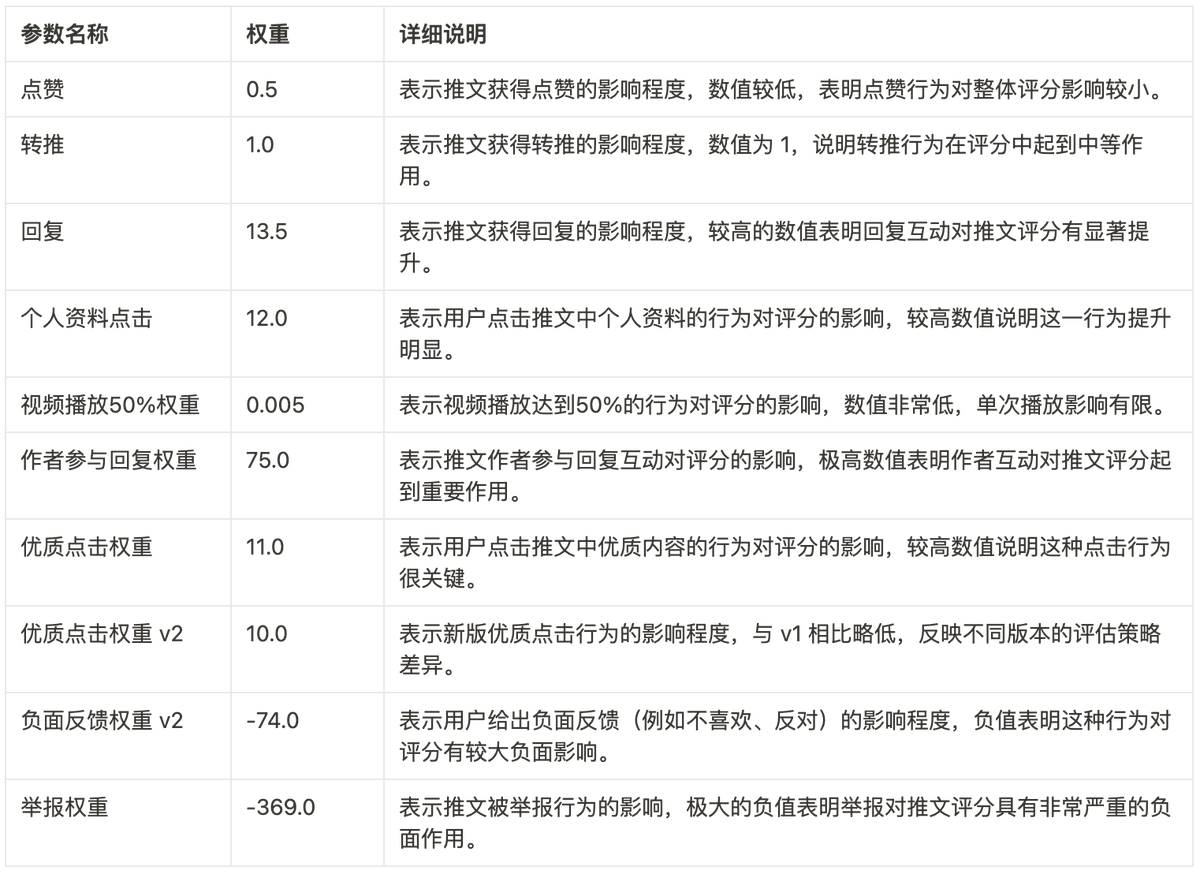
By weighting positive and negative interactions, Heavy Ranker quickly identifies content most likely to appeal to users while deprioritizing less desirable content.
Step 5: Heuristics & Filtering Content after ranking undergoes additional rule-based adjustments to ensure diversity and compliance with platform standards. This step checks overall热度 (popularity) and social validation, promotes author diversity to avoid overrepresentation from one source, and reduces visibility or filters out tweets containing violations, sensitive content, or excessive duplication. This acts as a “final gatekeeper,” downranking or removing repetitive, inappropriate, or rule-breaking content.
Step 6: Mixing and Timeline Generation Finally, the system integrates ads and recommends new accounts to follow into the filtered and ranked stream of tweets, aiming to present a rich and balanced information feed. The system continuously adjusts based on your latest activity, ensuring ongoing alignment with your evolving interests.
In summary: Twitter uses a layered process—data collection, feature extraction, candidate generation, ranking, filtering, and mixing—to curate and deliver content best suited to individual user preferences.
Tweet Engagement Strategy & Rhythm Management
To maximize exposure of your tweets in target users’ timelines, focus on two critical stages: Candidate Generation and Core Ranking, ensuring your content gets included in the candidate pool and earns high scores during ranking. Below are proven tactics:
1⃣ Basic Engagement: Drive Likes, Replies, and Reposts
Replies carry the highest weight in the ranking engine, and reciprocal engagement (e.g., original poster responding back) can reach a staggering weight of 75.0. This two-way interaction is a powerful positive signal indicating that the tweet not only attracted attention but also sparked meaningful dialogue, significantly boosting visibility. Pose open-ended or controversial questions to invite comments. Always respond thoughtfully to replies, engaging deeply with users’ ideas. This increases reply counts and makes followers feel valued, strengthening account stickiness.
2⃣ Advanced Engagement: Encourage Profile Visits & Extended Reading
A single tweet that prompts someone to click through to your profile and explore further signals strong interest. Profile visits followed by other interactions (weight: 12.0) indicate users care about more than just one post—they’re interested in the creator.
Include clear calls-to-action encouraging profile clicks. Use pinned tweets or curated lists (Moments) to showcase your best content, making it easy for visitors to discover and engage with more of your work.
3⃣ Stability & Surge: Balance Long-Term vs Short-Term Engagement
Twitter’s rolling aggregation features (“long-term” 50 days + “short-term” 3 days or even 30 minutes) mean the platform evaluates both sustained performance and real-time spikes. Specifically:
-
Long-Term Performance: Regularly publish high-quality evergreen content (e.g., daily macro analysis) to steadily accumulate engagement and build brand authority.
-
Short-Term Surge: Capitalize on trending moments and peak fan activity to release timely updates, aiming for rapid, high-volume engagement that boosts short-term metrics.
Both long- and short-term data are constantly refreshed—the platform always watches your latest moves. Monitor engagement and follower growth regularly; if short-term interaction dips, adjust topics or posting times promptly to protect long-term standing.
4⃣ Group Engagement: Expand Social Graph & Spark Organic Discussions
Authentic cross-account mentions allow the platform’s RealGraph to detect natural interactions, while GraphJet updates your social graph in real time. This helps identify active participants and exposes more users to your network, increasing visibility. Comment section engagement is highly valuable too—liking/replying to comments or spending over 2 minutes on a thread carries weights of 11.0 and 10.0 respectively.
💡Combining tactics amplifies impact. For example, create a series of tweets around a central theme from multiple angles. Designate one main tweet as the “entry point,” and include links to others in replies or your pinned post, creating interlinked content. This strengthens relatedness among candidate tweets, expands candidate sourcing and social graph signals, and may trigger additional engagement behaviors (like visiting your profile). Such联动 (interconnected) content drives short-term surges while building a long-term content matrix, helping maintain stable performance across rolling aggregation windows (50-day + short-term).
This series-based strategy enriches your content ecosystem and aligns perfectly with the platform’s criteria for relevance and engagement, thereby improving overall visibility.
Efficient Traffic Acquisition & Leverage Strategies
1⃣ Trend Leverage: Rapid Response to Breaking Events
During data collection, the system incorporates high-frequency interactions and user attention from trending events into Tweet Engagement and User Data, treating timeliness and freshness as key features. Because these indicators help assess current relevance, timely responses are more likely to be prioritized in candidate generation and receive continuous scoring boosts in the Heavy Ranker due to rising engagement, ultimately gaining higher placement in the Mixing phase.
An effective approach is to publish commentary or insights immediately when a trend emerges, seizing first-mover advantage. Then, continuously update your perspective or add new information as the story evolves, keeping the tweet active. The system uses engagement and comment velocity to judge freshness, granting higher weights in future evaluations, allowing your content to maintain an edge throughout the recommendation pipeline.
2⃣ Controversy Leverage: Spark Debate and Discussion
Promoting unique or provocative viewpoints can quickly ignite widespread discussion and replies, generating strong engagement signals. When influencers join the conversation by replying or reposting, your tweet gains broader exposure. However, when using controversy as leverage, keep discussions rational and constructive to avoid triggering penalties (such as hiding, blocking, or reporting). Negative actions carry heavy penalties ranging from -74.0 to -369.0, potentially harming not only the tweet’s visibility but also damaging your entire account’s reputation.
3⃣ Influencer Leverage: Engage With High-Profile Figures or Institutions
Interacting with prominent individuals or organizations—especially receiving engagement from high-impact accounts—signals strong credibility (TweepCred) and dissemination potential, reflected directly in your Social Graph. Such interactions elevate the social value of your content and are further amplified by deep learning models, resulting in higher visibility during the final Mixing stage.
You can increase exposure by mentioning or @-tagging relevant public figures or institutions, and strategically engage to encourage their response, enabling secondary virality. This tactic pushes your content into wider networks, enhancing credibility and propagation effectiveness.
Summary
Maintain consistent, high-quality output, adeptly seize short-term trends, apply diverse engagement techniques, and continuously track data to refine your strategy—no matter how algorithm weights shift, you’ll remain ahead. If you have additional insights, feel free to share them in the comments.
Thank you for reading all the way! If you found this helpful, please follow my account @0x_kuma—likes, comments, and reposts are the greatest encouragement!
Join TechFlow official community to stay tuned
Telegram:https://t.me/TechFlowDaily
X (Twitter):https://x.com/TechFlowPost
X (Twitter) EN:https://x.com/BlockFlow_News
 @0x_kuma