Can the "front shop, back factory" model combining Hong Kong and Shenzhen ensure compliance for Web3 startups?
TechFlow Selected TechFlow Selected
Can the "front shop, back factory" model combining Hong Kong and Shenzhen ensure compliance for Web3 startups?
The "front shop, back factory" model can still be a viable option today, provided that the team achieves clear separation of onshore and offshore resources and responsibilities.
 Navigating Web3 tides with focused insights
By Iris, Mao Jiehao
When discussing domestic Web3 entrepreneurship in China, people often refer to the September 24, 2021 document, emphasizing that conducting virtual currency financial services within mainland China constitutes illegal financial activity, which may lead to criminal liability.
However, we also observe a growing trend between Hong Kong and Shenzhen in recent years known as the "front shop, back factory" model—establishing projects or companies in Hong Kong to engage with regulators and overseas capital, while organizing development and certain operational functions in Shenzhen to leverage strong technical capabilities and lower costs.
This naturally raises questions: Is this model actually compliant? And if so, does it mean I can set up a project in Hong Kong and still operate from within mainland China?
Undoubtedly, this is both an intriguing and highly practical question.
Why Does the “Front Shop, Back Factory” Model Exist?
One might wonder: Given that the 2021 "924" document clearly states that engaging in cryptocurrency-related financial activities within mainland China is illegal, why has this “Hong Kong front shop, Shenzhen back factory” model become increasingly popular among Web3 entrepreneurs in recent years?
In 2023, Kong Jianping, board member of Hong Kong’s Cyberport, publicly stated in an interview with The Paper (Pengpai Tech) that the “front shop, back factory” arrangement between Shenzhen and Hong Kong would facilitate the development of Web3.
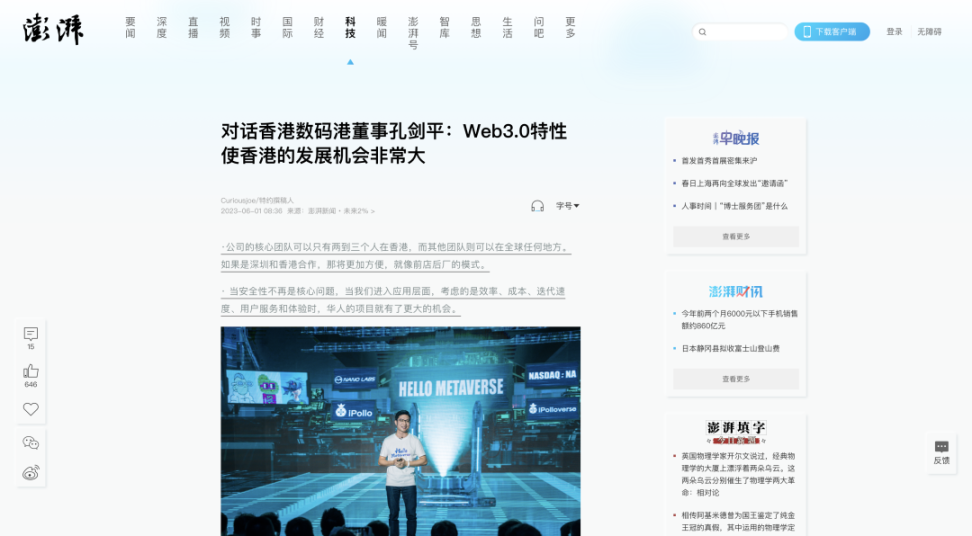
* Image source: The Paper
Mankun Law Firm believes the reason this model exists lies in how regulators assess risk—not solely based on whether a project directly serves users in mainland China, but more importantly on where the actual operations, core decision-making, and fund management take place, i.e., the location of real control and key resources.
On the surface, Web3 project teams register all legal entities and business operations in Hong Kong or other overseas jurisdictions. They use technical measures such as IP blocking and KYC procedures to restrict financial service offerings to Hong Kong and international users only. Meanwhile, processes like fund settlement, licensing applications, and marketing are carried out entirely through offshore entities.
In this way, both commercially and operationally, these projects avoid serving users in mainland China, thereby aligning with Chinese regulatory policies.
From a technical development perspective, choosing to build engineering teams in Shenzhen is driven by cost efficiency and technological advantage. As a key component of the Guangdong-Hong Kong-Macao Greater Bay Area, Shenzhen offers a mature R&D ecosystem and abundant Web3 talent. Compared to local Hong Kong teams, Shenzhen provides clear advantages in labor costs, development cycles, and technical expertise. For many Web3 teams, outsourcing core development work to Shenzhen is simply a rational business decision—no different in principle from the traditional internet industry practice of “offshore company + onshore outsourced development.”
In short, the Hong Kong–Shenzhen “front shop, back factory” model appears to temporarily sidestep direct regulatory intervention by clearly separating domestic and international operational roles. However, this model remains inherently sensitive from a compliance standpoint.
Potential Challenges of the “Front Shop, Back Factory” Model
At first glance, the “front shop, back factory” approach seems to achieve a “clear separation” between domestic and overseas operations—registering a compliant entity in Hong Kong while retaining only technical development within mainland China—to stay clear of red lines. But the issue lies precisely here: In Web3 projects, technical development, product iteration, and business operations are deeply intertwined. Domestic tech teams often go beyond mere coding and inevitably get involved in token design, partial operations, data processing, or even user support—creating latent compliance risks.
Regulators do not merely examine whether the nominal structure complies with rules; they conduct substance-over-form scrutiny into who holds real control over the project—who makes key operational decisions, manages funds, and controls user data. If day-to-day management, critical decisions, and financial handling remain concentrated within mainland China, even with a Hong Kong-registered entity and services limited to overseas users, regulators could easily conclude that the project is substantively using mainland resources to offer illegal financial services in disguise.
More notably, some projects, aiming to reduce costs or improve efficiency, outsource market promotion, community management, or even customer service to their Shenzhen teams—or allow mainland-based staff to initiate global operational campaigns. In such cases, regulators may determine that the core operational chain hasn’t been properly severed, suggesting deliberate circumvention of regulations.
Furthermore, because technical teams are deeply involved in product logic design, even when new products or features appear to launch overseas, the entire development and deployment process may have already taken place in Shenzhen. This further blurs the line between the domestic team and financial service provision.
In other words, the risk of the “front shop, back factory” model doesn’t stem from whether a compliant offshore entity exists on paper, but whether domestic and overseas functions are truly isolated in practice. Once the mainland team touches any core aspects—fund decisions, operations management, or user services—the compliance risk for the Web3 project spikes dramatically. Regulators could easily view it as “operating under false pretenses,” potentially leading to legal consequences.
Recommendations from Mankun Law Firm
As discussed above, while the “front shop, back factory” model creates a seemingly compliant structure by establishing a Hong Kong entity and restricting access to mainland users, today’s regulators increasingly focus on substance over form. To genuinely minimize legal risk, Web3 project teams cannot rely solely on superficial functional divisions.
Mankun Law Firm advises Web3 startups adopting the “front shop, back factory” model to pay close attention to the following:
First, completely sever the core control links between domestic and overseas operations. Day-to-day decision-making, fund flows, user data handling, marketing, and operational management must all be independently executed by the offshore registered entity. These responsibilities should never be outsourced back to mainland teams. Technical development may be handled by Shenzhen teams depending on project needs, but strictly confined to pure R&D tasks. It must not extend to post-launch activities such as fund management, user operations, or marketing events, to prevent crossing regulatory red lines.
Second, avoid mixing technical development with product operation roles. Many projects, due to their tech teams’ deep understanding of product logic, tend to involve them in tokenomics design or user engagement—this effectively blurs the boundary between onshore and offshore functions. Project teams should clearly define the scope of work for technical staff and strictly separate them from Hong Kong-based compliance and operations teams, ensuring that technical development remains purely a “back factory” function rather than participating in “front shop” business execution.
Third, establish clear legal and compliance firewalls. With assistance from legal professionals, Web3 teams should create robust isolation mechanisms at the contractual, personnel, and financial levels between the offshore entity and mainland team. This includes explicitly prohibiting mainland teams from involvement in fund settlement, token distribution, or user management within technical service agreements. Additionally, establish an independent offshore legal entity or foundation to hold intellectual property, assets, and brand rights, preventing the mainland party from being deemed a de facto partner or co-operator due to nominal “technical services.”
Finally, proactively complete compliance registrations across relevant jurisdictions. If the Web3 project is headquartered in Hong Kong, it is advisable to either self-initiate or hire professional legal counsel to apply for necessary licenses early on, ensuring all user-facing financial services operate within a regulated framework. At the same time, avoid conducting any promotional marketing, community operations, or payment settlements in mainland China to reduce the risk of being perceived as indirectly providing services to mainland residents.
In conclusion, while the current “front shop, back factory” model remains a viable real-world option, its legitimacy hinges on the team’s ability to achieve genuine separation of resources, responsibilities, and authority across borders—preventing mainland-based technical development from becoming the invisible backbone of offshore financial operations. Nevertheless, under existing regulations, this model is far from optimal for long-term sustainability. As oversight intensifies, so do the risks. A minor misstep could result in criminal penalties and total loss of progress.
Therefore, Mankun Law Firm continues to advise Chinese entrepreneurs to fully embrace a true “going global” strategy—relocating technology development, corporate governance, and financial operations entirely offshore—and subject themselves to the compliance supervision of foreign regulatory authorities.
Join TechFlow official community to stay tuned
Telegram:https://t.me/TechFlowDaily
X (Twitter):https://x.com/TechFlowPost
X (Twitter) EN:https://x.com/BlockFlow_News