









Crypto Survival Guide: From "Closing Eyes and HODLing" to "Making Fewer Mistakes"
TechFlow Selected TechFlow Selected
Crypto Survival Guide: From "Closing Eyes and HODLing" to "Making Fewer Mistakes"
No bad investments, no bad years.
 Navigating Web3 tides with focused insights
By: Blockchain Knight
After BTC broke through $100,000, instead of continuing its upward trajectory, the entire crypto market has entered a three-month-long bearish slump. Lately, the most frequently seen term is "falling back into poverty"—many players who previously enjoyed solid gains are now struggling anew.
On one hand, BTC ETFs have made a grand entrance onto the historical stage; on the other, the market has deteriorated severely. Facing such a dire environment, surviving amidst volatile ups and downs requires abandoning the mindset that worked in previous cycles—because we must admit: the market has changed.
So how do we survive in this frustrating market? The author recently came across some insightful perspectives worth sharing.
Let’s start with a question: In a top-tier professional tennis match, what matters more—technique or mentality? And how about in an amateur match?
To answer this, Dr. Simon Ramo, a scientist and statistician, wrote an excellent book on tennis strategy titled *Extraordinary Tennis for the Ordinary Player*.
Through long-term observation, he found that tennis takes two distinct forms: one played by professionals and a rare few gifted amateurs, and the other by ordinary recreational players. Despite using the same equipment and rules, the nature of these two games is fundamentally different.

Through systematic statistical analysis, Dr. Ramo concluded: professionals win points through active scoring, while amateurs lose points due to constant mistakes. Professionals engage in long, intense rallies with powerful, precise shots, applying relentless pressure to force opponents out of position. These elite players rarely make errors—their matches are classic "winner's games," where outcomes are determined entirely by the winner’s superior performance. Victory means not just scoring more, but dominating through aggressive play.
In contrast, amateur tennis looks completely different. Spectacular shots, thrilling extended rallies, and miraculous saves are rare. Instead, balls frequently hit the net or go out of bounds, service faults are common, and amateurs seldom truly beat their opponents—they mostly defeat themselves. The winner scores more not because of skill, but because the opponent makes more mistakes.
Dr. Ramo validated his theory with an innovative approach: replacing traditional scoring with a tally of points won versus lost. His data showed that in professional matches, 80% of points are won through aggressive play, while in amateur matches, 80% result from the opponent's errors.
This means professional tennis is a quintessential "winner's game," decided by the victor’s excellence, whereas amateur tennis is a "loser's game," determined by the loser’s mistakes—two entirely different contests at their core.
Based on this insight, Dr. Ramo developed a complete winning strategy: ordinary players can consistently win by simply following one principle—"minimize mistakes and let the opponent self-destruct."
He emphasized that if the goal is victory rather than entertainment, the key strategy should be steady defense, maintaining shot consistency, and giving the opponent ample room to err. After all, most amateurs unknowingly trap themselves in a "loser's game," eventually losing through self-inflicted damage.
In his book, Dr. Ramo reveals the essential difference between the "winner's game" and the "loser's game": in the former, victory depends on exceptional skill exceeding expectations; in the latter, victory goes to whoever makes fewer mistakes than others.
Charles Ellis, hailed by *Fortune* magazine as "the smartest man on Wall Street" and a leading figure in investing, classified modern investing as a loser's game and authored the bestseller *Winning the Loser's Game*.
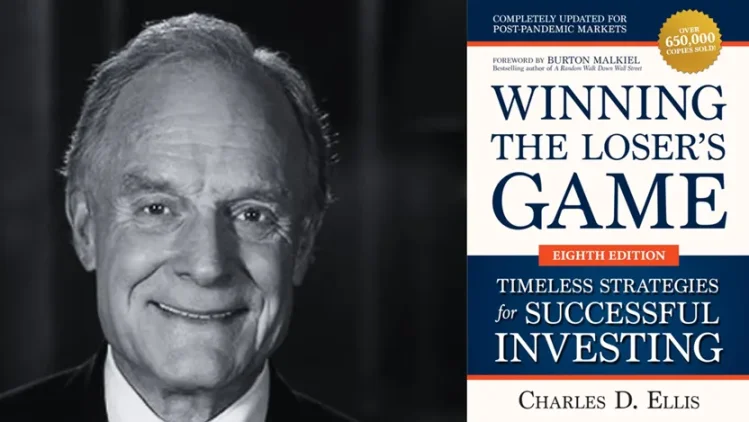
As Ellis writes, investing is like playing tennis—the winner prevails simply by making fewer mistakes, achieving better long-term results, while losers ultimately incur losses due to repeating the same errors. No one can avoid new mistakes, but successful investors repeat old ones far less often.
Applying this to the crypto market: it was once a winner’s game, where participation and victory required above-average skill. Today, however, the crypto market has largely devolved into a loser’s game—survival hinges on making fewer mistakes. Just staying in the game is enough to win.
The logic now is simple: when everyone else is recklessly engaging in PvP battles or over-leveraging, we merely need to refrain from crossing those lines, thereby greatly increasing our odds of success.
This explains why in past markets, blindly buying during bull runs was sufficient for profit—but that no longer works today. The game has fundamentally changed. Over 90% of market participants don’t need sophisticated techniques or strategies; what matters is reducing the frequency of errors to achieve above-average returns.
As Howard Marks, founder of Oaktree Capital, put it: “For long-term success in investing, perhaps the best approach is to avoid mistakes—don’t make bad investments, don’t have terrible years. Simply accumulate good investments one by one, deliver consistent performance year after year, decade after decade—20, 30, 40, 50 years—and that, over time, constitutes a successful investment career.”
May we all find our own victory in this game. Stay strong.
Join TechFlow official community to stay tuned
Telegram:https://t.me/TechFlowDaily
X (Twitter):https://x.com/TechFlowPost
X (Twitter) EN:https://x.com/BlockFlow_News












