Gold breaks through $3,000, reaching another price milestone
TechFlow Selected TechFlow Selected
Gold breaks through $3,000, reaching another price milestone
Trump becomes gold's "big benefactor"—next target $3,500?
 Navigating Web3 tides with focused insights
Author: Yang Dapan
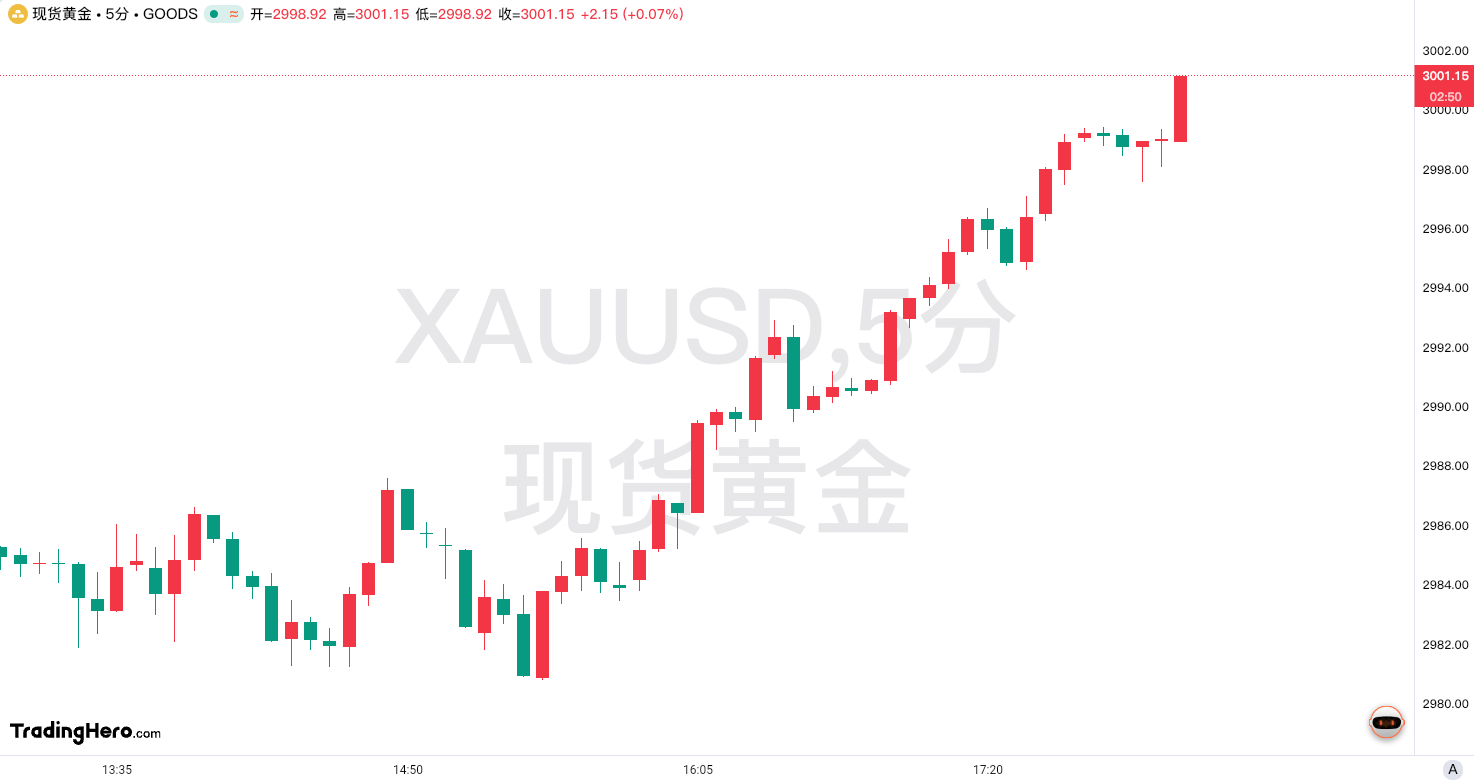
On Friday, gold hit a fresh all-time high, surpassing the $3,000 mark that many Wall Street investment banks had forecast. The precious metal has risen nearly 15% since the beginning of the year.
Nitesh Shah, WisdomTree's head of commodities strategy, said: "The risks for gold are slightly skewed to the upside, as market confidence in gold is strong and could persist if this disorderly policymaking continues."
U.S. President Trump’s tariffs have played a significant role in boosting gold demand. A global trade war has disrupted financial markets and sparked recession fears, with the conflict escalating further after Trump threatened on Thursday to impose 200% tariffs on alcohol imports from Europe.
"Momentum and safe-haven demand driving ETF holdings higher are also supporting gold prices," said Ole Hansen, head of commodity strategy at Saxo Bank.
The world's largest gold-backed ETF, SPDR Gold Trust, reported holdings of 905.81 tonnes, having reached their highest level since August 2023 by the end of February.
While all eyes are focused on this milestone, one bank says the rally in gold is far from over even after breaking through this level.
Macquarie Bank’s commodities team, led by Marcus Garvey, updated its 2025 gold price forecast on Thursday, now expecting the precious metal to climb as high as $3,500 per ounce in the third quarter, matching the inflation-adjusted all-time peak set in January 1980.
This update comes as gold is already trading at Macquarie’s previously projected Q2 target.
Analysts noted that gold remains a key safe-haven asset amid expectations from the bank’s economists for global economic growth to slow to just 0.3% in the third quarter of this year.
In their report, Macquarie analysts stated: “We believe the strength in gold prices so far—and our expectation for continued strength—is primarily driven by increased risk aversion among investors and official institutions. This is evident in gold reaching nominal record highs (US$2,956 per ounce on February 24), despite the relatively high opportunity cost of holding gold as a zero-yielding asset.”
Beyond gold’s safe-haven appeal, Macquarie also believes that deteriorating prospects for rising U.S. government debt are fueling gold’s rally. With Congress failing to pass a new appropriations bill, the U.S. government again faces a potential shutdown. Looking ahead, analysts expect the government will be unable to significantly cut spending.
“Although outcomes remain inherently uncertain, our base case assumption is that Congressional Budget Office projections for budget deficits will worsen relative to current law—tariff revenues, savings achieved by the Department of Government Efficiency (DOGE), and potential Medicaid cuts won’t fully offset the extension of the Tax Cuts and Jobs Act (TCJA), which could add 1.5 percentage points to the deficit,” analysts said. “In this challenging fiscal environment—and similar fiscal backdrops across many developed economies—gold prices could remain at historically elevated levels.”
Garvey’s team also expects that gold’s rally would accelerate if the Trump administration challenges the Federal Reserve’s independence by pressuring it to cut interest rates. The Fed has recently shifted toward a more neutral stance, stating it is not in a hurry to lower rates given the still-relatively healthy U.S. labor market and persistent inflation risks.
Despite approaching a major milestone, Macquarie notes there is very little frothiness in the market. They added that with investment demand via gold-backed ETFs still about 20% below the historical highs seen in 2020, there remains ample room for further upside.
Macquarie’s commodities analysts believe downside risks for gold this year are minimal.
“Ultimately, changing this structurally supportive environment for gold would likely require a shift in market expectations regarding the U.S. deficit trajectory or positive drivers pushing long-term real yields higher—such as stronger trend productivity growth leading to higher trend GDP growth. These are plausible scenarios, but not our current base case,” they said.
While gold is expected to continue outperforming within the precious metals complex, Macquarie is also bullish on silver, raising its silver price forecast from a previous $31 to $33.50 per ounce in the third quarter.
However, Macquarie still expects the gold-to-silver ratio to remain elevated near 92.
The Australian bank forecasts that silver fundamentals—specifically supply-demand imbalances—will continue to support prices this year and into 2026.
“Silver deficits remain too large to be closed by supply growth alone—forecast at 118.9 million ounces in 2024 and 157 million ounces in 2025. We expect tightness in the underlying physical market to persist throughout our current forecast window. Given our pre-investment balances of a 55 million-ounce surplus in 2025 and 75 million ounces in 2026, only modest coin and bar demand would be needed to maintain healthy silver prices before ETF inflows resume. This suggests substantial room for stronger financial buying—including via derivative positions—to drive further meaningful gains in silver prices,” analysts said.
Join TechFlow official community to stay tuned
Telegram:https://t.me/TechFlowDaily
X (Twitter):https://x.com/TechFlowPost
X (Twitter) EN:https://x.com/BlockFlow_News