Where will the Ethereum Foundation go after the power transition?
TechFlow Selected TechFlow Selected
Where will the Ethereum Foundation go after the power transition?
Superficial efforts and grand narratives can no longer sustain Ethereum's true future.
 Navigating Web3 tides with focused insights
In March 2025, the Ethereum Foundation (EF) announced a major leadership reshuffle: Executive Director Aya Miyaguchi stepped down from day-to-day management to become Foundation Chair. Meanwhile, Hsiao-Wei Wang and Tomasz Stańczak were appointed as new Co-Executive Directors. The return of former EF researcher Danny Ryan was also met with widespread community enthusiasm.
Amid ongoing market scrutiny of ETH's price and the Foundation’s role at the center of public debate, this personnel shift feels less like routine change and more like a pivotal moment shaping Ethereum’s future direction. Behind the power transition lies not just internal conflict and leadership changes, but broader market forces and rising expectations.
From Executive Director to Chair: A Promotion in Title Only?
After seven years as Executive Director, the controversial Aya Miyaguchi has been promoted to Chair of the EF Foundation. While this appears to be an elevation, in terms of actual power, it resembles what some might call a “promotion in name only.” The hands-on role of Executive Director has now been handed to two figures deeply embedded in the technical community—Wang and Stańczak. Aya’s new position seems more symbolic, positioning her as a figurehead or ambassador, which may better align with her personal style.
When Aya Miyaguchi took over as EF Executive Director in 2018, she set her sights on building a more "nonprofit-oriented and sustainable" future for Ethereum. Guided by idealism, she championed Ethereum as an “infinite garden,” encouraging developers to innovate freely within an open, permissionless ecosystem. She also helped grow Devcon into an annual global gathering for the Ethereum community.
(Further reading: From High School Teacher to Ethereum Foundation Chair: Aya and Her Infinite Garden)
However, while such lofty visions can inspire long-term thinking, they may fall short of meeting immediate community expectations. By last year, dissatisfaction with her leadership had grown. Critics argued that her resource allocation was overly conservative and that Ethereum responded too slowly compared to fast-moving competitors like Solana. As Executive Director, Aya focused more on cultural outreach than on technological breakthroughs or market strategy. Coupled with persistent news of EF selling ETH amid lackluster price performance, many developers and investors began to feel the foundation was becoming “unfit for purpose.” Community debates intensified, escalating to personal attacks and even death threats against her—prompting Vitalik Buterin to publicly call for calm.
Now, as Chair, Aya will focus on strategic guidance and external partnerships—marking the end of her era of operational authority.
Hsiao-Wei Wang: Early Core Researcher Bridging Technology and Community
One of the newly appointed Co-Executive Directors, Hsiao-Wei Wang, whose Chinese name is Wang Xiaowei.
Unlike Aya, Hsiao-Wei Wang’s journey began at the intersection of code and community. She joined EF in 2017 as a core researcher, leveraging her technical background with a Master’s degree in Network Engineering from National Chiao Tung University, quickly becoming a key force in Ethereum’s core development. Her expertise lies in sharding and the beacon chain, where she played a critical role in The Merge in 2022.
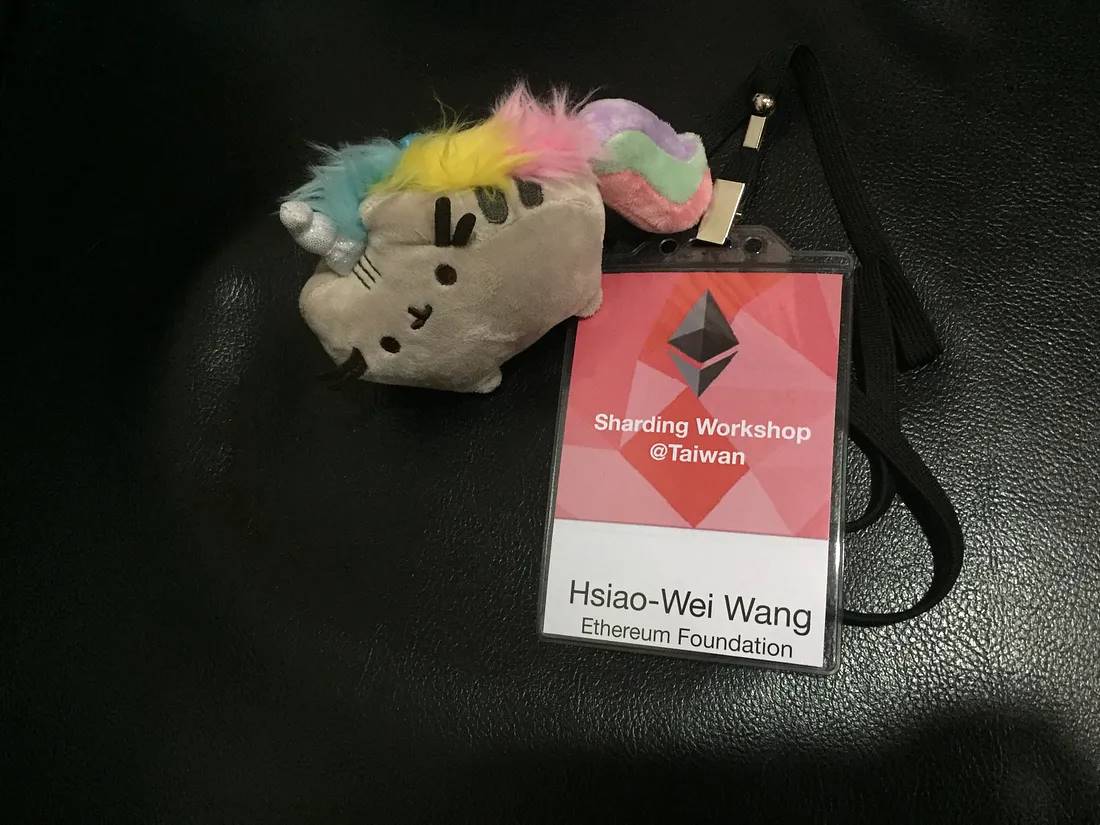
In 2018, she organized and participated in the Ethereum Sharding Workshop in Taipei, drawing developers from around the world. This event put the Asia-Pacific Ethereum community on the map and established her reputation as someone who bridges deep technical knowledge with effective communication. For years, she has traveled across Asia hosting developer meetups, breaking down complex concepts into accessible insights for local communities. Recalling the workshop, she wrote: “It was the first time we truly brought the global R&D team to a local setting—the atmosphere was amazing.”
Dr. Dong, founder of Celer Network, praised Hsiao-Wei Wang highly, noting that between 2018 and 2019, she co-managed EF Grants alongside Ken, now head of Uniswap Foundation. He described her as proactive and effective, particularly knowledgeable about builders in Asia, having advocated for many Asian and Chinese developers—pragmatic and results-driven.
Today, as Executive Director, Wang carries dual responsibilities: driving technical insight and strengthening grassroots engagement. Her appointment is widely seen as a signal that Ethereum is recommitting to its technical roots and community-driven ethos.

Tomasz Stańczak: The Architect of Ethereum’s Infrastructure
If Wang serves as a bridge between technology and community, then Tomasz Stańczak is more akin to an architect of Ethereum’s infrastructure. He is the founder of Nethermind, an execution client now essential to the Ethereum network.
Back in 2017, Nethermind was just a small project in Poland, with Stańczak and a few friends coding in a tiny apartment in Warsaw, aiming to build a high-performance Ethereum client.
Within a few years, he scaled Nethermind into a cornerstone of Ethereum’s tech stack, supporting the stability and efficiency of the entire network. His vision extends beyond client development into areas like MEV and PBS (Proposer-Builder Separation). As an early member of Flashbots, he contributed key ideas to enhance Ethereum’s decentralization and security—for example, optimizing block proposal mechanisms to reduce centralization risks among miners.
At Devcon SEA in 2024, Stańczak stood center stage, sharing his vision for Ethereum’s convergence with AI applications. Now, as Co-Executive Director of EF, he will oversee ecosystem growth and safeguard core values. With his engineering rigor and strategic foresight, the community has renewed hope for Ethereum’s technical roadmap.
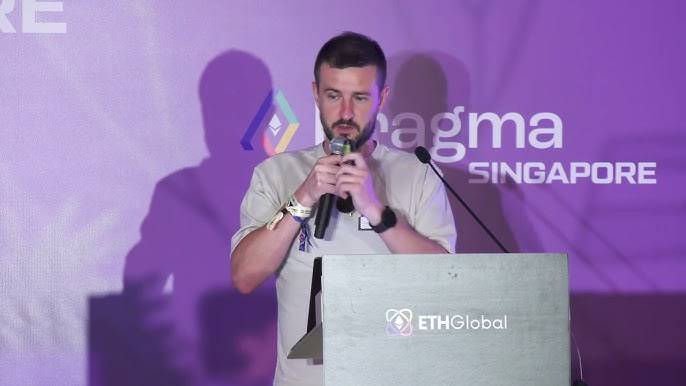
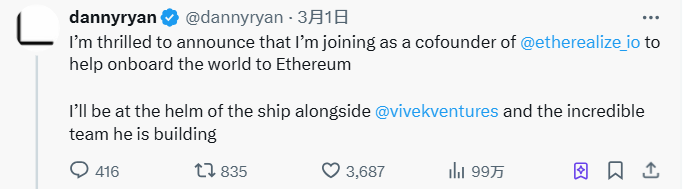
Danny Ryan Announces Return to Ecosystem—A Long-Awaited Homecoming
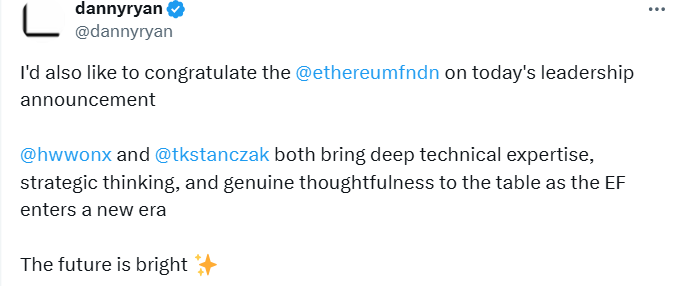
Following the leadership announcement, reactions poured in from the community. On Twitter, many praised Wang and Stańczak’s technical credentials, viewing the move as a return to Ethereum’s engineering-first principles. Others questioned on Reddit whether simply changing leaders could address deeper structural issues. Vitalik Buterin publicly endorsed the transition, calling it part of a “long-planned evolution.”
Meanwhile, Danny Ryan, a highly respected former EF researcher, expressed strong support for the changes and announced his return to the ecosystem as co-founder of Etherealize, an institutional marketing and product arm for Ethereum. Many believe Ryan’s comeback could guide Ethereum toward a more mature phase of development.
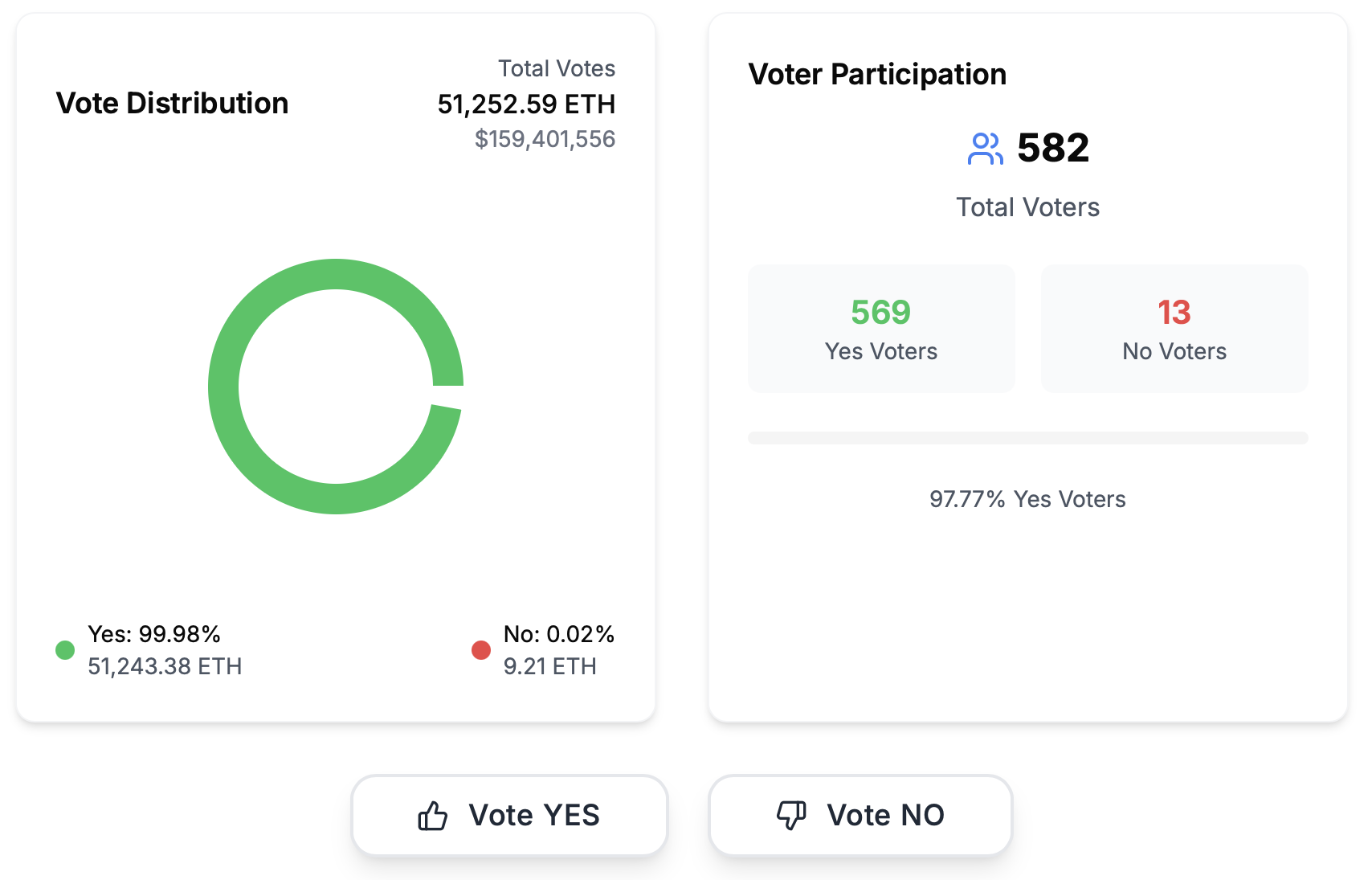
Interestingly, in an informal community poll of ETH wallet holders in January this year, Danny Ryan was voted the top choice to serve as the sole leader of the Ethereum Foundation.
Still Too Centralized?
This leadership transition didn’t happen in a vacuum—it’s the inevitable outcome of mounting community frustration, competitive pressure, and technological bottlenecks.
In 2024, Ethereum faced internal and external challenges: Solana captured massive attention and capital by creating a low-cost, high-efficiency “meme paradise,” while Ethereum continued to struggle with high gas fees and network congestion. ETH’s price performance lagged in comparison. At a deeper level, governance remained a pain point. EF’s decision-making has long been concentrated in a small circle, making the structure appear sluggish amid rapidly evolving market demands.
Community discourse grew increasingly heated, targeting EF for perceived passivity under Aya’s leadership and failure to respond swiftly to competition. Some directly criticized her, accusing her idealism of being out of touch with real market needs, with phrases like “How about you eat cake instead?” and “ruined Ethereum’s golden age” circulating widely.
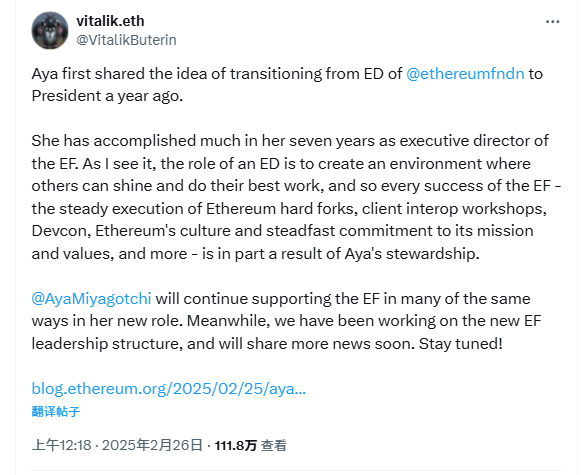
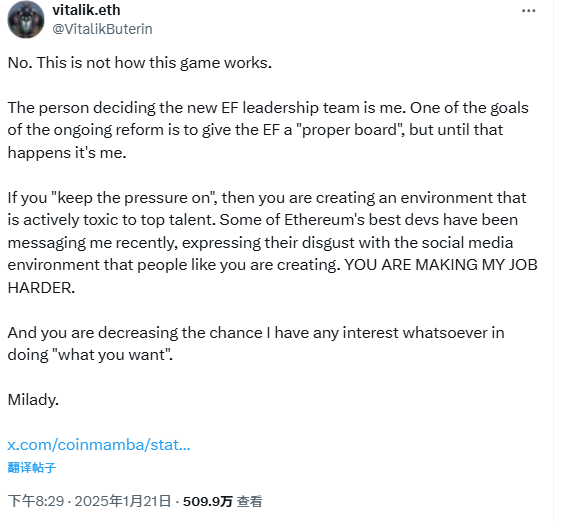
Yet this leadership change doesn’t fully resolve concerns about EF’s “centralization.” After all, Vitalik revealed that Aya had proposed stepping into the Chair role over a year ago, and he himself previously stated that the final say on senior leadership changes at EF still rests with him.
Thus, while the reshuffle appears responsive to community feedback, it may ultimately reflect yet another act of centralized decision-making.
Markets Demand Real Results: Ethereum Must Find Balance
Clearly, the appointments of Wang and Stańczak are met with both hope and skepticism. The community hopes for tangible progress but fears these changes are merely cosmetic under centralized control. This mix of anticipation and doubt defines the current transitional climate. Perhaps initial excitement over new leadership will fade quickly—what the community truly wants are transparent funding allocations and concrete reform actions. Every step taken by the new leadership will be closely scrutinized in the coming months.
For an Ethereum in need of transformation, differing perspectives naturally lead to divergent views. Foundation leaders may dream of a more idealistic future, but dreams require bread to survive. The crypto market is no longer one dominated solely by Ethereum. If EF continues merely selling tokens and engaging in lofty talk about building, while ignoring genuine community sentiment, it will only deepen skepticism around Ethereum’s claim to “decentralization.”
At this juncture, we cannot predict the outcome. But one thing is certain: superficial gestures and grand narratives can no longer carry Ethereum forward. Rather than leaving the community and token holders oscillating between forced contributions and frustrated criticism, Ethereum’s leadership—including EF—must strive to find real balance between decentralized ideals and centralized decision-making.
Join TechFlow official community to stay tuned
Telegram:https://t.me/TechFlowDaily
X (Twitter):https://x.com/TechFlowPost
X (Twitter) EN:https://x.com/BlockFlow_News
 深潮TechFlow