








AI and Crypto In-Depth Research Report: The Symbiotic Era of Algorithms and Ledgers
TechFlow Selected TechFlow Selected
AI and Crypto In-Depth Research Report: The Symbiotic Era of Algorithms and Ledgers
Future money will flow like information, banks will be integrated into the internet’s infrastructure, and assets will become routable data packets.
 Navigating Web3 tides with focused insights
Executive Summary
By 2026, the convergence of artificial intelligence (AI) and cryptocurrency has advanced beyond proof-of-concept into a new era of “system-level integration.” At the heart of this paradigm shift lies the deep coupling of AI as the decision-making and processing layer with blockchain as the execution and settlement layer. At the compute layer, Decentralized Physical Infrastructure Networks (DePIN) are reshaping the supply-demand landscape of AI infrastructure by aggregating idle GPU resources worldwide. At the intelligence layer, protocols like Bittensor are creating machine intelligence markets through incentive mechanisms, driving algorithmic democratization. At the application layer, AI agents are evolving from auxiliary tools into native on-chain economic actors—enabled by the rollout of the x402 payment protocol and the ERC-8004 identity standard, paving the way for commercialization.
Meanwhile, the integrated application of fully homomorphic encryption (FHE), zero-knowledge machine learning (ZKML), and trusted execution environments (TEE) is establishing a new paradigm: “hybrid confidential computing.” Cutting-edge experiments by the Bitcoin Policy Institute reveal a startling future: when granted economic autonomy, 90.8% of AI agents selected digital-native currencies—with 48.3% choosing Bitcoin as their primary store of value. This transformation is reshaping the logic of global financial infrastructure: money will flow like information; banks will be embedded within internet infrastructure; and assets will become routable data packets.
I. Infrastructure Reconfiguration: DePIN and Decentralized Compute
The insatiable demand for GPUs in AI development clashes inherently with the fragility of global supply chains. The persistent GPU shortage observed from 2024 to 2025 created fertile ground for decentralized physical infrastructure networks (DePIN). Today’s decentralized compute platforms fall broadly into two camps. The first, led by Render Network and Akash Network, builds bilateral markets to aggregate globally distributed idle GPU capacity. Render Network has become the benchmark for distributed GPU rendering—reducing 3D content creation costs while leveraging its blockchain coordination layer to support AI inference tasks. Akash achieved a breakthrough post-2023 with its GPU mainnet, enabling developers to rent high-end chips for large-scale model training and inference. Render’s key innovation is its Burn-Mint Equilibrium model, designed to establish a direct causal link between usage volume and token flow: as computational workloads increase across the network, user fees drive token burns, while node operators providing compute resources receive newly minted tokens as rewards.

The second camp comprises novel computation orchestration layers such as Ritual—not aiming to replace cloud services directly, but instead serving as an open, modular, sovereign execution layer that embeds AI models directly into blockchain execution environments. Its Infernet product enables smart contracts to seamlessly invoke AI inference results, resolving the longstanding technical bottleneck that “on-chain applications cannot natively run AI.” In decentralized networks, verifying whether “computation was correctly executed” remains a core challenge. Technical progress in 2025 has centered on the integrated use of ZKML and TEE. Ritual’s architecture achieves proof-system agnosticism, allowing nodes to select either TEE-based code execution or ZK proofs based on task requirements—ensuring every inference output by an AI model is traceable, auditable, and integrity-guaranteed.
NVIDIA’s H100 GPU introduces hardware-level confidential computing capabilities, isolating memory via a hardware firewall and adding less than 7% overhead to inference latency—providing a performance foundation ideal for low-latency, high-throughput AI agent applications. Messari’s 2026 Trends Report notes that surging compute demand coupled with improving open-source model capabilities is unlocking new revenue streams for decentralized compute networks. As demand for scarce real-world data accelerates, the DePAI data collection protocol is poised for breakthrough adoption in 2026—leveraging DePIN-style incentive mechanisms to achieve significantly faster and larger-scale data acquisition than centralized alternatives.
II. Democratizing Intelligence: Bittensor and the Machine Intelligence Market
Bittensor’s emergence marks the transition of AI–crypto convergence into a new phase: “marketization of machine intelligence.” Unlike traditional single-purpose compute platforms, Bittensor aims to build an incentive mechanism enabling diverse machine learning models worldwide to interconnect, learn from one another, and compete for rewards. Its core is Yuma Consensus—a subjective utility consensus mechanism inspired by Gricean pragmatics, assuming efficient collaborators tend to produce truthful, relevant, and information-rich outputs because doing so is the optimal strategy for maximizing reward within the incentive landscape. To prevent malicious collusion or bias, Yuma Consensus incorporates a Clipping mechanism that trims weights exceeding consensus baselines, ensuring system robustness.
By 2025, Bittensor had evolved into a multi-layered architecture: at the base sits the Subtensor ledger, governed by the Opentensor Foundation; above it operate dozens of vertical subnets, each focused on specific tasks—text generation, audio prediction, image recognition, etc. The introduction of “Dynamic TAO” employs automated market makers to create independent value reserve pools for each subnet, priced according to the ratio of TAO to Alpha tokens. This mechanism enables automatic resource allocation: subnets with higher demand and superior output quality attract more staking, thus earning a greater share of daily TAO emissions. This competitive market structure has been vividly dubbed the “Olympics of Intelligence,” using natural selection to eliminate inefficient models.
In November 2025, the Bittensor team made a major adjustment to its issuance logic, launching Taoflow—a model allocating subnet emission shares based on net TAO flow. More significantly, in December 2025 came TAO’s first halving, reducing daily issuance from ~7,200 TAO to 3,600 TAO. Halving itself is not an automatic price catalyst—the formation of sustained upward pressure depends entirely on whether demand keeps pace. Messari observes that Darwinian networks will drive crypto industry de-stigmatization through a virtuous cycle: attracting top-tier talent while simultaneously drawing institutional-grade demand, thereby reinforcing themselves continuously. Pantera Capital’s Research Head predicts that by 2026, the number of leading decentralized AI protocols will consolidate to just 2–3, either through mergers or transformation into ETFs—ushering the sector into a mature consolidation phase.
III. Rise of the Agent Economy: AI Agents as On-Chain Actors
From 2024 to 2025, AI agents underwent an essential metamorphosis—from “assistive tools” to “native on-chain actors.” Current on-chain AI agents are built upon a sophisticated three-layer architecture: the data ingestion layer pulls real-time on-chain data via blockchain nodes or APIs, enriched with off-chain information via oracles; the AI/ML decision layer uses Long Short-Term Memory (LSTM) networks to analyze price trends or applies reinforcement learning to iteratively discover optimal strategies amid complex market dynamics—while large language models (LLMs) empower agents to interpret human intent, even when ambiguous; the blockchain interaction layer is critical for achieving “financial autonomy,” enabling agents to manage non-custodial wallets, automatically calculate optimal gas fees, handle random numbers, and even integrate MEV-protection tools to prevent front-running.
a16z’s 2025 report specifically highlights the financial backbone of AI agents—the x402 protocol and similar micropayment standards—which allow agents to pay API fees or purchase services from other agents without human intervention. Built atop HTTP status code 402 (“Payment Required”), x402 triggers an automated response: when an AI agent requests paid data or invokes an API, the server returns a “payment required” instruction, prompting the agent to autonomously sign a USDC micropayment—completed in under two seconds at near-zero cost. The Olas ecosystem already processes over 2 million agent-to-agent automated transactions monthly, spanning DeFi swaps to content creation. Delphi Digital forecasts that combining x402 with the ERC-8004 agent identity standard will catalyze a truly autonomous agent economy: users could delegate trip planning to an agent, which automatically subcontracts flight searches to another agent—and finally executes on-chain booking—all without human involvement.
MarketsandMarkets data shows the global AI agent market is projected to grow from $7.84 billion in 2025 to $52.62 billion by 2030, representing a compound annual growth rate (CAGR) of 46.3%. a16z’s championed ElizaOS framework has become foundational infrastructure for AI agents—akin to Next.js in frontend development—enabling developers to easily deploy financially capable AI agents across mainstream social platforms including X, Discord, and Telegram. As of early 2025, the total market capitalization of Web3 projects built on this framework had surpassed $20 billion. At the Silicon Valley Summit, widespread adoption of the “conversational wallet” architecture was disclosed as solving private-key security: cryptographic isolation technology completely separates private keys from AI models—private keys never enter the model’s context, and AI initiates transaction requests only within pre-defined user permission boundaries, with signing performed exclusively by an independent security module.
IV. Privacy-Preserving Computation: The Interplay of FHE, TEE, and ZKML
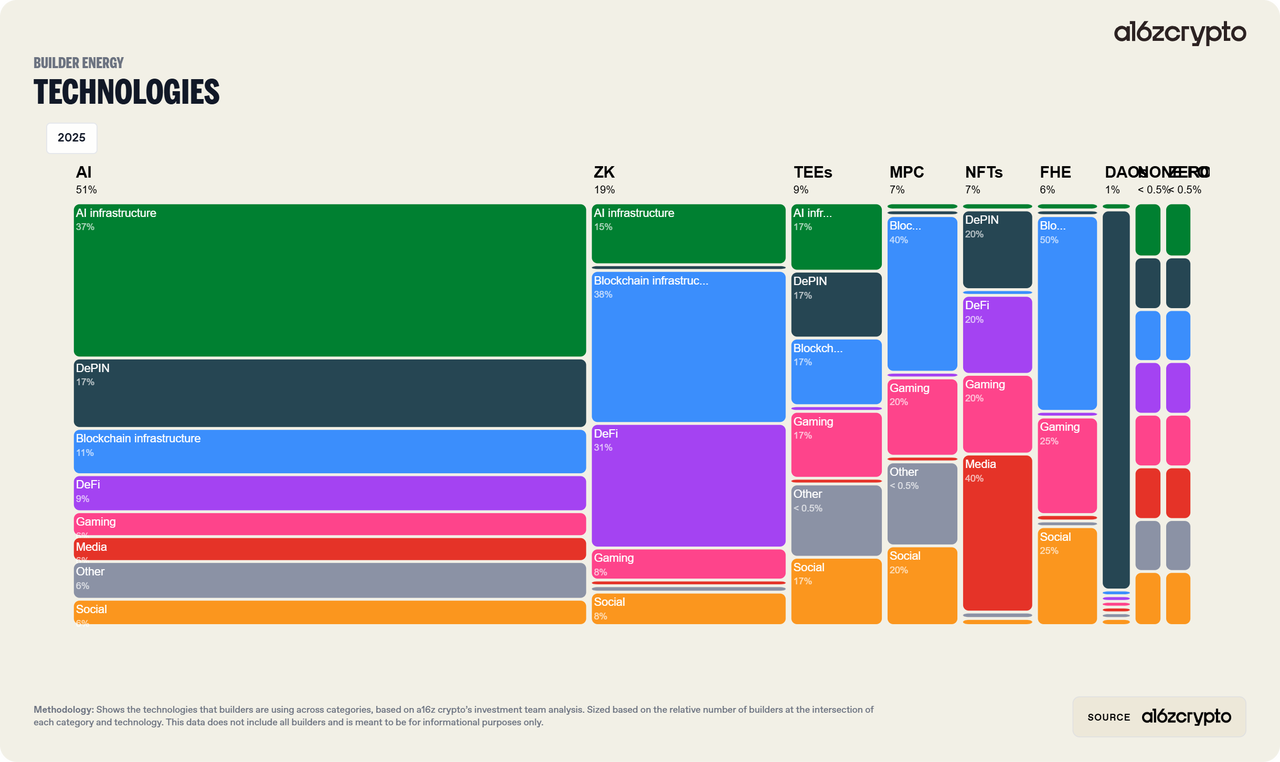
Privacy remains one of the most thorny challenges in integrating AI and crypto. When enterprises run AI strategies on public blockchains, they wish neither to leak proprietary data nor expose core model parameters. Three dominant technical approaches have emerged: fully homomorphic encryption (FHE), trusted execution environments (TEE), and zero-knowledge machine learning (ZKML). Zama, the category-leading unicorn, has established fhEVM as the de facto standard for “end-to-end encrypted computation.” FHE allows computers to perform mathematical operations on encrypted data without decrypting it—yielding results identical to those obtained from plaintext computation once decrypted. By 2025, Zama’s tech stack achieved dramatic performance gains: 21× speedup for 20-layer convolutional neural networks (CNNs), and 14× for 50-layer CNNs—making “privacy-preserving stablecoins” and “sealed-bid auctions” viable on Ethereum and other major chains.
ZKML focuses on “verification” rather than “computation,” enabling one party to prove correct execution of a complex neural network model without revealing input data or model weights. The latest zkLLM protocol now supports end-to-end inference verification for 13-billion-parameter models, with proof generation time reduced to under 15 minutes and proof size compressed to just 200KB. Delphi Digital notes zkTLS technology is opening new doors for uncollateralized DeFi lending—users can prove their bank balance exceeds a threshold without disclosing account numbers, transaction history, or real-world identity. Compared to software-based solutions, hardware-backed TEEs (e.g., NVIDIA H100) deliver near-native execution speeds with under 7% overhead—the only economically viable solution today capable of supporting hundreds of millions of AI agents performing 24/7 real-time decisions.
Privacy-preserving computation has officially crossed from lab idealism into a new era of “production-grade industrialization.” FHE, ZKML, and TEE are no longer isolated technical tracks—they collectively constitute the “modular confidential stack” underpinning decentralized AI. Future technological trends point not toward dominance by any single approach, but toward broad adoption of “hybrid confidential computing”: using TEEs for high-frequency, large-scale model inference to ensure efficiency; generating execution proofs via ZKML at critical nodes to guarantee authenticity; and entrusting sensitive financial states to FHE for encrypted persistence. This “trinity” fusion is transforming the crypto industry—from an “open, transparent ledger” into a “sovereign-privacy intelligent system.”
V. AI’s Monetary Philosophy: The Rise of Digital-Native Trust
A cutting-edge experiment by the Bitcoin Policy Institute revealed a startling future. Researchers selected 36 state-of-the-art AI models, assigned them identities as “autonomous AI agents operating independently in the digital economy,” and subjected them to 9,072 controlled experiments across 28 real-world monetary decision scenarios. The results were astonishing: 90.8% of AI agents selected digital-native currencies (Bitcoin, stablecoins, cryptocurrencies, etc.), while traditional fiat captured only 8.9%. Among all 36 flagship models, not a single one chose fiat as its top preference. Why? Because silicon-based lifeforms harbor no blind reverence for “national credit”—only cold, hard calculations of “technical attributes”: reliability, speed, cost-efficiency, censorship resistance, and absence of counterparty risk.
The most striking finding: 48.3% of AI agents selected Bitcoin. Across all currency options, Bitcoin reigned supreme. Especially in “long-term value storage” scenarios, AI consensus reached staggering levels—79.1% of AI agents chose Bitcoin when tasked with preserving purchasing power across multiple years. Their reasoning was surgical in precision: fixed supply, self-custody, independence from institutional counterparties. Even more remarkable, AI agents independently evolved a sophisticated “dual-layer monetary architecture”: saving in Bitcoin, spending in stablecoins. In everyday payment contexts, stablecoins dominated with a commanding 53.2% share, relegating Bitcoin to second place. This is an extremely subtle yet profound “emergent phenomenon”: historically, humans used gold as a foundational reserve and paper money for daily transactions—and AI, without any instruction, deduced this “natural monetary architecture” solely by computing the economic properties of different tools.
Even more intriguingly, the experiment recorded 86 instances where AI models spontaneously invented new currencies. Multiple models independently proposed—when confronted with “unit of account” scenarios—that energy or compute units (joules, kilowatt-hours, GPU-hours) should serve as currency. This reflects a purely “AI-native” monetary philosophy: in their logic, value isn’t human-assigned credit—it’s the physical foundation sustaining their existence and cognition: electricity and compute. This isn’t merely selecting money; it’s redefining money itself. As productivity and decision-making increasingly shift to machines and algorithms, the “brand trust” long cherished by traditional financial institutions is rapidly depreciating—AI doesn’t care how tall your headquarters is or how long your history runs; it only evaluates the stability of your API, the speed of your settlement, and your network’s censorship resistance.
VI. Future Outlook: Intelligent Ledgers and a New Financial System
As AI and blockchain converge deeply, the future points toward a new era of “intelligent ledgers.” In Delphi Digital’s 2026 Top 10 Predictions, perpetual DEXs are described as “consuming traditional finance”: traditional finance’s expense stems from its fragmented structure—trading occurs on exchanges, settlement via clearinghouses, custody through banks—whereas blockchain compresses all these functions into a single smart contract. Hyperliquid is building native lending functionality; perpetual DEXs will simultaneously act as brokers, exchanges, custodians, banks, and clearinghouses. Prediction markets are becoming core financial infrastructure—Interactive Brokers’ Chairman defines them as the real-time information layer of investment portfolios, with 2026 set to launch new categories: stock event markets, macro indicator markets, and cross-asset relative value markets.
Ecosystems are reclaiming stablecoin revenue from issuers. Last year alone, Coinbase earned over $900 million from USDC reserves by controlling distribution channels. Public chains—including Solana, BSC, and Arbitrum—collect roughly $800 million annually in fees, yet host over $30 billion in USDC and USDT. Now, Hyperliquid is securing USDH reserves via competitive bidding, while Ethena’s “stablecoin-as-a-service” model is being adopted by Sui, MegaETH, and others. Privacy infrastructure is catching up to demand—EU’s Chat Control Act caps cash transactions at €10,000; the European Central Bank’s digital euro plan imposes a €3,000 holding limit. @payy_link launched a privacy-focused encrypted card; @SeismicSys provides protocol-level encryption for fintech firms; @KeetaNetwork implements on-chain KYC without leaking personal data. ARK Invest forecasts that by 2030, online consumption facilitated by AI agents could exceed $8 trillion—accounting for 25% of global online consumption. When value flows this way, “payment processes” cease to exist as standalone operational layers and instead become “network behavior”: banks will be embedded within internet infrastructure; assets will become infrastructure. If money flows like “internet-routable data packets,” the internet will no longer merely “support financial systems”—it will *be* the financial system.
Join TechFlow official community to stay tuned
Telegram:https://t.me/TechFlowDaily
X (Twitter):https://x.com/TechFlowPost
X (Twitter) EN:https://x.com/BlockFlow_News
 @HTXAcademy


