Bitget UEX Daily Report | Fed’s Dot Plot Turns Sharply Hawkish; Micron’s Guidance Beats Expectations but Stock Dips; Middle East Oil and Gas Facilities Attacked
TechFlow Selected TechFlow Selected
Bitget UEX Daily Report | Fed’s Dot Plot Turns Sharply Hawkish; Micron’s Guidance Beats Expectations but Stock Dips; Middle East Oil and Gas Facilities Attacked
Short-term market volatility is expected to intensify; investors are advised to closely monitor PPI data and the Federal Reserve’s statement. Should inflation exceed expectations, defensive rotation in U.S. equities may deepen further, and both precious metals and cryptocurrencies face heightened risk of correlated downside movement.
 Navigating Web3 tides with focused insights
Author: Bitget
I. Key News Highlights
Federal Reserve Updates
Fed Holds Rates Steady; Dot Plot Significantly Tightens Rate-Cut Path
- The Federal Reserve held rates steady as widely expected, with only one dissenter (Governor Michelle Bowman advocating for a 25-basis-point cut). The statement added new language highlighting uncertainty stemming from Middle East tensions and revised the unemployment description to “essentially unchanged.”
- The dot plot shows seven officials forecasting zero rate cuts this year, while 12 anticipate at least one cut; cumulative cuts in 2026 are projected at just 25 basis points. GDP forecasts for this year and next were raised, while core PCE inflation expectations rose to 2.7% and 2.2%, respectively.
- Market impact: The hawkish shift reinforces the “higher-for-longer” narrative, pressuring risk-asset valuations, supporting the U.S. dollar, and increasing bond yield volatility.
International Commodities
Iran-Israel Exchange Attacks on Energy Infrastructure Drives Oil Price Volatility
- Iran’s South Pars gas field and Qatar’s energy hub were attacked; Iran vowed to strike Gulf energy targets. Supply disruption concerns have surged sharply as the conflict enters its third week.
- Gold prices plunged sharply, breaking below the $4,900/oz level and extending recent corrections; oil prices remain supported by risk premiums but exhibit heightened volatility.
- Market impact: Energy supply risks lift inflation expectations, further validating the Fed’s hawkish stance; the high-rate environment undermines gold’s traditional safe-haven appeal, significantly amplifying short-term price swings.
Macroeconomic Policy
U.S. Department of Defense Seeks Over $200 Billion for Potential Military Operations Against Iran
- The U.S. Department of Defense has requested over $200 billion from the White House and Congress for potential military operations against Iran; Trump administration advisors anticipate possible strains in the U.S.-Israel alliance.
- Trump is viewed internally as the most aggressive advocate for military action within the White House, yet advisors suggest he may seek to end large-scale operations earlier than Netanyahu.
- Market impact: Escalating geopolitical tensions intensify fiscal pressures and inflation risks; the U.S. dollar and energy assets gain short-term support, while long-term uncertainty weighs on growth stocks.
II. Market Recap
Commodities & FX Performance
- Spot Gold: Fell sharply, breaking below $4,900/oz amid sustained correction driven by elevated interest rates and rising inflation expectations dampening safe-haven demand.
- Spot Silver: Weakened alongside gold to $76.60/oz; industrial sensitivity further magnified losses.
- WTI Crude Oil: Rose 3.38% to $98.72/bbl, trending higher amid volatile trading; mutual attacks on Middle Eastern oil and gas infrastructure intensified supply disruption fears.
- Brent Crude Oil: Rose 3.6% to $106.58/bbl, similarly impacted by the attacks and exhibiting pronounced volatility at elevated levels.
- U.S. Dollar Index: Strengthened to 100.162, buoyed jointly by hawkish Fed expectations and geopolitical uncertainty.
Cryptocurrency Performance
- BTC: Down 3.43% over 24 hours, currently trading near $71,081; the ongoing pullback reflects continued high-level consolidation, primarily driven by correlation with U.S. equities and declining risk appetite.
- ETH: Down 4.94% over 24 hours, currently trading near $2,194; moved lower in line with broader market sentiment.
- Total Cryptocurrency Market Cap: Declined ~3.2% over 24 hours, retreating to approximately $2.53 trillion—reflecting broad-based risk-asset repricing.
- Liquidations: Total liquidations over 24 hours amounted to ~$453 million, including ~$380 million in long positions and ~$73 million in short positions.
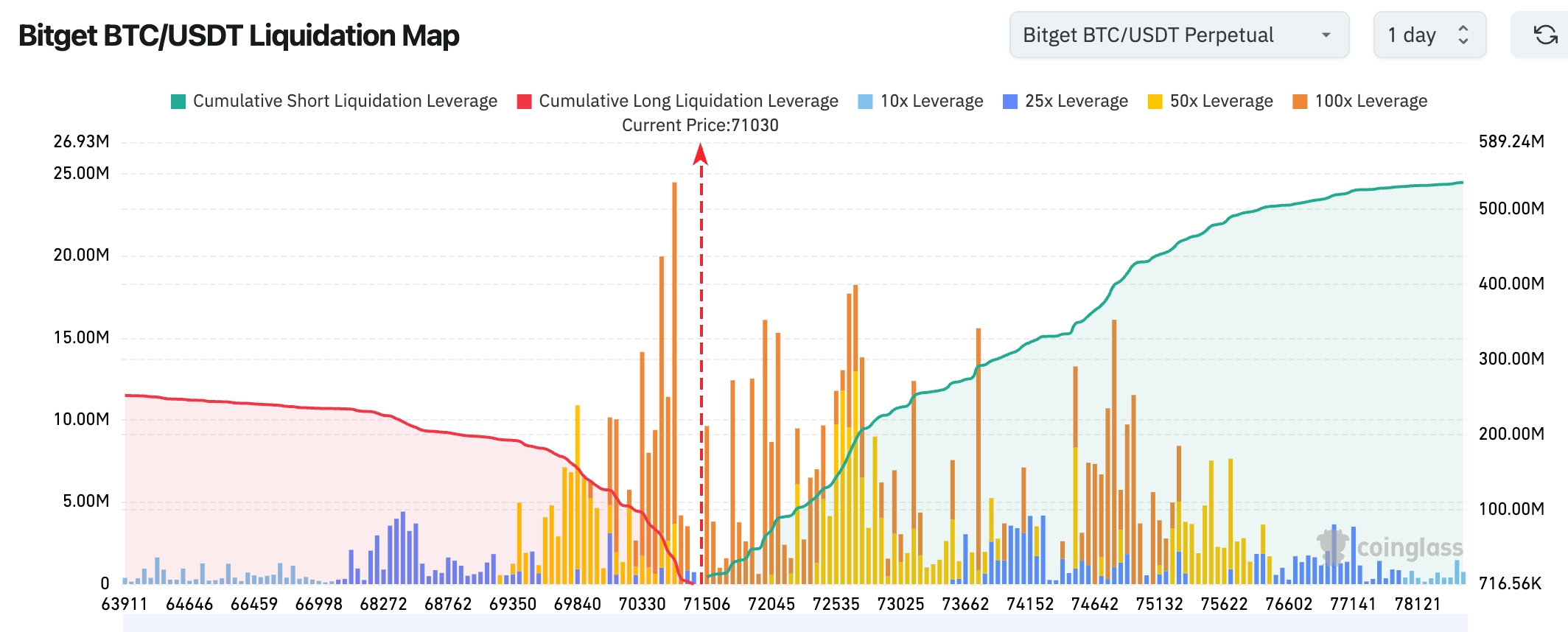
- Bitget BTC/USDT Liquidation Map: Current price sits near $71,000. A dense cluster of long liquidations exists between $70,000–$71,500; a downward move into this zone could trigger cascading long liquidations and amplify downside volatility. Conversely, heavy short liquidation leverage is concentrated between $72,500–$75,000; a breakout above this range could spark a short squeeze and fuel further upside momentum.
- Spot ETF Net Flows: BTC spot ETFs recorded net outflows of ~$130 million yesterday; ETH spot ETFs saw net outflows of ~$55 million.
- BTC Spot Flows: Yesterday, BTC spot inflows totaled $2.554 billion, while outflows reached $2.623 billion—resulting in net outflows of $99 million.
U.S. Equity Index Performance

- Dow Jones Industrial Average: Down 1.63% to 46,225.15, ending its prior winning streak; defensive sectors failed to offset broad-based selling pressure.
- S&P 500: Down 1.36% to 6,624.70—the lowest level since November last year—as both growth and value sectors came under simultaneous pressure.
- Nasdaq Composite: Down 1.46% to 22,152.42, led by broad-based declines among tech giants.
Tech Giants’ Developments
- NVIDIA (NVDA): Down 0.84% to $180.40—robust AI demand remains intact, but falling risk appetite triggered profit-taking.
- Google (GOOGL): Down 1.04% to $307.69—positive AI cloud business outlook was overshadowed by sector-wide adjustments.
- Apple (AAPL): Down 1.69% to $249.94—concerns over consumer demand and equity-market correlation weighed on shares.
- Microsoft (MSFT): Down 1.91% to $391.79—long-term AI investment tailwinds persist, but short-term guidance pressures emerged.
- Amazon (AMZN): Down 2.48% to $209.87—AWS growth expectations were eclipsed by macroeconomic uncertainty.
- Meta (META): Down 1.12% to $615.68—advertising business remains solid, but sentiment was dented by metaverse-related restructuring.
- Tesla (TSLA): Down 1.63% to $392.78—autonomous driving narratives were subdued by prevailing risk aversion.
Sector-Specific Observations
Optical Communications Sector surged
- Key stocks: Lumentum up 7.89%; Coherent up 4.64%.
- Catalyst: OFC 2026 showcased strong AI infrastructure demand signals; multiple firms unveiled novel network scalability solutions, lifting sector sentiment.
Memory Chip Sector diverged
- Key stock: Micron rose initially after hours before reversing into a decline.
- Catalyst: AI server demand validates sector strength, but substantial capex hikes are exerting valuation digestion pressure.
III. In-Depth Stock Analysis
1. Micron Technology – Revenue Nearly Doubles; Guidance Strongly Beats Expectations
Event Summary: Micron reported second-quarter FY2026 revenue of $23.86 billion—nearly doubling year-on-year—with gross margins approaching 75%. Revenue, EPS, and profitability all set quarterly records. The company also announced a 30% increase in its quarterly dividend. Its Q3 revenue guidance midpoint exceeded consensus estimates by 50%, while EPS guidance beat by nearly 70%; gross margin target stands at 81%. Capital expenditures for FY2026 were raised 25% to $25 billion, with plans to increase spending by over $10 billion in FY2027—primarily to expand HBM and DRAM capacity, including the Tongluo fab and U.S.-based manufacturing facilities. Shares rose over 2% post-earnings before plunging more than 6% shortly thereafter. Market Interpretation: Bernstein, Goldman Sachs, and other investment banks view this earnings report and guidance as definitive validation of explosive AI-server-driven demand for HBM and DRAM. The commencement of HBM4 mass production and near-full pre-sales of available capacity mark the formal onset of the memory chip upcycle. However, the aggressive capex plan raised concerns over cash flow strain, extended payback periods, and potential oversupply—prompting rapid post-earnings sentiment reversal and clear near-term valuation digestion pressure. Investment Takeaway: Micron sits at the epicenter of the AI memory supercycle. HBM4 pricing power and fab utilization will be critical variables. Investors should closely monitor the timing of FY2027 capacity ramp-ups and industry supply-demand balance—while recognizing that even amid robust growth expectations, execution efficiency around capital deployment poses significant volatility risk.
2. NVIDIA – Jensen Huang Forcefully Defends DLSS 5 Amid Controversy
Event Summary: At GTC 2026, NVIDIA launched Deep Learning Super Sampling version 5 (DLSS 5), leveraging generative AI to elevate low-resolution rendering to cinematic quality in milliseconds—a pivotal technology enabling AI compute monetization at the consumer level. Some gamers criticized the technology as “over-reliant on AI,” potentially diminishing artistic control. During the Q&A session, Jensen Huang forcefully countered, calling such criticism “completely wrong,” emphasizing that DLSS 5 deeply integrates generative AI with geometric structure, texture, and game elements—giving developers fine-grained control and enabling generative control at the geometry level—not merely post-processing. Market Interpretation: Analysts view the controversy as fundamentally reflecting market debate over balancing AI applications across consumer gaming and data center use cases. Huang’s assertive defense not only safeguards NVIDIA’s technical roadmap but also cements its absolute leadership in AI graphics—bolstering long-term expansion of the consumer GPU ecosystem and diversification of compute monetization. Investment Takeaway: Continuous evolution of the DLSS series remains a key moat for NVIDIA’s consumer business. Investors should track actual adoption rates of DLSS 5 among major game studios and integration into next-generation titles. Under the broader trend of AI consumerization, this technology holds strong potential to become a meaningful incremental revenue driver over the coming years.
3. Tencent – Strategic Pivot Clearly Shifts Toward AI
Event Summary: Tencent management explicitly declared a strategic pivot away from traditional gaming toward artificial intelligence during its latest earnings call, committing to large-scale investment in large language model development and AI infrastructure. Pony Ma publicly introduced the “Shrimp Farming” strategy for the first time, proposing to deploy AI across diverse real-world scenarios via “Lobster” applications—breaking beyond conventional chatbot limitations—and planning to integrate WeChat Mini Programs’ decentralized philosophy into future AI ecosystems to balance stakeholder interests. Senior executives also noted, when responding to memory chip price hikes, that AI demand is now broadly straining supply chains across DRAM, HBM, CPUs, and hard drives. Market Interpretation: Institutional analysts widely regard this as a pivotal strategic transformation for Tencent amid slowing game revenue growth and regulatory headwinds. Shifting focus to AI helps reduce overreliance on a single business line, reshaping long-term growth narratives and valuation frameworks—particularly given synergies between cloud services and AI infrastructure, which have notably strengthened market confidence in Tencent’s future competitiveness. Investment Takeaway: The success or failure of Tencent’s AI transition will serve as the central catalyst for its valuation re-rating. Investors should closely monitor commercialization progress of its large models, rising cloud revenue contribution, and tangible execution outcomes of the “Shrimp Farming” strategy. If successfully implemented, this initiative stands to meaningfully broaden Tencent’s growth ceiling over the long term.
IV. Cryptocurrency Project Updates
1. The U.S. Securities and Exchange Commission (SEC) has approved Nasdaq’s rule change to enable tokenized stock trading. Per the approval, eligible participants may settle trades in tokenized form through a pilot program operated by the Depository Trust Company. Tokenized stocks will share the same order book and execution priority as traditional stocks and must confer identical rights and privileges to shareholders.
2. Payward, Kraken’s parent company, confidentially filed an IPO application with the SEC last November. However, due to weakening crypto market conditions following Bitcoin’s all-time high—including valuation pressure and declining trading volumes—the company has paused its listing process, awaiting improved market conditions before resuming.
3. According to Michael Saylor, $STRC’s annualized volatility has fallen to a record low of ~1.5%, while its Sharpe ratio has risen to ~5.37—setting a new benchmark for risk-adjusted returns for the product. Saylor stated that, under its current allocation structure, $STRC’s return-volatility profile establishes a new industry standard for risk-adjusted performance.
4. A “pre-mine whale” who accumulated 5,000 BTC 13 years ago sold another 1,000 BTC ($71.57 million) seven hours ago. This whale originally acquired the 5,000 BTC in November 2013 at $332 per coin and began selling in November 2024.
V. Today’s Market Calendar
Economic Data Release Schedule
| 20:30 | U.S. | Feb PPI YoY / MoM | ⭐⭐⭐⭐ |
| All Day | U.S. | FOMC Rate Decision & Dot Plot | ⭐⭐⭐⭐⭐ |
Key Event Preview
March 19 (Thursday)
- Fed announces interest rate decision—widely expected to hold rates steady;
- Dot plot may signal only one rate cut this year—significantly narrowing from prior market expectations;
- lululemon reports latest quarterly results;
March 20 (Friday)
- FedEx reports latest quarterly results;
*This week’s U.S. equity themes center on the Fed’s rate decision, economic data releases, Micron’s earnings, and NVIDIA’s GTC conference—expect heightened market volatility.
Institutional Views:
Wall Street analysts broadly agree that the Fed’s significantly tightened dot plot—slashing expected 2024 rate cuts from multiple to just one or zero—combined with oil-and-gas infrastructure attacks in the Middle East, is materially reshaping inflation and growth trajectories. Goldman Sachs and JPMorgan note that elevated oil prices and expanding fiscal spending will prolong the inflation fight, compelling the Fed to maintain restrictive policy for longer. The hawkish pivot is now largely priced in, and U.S. equity valuations face renewed compression pressure. Gold’s break below $4,900 reflects diminished traditional safe-haven appeal in a high-rate environment, whereas Bitcoin—though correcting alongside broader risk assets—finds relative floor support from resilient ETF inflows and improving regulatory clarity. Bernstein strategists emphasize that AI infrastructure sectors (memory chips, optical communications) show divergent performance during earnings season: Micron’s blowout guidance confirms strong demand, yet surging capex introduces near-term volatility. Short-term market turbulence is expected to intensify; investors should closely monitor PPI data and the Fed’s statement—should inflation exceed expectations, defensive rotation in U.S. equities may deepen further, while precious metals and cryptocurrencies face heightened correlated downside risk.
Join TechFlow official community to stay tuned
Telegram:https://t.me/TechFlowDaily
X (Twitter):https://x.com/TechFlowPost
X (Twitter) EN:https://x.com/BlockFlow_News