From real-time data streams to historical analysis: a comprehensive roundup of Solana on-chain analytics tools
TechFlow Selected TechFlow Selected
From real-time data streams to historical analysis: a comprehensive roundup of Solana on-chain analytics tools
Step-by-step guide to efficiently obtaining and analyzing Solana blockchain data.
 Navigating Web3 tides with focused insights
Author: Jack Stewart
Translation: TechFlow

Introduction
Solana, with its high speed and low-cost architecture, has become one of the most watched blockchain ecosystems today. However, this speed also brings complexity—users new to Solana data may find it overwhelming. Compared to traditional blockchains, Solana’s parallel processing mechanism and account-based model present unique challenges in data querying, indexing, and analysis.
Whether you are a developer building applications, an analyst researching trends, or an enthusiast wanting to track transaction flows, choosing the right tools is key.
This guide will help you gain a comprehensive understanding of how to work with Solana data. We’ll cover best practices from accessing raw RPC endpoints to using powerful indexing services, and walk through how to efficiently retrieve and analyze Solana blockchain data.
After reading this article, you’ll clearly understand how to locate the data you need, process it efficiently, and which tools are best suited for each scenario.
Let’s begin exploring!
Solana RPC Services
Remote Procedure Call (RPC) services act as the bridge between developers, applications, and Solana. They provide access to blockchain state, transaction submission, and historical data retrieval.
Core Use Cases
Common scenarios for retrieving data via RPC providers include:
-
DeFi Applications – Querying token holders, checking account balances, etc.
-
NFT Applications – Tracking mint records, querying metadata, and ownership changes
-
Data Applications – Aggregating data to generate application metrics and dashboards
RPC Providers
There are many different RPC providers available in the market. While their core functionalities are similar, several key factors should be considered when selecting one: response latency, operational stability, data accuracy, request rate limits, service cost, native Solana support experience, and technical support capability.
Here are some common providers:
-
Helius
-
Triton
-
QuickNode
-
Alchemy
-
Ankr
-
ChainStack
For real-time response requirements (e.g., real-time account or program monitoring), consider tools like Webhooks, WebSockets, or gRPC. These are better suited for latency-sensitive tasks.
Real-Time Data Streaming Tools
In scenarios requiring real-time data access, Geyser streams and webhook-based services continuously push the latest updates on Solana blockchain activity without relying on traditional pull-based RPC polling. These solutions are especially important for trading bots, analytics platforms, and real-time monitoring applications, where ultra-low latency data is critical.
Geyser streams allow external services to receive real-time updates on transactions, account changes, and program interactions by directly subscribing to Solana validators. This method is more efficient than frequent RPC queries, reducing redundant requests and enabling instant capture of on-chain events.
Geyser Streams
The Geyser plugin provided by Solana enables validators to stream real-time data directly to external services. This makes it a powerful tool for indexing on-chain data, custom data aggregation, and on-chain analytics. However, using the gRPC streaming functionality of Geyser requires running your own validator node or relying on dedicated node services.
Webhooks, WebSockets, and Real-Time APIs
Webhooks offer an alternative to RPC or gRPC nodes by pushing event notifications, allowing developers to track specific blockchain activities.
Developers can subscribe to specific events (e.g., wallet transactions, token transfers, or on-chain program interactions) and receive real-time updates without repeatedly polling the RPC. This approach reduces infrastructure overhead and significantly improves efficiency.
Similarly, WebSocket connections enable real-time streaming of blockchain data, allowing applications to stay synchronized with the latest on-chain data without repeated requests.
For applications requiring real-time data, Geyser, WebSocket, and Webhooks provide the lowest-latency access methods, effectively reducing infrastructure costs and improving responsiveness.
However, note that real-time data streaming tools and RPC nodes are not suitable for large-scale historical data analysis. For historical data processing, SQL-based solutions like Flipside and Dune are more efficient and convenient.
Solana Historical Data Tools
Flipside and Dune are two SQL-based on-chain data analytics tools that help users query and analyze Solana's historical blockchain activity without dealing directly with complex RPC calls.
These platforms index and structure Solana data, making it more suitable for analytical use cases. However, due to inherent data update delays, they are better suited for historical analysis rather than real-time data retrieval.
For example, Flipside typically has a 15-minute data delay, while Dune’s delay varies by dataset, ranging from 1 to 60 minutes.
Dune
Dune is a platform that allows users to analyze Solana data using SQL queries, offering highly flexible data modeling capabilities. Users can create custom tables and dashboards to track blockchain activity and key metrics.
The platform operates on a pay-per-use model, where query costs increase with usage.

The Solana Key Metrics Dashboard displayed on Dune, provided by 21co
Flipside Crypto
Flipside is another SQL-based on-chain data analytics platform that offers pre-indexed Solana datasets. These datasets cover transaction records, token transfers, DeFi protocols, and NFT activity, structuring the data to simplify user queries.
Flipside provides a free tier with generous query limits, making it ideal for various analytical needs.
SQL-based historical data analysis tools are well-suited for intermediate to advanced data analysts, especially when handling large datasets, as they greatly simplify complex data querying. However, for accessing archival data or custom datasets, tools like Google BigTable and custom indexers may be more appropriate.
Archival Data and Custom Indexing Tools
For in-depth blockchain analysis, custom indexing solutions are a more efficient alternative to direct RPC node calls.
Due to the massive volume of Solana’s transaction history, extracting historical data directly from RPC nodes often results in slow speeds, high costs, and inefficiency.
Indexing solutions store and structure blockchain data, enabling faster and more flexible querying. For instance, when developers need to analyze large volumes of transaction data over time, these tools significantly improve query efficiency and reduce infrastructure overhead.
Custom Indexers
A custom indexer is a tool that allows developers to define their own data indexing logic based on specific needs. This helps users analyze long-term trends, DeFi activity, and token flows more efficiently without repeatedly pulling raw log data from the blockchain.
Unlike pre-built analytics tools like Flipside and Dune, custom indexers give developers full control over data storage and access methods, allowing flexible adjustments to data structures and query logic according to specific requirements.
Google BigQuery
Google BigQuery is a cloud platform supporting SQL queries, allowing users to access Solana’s historical blockchain data. It enables large-scale data analysis without requiring users to run their own indexers.
Unlike the pre-structured datasets offered by Flipside and Dune, BigQuery allows users to freely define their own data models. This flexibility makes it particularly suitable for custom analytics and business intelligence scenarios, such as enterprise-level data analysis or complex on-chain activity research.
Decentralized Data Storage
For long-term blockchain data preservation, decentralized storage tools offer reliable archival solutions. For example, Filecoin’s Old Faithful project, Arweave, and Shadow Drive can permanently store raw blockchain data without relying on traditional centralized databases.
These tools are ideal for developers, research institutions, or data analysts needing long-term on-chain data retention. For regular users who don’t require archival or large historical datasets, block explorers offer a simpler and more intuitive way to understand on-chain activity.
Block Explorers
Block explorers are tools used to view, analyze, and verify on-chain data. They present structured information such as transaction records, account balances, token flows, and program interactions, serving as essential tools for traders, developers, and analysts tracking blockchain activity.
Users can search by transaction ID, wallet address, token, or contract and view detailed information such as execution paths, fees, and account changes.
While all block explorers share similar core functions, they differ in data presentation, feature richness, and user experience. For example, Solscan is one of the most commonly used block explorers in the Solana community, widely appreciated for its clear interface and detailed data display.
Popular Block Explorers
Here are some of the most popular Solana block explorers currently available:
Solana Data Dashboards
Within the Solana ecosystem, numerous public dashboards track advanced data, such as network revenue, validator performance, token activity, and MEV (Maximal Extractable Value). MEV refers to additional profits gained through optimized block ordering, which is significant for studying on-chain value distribution.
These dashboards are widely used by Solana research firms (such as Pine Analytics), developers, analysts, and investors to understand Solana’s economic health, macro trends, and on-chain dynamics. Additionally, various platforms specialize in hosting and displaying this data, enabling users to quickly access relevant information based on specific needs.
Revenue and Network Metrics
Solana’s revenue sources primarily include transaction fees, staking rewards, and protocol-generated income. Understanding these revenue streams is crucial for assessing the sustainability and future growth of the Solana network. Below are some commonly used dashboards:
-
Blockworks – Provides research and financial reports on the Solana ecosystem
-
Artemis – Covers protocol revenue, fees, stablecoin inflows/outflows, and related data
-
DeFiLlama – Provides data on fees, revenue, total value locked (TVL), and yield
-
Nansen – Offers institutional-grade on-chain activity analysis
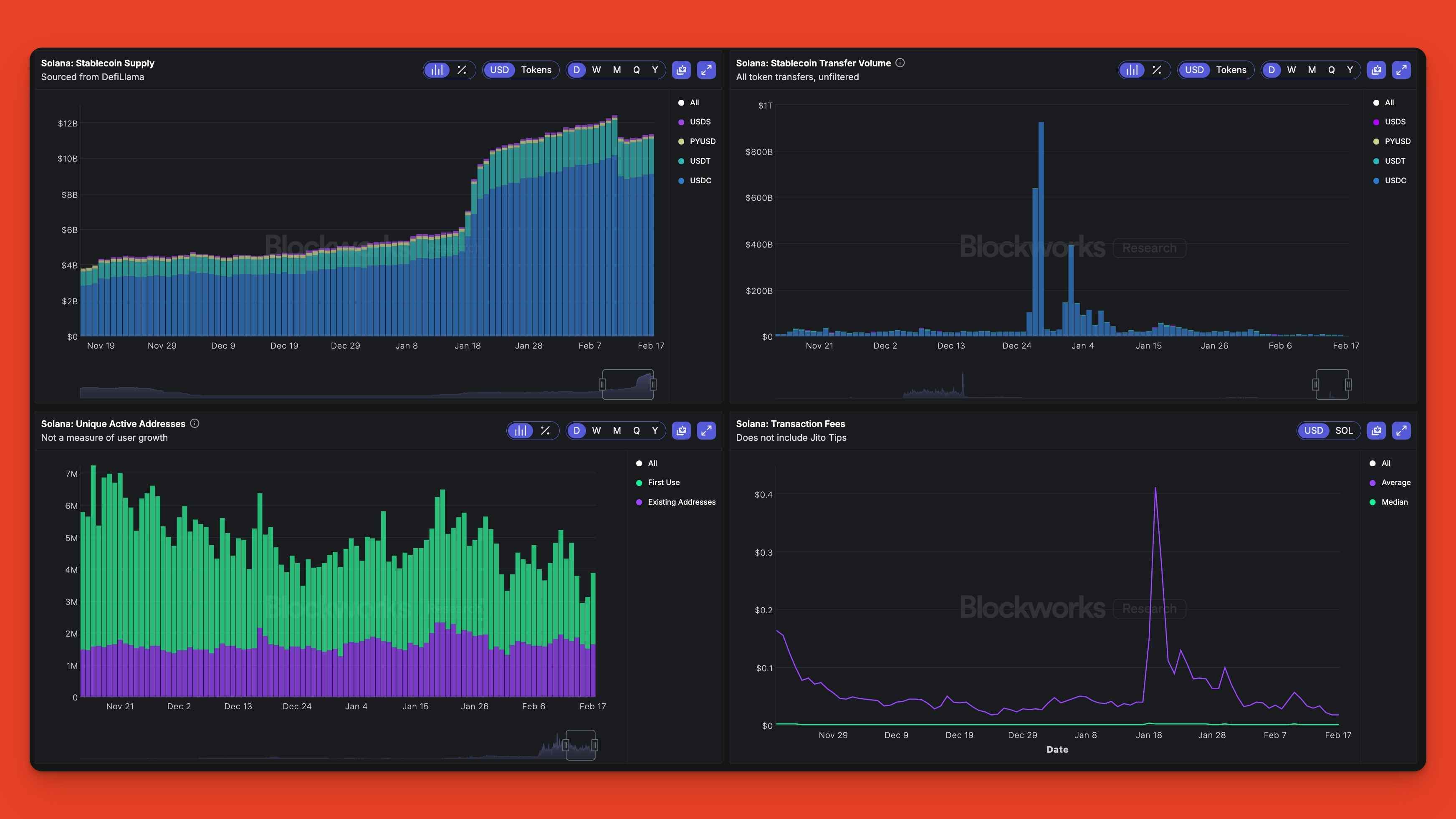
The Solana On-Chain Metrics Dashboard provided by Blockworks Research helps users intuitively understand key network data
Validator and Staking Dashboards
Validator data is essential for analyzing Solana’s degree of decentralization, staking distribution, and overall network health. These dashboards help users track annual percentage yield (APY) from staking, validator uptime, and other key metrics:
-
Stakewiz – Provides validator analysis, staking data, and APY information
-
Solana Beach – Focuses on validator performance, distribution, and governance-related data
-
Validators.app – Offers detailed validator metrics including software versions and latency tests
-
VX Tools – Provides cluster voting statistics, total blocks, and block reward data
Blockchain Forensics Tools
Blockchain forensics tools are professional tools used to monitor wallet activity, identify suspicious behavior, and assess risk. These are typically used by enterprises and teams with high compliance requirements, such as financial institutions or law enforcement agencies.
Below are two commonly used Solana forensics tools:
-
Chainalysis – Offers real-time monitoring, risk assessment, and blockchain forensics services, suitable for financial compliance scenarios
-
Arkham Intelligence – Provides wallet identity tracking and fund flow analysis to help users identify on-chain asset movements
Solana Token and Market Data
Token analytics platforms provide deep insights into token supply, liquidity, and market performance:
-
Birdeye – Offers token analytics and real-time price tracking for Solana assets, ideal for general users to quickly grasp token dynamics
-
Token Terminal – Provides key token metrics including price-to-earnings (P/E) ratio and user growth, suitable for in-depth financial and market analysis
-
Messari Token Portal – Delivers token reports and fundamental analysis, helping users understand a token’s potential value from a macro perspective
MEV (Maximal Extractable Value) Dashboards
MEV data platforms focus on analyzing frontrunning, sandwich attacks, and priority gas auctions within the Solana ecosystem:
-
Jito Explorer – Provides auction data, MEV tips, and detailed transaction information to help users understand on-chain auction dynamics
-
Sandwiched.me – Offers real-time sandwich attack and transaction data, ideal for studying on-chain trading behaviors and potential risks
These platforms provide structured data that helps developers, analysts, and investors deeply analyze Solana’s performance, security, and economic activity. Whether tracking network revenue, validator metrics, or transaction behavior, these tools offer valuable decision-making support.
Conclusion
Solana’s data ecosystem includes a wide range of tools optimized for different needs. Whether you require real-time data streams, historical data analysis, structured indexing, or simple on-chain transaction queries, there is a suitable tool available.
If you need low-latency data access and fine-grained control, consider RPC, WebSockets, Geyser (gRPC), or Webhooks. For querying historical states or analyzing processed datasets, Dune, Flipside, and Google BigQuery are ideal choices. For single transaction analysis or trend observation, block explorers and pre-built dashboards from Solana analytics firms meet most requirements.
If you have further questions about the Solana data ecosystem, feel free to reach out to @jackthepine on X (Twitter), or join the Helius community on Discord and Telegram.
Join TechFlow official community to stay tuned
Telegram:https://t.me/TechFlowDaily
X (Twitter):https://x.com/TechFlowPost
X (Twitter) EN:https://x.com/BlockFlow_News
 @heliuslabs