With so many cryptocurrency funds available, how should investors choose?
TechFlow Selected TechFlow Selected
With so many cryptocurrency funds available, how should investors choose?
Investment strategy is the core distinction among types of crypto funds, with each strategy corresponding to different investment objectives and market logic.
 Navigating Web3 tides with focused insights
Authors: Iris, Attorney Liu Honglin
Currently, the types of crypto funds have become increasingly diverse in response to evolving market demands. Differences across dimensions—ranging from investment strategies and fundraising methods to management styles and jurisdictions of registration—offer investors a wide array of options. These classifications not only reflect the innovation capacity of the crypto market but also provide suitable tools for investors with varying risk preferences.
Which crypto funds suit which Web3 investors? What compliance considerations do different crypto funds entail? In this article, ManQin Law breaks down each question, helping you make informed choices based on your Web3 investment needs.
Classification by Investment Strategy
Investment strategy is the core differentiator among crypto funds, with each approach aligning with distinct investment objectives and market logic. From short-term arbitrage to long-term value discovery, from stable and transparent index-based instruments to specialized funds targeting frontier assets, these strategies collectively offer diversified options for crypto investors.
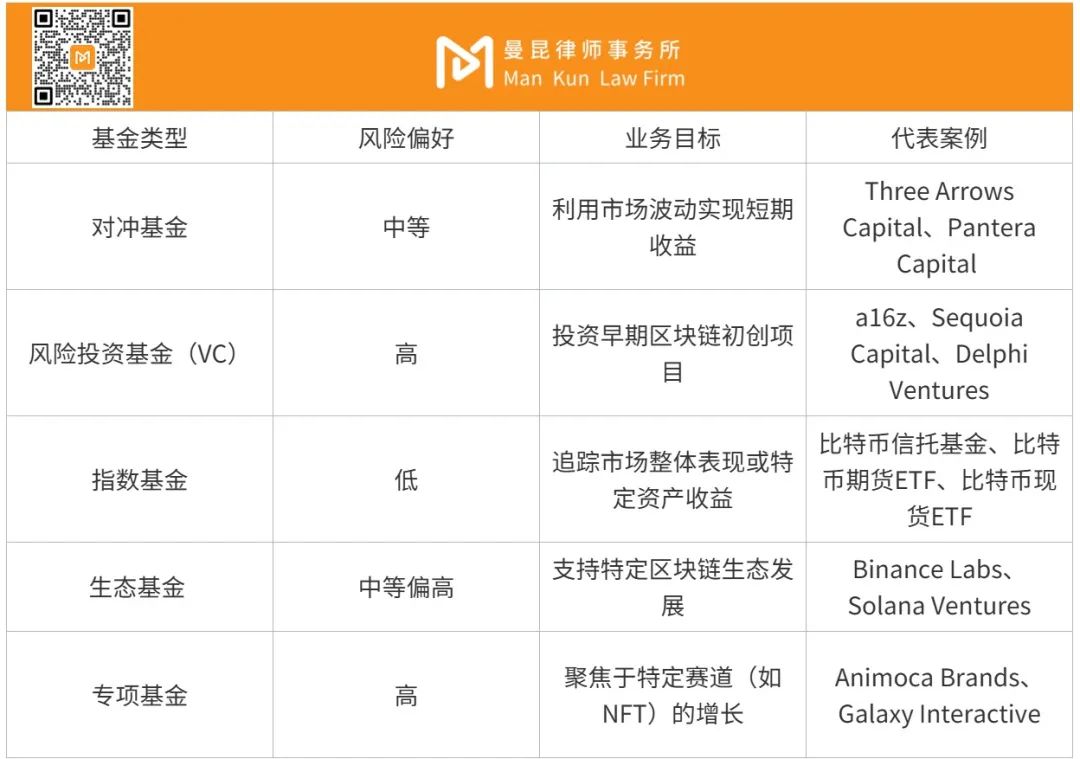
Hedge Funds
Hedge funds aim to generate stable returns amid cryptocurrency market volatility through high-frequency trading, market arbitrage, and risk hedging strategies. Their flexible design allows operations in both bull and bear markets. By capturing price discrepancies across platforms and futures contract gains, hedge funds attract significant institutional investors and high-net-worth individuals.
Hedge funds are typically established in offshore jurisdictions such as the Cayman Islands or Seychelles, where regulatory oversight for private funds is relatively lenient. If established in the U.S., however, hedge funds must comply with relevant provisions of the Securities Act and Commodity Exchange Act and register with the U.S. Securities and Exchange Commission (SEC). Additionally, funds must strictly fulfill anti-money laundering (AML) and know-your-customer (KYC) obligations to ensure transparency of funding sources and transactions.
Venture Capital Funds
Venture capital (VC) funds focus on supporting early-stage blockchain projects, offering investors potential for high returns by investing in emerging yet high-potential technologies or ecosystems. Typically, VC funds not only provide financial backing but also assist startups with resource integration and strategic guidance, accelerating project development. Similarly, venture capital funds are best suited for institutional investors and high-net-worth individuals.
Establishing a venture capital fund requires clearly identifying whether fundraising targets qualify as accredited investors. Particularly in the U.S. and European markets, laws mandate that such crypto funds raise capital exclusively from high-net-worth individuals or institutional investors. Furthermore, if invested projects involve token issuance, it must be ensured that tokens comply with securities laws in the target markets. To meet compliance requirements, fund managers must exercise particular caution when designing token economic models to avoid risks of illegal fundraising.
Index Funds
Index funds provide investors with simple and transparent investment tools by tracking market indices or specific asset performances. Their low-risk and high-transparency characteristics make them more suitable for traditional finance investors and general investors who are not deeply involved in Web3. Notably, the 2024 approval of spot Bitcoin ETFs in the U.S. attracted substantial participation from traditional financial investors. As of writing, the total market capitalization of spot Bitcoin ETFs has exceeded one hundred billion U.S. dollars.
The compliance of index funds heavily depends on the regulatory environment of their jurisdiction of registration. For example, in the U.S., the approval of spot BTC ETFs means fund managers must undergo strict SEC supervision, including regular disclosure of fund portfolios and operational data. In other countries, fund compliance may also involve tax treatment and investor protection regulations.
Ecosystem Funds
Ecosystem funds aim to promote the development of blockchain networks and applications, and are often established directly by project teams. By investing in projects within a specific ecosystem—such as dApps and infrastructure—they directly enhance token value and network activity.
Establishing an ecosystem fund requires special attention to the token design and issuance compliance of its invested projects. Funds operating across multiple jurisdictions must also satisfy securities regulations in each respective region. For instance, the EU’s compliance review of ICOs emphasizes disclosure and investor protection, while Hong Kong requires funds to obtain relevant licenses from the SFC. Additionally, if a fund plans to expand operations through cross-border fundraising or trading, it must comply with anti-money laundering and tax reporting rules in various countries.
Specialized Funds
Specialized funds offer opportunities to capture high growth potential in niche sectors by focusing on specific asset classes or market areas. Their hallmark is concentrated resource allocation, enabling more effective discovery of market value within targeted domains—such as NFTs, tokenized real-world assets, or blockchain infrastructure—through in-depth research. Specialized funds attract high-risk-tolerant investors seeking deep engagement in cutting-edge fields, including institutions and high-net-worth individuals.
Specialized funds are commonly established in jurisdictions like Singapore or the Cayman Islands, where legal environments are more accommodating toward innovative assets. However, fund managers must pay particular attention to the legality of target assets. For example, when investing in NFTs, intellectual property rights must be clearly defined; funds investing in tokenized physical assets must follow local laws regarding ownership verification and token trading. Moreover, specialized funds must adhere to tax reporting, anti-money laundering (AML), and KYC requirements to ensure transparency of funds and transactions.
Classification by Fundraising Method
A crypto fund's fundraising method is a key factor influencing its target audience, operational model, and compliance obligations. Based on investor type and regulatory framework, crypto funds can be categorized into private funds and public funds.
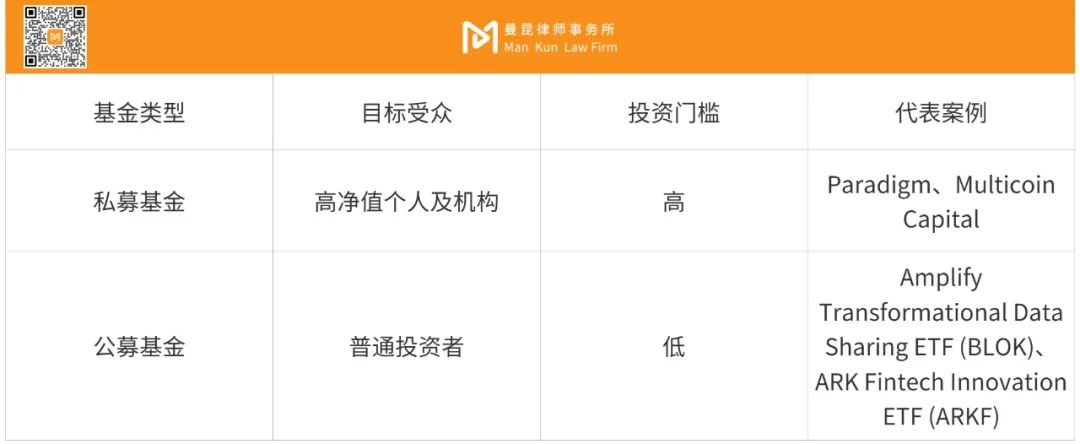
Private Funds
Private funds are typically raised through non-public offerings and often come with minimum investment thresholds, resulting in higher entry barriers. However, they allow more flexible investment strategies that can quickly adapt to market dynamics, helping investors achieve higher returns. Nevertheless, the high-risk nature of these funds also implies that investors need strong market understanding and risk tolerance.
Private funds are usually established in regions with relatively relaxed regulation, such as the Cayman Islands or Singapore. These jurisdictions impose lower requirements for fund registration and disclosure, offering greater operational flexibility. To establish a private fund in the U.S., Form D must be filed with the SEC, confirming that the fund is open only to qualified accredited investors. Additionally, private funds must fulfill AML and KYC obligations to ensure the legitimacy of funding sources.
Public Funds
Public funds lower the barrier for ordinary investors to enter the crypto market through public offerings. These funds typically adopt transparent investment strategies and must meet stringent information disclosure requirements, including details on investment strategy, risk assessment, and periodic portfolio reports. This makes them more suitable for investors with lower risk tolerance who seek stable returns.
Public funds must comply with strict regulatory rules in their target markets. For example, in the U.S., public funds require SEC approval and must adhere to the Investment Company Act, covering risk disclosure, investor protection, and operational transparency. Additionally, public fund managers must ensure compliant tax reporting and fulfill AML obligations.
Classification by Management Style
The management style of a crypto fund is one of the key factors affecting investment strategy and returns.
Based on management approach, crypto funds can be divided into actively managed funds and passively managed funds. The core difference lies in how investment decisions are made and the flexibility of management strategies.
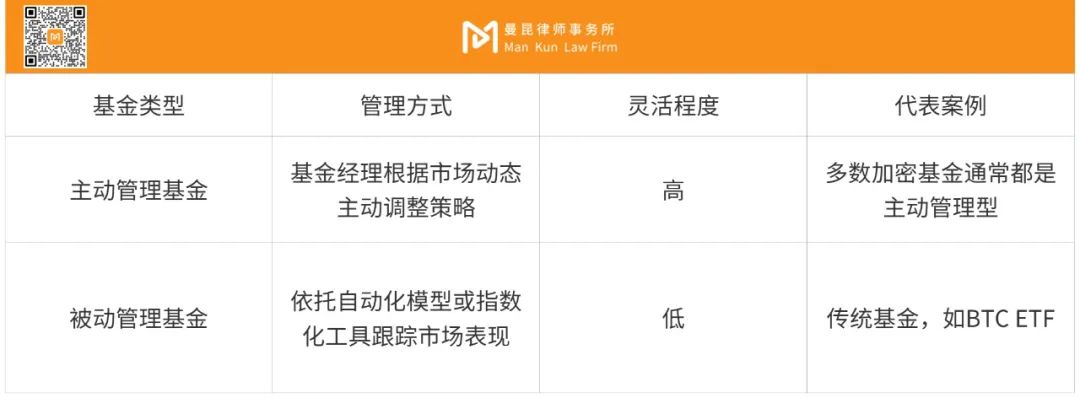
Actively Managed Funds
Actively managed funds are overseen by experienced fund managers who make investment decisions based on market trend analysis, adjusting asset allocations to achieve higher returns. For example, managers may increase exposure to high-performing assets or quickly reduce positions during market downturns to mitigate risk. This flexibility gives actively managed funds stronger resilience and return potential in volatile markets.
These funds suit investors with higher risk tolerance, especially high-net-worth clients and institutional investors seeking alpha through professional management. However, their higher management fees and more complex operational models demand exceptional market insight and adaptability from fund managers.
It is generally advisable to establish actively managed funds in jurisdictions like the Cayman Islands or Singapore, where regulations for private funds are relatively lenient. However, if established in stricter regulatory environments like the U.S., actively managed funds must submit investment strategy and risk disclosure documents to the SEC. Fund managers must also comply with AML and KYC regulations to ensure legitimate funding sources and mitigate compliance risks.
Passively Managed Funds
Passively managed funds use automated algorithms or track market indices to enable automated asset allocation, minimizing frequent intervention by fund managers and reducing human decision-making risks. Compared to actively managed funds, passively managed funds have lower fees and higher transparency, making them more suitable for risk-averse investors. Ordinary investors seeking to reduce risk through diversification can enter the crypto market via passively managed funds and benefit from overall market growth.
The operation of passively managed funds relies on the legal framework of their jurisdiction. For example, in the U.S., the approval of spot Bitcoin ETFs signifies that passively managed funds must undergo rigorous SEC oversight, including disclosure and risk review. In other markets, such as Canada’s Purpose Bitcoin ETF, funds must regularly submit operational data to local securities regulators to ensure transparency and compliance. Additionally, fund managers must still fulfill AML obligations and ensure effective investor protection mechanisms.
Classification by Jurisdiction of Registration
The jurisdiction of registration and its regulatory framework profoundly influence a crypto fund’s operational model and compliance posture. From tax-efficient offshore funds to tightly regulated onshore funds, different regional policy environments offer unique combinations of support and constraints. These choices not only affect setup costs and management flexibility but also determine the fund’s credibility and appeal to investors.
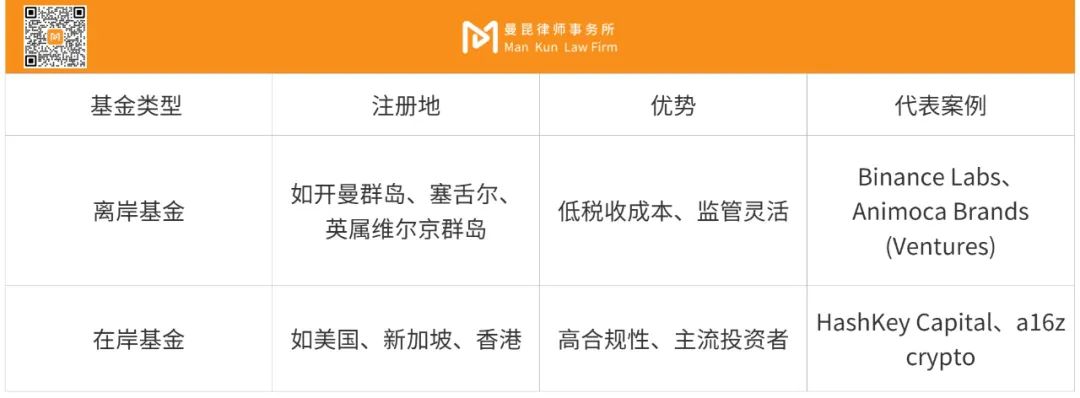
Offshore Funds
Offshore funds are registered in foreign or offshore jurisdictions, often referred to as tax havens, such as the Cayman Islands, Seychelles, or British Virgin Islands (BVI). Designed for non-resident investors, these funds leverage simplified legal frameworks to allow rapid portfolio adjustments in response to market fluctuations and gain advantages in cross-border arbitrage.
The lenient policies of these jurisdictions offer convenience for fund managers but come with lower transparency and governance risks. To build investor trust, offshore fund managers should establish clear governance mechanisms and regularly disclose operational information to enhance transparency. Cross-border investment and trading activities must also carefully consider anti-avoidance regulations in target markets to mitigate potential legal risks.
The registration process for offshore funds is relatively straightforward. For example, in the Cayman Islands, a fund can begin operations after basic registration, requiring only the appointment of a registered agent and periodic submission of financial reports. In Seychelles, funds must complete the registration process and comply with regulations set by the local Financial Services Authority, including minimum AML and KYC requirements. Additionally, cross-border investment or trading activities must pay special attention to anti-avoidance rules in target markets to avoid legal risks.
Onshore Funds
Unlike offshore funds, onshore funds are registered in the investor’s home country or region and are subject to strict local regulation. The U.S., Singapore, and Hong Kong are major jurisdictions for such funds. Through comprehensive disclosure and investor protection policies, onshore funds attract substantial mainstream capital and institutional investors.
The core advantage of onshore funds lies in their transparency and stability. A robust legal system provides greater security for investors, while high compliance standards make it easier for these funds to secure global capital support and regulatory endorsement. However, these benefits come with higher setup costs and operational requirements.
For example, in Hong Kong, crypto fund managers must apply for a Type 9 regulated activity license under the Securities and Futures Ordinance (SFO) to engage in virtual asset fund management or traditional asset management. Additionally, the Securities and Futures Commission (SFC) imposes stricter requirements on funds involving virtual assets—such as ensuring that invested virtual asset trading platforms are recognized or regulated—and mandates fulfillment of disclosure and risk management duties to provide stronger investor protection.
ManQin Law Recommendations
The diversity of crypto funds offers abundant choices for Web3 investors, but also places higher demands on investor judgment. Based on practical experience in crypto fund establishment, ManQin Law summarizes the following key points to help you make informed decisions:
Clarify Investment Objectives and Risk Tolerance
If seeking short-term returns and able to tolerate high risk, a hedge fund may be a suitable choice. If bullish on the high-growth potential of early-stage blockchain projects, consider a venture capital (VC) fund. Alternatively, for investors preferring long-term stable returns, index funds—especially low-risk instruments like spot ETFs—are more attractive.
Consider the Legal and Tax Environment of the Jurisdiction
Offshore funds suit investors seeking high flexibility and low tax costs, but attention must be paid to whether fund managers maintain sound governance and transparency. Onshore funds are better suited for investors prioritizing transparency and legal protection, especially those aiming to attract traditional financial capital or institutions with strong compliance requirements.
Additionally, investors are advised to align with the legal requirements of target markets, paying close attention to regulations in the jurisdiction regarding disclosure, licensing, AML, and tax reporting.
Evaluate the Professionalism and Track Record of Fund Managers
A fund manager’s investment strategy and historical performance are critical indicators of fund quality. Therefore, before participating, investors should examine the background of the management team, assess their experience in the blockchain industry and financial management, and analyze past investment performance and project portfolios to ensure the manager can achieve investment goals in complex market conditions.
Join TechFlow official community to stay tuned
Telegram:https://t.me/TechFlowDaily
X (Twitter):https://x.com/TechFlowPost
X (Twitter) EN:https://x.com/BlockFlow_News