








传统企业家如何看懂加密基金?
TechFlow Selected TechFlow Selected
传统企业家如何看懂加密基金?
Crypto funds represent not speculation, but "an opportunity window for a new generation of asset management strategies."
 Navigating Web3 tides with focused insights
By: Shao Jiaiod
Disclaimer: This article is based on an international legal perspective and does not apply to or target the legal environment of Mainland China.
Lately, I’ve increasingly heard traditional entrepreneurs ask one question: "I don’t understand the crypto market, but I want to know what crypto funds are all about."
Some seek asset diversification; some aim to hedge against currency fluctuations; others simply think, “Institutions are investing now—I can’t afford to ignore it.”
But once they open fund documents, business owners are immediately intimidated by a barrage of jargon:
-
Long Only?
-
Market Neutral?
-
Funding Rate?
-
Multi-Strategy?
-
Web3 VC?
-
CTA? Factor Model?
More importantly:
What do these strategies actually do? Which ones are stable? Which have large drawdowns? Who has actually made money over the past five years?
This article is written for you:
-
Using the most intuitive language to explain how crypto funds are categorized
-
Explaining exactly how each strategy generates returns
-
Clarifying their respective strengths and weaknesses
-
Revealing real performance trends over the past five years
-
Guiding entrepreneurs on how to select crypto funds
After reading this, you’ll be able to judge:
“Whether allocating to crypto funds suits me, and which type fits best.”
Why Are More and More Traditional Entrepreneurs Looking at Crypto Funds?
The reason is simple: Crypto funds have evolved from “speculators’ playgrounds” into asset classes recognized by institutions. Three major trends are unfolding:
Trend One: Global Institutions Are Quietly Increasing Exposure to Crypto
-
BlackRock and Fidelity have launched Bitcoin/Ethereum ETFs
-
JPMorgan, Deutsche Bank, and others are enhancing crypto custody services
-
Sovereign wealth funds, pension funds, and insurance capital are beginning to allocate to digital assets
Once institutions enter, the status of crypto assets changes. They are no longer fringe investments but part of alternative assets.
Trend Two: Crypto Funds Are Far More Professional Than Individual Trading
The crypto market is highly volatile, trades 24/7, features complex derivatives, and evolves rapidly.
Yet for professional teams, these aren't problems—they’re opportunities:
-
Clear trend signals → suitable for quant strategies
-
Fragmented exchanges → arbitrage opportunities exist
-
Perpetual contract mechanisms → funding rate yields available
-
Short innovation cycles → steep VC returns possible
-
Transparent data → strategies can be verified
Thus, crypto funds can achieve far more than individual investors.
Trend Three: Entrepreneurs Need a “New Vehicle” for Asset Allocation
Real estate cycles are weakening, A-shares remain in long-term consolidation, Hong Kong stocks suffer low valuations, and while USD assets offer high interest rates, their future outlook is uncertain.
Many entrepreneurs are now asking:
“Where will the next five years of growth come from?”
Crypto funds offer a new possibility:
-
Offensive (capture trends)
-
Defensive (arbitrage)
-
Bet on innovation (VC)
-
Rapidly increasing institutionalization
-
Eligible for custody, audit, and compliance
This is why crypto funds are becoming a new option for entrepreneurial asset allocation.
Six Major Types of Crypto Fund Strategies
The following six categories represent the most widely used and entrepreneur-friendly classification framework in the industry today (based on Crypto Fund Research + Galaxy VisionTrack):
1. Discretionary Long Only — Betting on Cycles, Riding Big Trends
How does it make money?
Buy major crypto assets (BTC, ETH, top altcoins), hold long-term, and add positions during dips.
The core logic boils down to one sentence:
“Believe in long-term crypto appreciation and hold through volatility.”
Advantages:
-
Highest returns during bull markets
-
Simple, transparent, low cost
Disadvantages:
-
Extremely deep drawdowns in bear markets
-
Requires very high risk tolerance
Suitable for: Investors willing to endure volatility and focused on long-term trends.
2. Discretionary Long/Short — Profitable in Both Rising and Falling Markets, Execution Skill Is Key
How does it make money?
Relies on team judgment:
-
Bullish → increase exposure
-
Bearish → reduce exposure or short sell
-
Event-driven → capture hot topics, airdrops, upgrades
In simple terms: “Professional traders managing your positions.”
Advantages:
-
Hedging capability during downturns
-
Lower volatility compared to Long Only
Disadvantages:
-
Success highly dependent on management team
-
Discernment ability is the core competitive edge
Suitable for: Those who want market exposure but don’t want full directional risk.
3. Quantitative Directional (Quant) — Models Decide, Emotions Step Aside
How does it make money?
Run trading via mathematical models:
-
Trend-following CTA
-
Momentum strategies
-
Multi-factor models
-
Statistical signal detection
You can think of it as:
“Robotic trading—no news, no emotion, only model-driven execution.”
Advantages:
-
Strong discipline
-
Good returns when trends are clear
-
Fewer human errors
Disadvantages:
-
Models may suddenly fail
-
Sensitive to transaction costs
Suitable for: Investors seeking “more stable trend returns.”
4. Market Neutral / Arbitrage — One of the Lowest Directional Risk Strategies
How does it make money?
Create non-directional portfolios to profit from price spreads and interest differentials.
Typical strategies:
-
Funding rate arbitrage
-
Spot–perpetual basis arbitrage
-
Cross-exchange price arbitrage
-
Market making
-
On-chain low-risk yield strategies
Think of it as:
“A crypto version of money market funds + arbitrage funds.”
Advantages:
-
Lowest volatility
-
Lowest risk
-
Smallest drawdowns
Disadvantages:
-
Limited upside potential
-
Risks lie with counterparties (exchanges) and on-chain technology
Suitable for: Corporate idle cash, entrepreneurs needing stable returns.
5. Crypto VC (Venture / SAFT) — Bullets for Betting on Innovation
How does it make money?
Invest in early-stage Web3 projects through:
-
Equity appreciation driven by project growth
-
Token Generation Events (TGE)
-
Secondary market exits after token unlocks
Similar to traditional VC, but with shorter cycles and higher volatility.
Advantages:
-
One big win can cover all losses
-
Gives access to future industry directions
Disadvantages:
-
Low survival rate
-
Long lock-up periods
-
Opaque valuations
Suitable for: Large capital aiming to bet on disruptive innovation.
6. Multi-Strategy — Combining Multiple Advantages
Simultaneously engages in:
-
Long Only
-
Quant
-
Arbitrage
-
VC
-
Event-driven
Purpose:
“Pursue diversified returns under controlled risk.”
Advantages:
-
Smaller drawdowns than Long Only
-
Higher returns than arbitrage
Disadvantages:
-
Complex structure
-
High managerial skill required
Suitable for: First-time entrants to crypto funds seeking a balanced entry.
Summary: The pros and cons of the above strategies are summarized below:
The Real Profit Logic Behind Crypto Funds
Why is the crypto market well-suited for fund strategies? Because it has three structural characteristics absent in traditional markets:
1. Perpetual Contract Mechanism → Funding Rate Arbitrage Opportunities
Perpetual contracts are unique to crypto markets.
Every 8 hours, longs and shorts pay each other an “interest” fee known as the funding rate.
This means:
“When sentiment is bullish, longs pay, shorts receive.”
Funds can then:
-
Buy spot
-
Short perpetuals
To “lock in price” and earn pure funding rate income.
This is one of the most stable sources of arbitrage returns in crypto.
2. Multi-Exchange Structure → Natural Price Spread Opportunities
Due to:
-
Multiple exchanges
-
Fragmented liquidity
-
Different user preferences
-
Inconsistent stablecoin systems
Price discrepancies frequently appear across exchanges.
Funds use algorithmic trading to conduct:
-
Cross-exchange arbitrage
-
Spot-futures arbitrage
-
Futures-perpetual arbitrage
These returns don’t rely on “betting direction,” but on “math and speed.”
3. High Volatility → Trend Strategies Work Better
In highly volatile markets:
-
Trends are clearer
-
Signals are stronger
-
Quant models have more “food” to work with
This is a key reason behind the rise of crypto quant strategies.
Performance of Different Strategies Over the Past Five Years
According to VisionTrack Crypto Hedge Fund Indices data, the annual returns of four tracked strategy types over the past five years are shown below:
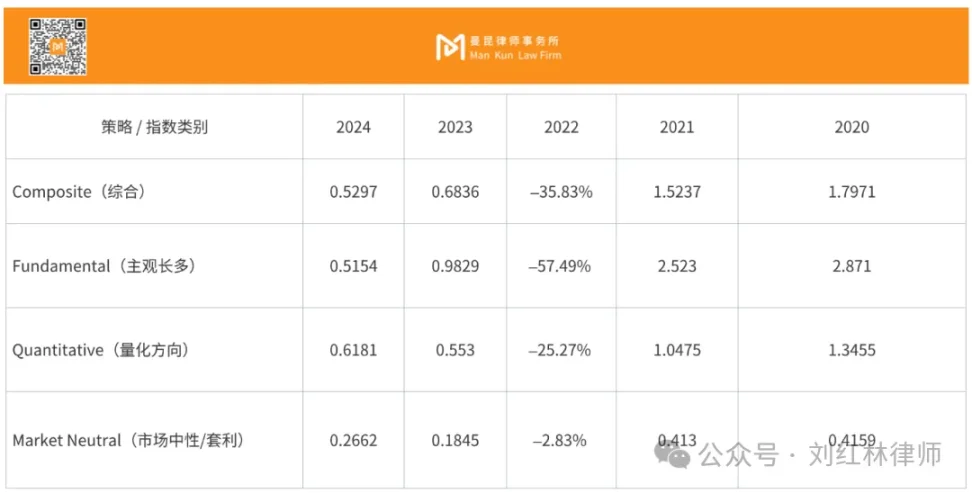
Based on widely cited public index trends in the industry, our summary of the six strategy types’ returns is as follows:
1. Discretionary Long Only: Highest Gains, Deepest Losses
-
Bull markets: Best performance (e.g., 2017, 2020–2021, 2023)
-
Bear markets: Largest drawdowns (e.g., 2018, 2022)
High elasticity, high volatility, high returns, high risk.
2. Quantitative Directional: Medium-High Returns, Controllable Drawdowns
-
Bull markets: Captures trends effectively
-
Bear markets: Models reduce exposure to limit losses
Smoother equity curves, ideal for those wanting “stable trend capture.”
3. Market Neutral Arbitrage: The Most Stable Strategy Type
Overall characteristics:
-
Annualized returns may not be high, but consistent
-
Smallest drawdowns
-
Ideal as asset base layer or corporate cash management
Industry trends are crystal clear:
“Stable, stable, stable.”
4. Crypto VC: Extremely Polarized Returns
-
Top-tier funds deliver astonishing IRRs (hitting one or two breakout projects)
-
Median fund performance is relatively mediocre
-
Long horizon, high risk, high uncertainty
Suitable for long-term capital, not short-term expectations.
5. Multi-Strategy Funds: The Most Accessible Combination for Entrepreneurs
Stable, balanced, controllable—ideal as an entry-level allocation.
How Should Traditional Entrepreneurs Choose Crypto Funds?
Many business owners’ first thought is: “Which fund should I pick?” But you should first ask yourself three questions:
1. Is this money “idle capital” or “capital you need soon”?
-
Idle capital → Market Neutral, Multi-Strategy
-
Capital intended for growth with tolerance for volatility → Quant, Long Only
-
Capital aimed at betting on innovation → VC
The nature of your capital determines the strategy—not the other way around.
2. How much volatility can you tolerate?
Can you accept a -70% maximum drawdown from a Long Only fund?
If not, such strategies are unsuitable for you.
3. What are you really after: Stability, Balance, or Explosive Growth?
Three paths:
-
Stability: Arbitrage / Market Neutral
-
Balance: Multi-Strategy / Quant
-
Explosive Growth: Discretionary Long Only / VC
Clarify your goal before selecting a fund.
Crypto Funds Are Becoming the Next Generation of Hedge Funds
The current crypto market is no longer the wild west of 2018:
-
ETFs exist
-
Custody solutions exist
-
Audits exist
-
Regulation exists
-
Major institutions are involved
-
Real-world applications are being deployed
-
Mature strategy frameworks exist
Crypto funds represent not speculation, but an “opportunity window for next-generation asset management strategies.” Over the next five years, crypto funds will become increasingly important in entrepreneurs’ asset allocation frameworks. Not because they’re mysterious, but because they’ve already gone mainstream. If you want to understand the crypto industry, you don’t necessarily need to trade yourself. You just need to understand: Who is using which strategies, and under what logic are they generating profits for you?
Still Hesitant and Uncertain? What Should You Do?
If you’ve read this far, you already have a foundational understanding of crypto fund strategy logic. But the real challenge isn’t “understanding concepts,” but rather:
-
Which funds are truly worth investing in?
-
Which strategies match your capital profile?
-
Which subtle clauses in documents, structures, and fee designs could affect your future exit?
-
Which risks are manageable, and which are structural?
-
Which teams are truly institutional, and which are merely “retail traders in institutional clothing”?
These questions have no standard answers, yet they directly impact your capital safety and return stability. I’ve seen many entrepreneurs struggle with decisions and accompanied numerous LPs through fund due diligence, structural analysis, term revisions, and risk assessments. I’ve noticed a pattern:
As long as you clarify strategy, structure, and terms before investing, your experience with crypto funds will improve dramatically.
Join TechFlow official community to stay tuned
Telegram:https://t.me/TechFlowDaily
X (Twitter):https://x.com/TechFlowPost
X (Twitter) EN:https://x.com/BlockFlow_News









