The Chinese company that files the most AI patents
TechFlow Selected TechFlow Selected
The Chinese company that files the most AI patents
In AI patents, China and the U.S. are leading globally.
 Navigating Web3 tides with focused insights
Article source: Align Lab
Image source: Generated by Wujie AI
On February 10–11 local time, the Paris AI Action Summit, hosted by the French government with co-sponsorship from the Indian government, attracted leaders from over 100 countries and senior executives from the global AI industry to discuss artificial intelligence’s impact on worldwide development.
Compared to the previous two summits held in the UK and South Korea, this year’s summit clearly shifted focus from safety and risks toward the potential of AI development. Fei-Fei Li, known as the "godmother of AI," stated in her opening speech: "We are now truly entering the 'first era of AI'." Google CEO Sundar Pichai went further: "We are now in a golden age of AI innovation, and the greatest risk is missing the opportunity."
France, as the host country, positioned the summit around the theme of "concrete action," interpreted as Europe's attempt to claim influence in AI development. Prior to the event, French President Emmanuel Macron told media: "We (Europe) must close the gap with China and the US in AI."
TechFlow analyzed patents related to generative artificial intelligence (GenAI) to present a granular view of today’s global AI competition landscape.
Surge in Generative AI Patents in 2024
Although generative artificial intelligence represents only one branch of AI and holds a small share among all AI patents—by the end of 2024, there were nearly 2.6 million AI patents globally, with about 90,000 in generative AI, accounting for just 3.6%—it has become a dominant force due to its ability to create new content such as text, images, and music by learning from existing data.
The pivotal moment that elevated this technology was OpenAI’s release of ChatGPT in November 2022, which demonstrated the immense potential of generative AI. Since then, China alone has launched hundreds of large models, with text-to-image and text-to-video applications emerging rapidly.
Based on WIPO’s (World Intellectual Property Organization) generative AI patent search methodology released in 2024 (details provided at the end of this article), TechFlow found that in 2024, 45,000 new generative AI patent records were added globally—an amount equal to the total of the past decade.
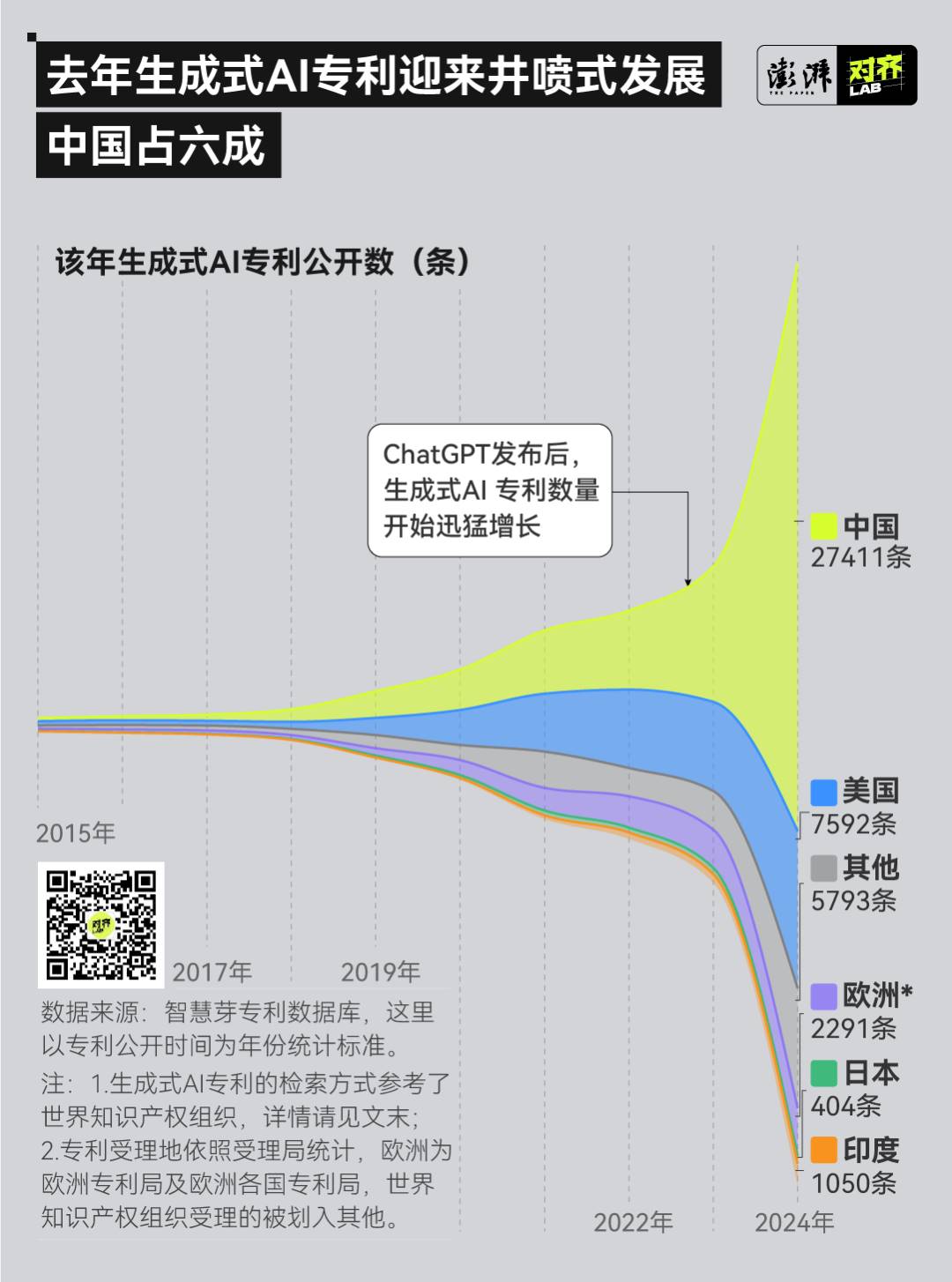
Of these 45,000 newly disclosed generative AI patents in 2024, 27,000 originated from China, making up 61.5%—the highest of any country. The United States ranked second with 7,592. Despite Macron’s belief that "Europe is severely lagging behind in today’s global AI race, even falling outside the 'race' altogether," Europe remained the third-largest recipient of AI patents last year.
It should be noted that filing location does not necessarily reflect inventor origin. In fact, in 2024, Samsung from South Korea filed the most generative AI patents at the European Patent Office (254), followed by Google from the U.S. (54), and Huawei from China (51).
The World Intellectual Property Organization previously tracked inventor locations for generative AI patents between 2014 and 2023, finding the top five countries to be China, the United States, South Korea, Japan, and India.
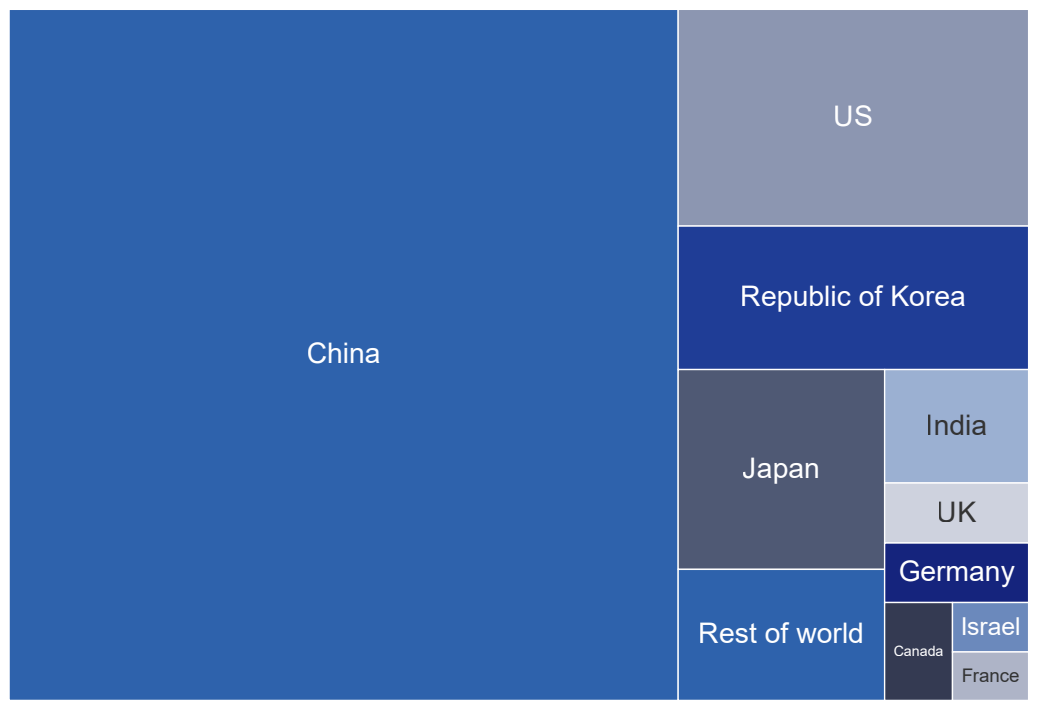
China leads in GenAI patents, followed by the U.S., South Korea, Japan, and India. Image source: WIPO, "Generative Artificial Intelligence"
While the U.S. and China lead in AI development, Europe has taken a more aggressive stance on regulation. The EU introduced the world’s first comprehensive AI regulation, the Artificial Intelligence Act, which officially took effect on August 1, 2024.
However, just six months after its implementation, EU officials, including Macron, indicated plans to loosen restrictions on AI development. At the summit, both Macron and senior EU officials stated that the EU would simplify regulations on AI development to foster growth within the region.
"Europe is overly centralized in governance, which means it fails to build advantages in diversity of perspectives and capabilities," said Neil Lawrence, Professor of Machine Learning at the University of Cambridge and Senior AI Researcher at The Alan Turing Institute, speaking to TechFlow.
Who Is Actively Filing Generative AI Patents?
Data on companies filing the most generative AI patents offers a clearer picture of the AI gap between Europe and the U.S./China that concerns Macron.
TechFlow’s analysis shows that among the top 20 companies with the most generative AI patents in 2024, 11 were from China—including Tencent, Baidu, and China Mobile—seven were from the U.S., and only one, Siemens, from Europe.
Given that tech giants from China and the U.S. are aggressively advancing in generative AI, it’s understandable why Macron worries Europe might be relegated to merely an AI consumer.
Beyond commercial entities, the academic institutions adding the most generative AI patents over the past year were also primarily from China. In 2024, the Chinese Academy of Sciences led with 492 newly added generative AI patents, followed by Zhejiang University and Tsinghua University.
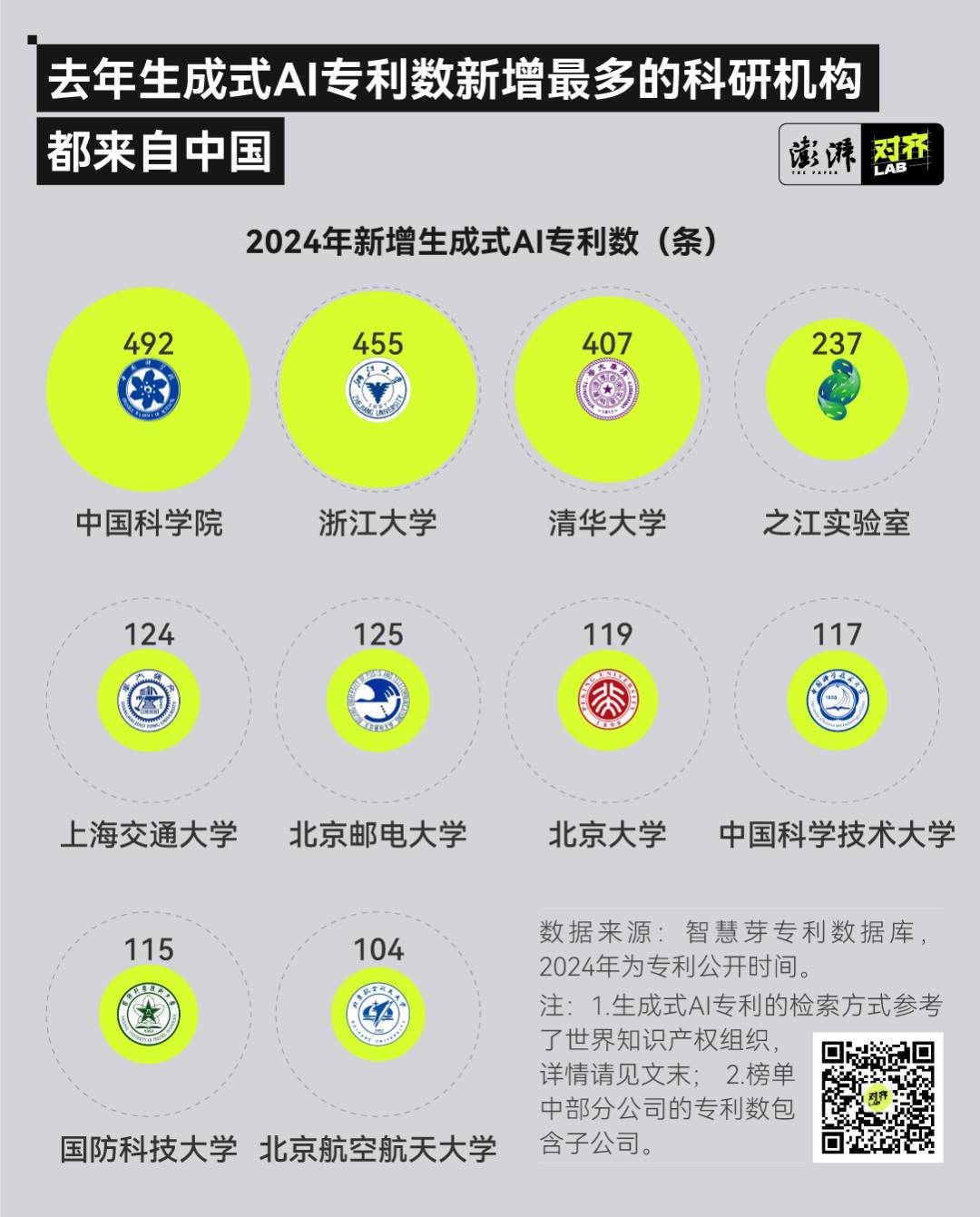
Still, some question how well patent volume reflects true innovation capability.
Xia Weifeng, a lawyer specializing in intellectual property, told TechFlow: "Patent count is one important indicator of a company’s strength in AI, as it directly reflects technological accumulation and R&D capacity." However, he added that "evaluation must also consider patent quality, commercialization ability, fundamental research, and ecosystem building." Xia noted that the once-capital-favored AI "Four Little Dragons" held substantial AI patent portfolios but faced criticism for lacking practical deployment capabilities.
Xia also observed in conversations with AI R&D professionals that many feel AI technology is evolving faster than ever, making patent filings increasingly competitive. Some companies strategically file large numbers of patents to build defensive IP barriers.
Whether this strategy of amassing patents to form technical moats is beneficial or harmful requires a balanced view, according to Xia: "Some of our clients—entrepreneurs entering the AI space and SMEs innovating in AI—have already been hindered by the so-called 'patent thicket,' facing higher innovation costs and fears of restricted technology application." Yet, he acknowledged that "patent filing and granting have also expanded market opportunities for Chinese AI firms, accelerating technology transfer and industrial upgrading."
"Open Source" Isn't Free, and Patents Don't Always Mean Monopoly
Besides identifying top patent holders in generative AI, data analysis revealed a striking contrast:
OpenAI, the creator of ChatGPT, has filed only 30 AI-related patents to date—all submitted in 2024. Similarly, DeepSeek, another disruptive force in AI, holds only 27 AI-related patents, including key ones like "A Method for Constructing Training Datasets for Artificial Intelligence Models," also filed in 2024.
Yet, public reactions to their patent strategies differ sharply: Many wonder why OpenAI has so few patents—practically none compared to rivals like Google. In contrast, many ask why DeepSeek bothers filing patents at all.
This double standard stems fundamentally from the differing technological philosophies represented by ChatGPT and DeepSeek:
ChatGPT champions "closed-source" (withholding software source code). WIPO’s "Generative Artificial Intelligence Report" suggests OpenAI’s minimal patenting is intentional—to avoid disclosing technical details through patents. In contrast, DeepSeek promotes "open-source" (publicly sharing source code), immediately releasing training details upon model launch.
Hence, many question: Why would DeepSeek apply for patents while freely sharing its technology? Xia Weifeng explained that without timely patent protection, DeepSeek risks having similar technologies claimed by others, potentially facing litigation. Patents help secure rights and reduce future disputes.
In Xia’s view, "open source" and "patents" are not mutually exclusive: "Essentially, open source expands the ecosystem, while patents protect core technologies." The key lies in how companies design licensing terms—enabling broader benefit while safeguarding their own investment returns.
Perhaps as open-source approaches like DeepSeek gain recognition, more teams will follow, creating more efficient and cost-effective large models. Generative AI patents are poised for exponential growth in the coming years.
Join TechFlow official community to stay tuned
Telegram:https://t.me/TechFlowDaily
X (Twitter):https://x.com/TechFlowPost
X (Twitter) EN:https://x.com/BlockFlow_News
 @thepapercn