








Kaito is about to launch its token—how to estimate your airdrop value using four key models?
TechFlow Selected TechFlow Selected
Kaito is about to launch its token—how to estimate your airdrop value using four key models?
Kaito AI is a Web3 search engine founded by former Citadel quantitative traders.
 Navigating Web3 tides with focused insights
Author: Luke, Mars Finance
Introduction
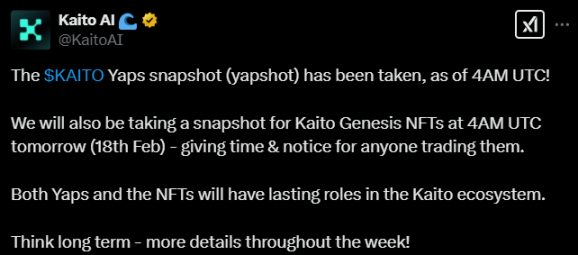
On February 17, Kaito AI, a Web3 search engine powered by AI, announced the completion of its KAITO Yaps snapshot, followed closely by the Genesis NFT snapshot. In this long-planned wealth distribution event, on-chain analyst Caneleo discovered that Kaito had deployed one billion tokens on Base chain, with 33.3% potentially allocated for airdrops.
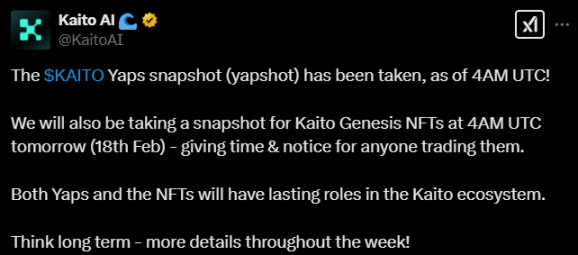
In other words, approximately 333 million $KAITO tokens are即将 being distributed to NFT holders and Yap contributors. Based on Kaito's previous funding round valuation of $87.5 million and an airdrop allocation of 33.3%, the theoretical total airdrop value approaches $28.875 million.
Kaito has designed a two-tier airdrop system:
-
Genesis NFT Holders: 1,500 NFTs will receive 15% of the airdrop pool (approximately $4.32 million), with each NFT expected to receive $2,880 worth of $KAITO;
-
Yap Contributors: The remaining 85% ($24.555 million) will be distributed proportionally based on Yap points. Based on current emission rates, each Yap is estimated to be worth around $13.
Once the market realized the scale and potential returns of this airdrop, FOMO quickly intensified. A wave of "airdrop farmers" rushed to climb the leaderboard, flooding Kaito’s posts across X (formerly Twitter), officially launching a Web3 version of an “Airdrop Hunger Games.”
Why has Kaito rapidly emerged as the most anticipated airdrop in Web3 after EigenLayer?
FOMO fueled by valuation expectations: Kaito was valued at $87.5 million during its Series A round in June 2023. Compared to Berachain, whose post-funding valuation increased eightfold, if Kaito follows a similar trajectory, the airdrop value could multiply up to tenfold.
Amplified returns via ecosystem leverage: Kaito employs a dual-points system of “Yap to Earn” and “Genesis NFT,” enabling NFT holders to potentially receive over $13,000 in airdrop rewards.
Backed by top-tier VCs: Institutional investors such as Sequoia Capital and Dragonfly have participated, significantly boosting credibility and market confidence.
Amid rising FOMO, Kaito is no longer just an AI-powered search engine—it resembles a Web3 wealth volcano on the verge of eruption.
Who is Kaito? – The “AI Rainmaker” of the Web3 Information Empire
If EigenLayer is this year’s hottest “re-staking liquidity” project, then Kaito is the pioneer in the InfoFi (Information Finance) space, aiming to become the Google + Bloomberg Terminal of the crypto world.
Founded by Yu Hu, a former quant trader at Citadel, Kaito focuses on solving information fragmentation in the Web3 world. By leveraging large AI models to consolidate massive, scattered data from platforms like Twitter, Discord, and governance forums, Kaito created MetaSearch—an intelligent search engine tailored specifically for crypto investors.
Unlike traditional search engines, Kaito not only indexes various Web3 data sources but also uses ChatGPT-like technology to generate deep analysis, allowing investors to instantly access market intelligence and precisely capture on-chain alpha opportunities. Hence, Kaito is often referred to as the “Alpha Hunter of Web3.”
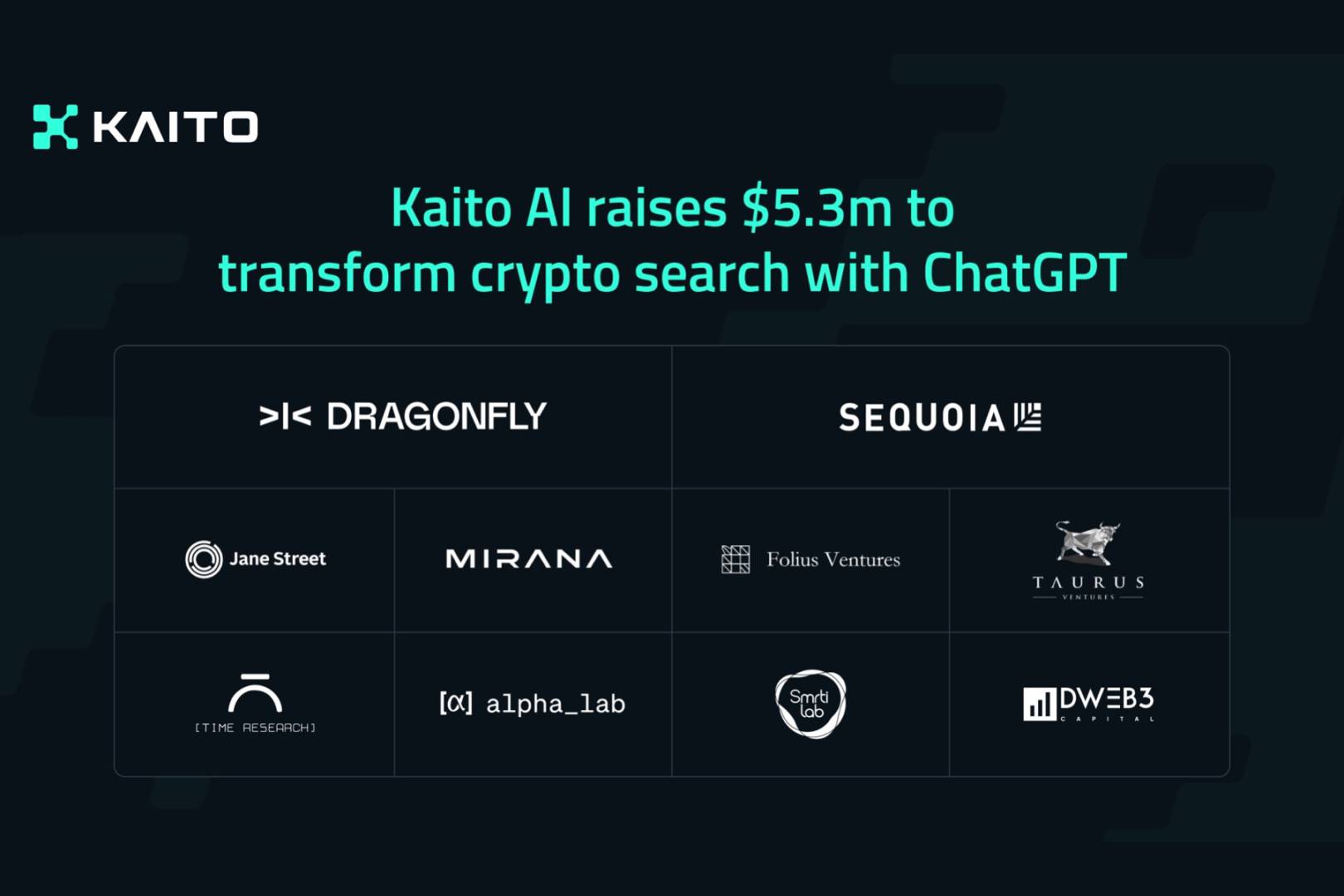
Over the past two years, Kaito has stood out in the capital markets, attracting attention from top-tier venture capitalists:
-
Seed Round (February 2023): Led by Dragonfly, raised $5.3 million at a $40 million valuation.
-
Series A (June 2023): Co-led by Superscrypt and Spartan, raised $5.5 million, with valuation surging to $87.5 million.
-
Growth Inflection Point (June 2024): Kaito announced its first profitable month, transitioning from a cash-burning startup to a self-sustaining AI powerhouse.
The backing from elite VCs not only validates Kaito’s business model but also strengthens its ecosystem value, providing robust support for its future tokenomics.
Kaito is more than just a search engine—it has built a complete information economy. Through its “Yap to Earn” model, users can earn Yap points via:
-
Content Contribution: Posting on Twitter tagged @KaitoAI with crypto market insights.
-
Social Virality: Inviting friends to participate, using multi-account tools (e.g., MoreLogin) to boost point accumulation efficiency.
-
NFT Utility: Holding a Genesis NFT (mint cost 0.1 ETH) increases airdrop weight and may unlock up to $13,000 in token rewards.
This mechanism transforms information attention directly into on-chain assets, turning Kaito from a mere tool into a platform where users can “mine” value.
Valuation Game: The Value Code Behind the Airdrop Feast
During Kaito’s airdrop frenzy, Yap points and Genesis NFTs have become focal points of market attention, sparking intense debate over their true value. Multiple analytical models attempt to predict fair valuations for Yaps and NFTs, and differing assumptions have turned rational valuation debates into full-blown FOMO mania.
1. Fund-Driven Model: Theoretical Maximum via FDV Formula
Crypto valuations are traditionally rooted in narrative and capital flow. Thus, the first model starts directly from Kaito’s future fully diluted valuation (FDV) to estimate the potential value of Yaps.
KOL Ren_gmi used the formula: FDV × Airdrop Percentage / Total Supply, assuming:
-
Kaito’s FDV reaches $1 billion;
-
30% of tokens are allocated for airdrops;
-
The Yapper program runs for 90 days, releasing a total of 2.275 million Yaps.
Based on these assumptions, the model calculates a Yap value of $131—far exceeding mainstream market expectations.
However, this model has clear flaws:
-
It doesn’t account for additional NFT airdrops, which could impact actual Yapper payouts;
-
The assumed total Yap supply is overly idealistic; real circulation may be affected by exchange listings and project team release schedules.
Despite this, the model provides an upper-bound optimistic scenario, offering theoretical justification for Kaito’s airdrop appeal.
2. NFT Voting Rights Model: Governance Dynamics in Web3 Communities
Compared to pure FDV derivation, KOL DeFiTeddy2020 proposed a model more aligned with Kaito’s ecosystem—the NFT voting rights model.
In Kaito’s design, Genesis NFTs grant holders greater influence in ecosystem governance and carry higher airdrop weights. Therefore, the model assumes:
-
The current market price of a single Genesis NFT is 9.3 ETH;
-
Its corresponding voting weight equals 1,162 Yaps;
From this, the theoretical value per Yap is calculated at approximately $22.
This method derives Yap valuation relative to NFT pricing, establishing a comparative valuation framework. However, it faces limitations:
-
Risks from ETH price volatility and NFT market liquidity fluctuations;
-
Voting power does not necessarily equate directly to token value, and the weighting mechanism for governance rights remains opaque.
Although the resulting value is much lower than the FDV-based model, it offers a fresh perspective grounded in NFT ecosystem dynamics.
3. Competitor Benchmarking Model: Comparing Kaito with Hyperliquid
In Web3, valuations often hinge on comparisons with similar projects. KOL Steve_4P adopted a competitive benchmarking approach, comparing Kaito with Hyperliquid to derive a more market-aligned valuation range.
From a PMF (Product-Market Fit) standpoint:
-
Hyperliquid: Built on a mature decentralized exchange (DEX) model, optimizing an already proven trading market;
-
Kaito: Exploring a new paradigm in InfoFi, without yet achieving a closed-loop demand cycle.
Regarding comparable valuations:
-
Hyperliquid can be compared to DEXs like dYdX and Drift, with relatively clear market recognition;
-
Kaito currently lacks direct competitors; the closest parallel might be Friend.tech, whose social finance model has significant shortcomings.
From a token value-capture perspective:
-
Hyperliquid has a clear token burn mechanism, supporting long-term value retention;
-
Kaito’s revenue distribution mechanism remains incomplete, leaving its token value highly uncertain.
Given these factors, the model concludes that Kaito’s token return expectations are unlikely to surpass Hyperliquid’s, suggesting that Yap’s valuation ceiling may fall well below some extreme market predictions.
4. Realistic Valuation Model: Market Expectations Derived from Funding Data
Compared to theoretical projections, markets favor hard data. Kaito’s Series A valuation was $87.5 million. Combined with the disclosed plan to allocate 33.3% of tokens for airdrops, we can derive a more realistic valuation range:
-
NFT Valuation: 1,500 Genesis NFTs cost $540,000 in total. Assuming an 8x valuation increase from funding levels, the total NFT airdrop value is projected at ~$4.32 million, or ~$2,880 per NFT;
-
Yap Valuation: The remaining $24.555 million will go to Yap holders. Based on current emission rates, 1 Yap is worth approximately $13.
However, funding valuation does not equal final market price. This model further benchmarks against Story Protocol and Berachain to establish a plausible market range:
-
Story Protocol: Achieved a 16x valuation increase, now with an FDV of ~$1.73 billion. Based on its performance, Kaito’s NFT airdrop value could range between $2,218–$2,880, with Yap valued at $10–$13.
-
Berachain: Experienced an 8x valuation increase, currently with an FDV of ~$2.8 billion. If Kaito follows suit, NFTs could receive $5,357 in airdrop value, with Yap reaching $24.
Under extreme FOMO conditions, Berachain’s FDV briefly peaked at $6.75 billion. If Kaito replicates this, NFTs could soar to $13,000, with Yap potentially reaching $59.
Conclusion: Variables in Valuation and Market Frenzy
Across these four models, we see varying possibilities for Kaito’s airdrop value:
Ultimately, the real value of Kaito’s airdrop will depend on three key factors:
-
Market response post-token launch: Strong liquidity could drive valuations significantly higher;
-
The project team’s long-term strategy: If the InfoFi ecosystem achieves closure, token value capture will be more stable;
-
Evolution of market sentiment: The duration of FOMO will influence short-term price volatility.
One thing is certain: Kaito is igniting a new airdrop storm in the crypto market. How this storm ultimately unfolds remains to be seen—and the market itself will deliver the final verdict.
Join TechFlow official community to stay tuned
Telegram:https://t.me/TechFlowDaily
X (Twitter):https://x.com/TechFlowPost
X (Twitter) EN:https://x.com/BlockFlow_News






