Web3 wallet wars have entered the second half: Five major development directions of Web3 wallets
TechFlow Selected TechFlow Selected
Web3 wallet wars have entered the second half: Five major development directions of Web3 wallets
Only by thoroughly understanding users' usage scenarios can we truly grasp their needs and provide them with products they actually need.
 Navigating Web3 tides with focused insights
Author: Yue Xiaoyu
As a Web3 wallet product manager and a direct practitioner in the Web3 wallet sector, I design various features daily and interact firsthand with users to understand their real needs.
But beyond just focusing on execution, it's also important to look up and navigate; beyond hands-on operations, macro-level awareness is essential for long-term growth.
I've always believed that the wallet sector is a critical infrastructure layer with immense potential. Wallets serve as gateways to the Web3 world—once you control the traffic, many opportunities open up.
Today, the wallet space is rapidly evolving and fiercely competitive. Established players like Metamask and TokenPocket dominate the market, while exchanges are investing heavily in their own Web3 wallets. Meanwhile, new entrants are emerging from niche use cases, such as Particle Network’s chain-abstraction wallet.
Wallet designs seem increasingly homogeneous—so how can new products establish differentiated advantages? What will be the future form of Web3 wallets?
The Web3 wallet war has already entered its second half.
Based on observed user needs, latest technological trends, and market directions, here’s a breakdown of several possible future development paths for Web3 wallets.
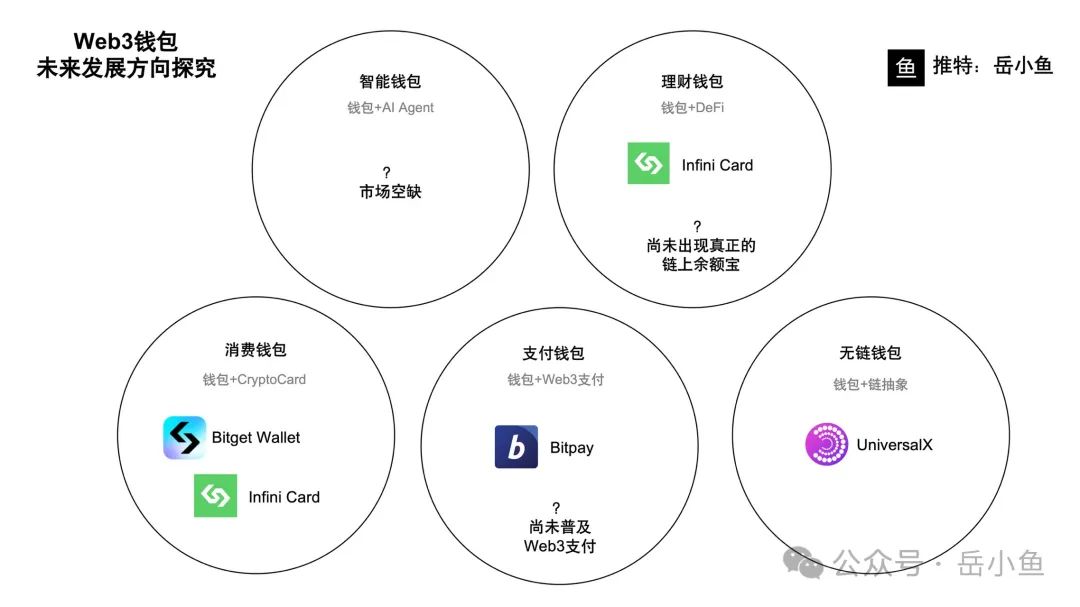
Direction One: Wallet + AI Agent = Smart Wallet
Combining AI Agents with blockchain wallets enables the transformation from ordinary wallets to smart wallets.
Current wallets are too basic—they’re like old "feature phones," offering only fundamental functions such as calling and texting.
But by integrating AI capabilities, could today’s wallets leap into a new era of intelligent wallets?
With AI integration, wallets evolve beyond mere asset storage tools into intelligent systems capable of proactively managing funds, optimizing investments, enhancing security, and delivering personalized services.
This significantly enhances wallet functionality, enabling a shift from traditional to intelligent wallets.
The fusion of AI Agents and wallets will completely transform existing interaction models.
Hopefully, the wallet industry will soon experience its "iPhone moment"!
Direction Two: Wallet + DeFi = Wealth Management Wallet
Asset management is the first step. Once user funds are deposited into an application, the next major value lies in wealth management.
The three core demands in the Web3 industry: asset issuance, asset trading, and asset management.
These form a progressive sequence—first solve asset issuance, then enable trading once assets exist, requiring effective trading tools. After that comes the need for efficient asset management tools.
Within asset management, beyond basic custody, the more important aspect is asset appreciation—i.e., wealth management.
Users want idle funds to generate yield even when they're not actively using DeFi or trading.
Ideal scenario: simply deposit ETH or stablecoins and automatically earn interest without extra steps, while still being able to access funds instantly—similar to Yu’ebao (Alipay’s money market fund).
Users need a true on-chain Yu’ebao!
Given Alipay’s current scale, the ceiling for wealth management wallets is extremely high—not only attracting massive asset accumulation but also generating stable, high revenue for wallet platforms.
Direction Three: Wallet + Crypto Card = Spending Wallet
Crypto Cards—also known as U Cards—are crypto debit cards where users load stablecoins like USDT/USDC, then link them to payment apps such as WeChat Pay or Alipay for daily spending without cashing out.
Integrating Crypto Card services within wallets is a highly synergistic move.
Crypto Cards directly address the biggest pain point in crypto: cashing out.
Due to frequent exposure to illicit funds, bank accounts used for withdrawals are easily frozen. Cashing out is often harder and more costly than depositing—with reliable OTC channels charging around 6% fees.
Crypto Cards solve small-scale withdrawal issues for crypto users. These cards can be linked directly to third-party payment systems (e.g., WeChat & Alipay) for everyday purchases and are treated in China as regular foreign currency cards.
Crypto Cards are essentially prepaid cards. Issuers hold accounts with Visa/MasterCard. When users send stablecoins to the issuer, they receive spending limits—similar to store gift cards. They can only be used for payments, not transfers, and do not hold fiat balances.
Fiat on/off-ramping typically involves OTC partners and strict KYC, whereas Crypto Cards offer a complementary workaround for indirect small-scale withdrawals, with healthy profit margins—making this a promising business direction for wallets.
Currently, Bitget Wallet integrates Crypto Card services directly.
A recently popular brand is Infini Card, which stands out among U Cards by combining spending with wealth management: users earn 7% annual yield on their stablecoin deposits automatically, effectively achieving a “on-chain Yu’ebao” experience.
Direction Four: Wallet + Web3 Payments = Payment Wallet
Payments are a high-frequency service, offering vast potential.
However, the biggest challenge facing Web3 payments today is the lack of use cases. Just as Web2 online payments grew alongside e-commerce, Web3 payments need killer applications to unlock blockchain’s unique advantages.
It was the rise of Taobao that created demand for digital payments and gave birth to Alipay.
For Web3 payments to achieve mass adoption, a breakthrough application scenario is required.
At present, consumer (C-end) spending scenarios remain far from ready for widespread Web3 payment adoption, making payment features a lower priority within wallets.
Still, Binance and OKX have made early attempts. Binance launched Binance Pay, partnering with merchants to allow one-click payment via the Binance app—offering a user experience similar to Alipay. OKX took a more direct approach by launching OKX House, an e-commerce platform within OKX Web3 Wallet, where users can make purchases and pay directly through the wallet.
Beyond consumer payments, business (B-end) use cases such as cross-border payments and merchant settlements are actually more mature. These needs are currently served by enterprise wallet providers like Cobo and Fireblocks.
Direction Five: Wallet + Chain Abstraction = Chainless Wallet
An average user's only expectation from a Web3 wallet is simple: make surfing the blockchain easier.
Yet most wallets today fall short. Ordinary users must grasp complex concepts before they can use them—private keys, gas fees, cross-chain transactions, etc.
Although many wallets try to minimize differences across chains at the application level and deliver unified experiences—OKX Wallet being a prime example, aggregating numerous chains, DEXs, and bridges into one interface—these solutions don’t fundamentally resolve the issue. Users still need to understand blockchain-specific concepts.
A bold and radical solution is to completely rebuild the user experience from the ground up, challenging what has become the "industry norm" in user interaction.
The complexity lies in the concept of "chains." With so many chains today, more abstraction is needed at the product level to create a truly different user experience.
This is where "chain abstraction" comes in—hiding the concept of chains entirely so users don't need to perceive chains, gas tokens, or manually switch or bridge between chains. Instead, a universal token covers all transaction fees across all chains.
This approach aligns perfectly with the familiar Web2 app experience expected by novice users.
A leader in this space is Particle Network. Reviewing its evolution—from wallet abstraction to account abstraction and now chain abstraction—its product strategy is highly focused and deeply technical.
It iterates progressively based on existing users and products, solving problems stage by stage while incorporating cutting-edge Web3 narratives.
Today, Particle Network has expanded into decentralized exchange services. UniversalX, for instance, takes the form of a DEX built on chain abstraction and passwordless wallets.
In the future, chain abstraction should become a foundational component, a standard feature across all types of products.
In Summary
These five wallet directions aren't mutually exclusive. A single wallet doesn't have to pick just one path or embody only one attribute—it can span multiple categories.
So how do you truly capture users?
To borrow a phrase from an OKX Wallet product manager during OKX's Lunar New Year sharing session: Dive deep into use cases, put users first.
Demand arises from context. Only by thoroughly understanding user scenarios can we truly identify user needs and deliver products people actually want.
Join TechFlow official community to stay tuned
Telegram:https://t.me/TechFlowDaily
X (Twitter):https://x.com/TechFlowPost
X (Twitter) EN:https://x.com/BlockFlow_News