Pi Coin is about to be listed on exchanges, what do lawyers think?
TechFlow Selected TechFlow Selected
Pi Coin is about to be listed on exchanges, what do lawyers think?
True innovation is not simple imitation, but finding sustainable growth methods within a compliant framework.
 Navigating Web3 tides with focused insights
Author: Liu Honglin
On February 12, 2025, OKX Exchange released a "thrilling" announcement: Announcement on OKX's Launch of Pi (Pi Network) Spot Trading.
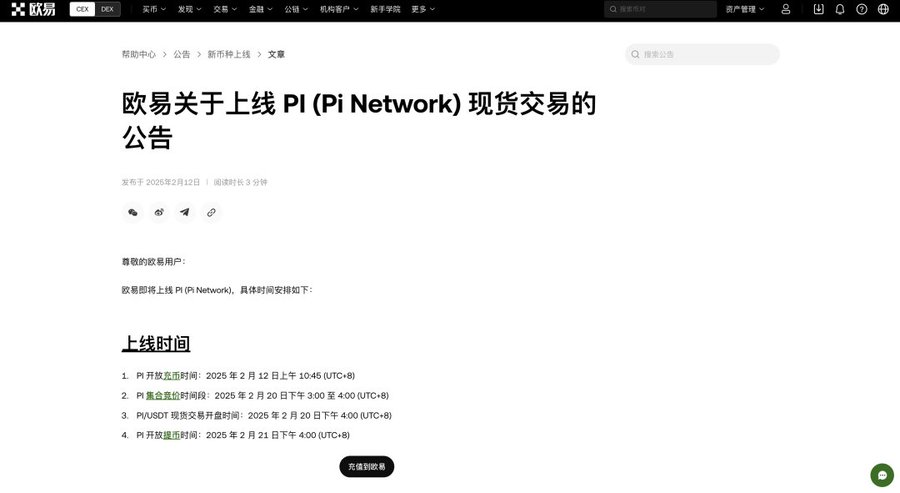
According to the announcement, Pi Network—an extremely controversial and community-driven crypto project in China—is finally launching its mainnet after six years. This news is expected to excite many domestic users. Finally, they no longer have to contribute out of passion alone!
However, Pi Network is rarely mentioned in mainstream Web3 circles.
Regarding this mainnet launch, prominent Web3 media outlet Odaily Star Daily published an article titled “'King of MLM' Pi’s Mainnet Countdown: Will 60 Million People Brainwashed for Six Years Finally Fulfill Their Dream?” The article questioned: Is it sharpening a sword or a scythe? Pi’s launch day becomes the ultimate IQ tax test. Previously available information about Pi Network in mainstream media mostly revolved around regulatory warnings and keywords like “pyramid scheme.”
In addition, Chinese regulators have taken an even stricter stance toward Pi Network and similar projects. For example, in April 2022, Nantong police issued a notice warning the public about risks associated with Pi mining; also in 2022, Pingan Sanming published an article titled “Organizing Lectures, Group Dinners… ‘π Coin’ Scam Appears in Sanming, Many Already Trapped,” as a public alert. Subsequently, local public security agencies and regulatory bodies such as Wuxi Cyber Police, Dehong Police, and Linyi Banking Association continued releasing warning notices/articles.
In reality, Manqin Lawyers found that although official institutions mainly highlight fraud issues, most criticisms of Pi Network label it as a “Ponzi” or “pyramid scheme.” Why does this perception exist?
Pi’s “Explosive” Viral Growth
From 2019 to now, over six years, Pi Network has amassed over 60 million users through its model of “free mining + viral promotion,” achieving astonishing growth speed. Central to this growth is community-driven viral expansion—users earn Pi coins by clicking check-in daily, while inviting new users increases their mining speed.

Since no financial investment is required, and the community promotion model is simple, low-barrier, and easily fosters consensus, combined with the team’s long-standing narrative of future high value, this model rapidly spread globally.
However, this growth model almost entirely crosses all red lines associated with pyramid schemes.
In a previous article by Manqin Lawyers titled “Web3 Entrepreneurship Criminal Risk Prevention Guide (I): Identifying and Avoiding MLM Risks,” the essence and characteristics of pyramid schemes were outlined. The article指出 that any business operation simultaneously meeting three criteria—payment of entry fees, recruitment of downlines, and multi-level compensation—constitutes a pyramid scheme.
Pi Network’s viral model closely resembles this definition.
First, revenue depends on user acquisition. Pi’s mining mechanism does not rely on users’ computing power but rather on user activity and referrals. This means user earnings do not stem from real productive activities but depend on bringing in more new users. Such a model easily evolves into a typical “recruiting heads” system rather than a genuine decentralized economy.
Second, market value is controlled by the team. Although Pi does not require direct payment in fiat or crypto assets, the “barrier to obtaining tokens” involves binding personal information and completing KYC (identity verification). The distribution of KYC eligibility is controlled by the team, and in some markets, a black-market KYC service has emerged, effectively creating an “entry cost.” Meanwhile, the team has long restricted Pi’s circulation, preventing users from freely buying or selling, making token market value entirely dependent on when the team opens trading permissions. This artificially created scarcity makes it resemble a “Ponzi scheme” more than a true Web3 project.
Additionally, there is an implicit design of hierarchical rewards. On the surface, Pi users do not directly receive payments from their downlines, but inviting new users boosts their own mining speed—an implicit form of “tiered rewards.” Users at different levels enjoy varying token appreciation rights, with early adopters holding advantageous positions within the community, similar to the “pyramid structure” in MLM models. This reliance on community virality and encouragement of tiered growth makes Pi more akin to a viral system with financial Ponzi attributes rather than genuine decentralized financial innovation.
Although labeled as a pyramid scheme, Pi undeniably demonstrates an extreme capability for viral expansion—one precisely missing in many Web3 projects.
But do all viral strategies inevitably touch upon MLM issues? Can other Web3 projects learn from such viral models?
Viral Growth ≠ Pyramid Scheme
Traditional internet development has long perfected user-acquisition and viral tactics. However, the key factor determining whether viral promotion is legal lies in how users create value.
Looking across the Web3 industry, many projects have experimented with similar strategies—GameFi task incentives, SocialFi social virality, and even platforms dedicated to referral-based marketing. But to avoid being classified as a pyramid scheme by regulators, Web3 projects must build on authentic user contributions and transparent token economies, rather than solely relying on recruitment to generate value.
User Growth = Real Contribution
If Pi’s issue lies in “directly linking referral rewards to the number of recruits,” then a compliant viral model must ensure rewards stem from actual behavioral contributions—not mere referrals—and must not establish upline-downline relationships or multi-tier commission structures.
For instance, Galxe uses “on-chain behavior incentives,” requiring users to complete on-chain interactions (e.g., governance voting, NFT holding) before receiving rewards.
The core logic here is: viral promotion is merely a tool; value contribution remains central. Only when rewards are tied to real contributions—not just recruiting downlines—can projects avoid MLM risks.
Transparent Token Circulation Mechanism
Another critical flaw of Pi is that the project team has long controlled token circulation, preventing users from freely trading. This leaves the market entirely subject to team decisions, easily forming a Ponzi structure and raising suspicions of market manipulation or illegal fundraising among regulators.
Therefore, a compliant viral growth model requires tokens to operate under more transparent and secure mechanisms—including real use cases, decentralization (not fully controlled by the team), and compliance registration under regulatory oversight.
In short, a truly compliant viral growth model must follow a closed loop of value contribution → community virality → transparent market circulation, not a capital scheme logic of recruit-to-profit → artificial scarcity → speculative exit.
Viral Community + DAO Governance, Replacing Tiered Rewards
The marketing tactic of “referrers enjoying higher mining rewards” is essentially a hidden form of tiered income, prone to forming pyramid structures—the very reason Pi is widely seen as a pyramid scheme. Thus, compliant viral promotion must avoid such designs.
Currently, some Web3 projects use DAO governance to redirect the value of community virality back into ecosystem contributions. This transforms the growth model from one-way hierarchical incentives into a decentralized contribution mechanism, ensuring sustainable growth driven by virality.
Manqin Lawyers Summary
Pi Network once again proves that strong community virality is one of the most powerful drivers of growth in the crypto market. Yet, its model also exposes the dilemma of Web3 growth—when token value growth detaches from real economic contributions and relies instead on user recruitment to inflate bubble value, such models are often deemed “pyramid schemes” or “Ponzi scams” by regulators.
Today, global regulatory environments are tightening. Web3 growth logic has long moved beyond the era of “wild west” expansion toward “compliant virality.” Simply copying Pi’s model without adjustments may lead not to user dividends, but to severe regulatory crackdowns.
Because true innovation isn't mere imitation, but discovering sustainable growth methods within a compliant framework.
Join TechFlow official community to stay tuned
Telegram:https://t.me/TechFlowDaily
X (Twitter):https://x.com/TechFlowPost
X (Twitter) EN:https://x.com/BlockFlow_News