








Can the山寨 season really be driven by the Fed's liquidity injection?
TechFlow Selected TechFlow Selected
Can the山寨 season really be driven by the Fed's liquidity injection?
The key is that substantial funds must first flow into Bitcoin and major altcoins.
 Navigating Web3 tides with focused insights
Author: CryptoAmsterdam
Translation: TechFlow
Is it true that "there will be no altseason without Quantitative Easing (QE)"?
Recently, my comment sections have been filled with similar opinions:
-
"We need QE to trigger an altseason."
-
"An altseason will never begin without QE."
Let's analyze this.
This is usually not my primary area of focus, but since everyone is talking about QE, I'll offer a brief analysis.
(Note: I am not an expert in this field; please correct me if there are errors. For simplicity, we’ll stick to chart observations without over-speculating—use caution when referencing.)
1. What are QE and QT?
QE (Quantitative Easing):
-
Central banks create new money to inject funds into the market
-
Specifically, they increase market liquidity by purchasing assets
-
Increased liquidity = favorable for risk assets (such as cryptocurrencies)
QT (Quantitative Tightening):
-
Central banks reduce the amount of money in the market
-
Achieved by selling assets or letting them mature, thereby withdrawing liquidity
-
Reduced liquidity = unfavorable for risk assets
If we overlay the total market cap chart of the altcoin market with Bitcoin Dominance and mark the periods of QE (favorable for markets) and QT (unfavorable), we find that these claims do not hold.
The crypto market has experienced significant rallies,bull runs, and altseasons even in the absence of QE.
In fact, QE only coincided once with a bull run—that was in 2021.
Chart analysis summary:
-
An altseason does not depend on QE.
-
During QT, the total altcoin market cap surged from $400 billion to $1.7 trillion.
-
While QE can boost the market, it is not a prerequisite—other factors may also drive growth, such as ETF approvals, supportive government policies, SBR, or rising Bitcoin value.
-
Halting QT would theoretically benefit the market, but growth occurred even during QT, indicating QT is not a decisive factor for market performance.

2. What is Altseason?
In the cryptocurrency market, there are typically two main phases:
-
Bitcoin Season
-
Altcoin Season
Bitcoin Season:
-
Characterized by rising Bitcoin Dominance (the percentage of Bitcoin’s market cap relative to the entire crypto market). This happens when capital flows from alts into Bitcoin, causing overall alt performance to lag behind Bitcoin.
-
New capital primarily flows into Bitcoin, reducing the altcoin market share.
Altcoin Season:
-
Characterized by declining Bitcoin Dominance, as capital shifts from Bitcoin into alts.
-
Influx of new capital drives up altcoin market share and causes the total altcoin market cap to surge rapidly.
Historically, most of the time the market is in a Bitcoin Season, where alts generally underperform compared to Bitcoin. Below are several typical Bitcoin Season phases:
-
Bitcoin in a bear market? That's Bitcoin Season.
-
Bitcoin bottoming out and rebounding? Still Bitcoin Season.
-
Bitcoin beginning its initial rise? Bitcoin Season.
-
Bitcoin reaching previous cycle highs? Bitcoin Season.
-
Bitcoin breaking new all-time highs? Still Bitcoin Season.
Altseason tends to follow a certain pattern: it usually occurs after Bitcoin first breaks new highs and enters a consolidation phase. Then, when Bitcoin begins rising again, altseason truly arrives—Bitcoin Dominance starts to decline, and the alt market explodes.
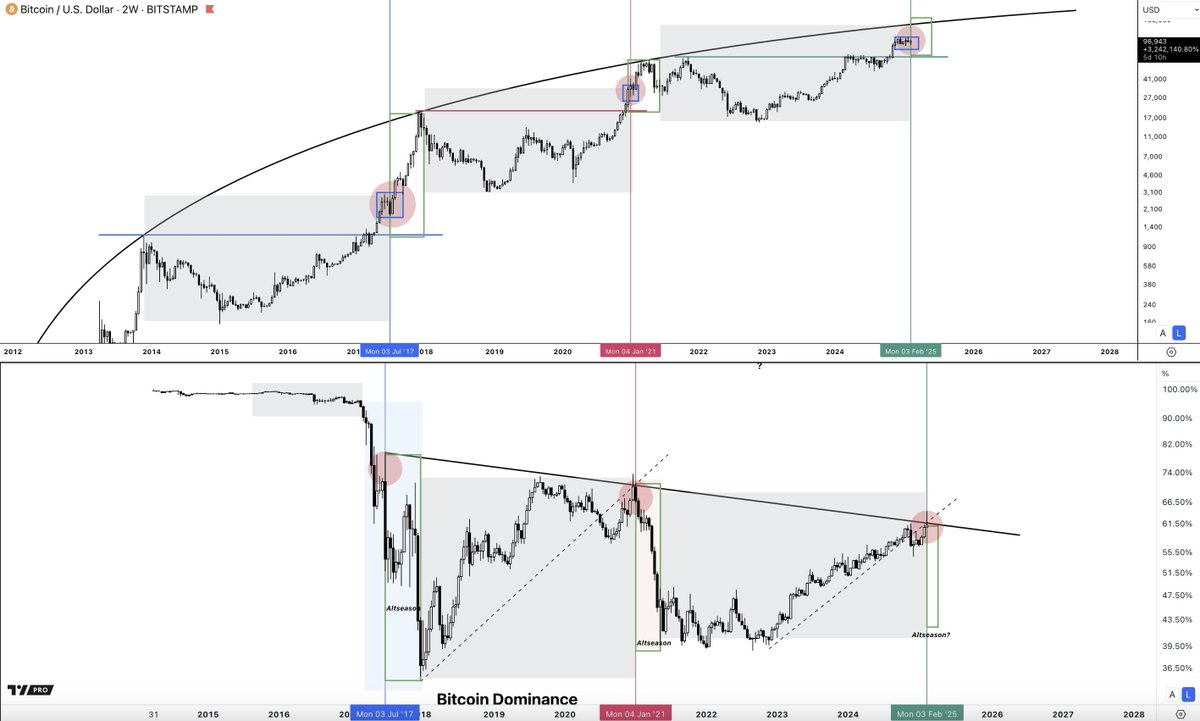
3. What Triggers Altseason?
Altseason is typically triggered by the start of a Bitcoin bull run. (Note: This does not depend on Quantitative Easing—currently we are in a Quantitative Tightening phase. Other potential triggers include Bitcoin’s value and cycle, SBR, Bitcoin ETF launches, etc.)
The first step in capital flow is usually into Bitcoin and major alts.
The subsequent outcomes are:
-
Media hype draws retail attention, prompting retail investors to start buying alts.
-
Meanwhile, investors who have profited from Bitcoin seek higher returns and shift their capital into the alt market.
Historically, this phenomenon typically occurs during Bitcoin’s second breakout above new highs. This pattern can be observed in the earlier charts.
Crypto market capital flow follows a relatively clear path:
Bitcoin → Major Alts → High-Market-Cap Tokens → Mid-Market-Cap Tokens → Low-Market-Cap Tokens
For example, on January 18, 2021, Bitcoin was consolidating and attempting to break new highs (red arrow in chart), while Total 3 (the total market cap indicator for alts) remained at a mid-level (red arrow in chart).
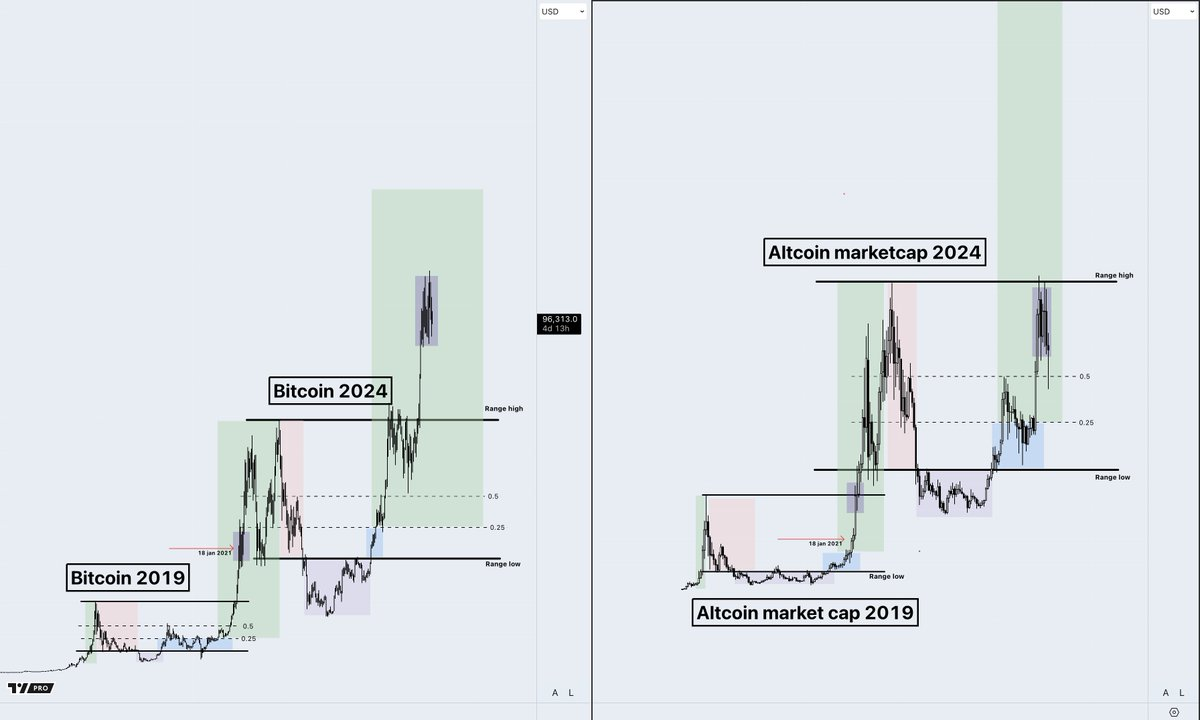
From here, we can see that Bitcoin is usually the starting point of capital flow, followed by the total market cap of major alts (Total 3), and finally other tokens (including high- and mid-market-cap tokens).
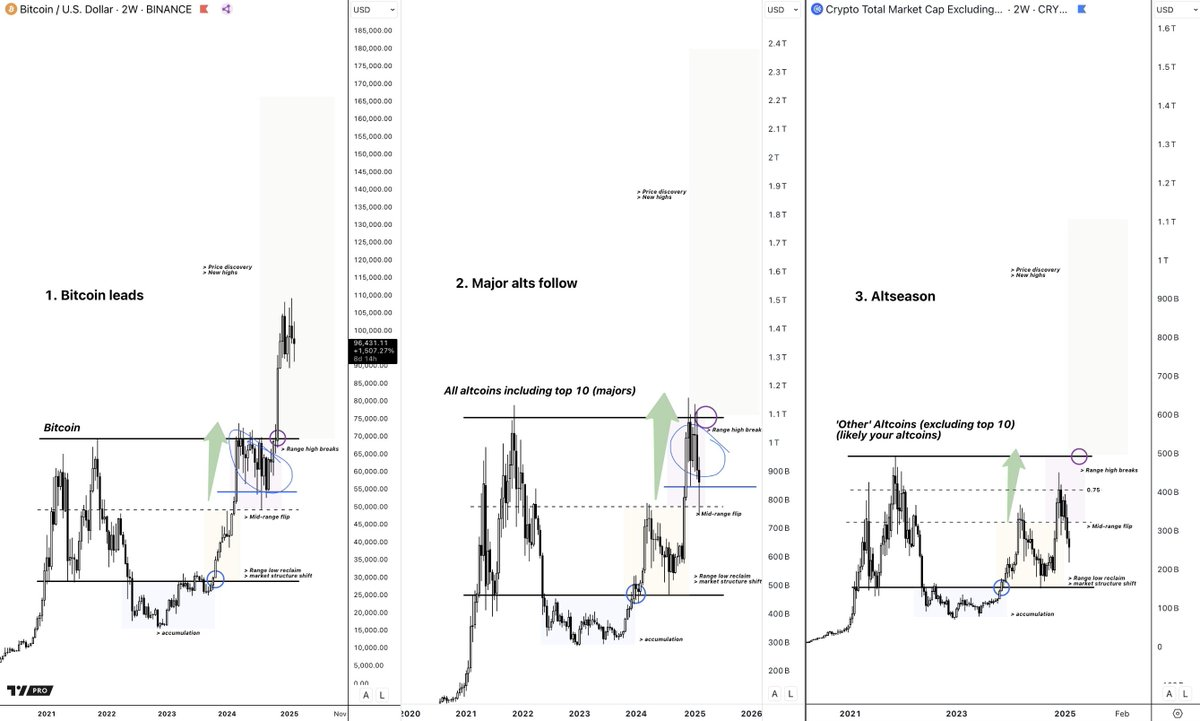
Altseason does not depend on QE. (Of course, QE does help the market.)
The key is that large amounts of capital first flow into Bitcoin and major alts, after which market greed drives further capital into other alts.
This is how altseason is triggered. So far, regardless of QE, QT, or other external factors, we are already on the right track. The entire cryptocurrency market (mainly composed of Bitcoin and some major alts, as a true altseason hasn't arrived yet) has grown from $700 billion to nearly $4 trillion.
(Think about it—achieving such growth during a QT phase is undoubtedly a very bullish signal. As policy conditions evolve, this trend could become even more favorable.)

Join TechFlow official community to stay tuned
Telegram:https://t.me/TechFlowDaily
X (Twitter):https://x.com/TechFlowPost
X (Twitter) EN:https://x.com/BlockFlow_News
 @damskotrades


