Apple and Alibaba Team Up: From "Two Elephants Don't Fight" to an AI Alliance
TechFlow Selected TechFlow Selected
Apple and Alibaba Team Up: From "Two Elephants Don't Fight" to an AI Alliance
Alibaba's collaboration with Apple is not a so-called "snatching away."
 Navigating Web3 tides with focused insights
Author: kiki, Silicon Lab

Image source: Generated by Wujie AI
Apple’s much-anticipated “Chinese AI partner” has ultimately landed with Alibaba.
According to a recent report from The Information, Apple has recently partnered with Alibaba Group to launch “Apple Intelligence” in China. The report notes that both parties have already submitted their jointly developed artificial intelligence features to China's cyberspace regulators for approval.
Current policies and regulations regarding the registration and approval of AI products in China include the "Interim Measures for the Administration of Generative Artificial Intelligence Services," the "Administrative Provisions on Algorithmic Recommendations for Internet Information Services," and the "Administrative Provisions on Deep Synthesis of Internet Information Services." A person familiar with large model registration procedures told Silicon Lab that before launching AI products and services, companies must primarily complete algorithm registration and pass security assessments. From the approval process perspective, applications require initial review at the local level followed by final review at the central level.
If this timeline holds, Apple and Alibaba's collaboration has achieved a critical milestone. Additionally, Cook previously revealed during an earnings call that “AI is expected to launch in China by April this year,” suggesting that AI-powered iPhones equipped with domestic large models are nearing market entry.
Perhaps it’s some kind of coincidence.
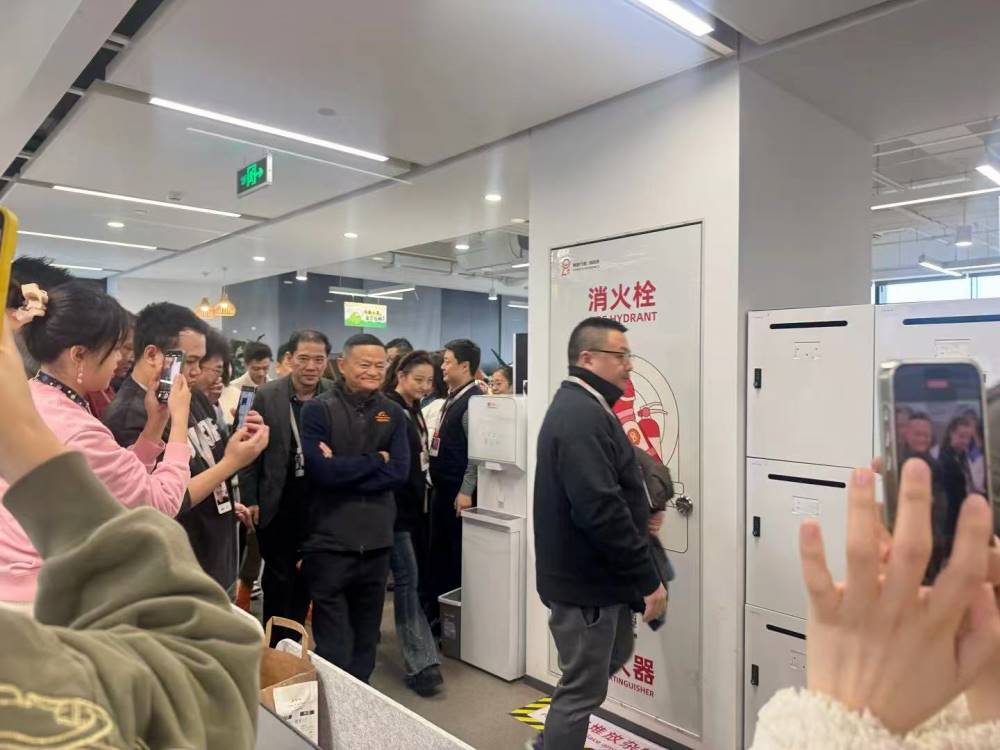
Shortly before the news broke, Jack Ma, Alibaba's famously low-key founder, suddenly made an appearance at Alibaba’s Hangzhou campus. Looking back further, his most crucial insight into Alibaba and future business trends remains centered on “AI”—“AI will change everything, but that doesn’t mean AI can determine everything. Technology is important, but what truly decides the future is what meaningful and unique things we do today to prepare for this coming era,” said Ma.
Apple’s choice of Alibaba was no accident.
In fact, since 2023, Apple has been testing various domestic models. At least seven companies were rumored to be potential partners, including tech giants like Baidu and ByteDance, as well as AI startups such as Baichuan AI, Moonshot AI, and DeepSeek—none of which led to concrete outcomes. Before the announcement, industry insiders noted that Apple’s viable options had become increasingly limited.
Alibaba’s partnership with Apple isn’t a case of last-minute “snatching”—in the race among China’s large models, Alibaba has followed a “cloud + model + application” strategy, missing almost none of the key milestones, whether in foundational model capabilities, open-source ecosystem development, or external investments.

The collaboration between Apple and Alibaba is not surprising.
As previously reported by The Information, Apple initially chose Baidu as its primary partner last year. However, due to Baidu’s failure to meet Apple’s standards in developing models for “Apple Intelligence,” the cooperation encountered difficulties. Apple also considered DeepSeek but eventually abandoned collaboration with the team.
To understand why Apple’s selection of Alibaba isn’t surprising, one must first grasp what exactly constitutes the so-called “Apple standard.”
First, foundational model capability. When evaluating multiple domestic AI models, Apple sought a large model better aligned with the intent of Apple’s on-device systems—a model capable of providing personalized, targeted responses based on users’ iPhone usage patterns and delivering customized services. This poses significant challenges to domestic model providers’ development and engineering capabilities (e.g., building high-quality datasets).
For Alibaba, on the consumer side, it not only understands user shopping and payment behaviors and possesses richer data, but its Tongyi large model has also drawn attention for its strong base model performance among domestic large models.
Second, responsiveness and experience serving major clients—this is where large enterprises hold an advantage over startups like DeepSeek.
Third, strong reputation and brand image among users and developers, thanks to Alibaba Cloud’s commitment to open-source initiatives and the group’s focus on “returning to user value.”
Finally, there’s ecosystem understanding, which may also explain why Apple did not partner with Tencent—two closed ecosystems would inevitably face greater friction and competition. In contrast, the relationship between Apple and Alibaba is far simpler and friendlier.
With strengths in model capability, enterprise advantages, solid reputation, and ecosystem comprehension, Alibaba stands as Apple’s best possible choice.

In terms of impact, Alibaba benefits the most. Immediately after the partnership announcement, Alibaba’s U.S.-listed shares rose sharply.
For Alibaba, teaming up with Apple presents three key opportunities: first, technological and brand endorsement; second, synergy with Alibaba Cloud to boost cloud computing market share; third, access to valuable entry points—leveraging Apple’s hardware ecosystem and use cases to further optimize model performance and potentially spawn new business models.
For Apple, partnering with Alibaba helps counter competition from Huawei and other domestic smartphone brands, enabling it to wage a more effective localized battle and alleviate pressure in the Chinese market through fully functional AI smartphones.
In our article "Cook’s Year of the Snake Off to a Rough Start", we mentioned that Apple and Cook’s top priority is securing their position in the Chinese market.
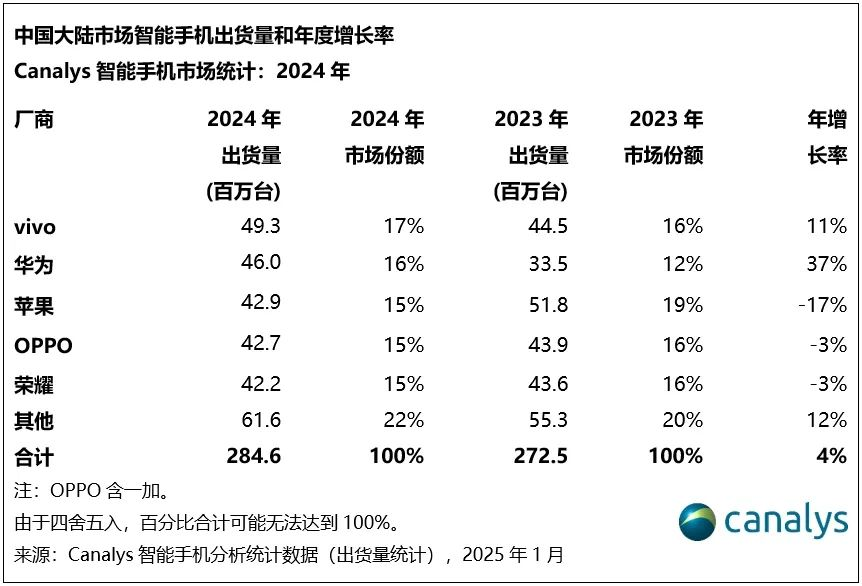
Data released by research firm Canalys shows that in mainland China, over the past year, measured by shipment volume, vivo took first place with a 17% share, followed closely by Huawei, while Apple ranked only third. Leveraging localized “Apple Intelligence” to revitalize its presence in China is undoubtedly something Cook is eager to achieve.
With the entry of “Apple + Alibaba,” the domestic AI smartphone market is poised for a new wave of “camp battles” in 2025. Samsung recently announced its latest Galaxy S25 smartphone will integrate agent capabilities from Zhipu AI’s GLM model, while Xiaomi previously partnered with ByteDance’s Doubao.

Despite the seemingly perfect match between Apple and Alibaba, deep integration between the two ecosystems may still face numerous challenges.
For instance, Apple’s requirements for on-device AI are extremely strict. According to Alibaba Cloud’s March 2024 technical whitepaper, Qwen reduced its parameter count from 7B to 2.2B (a 68% reduction) via structured pruning. However, according to tests by GeekPark, its FP16 precision model occupies 2.1GB of memory on the iPhone 15 Pro, and Machine Heart testing showed first-round inference latency at 0.62 seconds—still above Apple’s Core ML recommended thresholds (≤1.5GB / ≤0.4 seconds).
Another challenge lies in balancing the respective ecosystems of Alibaba and Apple. When you want to turn on a light via voice command, Tmall Genie and Siri might end up competing—when you say “turn on the living room light,” your phone must decide within half a second whether to follow Tmall Genie or Siri. This “whoever responds faster wins” scenario reflects the underlying technological race between the two companies for control over smart home ecosystems.
Going back to 2014, when Jack Ma reflected on his first meeting with Cook, he commented: “My impression was good; I thought Cook was quite remarkable.” On cooperating with Apple at the time, Ma said: “We must find ways to collaborate more and compete less. When two elephants fight, the surrounding animals always suffer.”
A decade later, in the rapidly evolving world of AI, those words carry even greater weight.
Join TechFlow official community to stay tuned
Telegram:https://t.me/TechFlowDaily
X (Twitter):https://x.com/TechFlowPost
X (Twitter) EN:https://x.com/BlockFlow_News