Alliance DAO Founder Discussion: Solana Will Ultimately Prevail, Bitcoin Strategic Reserve (SBR) Could Become the Next ETF Moment
TechFlow Selected TechFlow Selected
Alliance DAO Founder Discussion: Solana Will Ultimately Prevail, Bitcoin Strategic Reserve (SBR) Could Become the Next ETF Moment
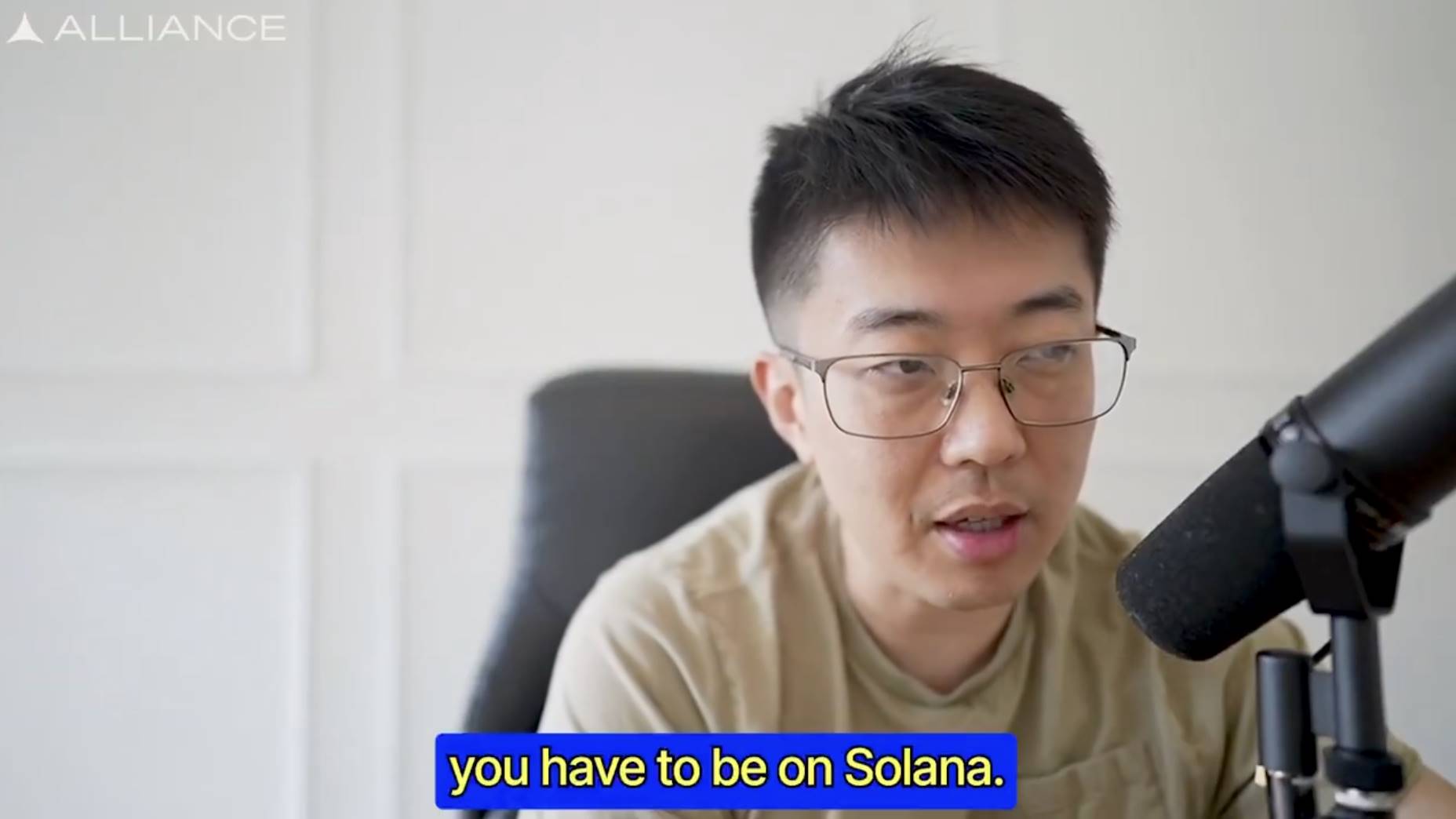
You have to be on Solana.
 Navigating Web3 tides with focused insights
Compiled & Translated: TechFlow

Guests: Imran Khan, Founder of Alliance DAO; Qiao Wang, Founder of Alliance DAO
Podcast Source: Good Game Podcast
Original Title: On Consumer Crypto | EP 70
Release Date: February 7, 2025
Background Information
Imran and Qiao had an in-depth conversation with Iljia and Richard from Tensor, discussing consumer-facing cryptocurrency and other related topics, offering founders sharp insights into the crypto space.
Main Topics Covered:
-
Market Analysis
-
Strategic Bitcoin Reserves (SBR) are underway – David Bailey
-
The profound impact of government policy on the economy
-
AI adoption and future trend forecasting
-
Vine & JellyJelly
-
The future prospects of tokenization in startups
-
Clout and Tribe
-
The vision of the Tensor team: Richard and Ilja
-
Tokenization strategy as a market entry point
-
The convergence of memecoins and attention economics
-
Vector's current scale and growth status
-
Qiao's annual experiment sharing
-
The trend of developers migrating from Ethereum to Solana
-
User profile analysis across different blockchains
-
Outlook on the ultimate form of blockchain technology
-
Coinbase’s strategic positioning
-
Discussion on “Blast should have been Hyperliquid”
Market Analysis
Imran: A lot has happened in recent weeks. Over the past month, the market has shown a continuous downward trend, and I feel our sentiment closely mirrors market performance.
Qiao: The market does seem somewhat weak.
Imran: Overall, the market is digesting the major news from Trump and the subsequent liquidity injection. As for short-term movements, I can't give a clear judgment, but from a medium to long-term perspective, I remain optimistic about the market.
Qiao: I think the market may remain range-bound in the near term. In fact, there have been many positive developments over the past two weeks—executive orders supporting crypto, repeal of the SAB rule, progress on stablecoin legislation, and various policy speeches on crypto. Yet despite all these positives, the market has barely reacted. This reflects a relatively muted response to favorable news. That said, from a macroeconomic standpoint, I believe the overall economic situation remains solid.
Strategic Bitcoin Reserves (SBR) Are Underway
Qiao: David Bailey mentioned that the market's current behavior is misleading. He tweeted that during today’s press conference, the Strategic Bitcoin Reserves (SBR) initiative is moving forward. This is DJT’s top priority. They’re convening top national officials and plan to finalize a comprehensive framework within the next 80 days. Notably, half of the working group members are individuals who’ve achieved great success in their respective fields. The SBR plan is gradually being implemented. If SBR truly materializes within the next 80 days, the market is currently severely underpricing it. This potential impact cannot be fully reflected through existing market mechanisms.
Qiao: This reminds me of the launch of Bitcoin ETFs. At the time, many thought Bitcoin ETFs were bearish and advised selling. But the reality was completely opposite—the launch of Bitcoin ETFs opened a new gateway for financial institutions and traditional investors, especially those from traditional finance and older generations, right?
The situation with SBR is very similar. If the Strategic Bitcoin Reserves plan succeeds, it would mark formal governmental participation. Not just the U.S. federal government, but state governments and even foreign governments might choose to cooperate with the U.S. or at least try to keep up with this trend. This would bring a whole new class of net buyers into the market—buyers who are currently entirely absent. Meanwhile, sovereign wealth funds’ moves are also worth watching, as they could become a key force driving this trend.
Imran: Additionally, the Trump administration is planning to create a sovereign wealth fund. It’s reportedly led by Lutnik from Cantor Fitzgerald, who himself has made massive investments in cryptocurrency, particularly Bitcoin. If he’s involved and leads this sovereign fund, things could get very interesting.
From my perspective, the market is currently somewhat chaotic. We’ve just gone through a huge meme bubble, Bitcoin hit new highs, yet at the same time, these extremely bullish signals are emerging, making it hard for the market to respond clearly.
Qiao: I don’t think the market is truly confused. It’s just that most of the good news has already been priced in.
If the SBR plan does materialize, we’ll see a significant market surge. Until then, I think the market may remain subdued for a while.
Imran: I understand—this should conclude within 80 days, right? They should announce something within 80 days. So I believe the current market slump will improve soon.
Qiao: Still, Standard Bank (managing $870 billion in assets), which relies on OPM (Other People’s Money), predicted that Bitcoin could soar to $500,000 before Trump’s presidency ends. What do you think? $500,000? That’s almost a third—or even more than half—of gold’s total market cap.
Actually, I wouldn’t be surprised if Bitcoin reached $500,000. Conversely, gold prices might decline somewhat as capital shifts from gold to Bitcoin.
Imran: Did you see how gold performed today or yesterday? What do you think is driving this? Is it just global tariff uncertainty?
Qiao: Gold hit a new all-time high. I think it’s mainly due to the massive uncertainty surrounding Trump. His first term was nearly described as “chaotic.” He launched trade wars with nearly every country, including U.S. allies. Gold serves not only as a hedge against chaos but also against the risk of America’s massive debt.
The Profound Impact of Government Policy on the Economy
Imran: I did some quick calculations. The U.S. government is expected to reduce its fiscal deficit by about $1 trillion annually. The current annual deficit is around $2 trillion. If they actually cut $1 trillion, in the long run, the national fiscal deficit will gradually decline, profoundly affecting interest rates and inflation—even without direct intervention from the Fed.
Qiao: And the Fed might be rethinking their strategy because all these government actions will alter their pace of rate cuts.
"I'm glad Powell didn't cut rates" - Trump
Imran: Trump’s shifting stance recently is also interesting. Just days ago, he was tweeting that Powell must cut rates immediately, even saying, “He must cut rates no matter what.” But a few days later, he tweeted: "I'm glad Powell didn't cut rates. I respect his decision greatly." This shift is intriguing, though I’m not sure what it really means.
Qiao: In the short term, a reduction in government spending may create deflationary pressure, as it effectively withdraws money from the economy. Government spending is a key component of the economy—a basic concept in macroeconomics. However, tariff policies introduce inflationary pressure. Restoring tariffs would undoubtedly drive inflation.
Imran: I think this is more of a negotiation tactic for Trump. He used a similar approach in 2017 to force renegotiations. For him, these headlines are tools. He secured 20,000 law enforcement officers from the Mexican government to strengthen border control, theoretically reducing drug and illegal immigration flows. Now, another 10,000 Canadian officers are deployed along the Washington border. I also read reports indicating Canada’s drug smuggling controls are relatively weak, allowing many drug cartels to reorganize in Canada and transport drugs into the U.S. through those channels. These measures are undoubtedly beneficial for the U.S. economy. So I believe Trump’s goal is always to pressure others into making deals on his terms.
He imposes tariffs on China, and China says, “We’ll impose tariffs on you too.” As a result, the U.S. Postal Service has stopped providing services for platforms like Temu and Alibaba-like companies. This caused their stock prices to drop by 2% to 5%. To me, Trump is simply using these tactics to force the other side to comply with his demands. While this strategy may cause short-term market volatility, in the long run, he often achieves his goals.
Qiao: I don’t recommend trading based on these short-term headlines. Outside Trump’s inner circle, no one has a real informational edge.
AI Adoption and Future Trend Forecasting
Imran: I believe nearly every startup in the future will use crypto and AI in some form. These technologies may be embedded into products in various ways, so companies won’t need to specifically label themselves as “crypto startups” or “AI startups.” They’ll just be called “startups,” with these technologies becoming core features. This trend opens up more possibilities for innovation in AI and crypto. In fact, many of the startup applications we receive don’t involve crypto at all—they’re focused on AI.
What drives this phenomenon? I read an application the other day where someone said, “Although we’re an AI startup, I see potential applications in crypto and want to explore them.” He knew nothing about crypto but still wanted to try, which I found fascinating. It seems to confirm our view: every startup will eventually realize that crypto and AI are just features within their core product.
Qiao: Over the past two years, many people tried predicting the convergence of AI and crypto, but many ideas felt forced. Some hoped to use crypto to train AI or use AI to solve crypto problems, but these attempts lacked practical significance. I think a more realistic scenario is that people build products using large language models (LLMs) in some features and crypto in others. This integration feels natural, with the tech hidden in the background. End users won’t even need to know these features exist—they’ll just enjoy a better experience, regardless of whether it’s AI- or crypto-driven.
Imran: There are two dominant views on AI. One sees AI becoming authoritarian like China; the other believes AI will completely replace human jobs. But no one seriously considers the middle path: how AI can enhance our daily efficiency and optimize business models. Similarly, technologies like AI and crypto will gradually become part of product functionality rather than standalone selling points. They’ll improve user experience tenfold, yet users won’t even notice the technology. This makes me realize we don’t need to distinguish between “crypto startups” or “AI startups”—they’re ultimately tools for boosting productivity. People tend to go to extremes, but the future will likely lie somewhere in between.
DeepSeek
Imran: Months ago, when DeepSeek first launched, we discussed its potential impact. But recent news drew more attention, like their claim of completing a project with just $6 million. Opinions vary widely—some believe it’s impossible with only $6 million, suggesting DeepSeek may have more resources behind the scenes.
Qiao: Regardless, one thing is clear: the cost of AI inference and model training is rapidly declining. This is good news for application-layer development.
In crypto, we see a similar trend. As infrastructure costs fall, the industry is gradually shifting from infrastructure to applications.
Because lower infrastructure costs in both AI and crypto are enabling more application-layer innovation.
Talking About Recent Vine & JellyJelly
Imran: Vine and JellyJelly are the two most interesting things that recently happened. They again demonstrate the potential of tokenization, possibly becoming a major opportunity in crypto. I call these “application tokens” or memes—subcategories of tokens.
There are two other interesting stories. First, after Trump launched his personal token, people began viewing tokenization as a novel marketing tool. Vine’s founder sold Vine to Twitter for $30 million in 2018.
Elon Musk has long discussed restarting Vine on Twitter, holding a vote every few months. Recently, an external team launched a token campaign themed “Bring Vine Back.” According to their plan, 5% of Vine’s token supply will be donated to Twitter. If Vine successfully returns, there are already over 145,000 token holders. Since launch, they’ve reignited interest in Vine through meme culture and token virality.
More interestingly, Vine’s social media activity and private Twitter groups have started forming a kind of “community energy.” For example, people graffiti Vine’s logo on streets or print and paste it on walls. This phenomenon is pushing Vine’s revival. I find this case fascinating.
Using Application Tokens for Advertising Spend
Imran: I think tokens, or application tokens, can essentially be viewed as advertising spend. As more people become interested, this phenomenon may relate to the founder or other factors. Through tokens, you can attract users and capture market mindshare. To me, there’s a correspondence between ad spend and viral spread. Memes are a form of token, while application tokens are more like tools to drive virality. This may also involve concepts like the “user acquisition funnel.” The JellyJelly team experimented with a similar approach.
JellyJelly
Qiao: How did JellyJelly’s token launch go?
Every time they launch a token, I’m asleep. They always release at 9 PM, and I have a habit of turning off all screens two hours before bed. So I always miss it. Trump’s token was at 9 PM, Vine’s token at 9 PM, JellyJelly’s token at 9 PM—I probably missed eight figures in gains.
Imran: These are just ongoing experiments. I think they’ll get better and improve over time.
Qiao: People’s consumption habits have changed now. Token launches are common—no one is surprised anymore, and it all started with $TRUMP.
The Future Prospects of Tokenization in Startups
Imran: I believe nearly every startup in the future will use tokens, both as a self-funding mechanism and for user acquisition. This is my take on future trends. I’ve discussed this with many people on Twitter, and some disagree.
They always say, “Oh, that won’t work.” Then their extreme supporters go wild liking their tweets. This is completely different from the old world—I understand such changes are hard to accept. Clearly, these innovations might happen on blockchains you don’t like. But precisely because of that, it’s where real innovation thrives.
Clout and Tribe
Imran: Earlier we discussed startups and application tokens. Now let’s talk about Clout and Tribe. I think the idea of creator tokens is similar, with the core assumption being: the cost of acquiring followers is low. You can easily attract a large following. But the question is, will people pay for “social capital”? In other words, in an environment flooded with followers, can social capital become a true measure of influence?
Right now we’re trying two distinct experiments. One is a more user-friendly platform where anyone can easily buy and hold tokens, simple and low-barrier. The other leans more into crypto-native traits, offering a new way to interact with creators—for example, users can participate in live streams via tokens, interact in real-time, and support creators through subscriptions. These two experiments represent the different experiences we’re exploring.
Views From the Tensor Team Members
Imran: I think this is exactly the trend unfolding across the speculative crypto market. In the token space, the Tensor team has particularly insightful perspectives on consumer trading. Today we’ve invited Richard and Ilja, founders of Tensor and Vector, to share their thoughts.
Consensus Mechanism and Vector’s Development Direction
Imran: What are your thoughts on consensus mechanisms? What’s your current product direction?
Richard: Our team built an excellent mobile-native trading experience for memes. We were among the first to try this model. Projects like Moonshot are also notable examples. Now, more teams realize it’s feasible to build high-quality trading experiences on mobile, such as integrating wallet functions directly into apps. The user logic is: Can all these professional meme trading features be moved onto phones? These platforms offer complex stats and trading charts. In other words, we can deliver a Tensor-like experience on mobile, but focused on memes.
However, from a “first principles” perspective, we need to ask: Would professional traders really choose mobile for complex trades? Maybe, but historically, mobile devices suit scenarios requiring quick, on-the-go actions—like trading on a train, during work breaks, or downtime—rather than staring at screens for four or five hours daily like on desktop. Fundamentally, we believe mobile isn’t meant for professional-grade trading but for creating a more accessible, retail-friendly experience. We’ll also consider developing a desktop app to achieve seamless integration between the two.
Currently, the professional trading market on desktop is already a “red ocean.” Many teams are building nearly identical products, leading to fierce competition. So we decided to prioritize retail-focused mobile products and gradually consider desktop development. We intentionally avoid adding professional features based solely on user feedback, instead aiming to provide novel experiences that highlight mobile’s unique advantages—like push notifications for real-time alerts or one-click trade copying, which aren’t possible on desktop. This is the differentiated experience we aim to create in mobile-native apps.
Photon
Imran: I think Photon’s features are outstanding. You also offer features like Meme Scope, letting users get early access to upcoming token launches. I noticed users enjoy sharing trading ideas and interacting with each other on the platform. How do you view the differences between these markets? Are you targeting more social interaction among regular consumers, or focusing on professional traders’ needs? How do you balance these directions?
Ilja: Trading is a very complex and multidimensional “game,” which is part of its appeal. The more complex and challenging the game, the more interesting it becomes. Different users engage with this “game” in different ways. This was a key insight when developing our second trading product.
When we entered the NFT space, we found most people participated in a single way. So we developed a suite of professional tools to help users engage more diversely. With this new product, our approach is almost the opposite. Previously, people relied on quantitative analysis and professional tools for meme token trading. Now we want to introduce a completely new gameplay—interactive experiences based on social signals.
vector.fun
Ilja: Great startups often redefine markets to change industries, rather than competing head-on with existing players. They tell users that what you’ve been focusing on is now irrelevant.
That’s our goal with Vector. We’re not just telling users, “Use Vector because it offers faster, more efficient trading tools.” Instead, we want to say, “Fast trading tools are no longer that important.” By providing richer signals, more engaging content, and experiences consumable anytime, anywhere—like browsing and participating in trades on a bus or in the bathroom—we make speed irrelevant. This experience might not have an existing market, might seem uninteresting, or even sound like a bad idea. But we believe you only know by trying. Based on current user feedback, we’ve indeed found some demand.
Users genuinely enjoy sharing their trading results in a “broadcast” style. That’s Vector’s core philosophy. Just as Twitter’s core is posting tweets, Vector’s core is sharing trading activity.
Richard: For example, someone shared a trade saying they made $2 million today. This trade was on a token launched via Pump Fun. The developers actually made their first trade on Vector, almost like an advertisement. They weren’t sure about the project’s future but decided to buy $500 worth of their own token. If the project succeeds, it becomes a viral case. That’s exactly what happened. Users took screenshots and shared the trade results. So developers effectively promoted their project using Vector. Once the project succeeds, it gains widespread attention.
Comparative Analysis of Vine and JellyJelly
Qiao: What do you think about Vine and JellyJelly? Both tokens attracted massive attention at launch, surged quickly, then fell sharply. What lessons can we learn?
Imran: JellyJelly’s热度 has faded, while Vine’s performance has held up relatively well.
Qiao: Vine’s price movement has been stable, while JellyJelly looks like a Christmas tree.
Richard: It’s indeed interesting. I think we’re experiencing a shift in mindset, especially in how we view assets. In traditional finance, like the U.S. stock market, there are about 30,000 stocks available, plus bonds and other assets. In crypto and DeFi, while some assets are limited, launching a token with sufficient liquidity is becoming increasingly difficult. On platforms like Pump Fun, perhaps only around 100 tokens receive real attention. But with the “bonding curve” mechanism, the floodgates for token issuance have opened, allowing near-unlimited new tokens.
This means we need to view these tokens differently. Each token’s speculative cycle may be very short, but similar opportunities will keep emerging across different asset types. Rather than holding a single asset (like Bitcoin or Solana) long-term, it might be better to switch flexibly between different assets.
Tokenization Strategy as a Market Entry Point
Imran: People outside crypto are entering the crypto space by issuing tokens. It’s almost become a new marketing strategy—using tokens to grab attention and acquire users. For instance, Vine’s founder launched a token to spark interest in Twitter rebuilding the Vine client. Even people painted Vine’s logo on walls in New York to express hope for Vine’s return. In contrast, JellyJelly tried a similar approach, but I think their launch strategy had some issues.
Qiao: What specific issues? How would you improve it if it were you?
Imran: I think the problem is everyone rushes in simultaneously, creating a highly speculative bubble in a short period. In such an environment, it’s hard for projects to escape the hype and must strive to build more organic, sustainable growth models—a challenge they must face.
Another issue is so-called “snipers.” These people buy large amounts of tokens in the first few minutes after launch, taking 5% to 10% of the supply, then quickly dump them. Almost every token launch faces this challenge.
Still, from another angle, this might not be unacceptable. Short-term speculators will eventually exit, while long-term believers in the project’s vision will stay.
More importantly, this shows that by issuing a token, an app can rapidly attract market attention and users without relying on traditional PR, media coverage, or VC funding. Just launching a token creates buzz, which can then be leveraged to build a community.
When I first heard about Vine’s token, I thought it might be a scam, as its market cap was only around $1 million. But then I saw Russ, Vine’s founder, post a video verifying his identity. From then on, the community took over the project. Now there’s a group of over 8,000 Vine enthusiasts discussing Vine’s future daily.
The Future of Tokenization
Imran: I believe we’re entering a new era—where nearly everything will be tokenized.
Qiao: Yes, for example, Ondo is tokenizing stocks, bonds, etc.
Imran: They’re building a platform allowing anyone to tokenize stocks, bonds, and ETFs. And as the regulatory environment changes, the pace of tokenization is accelerating.
Iljia: Looking back at early crypto blog posts, initial discussions centered on two points: First, you can own assets in a decentralized way—a model previously impossible. Second, tokens can be used to bootstrap networks.
But note: networks mean not just liquidity, but attention. When you start, you have nothing—you need to push a two-sided market. For example, on Vector, one side is callers, the other side is traders. Here, tokens become an excellent tool to incentivize cold starts. They generate momentum and heat, attract user attention, and foster network effects. If you build a truly popular product, users will naturally stay.
I’ve also noticed an interesting phenomenon. Over the past few years, due to regulatory constraints, many believed tokens’ only use was as securities or assets. This caused us to nearly forget tokens’ original purpose—they weren’t meant to be securities, but tools to bootstrap networks.
Now, as the regulatory environment shifts, smart entrepreneurs are rediscovering this and using tokens to build new products. I believe this trend will become increasingly evident in the next two to three years, making tokens ubiquitous.
Two Main Tokenization Models
Richard: I see two main tokenization models today. The first is tokenizing traditional financial instruments, like converting equity or future cash flows into tokens—closer to securitization. The other is tokenizing real-world assets (RWAs), digitally representing physical assets or goods on blockchain.
Yet recently we’re seeing a new trend: memes. These tokens’ value is primarily driven by supply-demand dynamics and market consensus. In other words, people buy these tokens because they believe others will too, pushing prices higher. This model makes sense in bull markets with abundant capital flow, where investors seek speculative gains. But I wonder if these attention-based tokens can survive multiple market cycles, especially in bear markets—can they still attract investor attention, or are they merely short-term speculation tools?
The Convergence of Memecoins and Attention Economics
Qiao: Actually, attention assets aren’t a new concept—they’ve appeared across multiple market cycles. Early on, Bitcoin’s colored coins could be seen as a form of attention asset. Similar ideas have existed for over a decade. In the last cycle, NFTs became mainstream—essentially attention assets. Now, we’re seeing the rise of memecoins. Though named differently, they’re fundamentally attention assets, just in different forms. If in the last cycle we’d had sufficiently cheap and efficient blockchains, memecoins might have dominated instead of other speculative tools. Unless the next cycle introduces a new token form for attention, I believe memecoin热度 will persist.
Richard: We’re very bullish on the future of attention assets—this is the core philosophy behind building Vector. We observed the trend from NFTs to memecoins, which reflect market sentiment and conditions. In bull markets, they perform well, but in bear markets, they may be more volatile than RWA-based tokens. Iljia:
Indeed interesting. When introducing a new idea to the market, we often apply old models or product logics to it. I can’t recall the name of this phenomenon, but it highlights a problem: people still tend to view crypto as a financial industry. While crypto is indeed tied to finance, its potential goes far beyond. Crypto is actually an embodiment of attention economics, even a new form of advertising. But many haven’t fully grasped this yet.
I think there are two types of exciting products worth exploring in crypto. First are stablecoin products designed for developing countries, solving real economic problems with significant social impact. Second are extreme long-tail products, like attention assets with lifespans as short as 13 seconds. These may seem crazy but brim with innovative potential. Traditional products in between—like putting equity on blockchain—don’t excite me much. They’re not 10x breakthrough innovations. In my view, the most successful future companies will emerge from these two extremes.
Vector’s Current Scale and Growth Status
Imran: How is Vector scaling currently? I noticed your trading volume has surpassed one billion dollars.
Iljia: At our peak, our platform’s annual trading volume approached $9 billion, with daily volume around $25 million—projecting to about $9 billion annually. I believe we have the chance to reach those highs again. Products like this take time to refine—we’ve been continuously optimizing and fixing issues since launch.
Currently, we have 20,000 active users, with 5,000 active traders, and daily trading volume between $5 million and $15 million. It’s important to note the product has only been live for two months, with plenty of room for improvement.
Qiao: And the platform is still in testing, right? Only whitelisted users can access it?
Iljia: Yes, current users are mainly whitelisted testers. We want to be cautious in rollout because this is a product reliant on social spread. Users invited by friends typically feel more trust and are more receptive. The invite mechanism is designed to encourage users to bring in friends.
Additionally, this approach has another benefit: since the product isn’t fully polished, when new users encounter issues, they can directly ask the friend who invited them—like “Why doesn’t this feature work?” or “What does this action mean?” This “hand-holding” support greatly enhances user experience. If users are thrown into an unfinished product, poor experience might lead them to abandon it. And once abandoned, they rarely return. So we hope this careful rollout helps gradually optimize the user experience.
Qiao’s Annual Experiment Sharing
Qiao: Well, I ran my annual experiment—posted a tweet saying “Solana is the endgame of blockchains,” just to see reactions.
This year’s reaction was much better than last. Last year, every Ethereum fanatic attacked me. But this year it’s different—many people had just experienced crashes two weeks prior. So discussions were relatively rational this time.
Imran: Speaking of that, I think it relates to what we discussed earlier. Alliance, as a neutral startup accelerator, is currently investing in multiple projects—including about 100 Layer 1 and Layer 2 projects, and emerging platforms like Mega ETH, Monad, Abstract, Story Protocol, and Hyper Liquid.
This list keeps growing. We receive thousands of startup applications, and the quality of projects on Base and Solana stands out.
But the problem is, too many Layer 1 projects are launching—I can’t even keep up. Blast’s launch was somewhat successful, but user feedback says their opinions weren’t valued, feeling “farmed.”
Abstract’s performance surprised me—though the launch was decent, their consumer-market focus seemed unpopular, causing many users to leave. I think this frequent rotation tires users, gradually reducing liquidity flowing into these Layer 1 projects.
Qiao: This is indeed a worthwhile discussion, as it’s crucial for investors and startup teams. The information we have is hard to obtain elsewhere, as we’re directly involved in startups’ early stages.
A year ago, I didn’t pay much attention to the difference between Ethereum Layer 2 and Solana. But after observing how our partnered startups perform in these two ecosystems, now it’s clear Solana is the better choice. We’ve seen many cases where the same product gets almost no users on Ethereum Layer 2 but runs smoothly and attracts many users on Solana. I’ve encountered so much evidence that now, if I didn’t advise founders to build on Solana, I’d feel irresponsible. The conclusion is crystal clear.
The Trend of Developers Migrating from Ethereum to Solana
Imran: I’ve noticed some Base supporters have shifted to Solana. What do you think drives this?
Qiao: The reason is simple—users are easier to attract on Solana. Though for EVM-experienced developers, switching to Solana isn’t easy. They need to learn a whole new toolkit, master Rust, and adapt to Solana’s unique development frameworks. This might take one to two months, but even so, they still find it worthwhile due to Solana’s better user base and ecosystem support.
I’ve actually held Ethereum since genesis. But I sold it last year—after holding it for a full 10 years. You can imagine—holding an asset for 10 years, then suddenly realizing, “Its growth potential is basically exhausted.” Truly exhausted.
User Profile Analysis Across Different Blockchains
Imran: I think Base’s strategy is actually quite good, thanks to their strong distribution channel. Jessie’s strategy is “I want to help developers go viral.” The idea itself makes sense. But in reality, many developers launching apps on Base don’t attract enough users or sufficient liquidity. I call this “speculative liquidity”—the liquidity needed for apps to function normally. On Solana, users seem more inclined to speculate and willing to try new apps, rather than staying on Base.
Qiao: When we say “speculative,” it’s not just about traders. These users are very open to novelty and willing to try various new apps.
Imran: So from a user profile perspective, Base and Solana do differ significantly. Is this due to cultural differences?
Qiao: I think it’s both cultural and product design. For example, no EVM wallet today matches Solana’s Phantom.
In the EVM space, user experience is fragmented. New users facing numerous wallet choices often feel overwhelmed—a psychological burden. On Solana, for me there’s currently only one mainstream option: Phantom. This singular choice actually reduces users’ decision-making cost.
Outlook on the Ultimate Form of Blockchain Technology
Imran: Though I hate to admit it, Solana’s development currently shows a “winner-takes-all” trend. I mean, while there are still emerging projects, this race is far from over—it could last decades. For example, Hyperliquid is a very interesting startup, built on Solana with a compelling narrative. SUI and Aptos are also noteworthy. What do you think the final form of blockchain will look like?
Qiao: In my view, four or five blockchains will eventually stand out as industry leaders. Solana is clearly the current frontrunner, with obvious advantages. Besides Solana, I believe SUI, Aptos, and Monad also have potential. These chains fully leverage modern hardware, maximizing transaction throughput while maintaining a degree of decentralization.
In contrast, Ethereum prioritizes high decentralization to resist government interference, sacrificing much scalability. Practically speaking, this theory lacks competitiveness when handling high transaction volumes.
On the other hand, some chains boost speed through centralized nodes but sacrifice decentralization. This model may favor market makers, who can collaborate with nodes in centralized data centers. However, this model hasn’t been proven yet, as these chains haven’t officially launched. So we need to keep watching. I think they have a 10% to 20% chance of challenging Solana, but currently, Solana holds a strong competitive moat in user throughput.
Double Zero is also heavily geared toward high-frequency trading (HFT)—their DNA lies in fast communication. That’s exactly what HFT firms excel at. Hyperliquid and DeepSeek also come from the HFT world.
Imran: There’s a pattern here. In fact, when Anatoly first conceived Solana, he envisioned it as NASDAQ on-chain—the original use case he wanted to enable.
Qiao: From my experience, among all centralized exchanges, NASDAQ’s technology is indeed the most advanced. Compared to NYC and CME, NASDAQ has the lowest latency and most stable matching engine. That’s why market makers prefer trading on NASDAQ.
Imran: You could say Anatoly’s approach was to tackle the hardest problem first. For example, how to build a trading market or exchange on-chain? If you can solve that, you can build almost anything else. That’s why he focused so intensely on this scenario—because solving it unlocks everything.
Projects like Double Zero, Fire Dancer, and more applications are joining our ecosystem. For example, Clout’s founder, who was also a co-founder of Monkey (one of the biggest Web 2 social apps), chose to build on Solana proactively. That’s a great example—he came to us, not the other way around.
Qiao: Someone asked me, what’s the ratio of founders between Solana and Ethereum? I’d say roughly 50:50, but among the top 1% talent, I think it’s closer to 75:25. What do you think?
Imran: I feel the same. This is a big advantage for Solana—founders who find product-market fit will recommend Solana to friends and colleagues, encouraging them to build here. Over time, this word-of-mouth effect creates Solana’s structural moat.
Coinbase’s Strategic Positioning
Imran: As a pioneer in crypto, Coinbase has long been respected. We admire Brian Armstrong and his executive team, including Jesse. But from my external observation, Base might not be Coinbase’s optimal strategic choice.
Qiao: I think Base should try building their own Layer 1.
Imran: Whether Layer 2 or Layer 1, my point is, as a large company, Coinbase is politically too tightly bound to Base and its assets, limiting their support for other ecosystems.
It’s not just politics—resource constraints matter too. Their resources are limited, so naturally they prioritize Base. This makes supporting Solana difficult, even failing to list many popular memes.
Qiao: I’m not criticizing their choice, but I want to point out that Coinbase’s focus on Base creates a “tunnel vision” structurally and politically, causing them to overlook major shifts happening on Solana.
Imran: Indeed. This causes their Solana withdrawals to take up to 9 hours, and they don’t list many memes users want to trade. As a result, emerging projects like Moonshot seized the opportunity, leveraging the Solana meme wave to attract 400,000 to 500,000 new users.
Qiao: And these users could have potentially gone to Coinbase.
Imran: So I feel Coinbase is gradually losing the macro vision they once had—and that’s the potential crisis I see.
Qiao: We actually see intense competition between Coinbase and Solana. Coinbase’s Base contrasts sharply with projects like Jupiter, Meteora, and Moonshot. Disruptive innovation often starts from the bottom, as chains mint and trade too many tokens for centralized exchanges to cover—all gradually losing market share.
Especially when a token lists on Binance, the community often views it negatively, as prices usually drop post-listing.
From app store data, projects like Phantom and Moonshot are often more popular than Coinbase, showing more users are choosing on-chain trading over centralized exchanges.
Discussion on “Blast Should Have Been Hyperliquid”
Imran: I think it might already be too late. Though competition continues, Solana still leads. The lead isn’t huge, but I believe they’re gradually losing market share. Let’s talk about Hyperliquid. At least from Twitter discussions, many influential founders are choosing to build on Hyperliquid. I feel they’re attracting a large number of EVM degens (speculators in the Ethereum Virtual Machine ecosystem). In a way, Hyperliquid should have been Blast’s role.
Blast had the chance to be a project like Hyperliquid, but they moved too slowly. I tried the Blast Wallet app, but I couldn’t even figure out its core functionality. Though it offers 20% yield, which sounds good, the wallet has almost no other practical uses.
So I think they lost to Hyperliquid in the competition. Hyperliquid successfully attracted the EVM Degen community and built an ecosystem around trading features. Even if their focus is only trading, that’s acceptable. Also, projects like SUI and Aptos are advancing rapidly. Their TVL (Total Value Locked) today hit an all-time high. These projects do have亮点, though I’m not fully bullish, I can’t ignore their potential.
Qiao: I remain open-minded. But currently, Solana still leads all competitors by a wide margin. I’m not saying the race is over, but I believe the probability of Ethereum Layer 2 (second-layer scaling solutions) or other emerging Layer 1 (first-layer blockchains) surpassing Solana is less than 50%, maybe even only 10% to 20%.
Imran: Also, the way new Layer 1 projects launch is crucial. So far, apart from BeraChain building a massive TVL base, narratively speaking, other projects haven’t truly excited me. Many recently launched Layer 1 projects lack appeal and sufficient incentives. I hope this improves over time. Ultimately, the key is what products can be built on these platforms.
Join TechFlow official community to stay tuned
Telegram:https://t.me/TechFlowDaily
X (Twitter):https://x.com/TechFlowPost
X (Twitter) EN:https://x.com/BlockFlow_News
 深潮TechFlow