Soon, Solayer, Sonic: Three Innovative Paths in the SVM Sector
TechFlow Selected TechFlow Selected
Soon, Solayer, Sonic: Three Innovative Paths in the SVM Sector
The better SVM performs, the greater Solana's influence becomes.
 Navigating Web3 tides with focused insights
Author: jiayili.eth
Behind every successful token launch, there's often a crucial clue: the infrastructure demanded by the market is being redefined!
From DeFi to blockchain gaming, and onto social applications, users' demands for "speed, low cost, and high experience" are growing stronger. In this process, the bottlenecks of traditional EVMs have gradually surfaced—precisely why SVM's innovation is so significant.
What is SVM? Its full name is Solana Virtual Machine, an execution environment that handles transactions, smart contracts, and programs on the Solana network, specifically designed to solve key scaling and user experience challenges.
Why is SVM important?
Traditional EVM (Ethereum Virtual Machine) performs well in compatibility, but struggles with performance in high-frequency scenarios such as gaming, DeFi, and social networks. In contrast, SVM leverages Solana’s core performance to deliver extremely fast transaction speeds and lower gas fees. Moreover, SVM itself extends Solana's influence—even further: the better SVM performs, the greater Solana's impact becomes.
Today, let’s break down the three major SVM players, especially the ones yet to launch tokens—Soon and Solayer.
Please note: Jiayi's content is always subjective, and the projects I analyze are generally tied to my investments. With that conflict of interest disclosed, let’s dive into the topic.
Soon — The Movement of SVM?
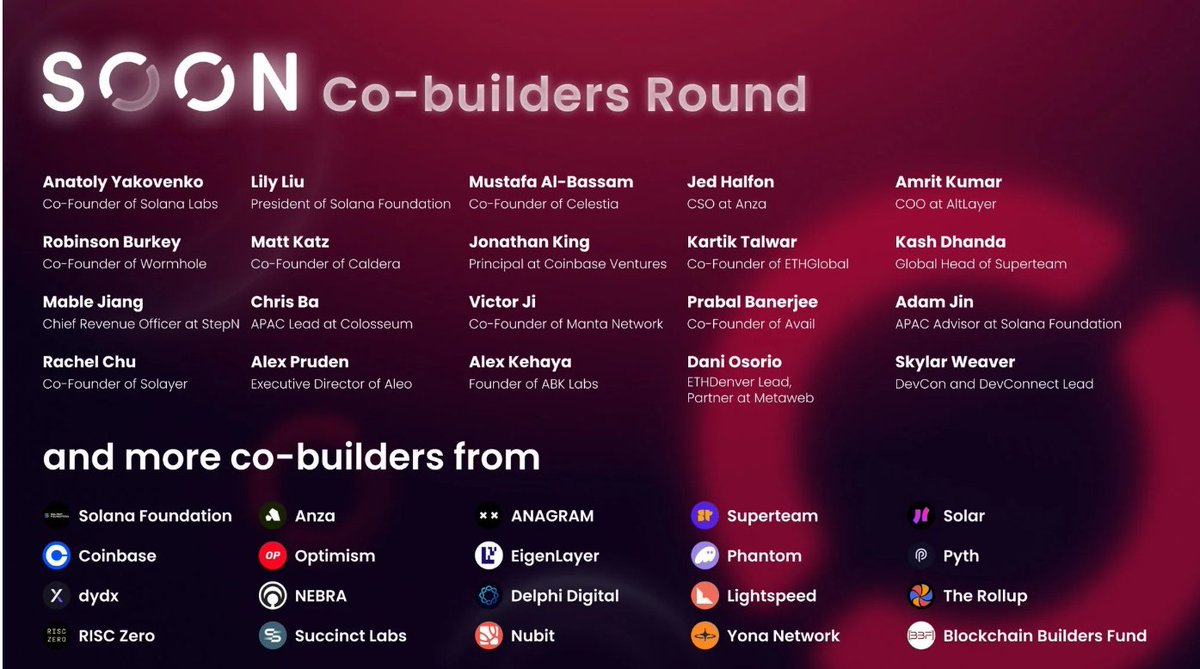
@soon_svm positions itself more like "Movement of SVM"—prioritizing community engagement during development, and notably using a builder round and community fair launch model for fundraising.
If Movement brought Move to Ethereum, Soon goes one step further by bringing SVM to all L1s. Unlike the imagined "Solana Layer2," it does not rely on the Solana mainnet. Instead, it uses the SOON Stack to offer flexible scalability, enabling SVM deployment across other major Layer1 blockchains.
This design allows any L2 within a public chain ecosystem to benefit from SVM advantages—faster transaction speeds and lower gas fees.
Therefore, SOON operates in a fundamentally different environment compared to other SVMs, requiring higher-performance rollups and tech stacks for support.
The multi-chain phenomenon under EVM forces developers to reinvent the wheel (multi-chain deployments), leading to degraded product quality and user fatigue. SOON, however, centralizes resources through a unified environment, significantly improving developer experience.
On fees: Ethereum's "global pricing model" isn't user-friendly—a popular NFT auction can spike costs for ordinary transactions. SOON’s localized fee market is clever: spend only what’s needed, with zero interference between use cases.
Critically, SVM supports parallel transaction processing, unlike EVM which processes transactions sequentially (like having only one cashier during peak shopping hours). The benefit of parallelization: multiple transactions run simultaneously, maintaining speed during high demand while keeping fees low.
Likewise, SOON’s private round attracted co-founders from prominent projects (Solana, Celestia, etc.), allocated 51% of tokens to NFT buyers, and promptly responded to community feedback.
This aligns perfectly with Movement’s philosophy: prioritizing the community and listening to its voice, ultimately driving collective success and shared positive outcomes.
SOON leads in development progress among the three SVM projects. SOON isn’t just another "grind champion"—its design actually addresses chronic issues in both EVM and Solana. If you’re in marketing or operations, consider learning from its community-driven, resource-centralized approach—achieving dual wins in user experience and efficiency is no fantasy!
Solayer — High TVL, High Efficiency
Solayer got so hot yesterday it temporarily crashed ICO platforms one after another.
I first heard about @solayer_labs over a year ago, when EigenLayer was booming. Solayer emerged out of nowhere, focusing on staking within Solana—becoming the Solana version of EigenLayer, starting from SOL’s staking ecosystem. Leveraging Solana’s staking data and infrastructure, Solayer built a solid foundation early on.
However, recent updates show Solayer is no longer limited to staking—it has entered the SVM technology space. For a project born from staking, what exactly is its competitive edge in the SVM domain?
A key turning point: Solayer acquired the tech firm FuzzLand and jointly launched Solayer InfiniSVM. With this technical backing, Solayer has begun a new, grander narrative chapter.
Thus, Solayer has launched its own SVM, aiming to become the first public chain to implement hardware-accelerated scaling, ultimately achieving true high-speed blockchain performance!
In the Solayer Chain, each transaction follows a workflow. Transactions first enter a scalable entry cluster composed of hundreds of thousands to millions of nodes, which clean and pre-execute transactions based on probabilistic predictions of future states.
Then, all execution snapshots are sent to an orderer built with Intel Tofino switches and additional FPGAs. Notably, most transactions are already confirmed as valid during pre-execution, eliminating the need for re-execution at the orderer.
Hard to grasp? Here’s a simple analogy:
Imagine queuing at airport security, where every bag is scanned by machines (representing transaction cleaning and pre-execution). Most bags are fine and can pass directly.
But if the machine detects a suspicious item (conflicting transaction), it gets sent to a higher-level inspection station for detailed checks (orderer and re-execution). This station has top-tier detection equipment and experts (Intel Tofino switches and FPGAs), ensuring inspections are both efficient and fair.
In this airport, routine bag checks can handle 16 billion per second (TPS for simple transactions); even problematic bags can be processed at 890,000 per second (TPS for conflicting transactions).
In other words, the airport (Solayer’s SVM) can simultaneously process billions of routine passenger bag checks and millions of complex problem-bag inspections per second—ensuring both efficiency and proper handling of edge cases.
Solayer has also gained recognition from Solana and major institutions. Both funding rounds included investment from Solana co-founder @aeyakovenko, as well as top-tier institutional support from @BinanceLabs and @polychain. Solayer has now started its community sale—interested parties can check details on Buidlpad’s official website:
Sonic SVM
@SonicSVM was the first project in the sector to conduct TGE, officially launching its token on the 7th of this month. It’s now listed on most major exchanges’ spot markets, except Binance. Its current market cap is around $250 million, with a fully diluted valuation of approximately $1.7 billion.
Their focus is squarely on gaming—Sonic SVM’s innovative design primarily targets high concurrency and instantaneous transaction demands in gaming scenarios.
Sonic SVM is built entirely on the HyperGrid framework—the first concurrent scaling framework for Solana—designed for high customization and scalability while preserving native composability with Solana.
HyperGrid enables developers to write applications in an EVM-like environment, but execute them on Solana, with settlement still occurring on Solana. This design makes it easier for developers to use familiar programming languages, reducing the time needed to learn a new blockchain.
Notably, Sonic SVM is the first Grid instance within the HyperGrid framework—does this remind you of the relationship between Virtuals and Luna?
In addition, Sonic’s Guardian Nodes system focuses on validating on-chain user behavior, effectively preventing bot attacks and malicious activities, providing gamers with a safer interaction environment. Node operation also ensures stable network performance.
Another key highlight of Sonic is its TikTok Mini App—SonicX. Leveraging TikTok’s massive user base, SonicX generates a wallet linked to a TikTok account via simple login, achieving seamless account abstraction. This design drastically lowers the Web3 entry barrier, allowing regular users to participate in blockchain gaming activities without understanding private keys or on-chain operations.
Side note: TikTok currently faces policy risks in Europe and North America, with traffic trending downward. So whether this user acquisition channel remains viable long-term is a challenge.
[Summary]
The three major projects in the SVM space each have distinct strengths:
@SonicSVM focuses on gaming experience through TikTok traffic and seamless on-chain interactions;@solayer_labs aims for higher efficiency, combining restaking and liquidity optimization to expand its ecosystem; while @Soon_svm emphasizes community-driven growth, adopting Movement’s philosophy to extend SVM across the entire blockchain landscape.
I’d love to hear your thoughts: Which project are you most bullish on? And why?
Join TechFlow official community to stay tuned
Telegram:https://t.me/TechFlowDaily
X (Twitter):https://x.com/TechFlowPost
X (Twitter) EN:https://x.com/BlockFlow_News
 @mscryptojiayi