








Berachain Airdrop Shows "Wealth Gap": 6 NFT Whales Split $300 Million in Tokens, Testnet Users Get Only $60
TechFlow Selected TechFlow Selected
Berachain Airdrop Shows "Wealth Gap": 6 NFT Whales Split $300 Million in Tokens, Testnet Users Get Only $60
NFT holders earned up to $55.77 million.
 Navigating Web3 tides with focused insights
Author: Frank, PANews
Berachain, the first major project to launch in the Year of the Snake, officially began its airdrop distribution on February 6. Judging from price movements, its token BERA followed a low-open, high-rise trajectory, surging from an initial $7.5 to a peak of $15.5, with the initial circulating market cap reaching as high as $1.58 billion.
However, Berachain's airdrop allocation has sparked considerable controversy on social media, with many testnet users noting that official allocations to testnet participants were only 1.65%, while Binance users and NFT holders received 2% and 6.9% respectively—triggering community backlash.
Since Berachain did not release a data dashboard for this airdrop, and its official explorer does not support viewing detailed statistics from the airdrop smart contract,
PANews could only calculate and estimate Berachain’s airdrop distribution based on available data.
Six NFT whales received $306 million, top single address got $55.77 million
According to the official airdrop announcement, holders of Bong Bears NFTs or subsequent series (Bond, Boo, Baby, Band, Bit Bears) are collectively eligible for 34.5 million tokens.
How many such NFTs exist? Official information shows six NFT series involved in the airdrop: Bong Bears NFT (107 issued), The Bond Bears (126 issued), The Boo Bears (270 issued), The Baby Bears (570 issued), Bit Bears by Berachain (2,298 issued), and The Band Bears (1,162 issued).

The total supply amounts to approximately 4,533 NFTs. On average, each NFT would receive 6,553 tokens. At the peak price of $15.5, this equates to a maximum value of $101,000 per NFT. However, the distribution is likely not equal but rather based on the rarity of each NFT type.
PANews found that the Bong Bears NFT series received the largest individual allocation, with each NFT entitled to 48,797 tokens—worth up to approximately $756,000. The Bond Bears ranked second, receiving 39,115 tokens worth around $606,000.
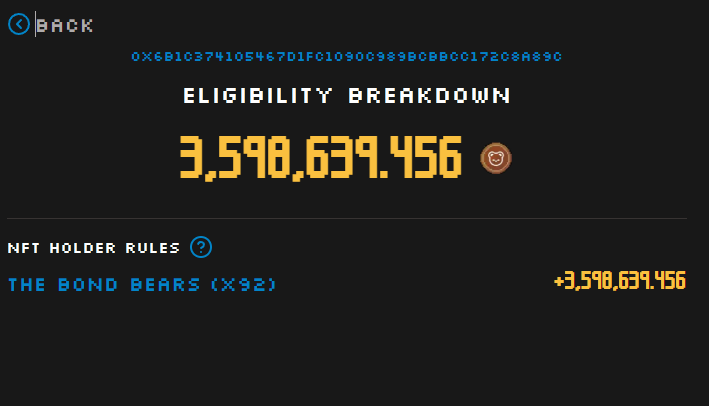
NFT holdings are often concentrated among a few large holders. For example, the address 0x6b1C...A89c holds 89 The Bond Bears NFTs—70% of the total supply. According to blockchain data, this address received 3.598 million tokens, valued at up to $55.77 million. On the evening of February 6, the highest trading price for this NFT series reached 140 ETH (valued at $378,000). Based on this, the total value of 92 NFTs would be about $34.77 million—still lower than the airdrop gain. Currently, the asking price for these NFTs has dropped to around 10 ETH.
PANews discovered that the majority of NFT holder allocations are concentrated among a few large addresses. The six largest holders collectively received 19.78 million tokens, worth up to $306 million—averaging 3.29 million tokens per address. These six alone received more tokens than the entire testnet user base (over 2.38 million wallets), which was allocated only 8.25 million tokens in total.
Testnet users’ basic allocation may be just $60
In stark contrast to NFT holders who became instant millionaires, testnet users received a total of 8.25 million tokens. According to previous media reports, as of January 2, the number of wallets participating in Berachain’s Proof-of-Liquidity (PoL) mechanism exceeded 2.38 million. This means each wallet received approximately 3.46 tokens—worth up to $53.7 at peak prices.
Overall, the total airdrop amounted to about 79 million tokens. As of February 7, there were approximately 730,000 token-holding addresses listed on the official site, averaging about 108 tokens per address (the actual number may be lower due to unclaimed airdrops and unlock delays). From on-chain data, the minimum airdrop amount was 3.92 tokens—worth up to $60.

However, compared with recent airdrops, Berachain’s total airdrop value was approximately $592 million (calculated at the opening price of $7.5)—similar to HYPE. In terms of the largest single allocation, Berachain’s top recipient received $55.77 million—highest among recent projects. Yet, the baseline allocation of 3.92 tokens appears to be among the lowest in recent major airdrops. From this perspective, the wealth gap in Berachain’s airdrop seems particularly pronounced.
Large wealth gap—can VCs indirectly unlock?
The airdrop allocation ratio has drawn criticism from early contributors who actively participated in Berachain’s testnet. Particularly contentious is that testnet users received only 1.65% of the airdrop, while Binance users received 2% and NFT holders 6.9%.
In response, the team stated: “Without Bong Bears and their subsequent derivatives, Berachain would never have existed. The NFTs predated the chain; NFT holders have been among the longest-standing and most supportive members of the Berachain community, with countless holders going on to launch their own dApps or community initiatives within the ecosystem.”
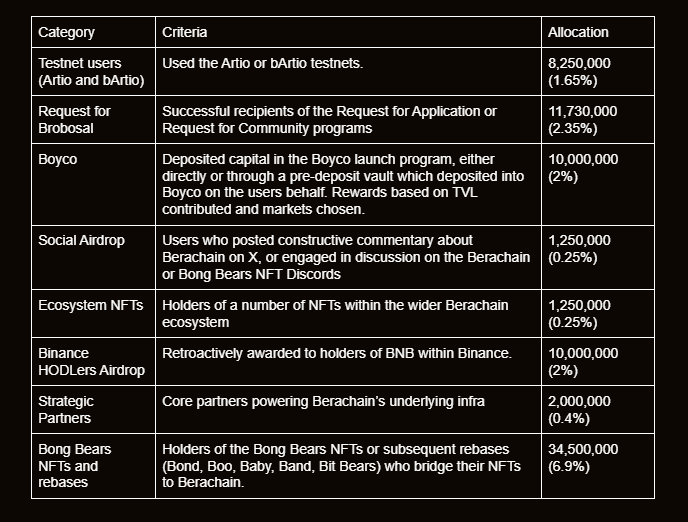 Regarding Binance user allocations, the explanation given was: Berachain holds great respect for the BSC chain.
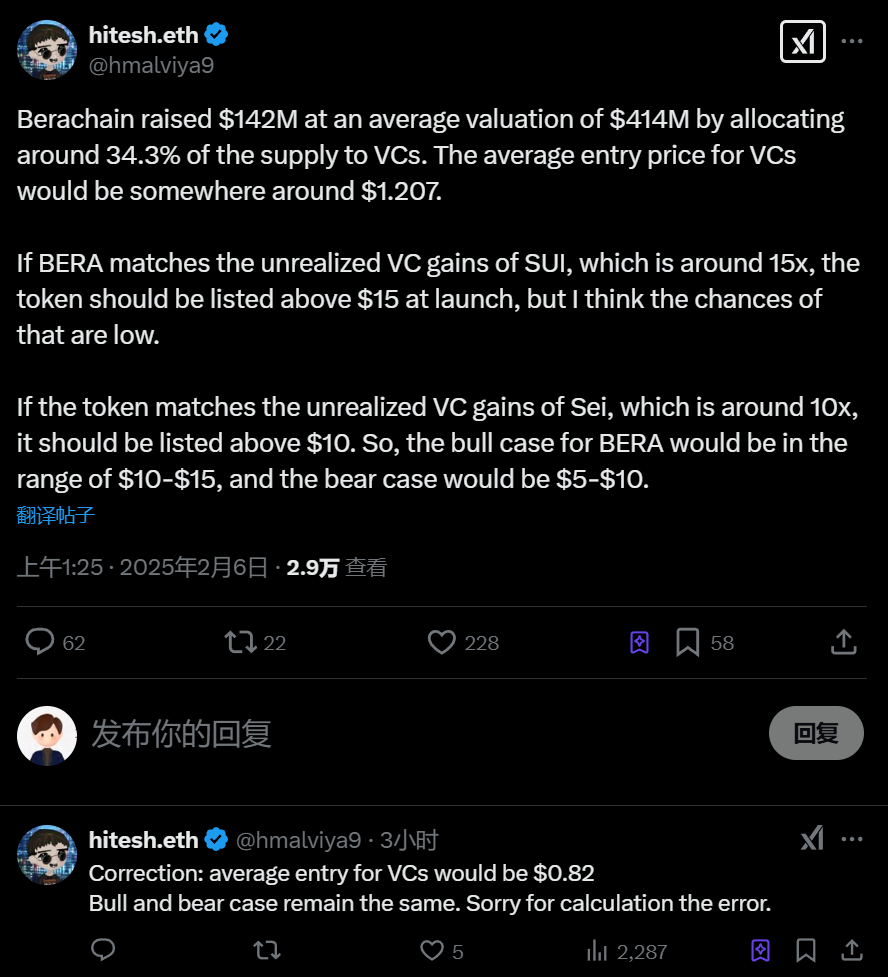
Additionally, Berachain’s VC allocations have also attracted market attention. hitesh.eth, founder of DYθR, noted on X that Berachain allocated approximately 34.3% of the supply to VCs, with an average entry price of about $0.82. If BERA achieves the same unrealized VC returns as SUI (around 15x), the token should have launched above $15—but hitesh.eth considers this unlikely. If it matches Sei’s unrealized VC returns (around 10x), the launch price should exceed $10. Thus, BERA’s bull market price range is expected to be $10–15, and bear market range $5–10.
Post-launch, BERA briefly surpassed $15.5 before rapidly correcting. However, VCs face a one-year lock-up period, making future price movements uncertain. Still, some KOLs have pointed out on social media that VCs can stake their locked tokens to earn rewards—an indirect form of monetization. This practice has raised concerns within the community.
After briefly exceeding $15.5, BERA quickly fell to a low of $6.7—a decline of over 50%. HashKey Capital’s Rui attributed this to: “poor overall market liquidity, and record-high sentiment favoring short positions.”
On-chain data shows that on its mainnet launch day, Berachain processed over 1.14 million transactions involving more than 140,000 unique addresses. As more users claim their airdrops, these figures are expected to rise further in the short term. However, amid widespread community discontent over airdrop allocations and strong bearish sentiment, whether Berachain can sustain high on-chain activity after the airdrop concludes—and whether its price can follow in Hyperliquid’s footsteps—remains uncertain.
Join TechFlow official community to stay tuned
Telegram:https://t.me/TechFlowDaily
X (Twitter):https://x.com/TechFlowPost
X (Twitter) EN:https://x.com/BlockFlow_News
 PANews






