









Is the crypto market no longer rewarding diamond hands?
TechFlow Selected TechFlow Selected
Is the crypto market no longer rewarding diamond hands?
To trade short-term swings or to diamond hand? That is the question.
 Navigating Web3 tides with focused insights
By: 1912212.eth, Foresight News
There was a time when CZ's statement "If you can't hodl, you won't get rich" was widely celebrated as golden wisdom in the crypto investment community. Buy, hold, and steadfastly maintain your position—then sell at peak profits for massive gains. The HODL philosophy once dominated the space.
Certain investment firms achieved substantial returns through deep research and strategic bets—for example, TopFund earned hundreds or even thousands of times returns on MATIC and AAVE in the previous cycle. Such legendary wealth stories led retail investors to widely believe in the immense power of diamond hands. However, while this investment approach may have worked reasonably well in the last market cycle, it is no longer favored by the market in this cycle—especially for those holding bags of obscure altcoins.
With a four-year market cycle, structural changes have already taken place. Failure to adapt investment styles promptly often leads to the risk of being left stranded at the top. Has the market truly stopped rewarding diamond hands?
1. Memes and AI Take Center Stage, Broad Market Rallies Are Gone
In past crypto market cycles, a broad rally typically emerged about six months after the Bitcoin halving. Capital would first concentrate in Bitcoin, then gradually flow into Ethereum, followed by major altcoins, and finally into small-cap alts and meme coins—marking the end of a typical bull run.
This cycle, however, saw the first wave of price surge pulled forward due to the approval of Bitcoin spot ETFs. After BTC had its moment in the spotlight, the broader crypto market fell into prolonged silence. The long-awaited Q4 2024 rally turned out to be extremely short-lived.
If you embraced popular assets like Bitcoin, SOL, or Dogecoin early in this cycle and held them until now, diamond hands would have delivered very attractive returns. But if your chosen altcoins were out of favor—such as restaking, inscriptions, gaming, or NFT projects—your unrealized returns are likely dismal.
Recently, new tokens listed on Binance, which has drawn heavy market criticism, often peaked immediately upon listing and then entered a continuous downtrend. Projects with decent quality and some popularity might enjoy a temporary uptick, but those lacking hype, utility, and facing constant token unlocks suffer from weak buying pressure and keep hitting new all-time lows. Diamond hands unlucky enough to pick niche sectors and obscure tokens and stubbornly hold without selling face significant losses.
Moreover, compared to the thriving DeFi and NFT innovations of the last cycle, this cycle has not seen any truly breakout innovation capable of rivaling them. Market capital has remained largely stuck in Bitcoin, meme coins, and AI-themed tokens.
The chart below clearly shows that Bitcoin's market cap share experienced sharp declines in both 2017 and 2021—coinciding with broad rallies in altcoins. In 2023, however, Bitcoin's market dominance began a steady climb, rising from 38% to over 60% at one point. In contrast, Ethereum's market share has been declining since the beginning of 2023 amid multiple headwinds.
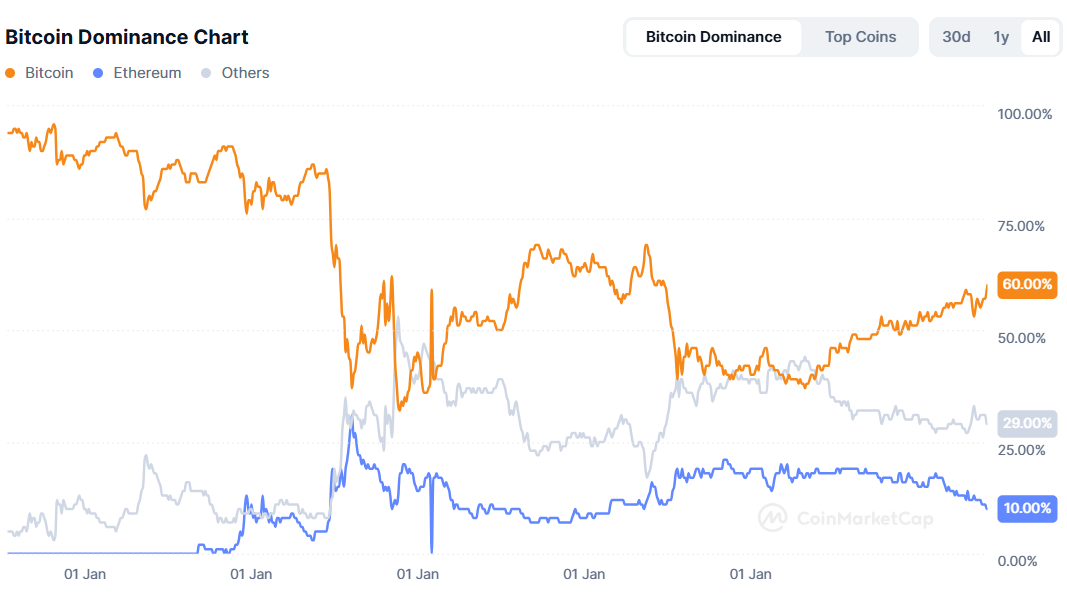
Historically, periods of rising Bitcoin dominance rarely coincide with widespread altcoin rallies.
Today, the market appears to reward only those diamond hands who hold Bitcoin and a select few other top-tier assets.
2. Major Altcoins Underperform Expectations
The difficulty of succeeding in the altcoin market this cycle has increased dramatically compared to the last. Take last cycle’s L1s: measuring from their lowest post-listing prices on Binance, DOT achieved over 20x returns, NEAR nearly 40x, AVAX over 40x, SOL more than 250x, and UNI in the DeFi space also delivered over 20x. The sector-wide wealth effect was highly evident.
Notably, all these high-return tokens eventually fell back to bottom ranges half a year—or even a full year—after reaching their peaks.
Among infrastructure L1s in this cycle, only SOL and SUI have performed reasonably well; others have disappointed. For L2s, OP achieved a maximum 10x return, while ARB peaked at just 3x. Both dropped back to bottom levels within five months of their highs—ARB, for instance, fell from a record high of $2.42 to a low of $0.34. Stablecoin-related tokens like USUAL and ENA delivered notable returns, but still less than 10x from their lows.
Some VC-backed darlings have underperformed badly—EIGEN reached a mere 2x high and has now hit an all-time low. Restaking tokens ETHFI and RENZO began setting new lows immediately after their Binance listings. IO achieved a 2x high but has also since made new lows.
As more investors refuse to buy overvalued VC tokens, market participation in both new and existing projects has significantly declined.
Additionally, data from CoinMarketCap and CoinGecko show there are now over 20,000 altcoins (excluding low-cap memes), two to three times more than in 2021. The explosion in token variety and meme mania inevitably dilutes attention on mainstream altcoins, reducing their potential returns.
3. Meme Markets: Fast-Paced and High-Intensity
VC-backed tokens, once hot commodities, are no longer desirable. As traders fail to find wealth opportunities on centralized exchanges, many have turned to on-chain hunting.
The Solana-based "pump and dump" trend has swept the industry. Undeniably, memes like WIF, BOME, and TRUMP generated strong wealth effects and attracted significant attention. But if you held with diamond hands and haven’t cashed out yet, your profits may have shrunk by multiples.
WIF surged to nearly $4.8 shortly after its Binance listing but has since dropped to $0.8. BOME peaked at $0.029 post-listing and now trades at $0.002. While TRUMP brought windfall gains to some on-chain players, anyone who didn’t exit near its peak of $70 saw it plunge to a low of $16 within about a week.
Meme markets may seem fair, but they are far from easy. The pace at which projects rise and collapse accelerates constantly—participants who hesitate or act slowly risk getting severely trapped.
Take the AI-themed meme GOAT as an example. On October 23, 2024, trader Nachi tweeted, “I’ve acquired 4% of GOAT’s total supply. This will be the best trade of the cycle,” when GOAT was trading around $0.5. On December 12, he confirmed he still held GOAT, then priced at $0.84. Shortly afterward, sentiment shifted sharply—ACT stole the spotlight, followed by VIRTUAL and other AI agent tokens. GOAT’s price plunged below $0.1, despite having previously reached an all-time high of $1.37.
Consider Moonshot, known for launching meme coins. Foresight News analyzed tokens launched on Moonshot between November 2024 and January 2025. Out of 116 listed tokens, only 17 currently trade above their listing prices—a rate below 15%. The vast majority are in decline, with over 85% down from launch.
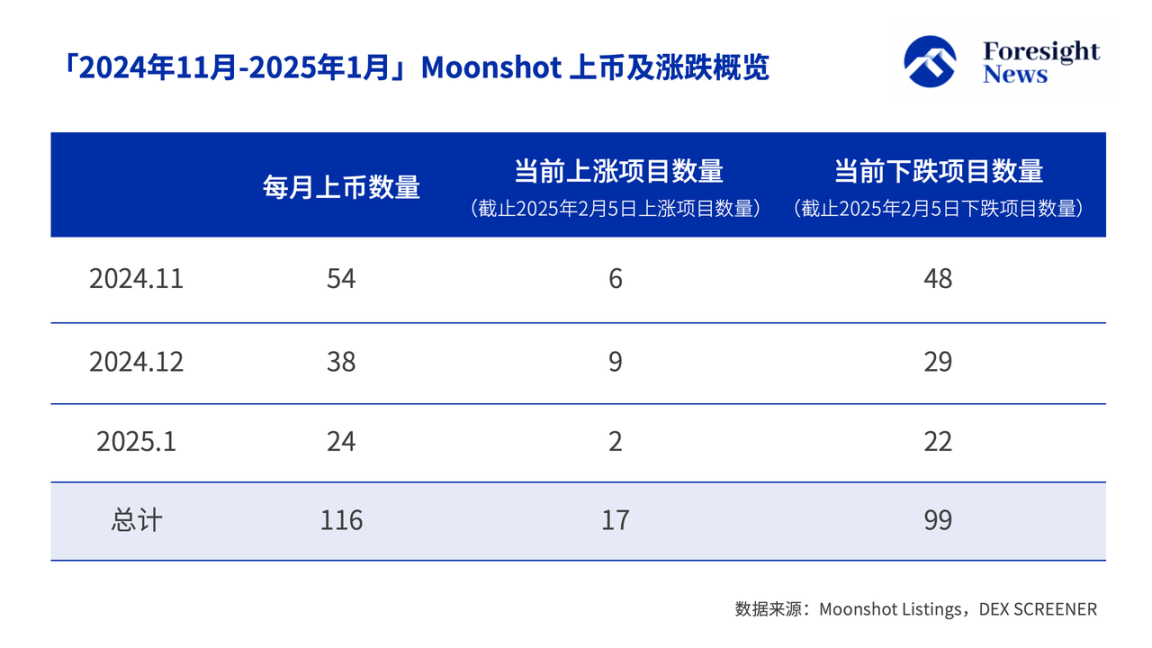
Behind these cold, hard numbers lies a harsh truth: identifying winning projects, acquiring them cheaply, and exiting profitably is extremely difficult. Drops of 80% or more—or complete failure—are standard in the meme space.
The fast-paced, high-intensity nature of meme markets has also spilled over into parts of the altcoin sector, where liquidity was already fragile. Altcoins with weak narratives, low popularity, and inflated valuations—especially those listed on exchanges—are now entering their "dark age."
4. What Should You Do?
From a macro perspective, the bar for successful diamond hands is rising. First, accurately assess market sentiment and identify optimal take-profit zones. Holding blindly at the wrong time could erase all your gains. Second, carefully select investment targets—choosing the right ones demands great caution. Pick the wrong sector or project, and even a new bull market might pass you by.
Avoid adopting diamond hands in the meme coin space.
Cashing out timely to improve your life is also a solid strategy. Reducing positions eases future holding pressure—should a sharp correction occur, realized profits ensure you still have capital to capture new opportunities.
Join TechFlow official community to stay tuned
Telegram:https://t.me/TechFlowDaily
X (Twitter):https://x.com/TechFlowPost
X (Twitter) EN:https://x.com/BlockFlow_News
 Foresight News











