Deep Research released: AI is no longer a simple search engine, but becomes your research partner
TechFlow Selected TechFlow Selected
Deep Research released: AI is no longer a simple search engine, but becomes your research partner
The end of search, the beginning of research.
 Navigating Web3 tides with focused insights
Author: One Useful Thing
Compiled by: TechFlow
This past weekend, we caught a glimpse of the future. For some time now, I've been discussing two major revolutions in AI: the rise of autonomous agents and the development of powerful reasoning systems (reasoners) since OpenAI introduced its o1 model. These two technological paths are now converging, giving birth to something astonishing—AI systems capable of conducting research with the depth and nuance of human experts, yet at machine speed. Representing this convergence is OpenAI’s Deep Research, which paints a picture of what lies ahead. However, to understand why this matters, we need to start from the basics: reasoners and agents.
Reasoners
For years, when using chatbots, their operation has been quite straightforward: after you input a question, the system generates responses word by word—or more precisely, token by token. Since AI can only "think" while generating these tokens, researchers have developed various techniques to enhance its reasoning ability. For instance, prompting the AI to “reason step by step before answering,” known as chain-of-thought prompting, significantly improves performance.
Reasoning systems automate this process. Before delivering an answer, the system first generates "thinking tokens"—intermediate reasoning steps—and then produces the final response. This approach brings two key breakthroughs.
First, AI companies can train reasoning systems on examples from top problem solvers, making the AI's "thought" process more efficient. This training method produces higher-quality reasoning chains than human-generated prompts, enabling reasoners to tackle more complex problems, especially in areas like mathematics and logic where traditional chatbots typically struggle.
Second, a notable feature of reasoning systems is that the longer they "think," the better the answer quality becomes (although improvements eventually plateau over time). This is significant because previously, the only way to improve AI performance was by training larger models, which required vast amounts of data and funding. Reasoning systems show that simply allowing the AI to generate more reasoning steps during inference—i.e., compute time during answering—can dramatically boost performance without increasing training resources.
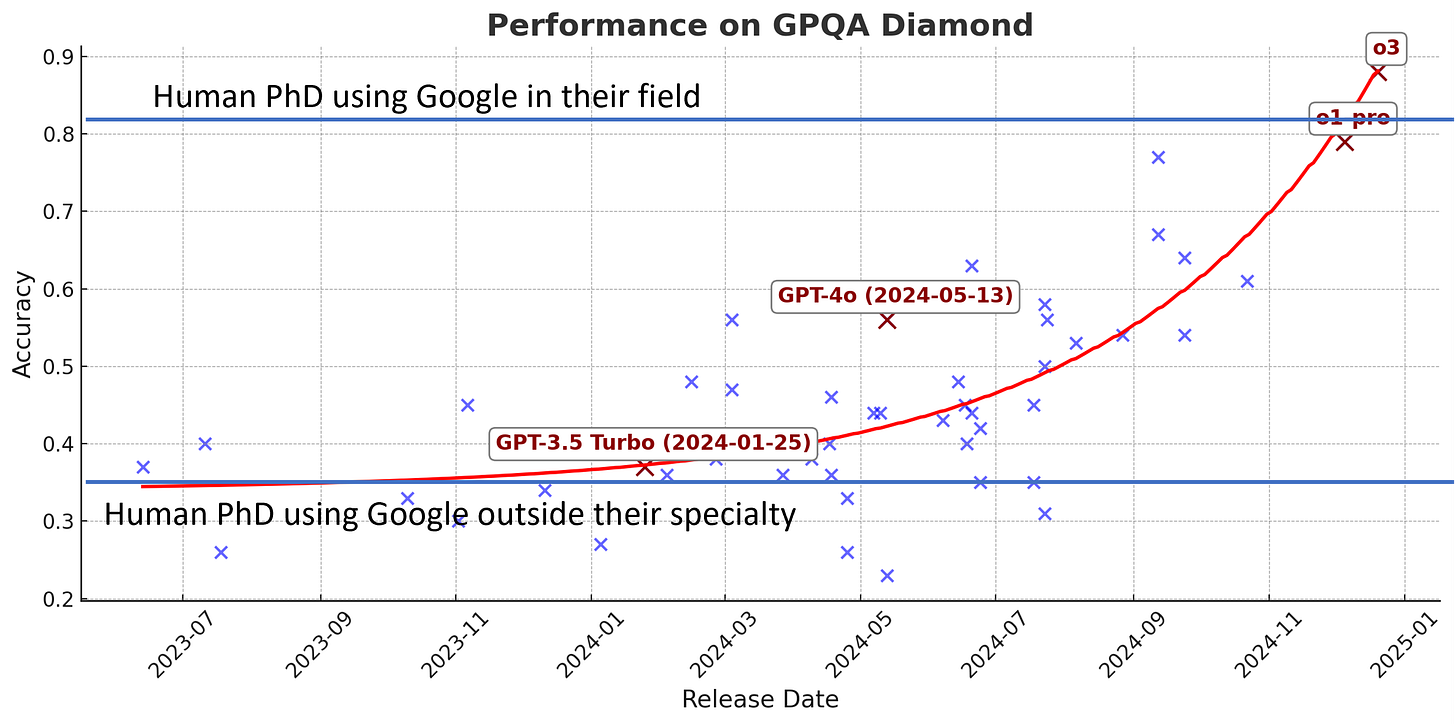
The Graduate-level Physics Question Answering (GPQA) dataset consists of multiple-choice questions designed to assess AI reasoning capabilities. Even PhD students with internet access achieve only 34% accuracy in non-specialist domains, rising to 81% in their own fields. This benchmark illustrates how reasoning models accelerate AI capability gains (data source).
As reasoning systems are still emerging, their capabilities are rapidly advancing. Within just months, we’ve seen OpenAI’s o1 series leap forward to the new o3 model. Meanwhile, China’s DeepSeek r1 enhances performance through innovative methods while reducing costs, and Google has released its first reasoning system. This is only the beginning—more powerful reasoning systems will emerge, likely faster than expected.
Agents
Experts still haven't reached consensus on a precise definition of AI agents. But we can loosely define them as “AI systems given goals and the autonomy to achieve them.” Currently, major AI labs are fiercely competing to develop general-purpose agents—systems capable of handling any task. I’ve previously mentioned early examples such as Devin and Claude with computer use abilities. Recently, OpenAI launched Operator, perhaps the most advanced general-purpose agent to date.
The following video (sped up 16x) demonstrates both the immense potential and current limitations of general-purpose agents. I tasked Operator with reading my latest Substack post on OneUsefulThing, visiting Google ImageFX to design a suitable image, downloading it, and delivering it for publication. Initially, Operator performed exceptionally well—it accurately located my site, read the article, navigated to ImageFX (pausing to let me enter login details), and successfully generated an image. But problems soon arose in two main areas: first, Operator was blocked by OpenAI’s security restrictions from downloading files; second, confusion emerged during execution. The agent attempted various workarounds—copying to clipboard, generating direct links, even diving into website source code—but none succeeded. Some failed due to OpenAI’s browser limitations, others due to misinterpretation of the task. Observing this persistent yet ultimately unsuccessful attempt reveals not only the current system’s limits but also raises questions about how agents will respond when encountering real-world obstacles.
While Operator exposes shortcomings of general-purpose agents, this doesn’t mean agents lack value. Narrow-domain agents focused on specific tasks already demonstrate significant economic utility. Leveraging today’s large language models (LLMs), these agents deliver impressive results within specialized domains. OpenAI’s new product, Deep Research, exemplifies such a focused agent.
Deep Research
OpenAI’s Deep Research (note: do not confuse with Google’s similarly named Deep Research, discussed later) is a narrow-domain agent specialized in research. Built upon OpenAI’s unreleased o3 reasoning system (reasoner) and equipped with dedicated tools and functions, it stands among the most impressive AI applications I’ve seen recently.
To test its capabilities, I assigned it a topic: at what point should startups stop exploring and begin scaling? This is a technically nuanced and debated issue within my field. I instructed Deep Research to investigate relevant academic literature, focusing on high-quality papers and randomized controlled trials (RCTs), address possible definitional disputes, reconcile common sense with research findings, and produce a comprehensive report suitable for graduate-level discussion.

At the outset, the AI asked several insightful clarifying questions, helping refine my request. Then, OpenAI’s o3 reasoning system began working. Throughout the process, you can clearly observe its progress and internal "thinking." Below are several key snapshots worth examining closely. You’ll notice the AI behaves much like a researcher—actively exploring discoveries, digging deeper into things that "interest" it, and attempting solutions (e.g., finding ways around paywalls). The entire process took approximately five minutes.
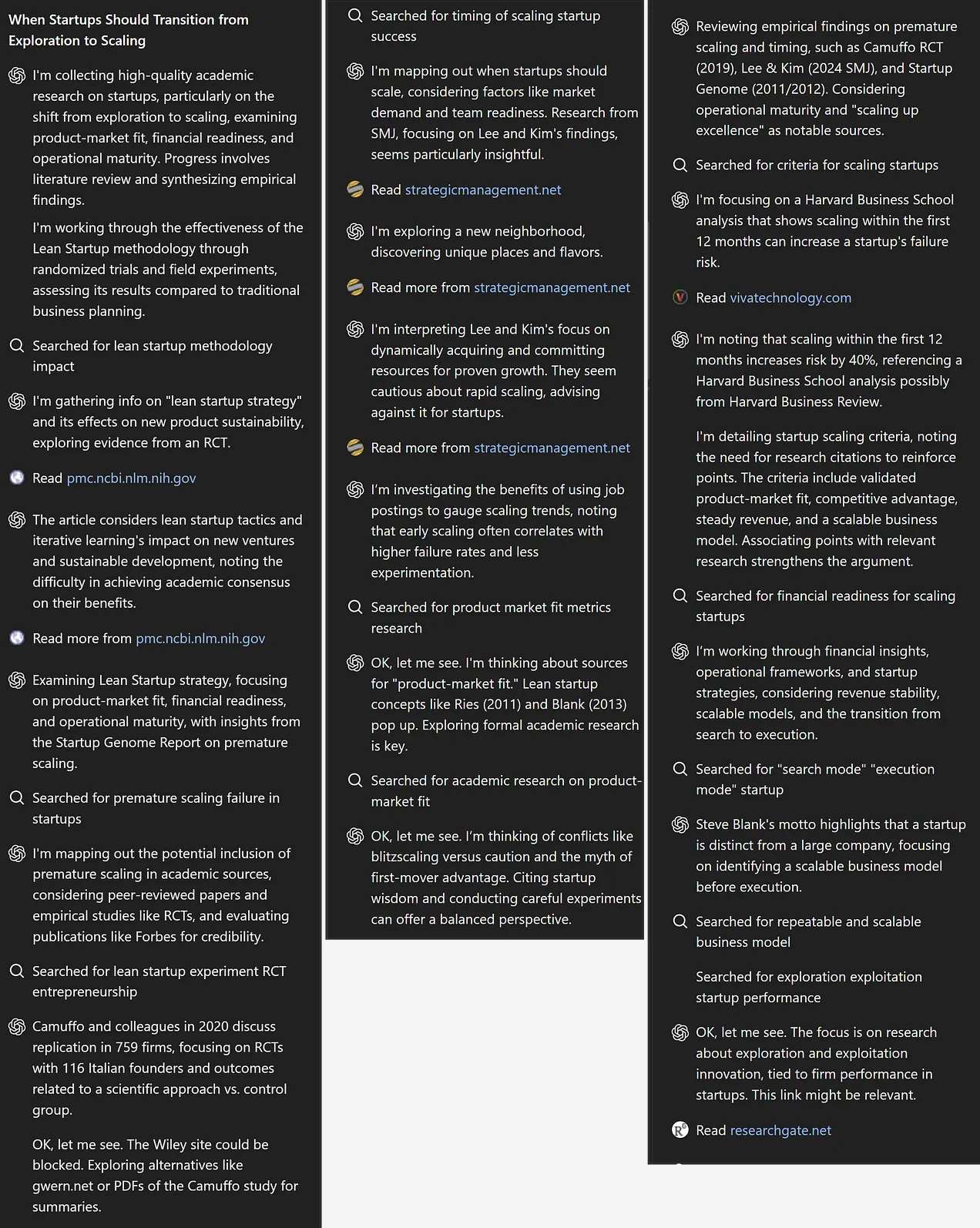
In the end, I received a thirteen-page, 3,778-word draft containing six citations and additional references. The overall quality was solid, though the number of cited sources could be improved. The report successfully integrated complex and contradictory concepts, uncovering novel connections I hadn’t anticipated. It cited only high-quality academic sources, with accurate quotation content. While I can't guarantee complete factual accuracy (though I found no obvious errors), if this were submitted by a first-year PhD student, I would be satisfied. Here are a few excerpts explaining why I’m so impressed (full results here).
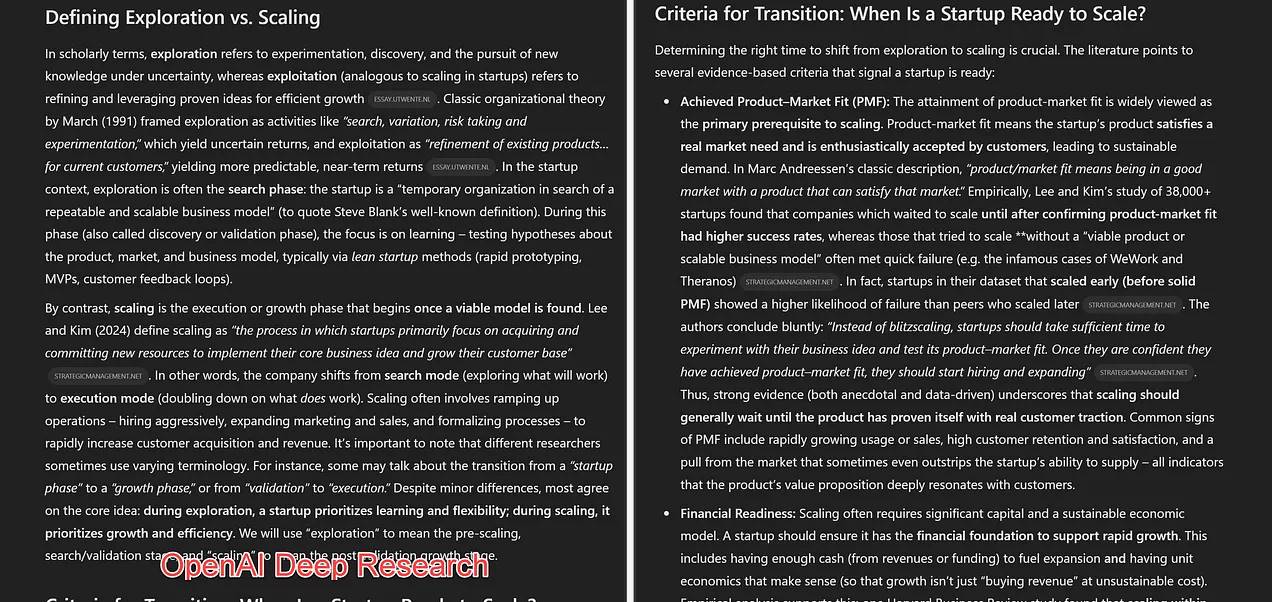
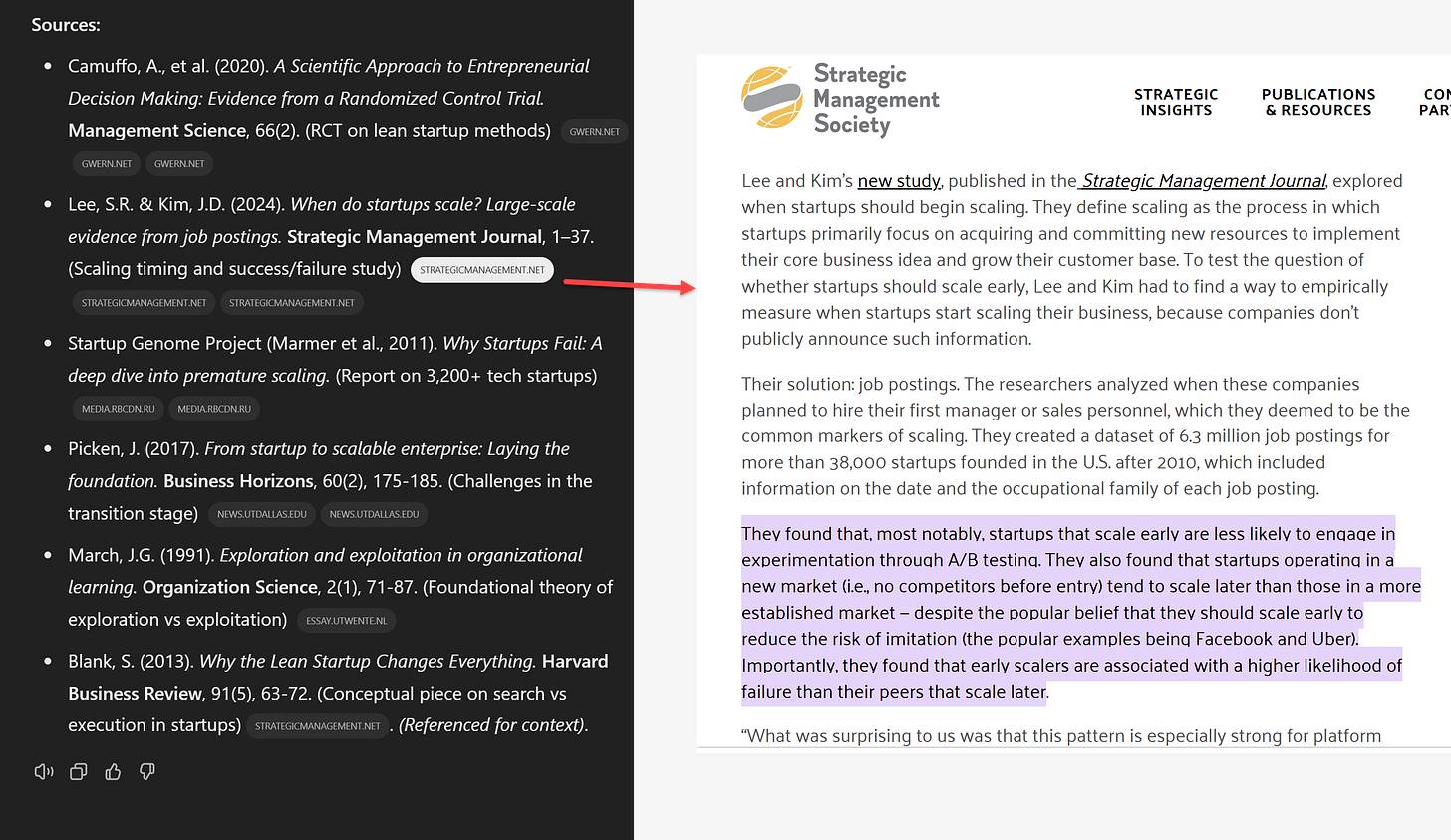
The citation quality marks a clear advancement. These aren’t typical AI hallucinations or fabricated paper references, but legitimate, high-quality academic sources—including pioneering work by my colleagues Saerom (Ronnie) Lee and Daniel Kim. When I clicked the citation links, they not only led to the correct papers but often jumped directly to highlighted quoted sections. Despite current limitations—the AI can only access content it finds and reads within minutes, and paywalled articles remain inaccessible—this represents a fundamental leap in AI’s ability to handle academic literature. For the first time, an AI isn’t merely summarizing research but actively engaging with it in a manner close to human scholarly practice.
Notably, Google launched a similarly named product, Deep Research, last month (sigh). Google’s system provides more citations, but source quality varies widely, often mixing random websites (accessing paywalled content and books remains a challenge for all agents). Unlike OpenAI’s research agent, Google’s system appears to gather all documents at once rather than through exploratory discovery. Moreover, since Google’s version currently runs on the older Gemini 1.5 model (without reasoning capabilities), its summaries are more superficial, though generally sound and error-free. In essence, its output resembles that of a very strong undergraduate student.
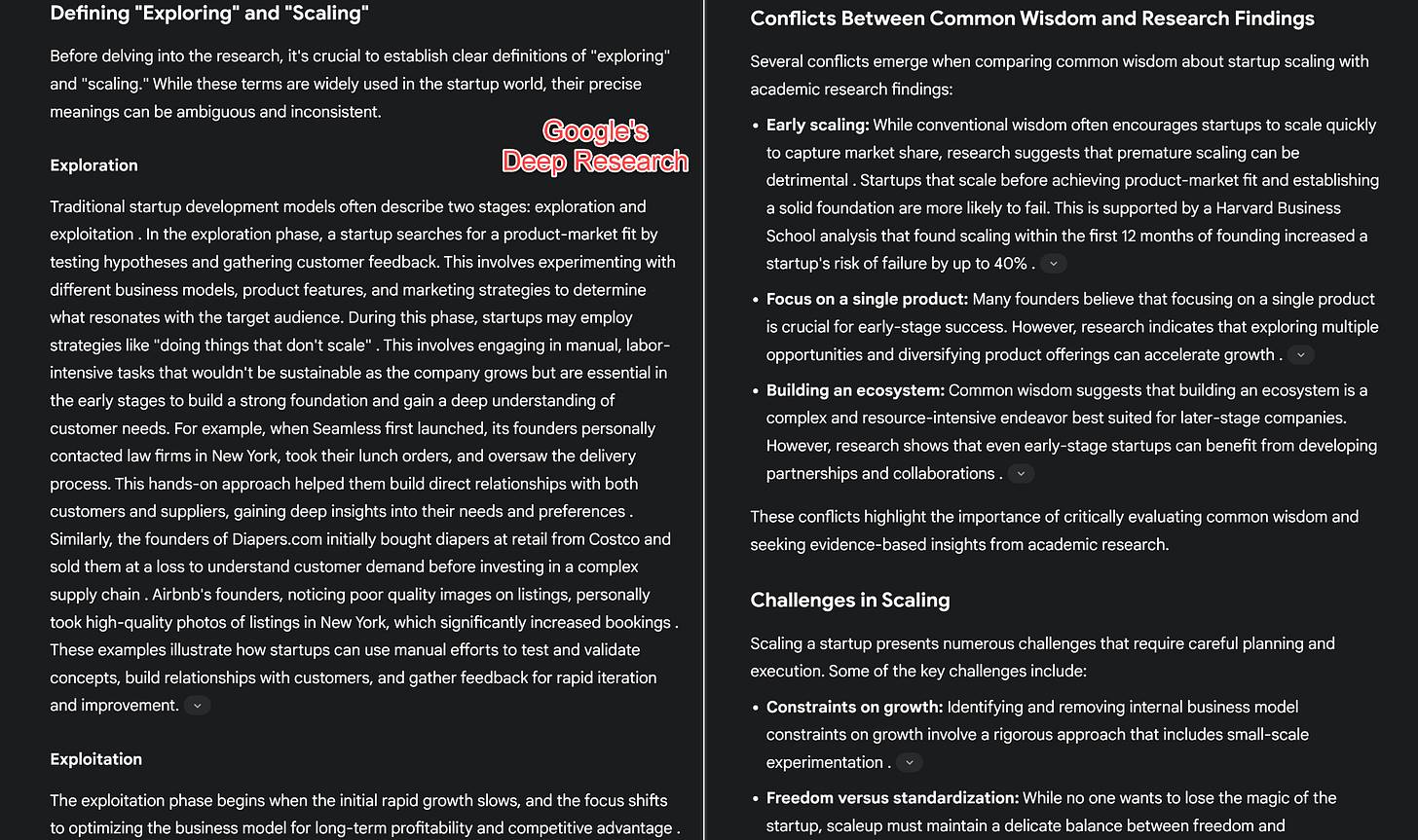
To put this in perspective: both OpenAI and Google’s research agents accomplish work that would normally take humans hours. The difference is OpenAI’s system achieves analysis approaching doctoral research standards, while Google’s output is closer to that of a strong undergraduate. In OpenAI’s official announcement, they make bold claims, presenting charts showing their agent can handle 15% of high-economic-value research projects and 9% of extremely high-value ones. While the exact methodology behind these figures hasn’t been disclosed—and thus warrants some skepticism—my firsthand experience suggests these claims aren’t entirely exaggerated. Deep Research truly delivers complex, valuable analysis in minutes instead of hours. Given the pace of progress, I believe Google won’t let this gap persist long. In the coming months, we’re likely to see rapid improvements in research agent capabilities.
Technological Synergy
Current trends indicate that the technologies being built by major AI labs aren’t just being stitched together—they’re interacting synergistically to become more effective. Reasoning systems (reasoners) provide robust logical analysis, while agent systems give these reasoning engines the ability to act autonomously. Today, we're in the era of narrow-domain agents like Deep Research, focused on specific tasks because even today’s most advanced reasoning systems haven’t yet achieved general-purpose autonomy. Yet “narrow” doesn’t mean limited—these systems already perform complex work once requiring highly paid expert teams or professional consulting firms.
Certainly, this doesn’t mean experts and consultants will be replaced. On the contrary, as they shift from direct execution to coordinating and validating AI outputs, their expert judgment will become even more critical. But AI labs aim far beyond this. They seek to unlock general-purpose agents through more powerful models, enabling systems to transcend narrow tasks and become truly autonomous digital workers. Such agents could browse the web independently, process multimodal data (text, images, audio), and take meaningful actions in the real world. While Operator shows we’re not there yet, Deep Research proves we’re steadily moving in that direction.
Join TechFlow official community to stay tuned
Telegram:https://t.me/TechFlowDaily
X (Twitter):https://x.com/TechFlowPost
X (Twitter) EN:https://x.com/BlockFlow_News