BTC Reclaims $100K, Presidents Support Crypto—But Why Isn't Everyone Happy?
TechFlow Selected TechFlow Selected
BTC Reclaims $100K, Presidents Support Crypto—But Why Isn't Everyone Happy?
I don't know.
 Navigating Web3 tides with focused insights
Author: Happy
Translation: TechFlow

Bitcoin has surpassed $100,000; we’ve got a crypto-supportive president—but strangely, everyone seems angry.
The Overton Window has shifted completely. This time, things are indeed different—but not in the way we expected.
Trump’s presidency presents a puzzling dilemma—what does it mean for my digital assets? My mind is flooded with thoughts.
On one hand, he’s the most powerful man in the world, publicly shilling our cryptocurrencies.
On the other, he’s leveraging his power and influence to launch meme coins that dilute market value, enriching his family by extracting maximum capital from this space.
Reality is often stranger than fiction.
Looking back at Bitcoin’s history, early supporters designed a game-theoretic plan predicting how Bitcoin would gradually take over the world. They believed governments would first resist us, but eventually we’d prevail. On the surface, that appears to have come true.
Bitcoin did win. It evolved from being seen as “money for criminals funding illicit activities” to “freedom money,” now embraced and promoted by the world’s most powerful institutions, individuals, and even nations.
Figures like Larry Fink, Donald Trump, Stanley Druckenmiller, Ray Dalio, and Elon Musk have all expressed positive views on Bitcoin at various points—a stark contrast to a decade ago, when Bitcoin’s only use case might have been buying a pizza or enabling environmental activists to glue themselves to your driveway accusing you of “destroying the planet.”
Yet for those of us spending 16 hours a day staring at computer screens, chatting with online friends, and speculating wildly on virtual currencies: I feel the future may become even stranger and more difficult.
Throughout crypto’s development, we’ve dreamed about how these technologies could change the future—“the entire world will go on-chain,” “everyone will transact using stablecoins,” “NFTs will replace physical art,” “decentralized finance (DeFi) will replace traditional banking.”
But historically, none of these visions have truly materialized. The technology wasn’t ready, and governments were hostile. They wished we didn’t exist and used every means to suppress us.
As a result, many teams had to focus their efforts on designing products that could both evade legal risks and maximize token prices. Genuine user-centric design has long been at the very bottom of the priority list.
In some ways, this situation was highly advantageous for us internet geeks. To inflate token prices while avoiding legal trouble, a key strategy adopted by many project teams was distributing tens of thousands of dollars in “free money” directly to people like us via airdrops.
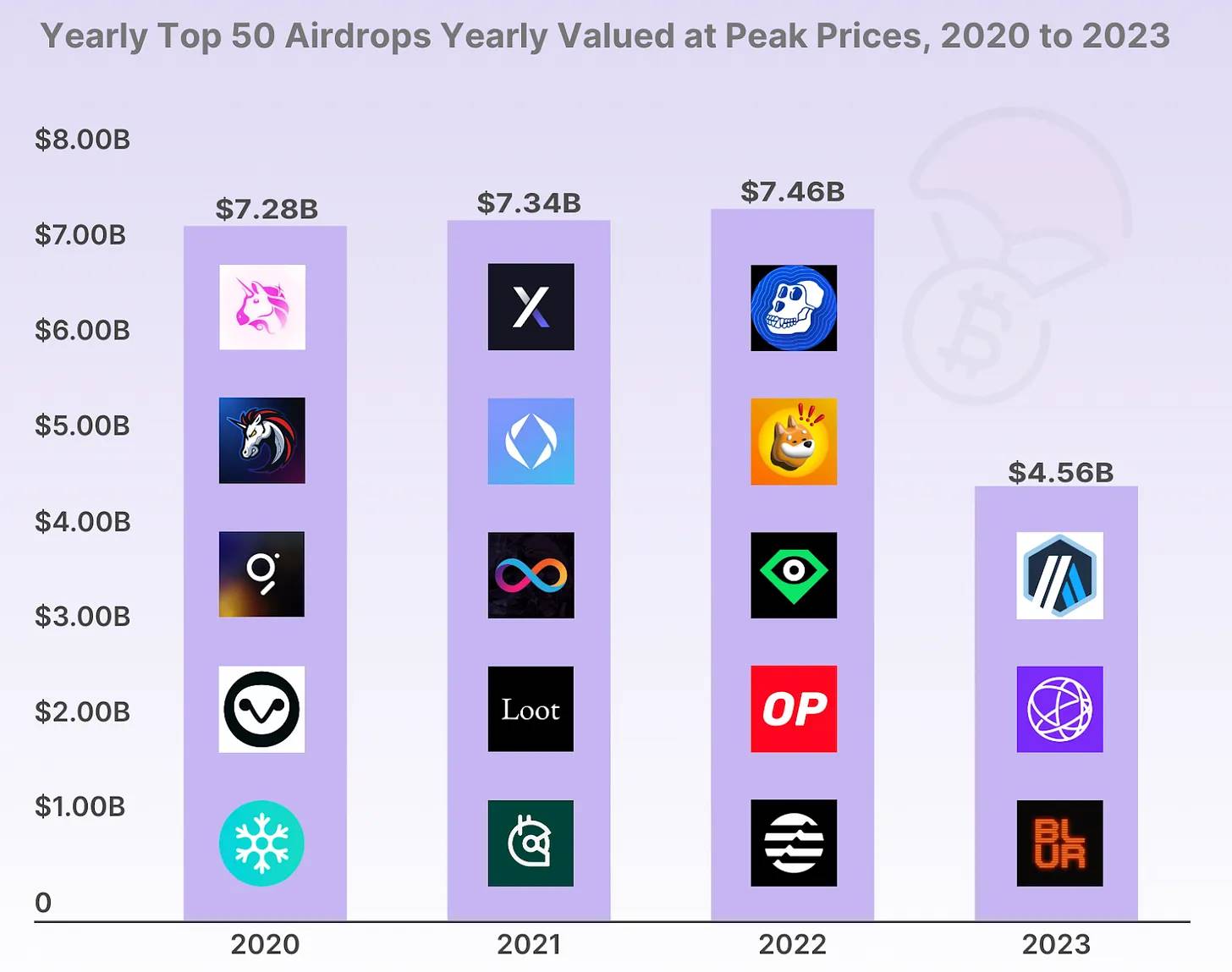
According to CoinGecko data, the total value of the top 50 airdrops reached as high as $26 billion.
Since the environment made it nearly impossible to produce genuinely high-quality products, we pretended these projects had already achieved their goals and valued them accordingly.
Thus, we witnessed many bizarre phenomena: Layer 1 blockchains with no users valued higher than most traditional tech companies; “Ponzi stablecoins” dependent on new inflows valued beyond some countries’ GDP; ape pictures selling for more than real estate.
What I’m trying to say is, the entire crypto industry is built upon a deeply flawed incentive structure.
In this system, merely talking about building something is just as profitable as actually building it. While many of us criticize this phenomenon, we’ve also directly benefited from it.
However, I believe this may be about to change.
With the emergence of crypto-friendly governments and clearer regulations, we finally have the chance to build serious, useful products for real users.
This is fantastic news for the industry as a whole, but I have absolutely no idea what it means for us “speculators.”
In a world where regulatory clarity enables real innovation, will builders still give us “free money” through airdrops?
As legal frameworks become clearer, will more professionals enter the on-chain ecosystem, weakening today’s “speculator culture”?
If crypto projects achieve technological breakthroughs and attract “real users,” what will happen to applications that still lack users?
If governments shift from hostility to support, will we blindly migrate to more centralized blockchains?
When the barrier to creating tokens drops to zero, will all tokens be diluted and lose value?
As higher-quality applications emerge, will we see massive real-user adoption and spending within the on-chain economy? Will that money stay on-chain long-term, or flow back into traditional systems?
In the end, will we end up like Web 2.0—where a few dominant companies capture all the profits, rendering others insignificant?
Will your family’s future really depend on whether you bought those seven tokens? If you missed them, are you doomed to poverty for holding Ethereum too long?
Will Michael Saylor impulsively sell off (FSH) all his Bitcoin? Sounds absurd—but if it happens, we might end up with nothing.
Will the Ethereum Foundation suddenly disband, leaving us watching helplessly as Vitalik frantically launches a new blockchain embodying his “Milady spirit”?
What if Trump launches an “American Chain,” airdropping tokens to every citizen while heavily taxing other chains and tokens?
Will these changes drive prices up—or trigger a market collapse?
To be honest, I have no answers. This might be the most confused I’ve felt in the past five years.
The only thing I’m certain of is that everything will change—the crypto world four years from now will be utterly different from today.
So, how should I respond to these changes?
To be frank, I’m not smart—I just got lucky making some money over the past few years. So I’ve decided to reduce investment risk and pull part of my funds out of crypto.
I can no longer bear having 95% of my net worth tied up in “virtual currencies” that crash 95% every few years.
I can’t bring myself to tell my girlfriend I’ve bet our future on Trump fulfilling his campaign promises—after already betting everything on him winning the election.
Still, I think I’ll perform better going forward. Now I know that even if I mess up, I won’t end up homeless, because I’ve moved part of my wealth into “physical assets.”
Meanwhile, I’m quite fearful of sophisticated scams and phishing attacks that may emerge this year. With AI now capable of writing better content than most humans, it’s only a matter of time before bots are deployed specifically to steal your private keys.
To hedge against future risks, I’m considering further diversification—adopting a multi-device, multi-wallet, multi-chain strategy feels more important than ever, and I’m using hardware wallets.
I’ll continue holding all my Bitcoin. It’s the only asset in crypto I truly trust, and I believe Bitcoin still has enormous growth potential over the next decade.
As for my plan: adapt as events unfold, go with the flow. The future will be full of unknowns and surprises, with constant innovation. Crypto will experience massive growth, bringing countless opportunities.
I want to remain flexible. I want to keep some stablecoins on hand to participate in all exciting new projects—whether experimental, seemingly ridiculous, or meme-based.
I don’t want to take all this too seriously. I want to enjoy the fun, make some money, and live happily.
That’s my strategy: take profits when appropriate, secure my livelihood, keep HODLing my Bitcoin, wait and see, then try to profit from whatever comes next.
The future may be uncertain and unusual, but no matter what, make sure you at least enjoy the ride.
Final reminder: Don’t treat this article as financial advice. I’m just an ordinary person—possibly even foolish. If you sell your coins, they might surge to a trillion dollars; if you hold, they might drop to zero. So close this page and stop reading. Don’t follow me—I’m just rambling.
Join TechFlow official community to stay tuned
Telegram:https://t.me/TechFlowDaily
X (Twitter):https://x.com/TechFlowPost
X (Twitter) EN:https://x.com/BlockFlow_News
 @happysubstack