The battle of public chain fees: Did Solana achieve nearly 30x astonishing growth in 2024?
TechFlow Selected TechFlow Selected
The battle of public chain fees: Did Solana achieve nearly 30x astonishing growth in 2024?
In 2024, Ethereum earned an average of $6.79 million in fee revenue per day, while Tron earned $5.89 million per day.
 Navigating Web3 tides with focused insights
By 1912212.eth, Foresight News
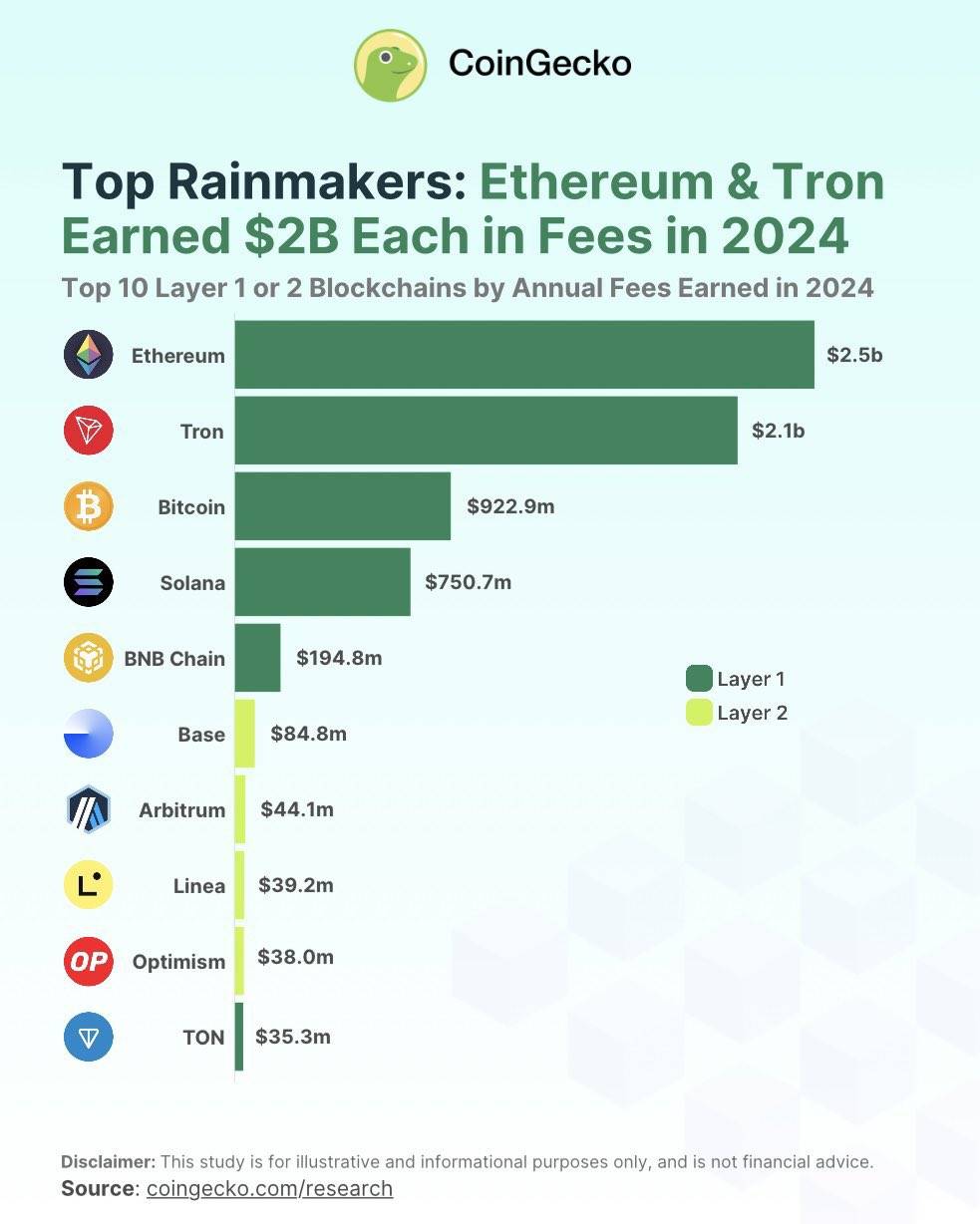
Protocol fee revenue remains one of the key metrics for measuring a blockchain's activity, value capture, and ecosystem health. Recently, CoinGecko released its 2024 Top 10 ranking of L1 and L2 protocol fee revenues, with Ethereum and Tron securing first and second place respectively, each surpassing $2 billion in fees. This translates to Ethereum earning an average of $6.79 million per day, while Tron earns $5.89 million daily.
Solana’s fee income reached $700 million. TON, once highly popular, has cooled significantly, generating only $35 million in revenue last year. BNB Chain performed modestly, collecting nearly $200 million in fees. Bitcoin’s fee income amounted to $920 million.
In the L2 category, Base took a clear lead, topping the list with nearly $85 million in protocol fees—surpassing the combined total of Arbitrum and Optimism (OP).
Ethereum’s Protocol Revenue Rises, But Price Lags Behind Expectations
Chain fee revenue typically comes from multiple sources, including transaction fees, smart contract execution fees, indirect block rewards, MEV-related income, cross-chain bridge and asset transfer fees, on-chain storage fees, token burn mechanisms, governance fees, and more.
Since the Cancun upgrade, Ethereum has significantly reduced L2 transaction costs and boosted their development. However, this benefit hasn’t translated into a noticeable improvement in Ethereum’s own revenue—almost a case of “sacrificing self for the greater good.” In 2023, Ethereum generated $2.41 billion in protocol revenue; in 2024, that figure grew by just 3%. Ethereum earned $1.17 billion in the first quarter alone—nearly half of its annual total. While the numbers show growth, given the broader market upswing and high expectations, the fee performance remains underwhelming.
This sluggish data is directly reflected in ETH’s price, which oscillated around $3,000 for much of the past year. The prolonged stagnation has led to widespread dissatisfaction and criticism within the community, placing Vitalik Buterin and the Ethereum Foundation under intense public scrutiny.
The revenue performance of various Ethereum L2s has also been relatively mediocre, with Base standing out as one of the few bright spots. Its success stems largely from capitalizing on the meme coin wave. In 2024, Base saw the emergence of AI-themed tokens like VIRTUAL/AIXBT and meme coins such as DEGEN, delivering wealth effects far exceeding those on Arbitrum and OP. Although it still lags behind Solana, Base’s potential cannot be ignored.
However, even when Layer-2 protocols generate profits, the benefits do not necessarily flow back to Ethereum. Take Base: most of its network fees have turned into Coinbase’s profits, with very little flowing back to the Ethereum mainnet. On an annualized basis, Coinbase earns close to $100 million from Base.
With weak monetization on the L1, whether L2s can truly serve as Ethereum’s “supersonic missile” remains questionable.
Tron and Solana Achieve Breakouts Through Single-Point Focus
As a stablecoin-focused blockchain, Tron’s protocol fee revenue surged from $922.08 million in 2023 to $2.15 billion in 2024. Stablecoin-related fees, the primary contributor, rose from $38.36 million in January 2023 to a peak of $342.54 million in December 2024—an almost tenfold increase.
Solana also delivered impressive results, with fee revenue skyrocketing from $25.55 million in 2023 to $750.65 million in 2024—a nearly 30-fold increase, far outpacing competitors. Solana’s fees primarily come from transaction fees and priority fees (for front-running transactions). The reason is obvious: since last year, meme coins and AI-themed tokens on Solana have exploded in popularity, drawing massive user interest chasing speculative gains.
Taking Pump.fun—the primary token launch platform on Solana—as an example, its cumulative revenue has already exceeded $400 million. Raydium, a key meme liquidity infrastructure, achieved an annualized revenue of $363 million. Over the past three months alone, fee growth exceeded 370%, and revenue growth surpassed 260%.
BTC benefited from the 2024 ordinals boom, with annual fee income rising 15.9%. Meanwhile, TON experienced its peak moment in the first half of 2024, driven by “play-to-earn” gaming.
Conclusion
Looking back at annual fee revenues, it’s clear that the chains with the strongest performance were those that seized their moment. The stagnation of L2s, DeFi, and NFTs failed to propel Ethereum forward, while the two biggest trends of the cycle—meme coins and AI-themed tokens—gave Solana a golden opportunity to shine. Tron, meanwhile, rode the wave of stablecoin inflows to achieve significant revenue growth.
Yet some trends fade quickly—and sometimes never return—casting doubt on the sustainability of future fee income. After the decline of the 2024 ordinals trend and TON’s gaming ecosystem, neither has shown signs of recovery. Once these temporary revenue streams dry up, the real challenge lies in planning the next phase of development.
Catching opportunities when they arise is crucial. But without adequate preparation, even golden chances may be missed. If Solana continues to suffer frequent outages and poor wallet user experiences, it might not get lucky again. Conversely, if Ethereum can swiftly resolve its scalability issues, meme-driven momentum could shift to its ecosystem, enabling a long-awaited comeback.
Join TechFlow official community to stay tuned
Telegram:https://t.me/TechFlowDaily
X (Twitter):https://x.com/TechFlowPost
X (Twitter) EN:https://x.com/BlockFlow_News
 Foresight News