AI is Crypto's Agent: The Evolution of AI Agents
TechFlow Selected TechFlow Selected
AI is Crypto's Agent: The Evolution of AI Agents
AI is the agent of crypto—this is the best interpretation of the current AI surge from a crypto-centric perspective.
 Navigating Web3 tides with focused insights
By Zuo Ye
A work of art is never completed, only abandoned.
Everyone is talking about AI Agents, but they're not referring to the same thing. This leads to a disconnect between what we mean by AI Agent, the public's understanding, and how AI practitioners view it.
Some time ago, I wrote Crypto Is the Illusion of AI. Since then, the convergence of Crypto and AI has remained one-sided: AI practitioners rarely mention Web3 or blockchain, while those in Crypto remain deeply infatuated with AI. After witnessing even AI Agent frameworks being tokenized, I wonder if we can finally draw real AI experts into our world.
AI serves as Crypto’s agent—a perfect interpretation of this AI frenzy from a crypto-centric perspective. The crypto community's enthusiasm for AI differs from other industries because we are particularly eager to integrate financial asset issuance and operations with AI.
Agent Evolution: Origins Beneath the Hype
At its core, the concept of AI Agent stems from at least three distinct lineages. OpenAI has positioned AGI (Artificial General Intelligence) as a critical milestone, elevating "Agent" into a buzzword that transcends technical definitions. Yet fundamentally, Agent is not a new idea—even when enhanced by AI, it hardly qualifies as a revolutionary technological trend.
First, there’s the OpenAI vision of AI Agent—akin to Level 3 autonomy in self-driving cars. An AI Agent here possesses advanced assistive capabilities but still cannot fully replace humans.
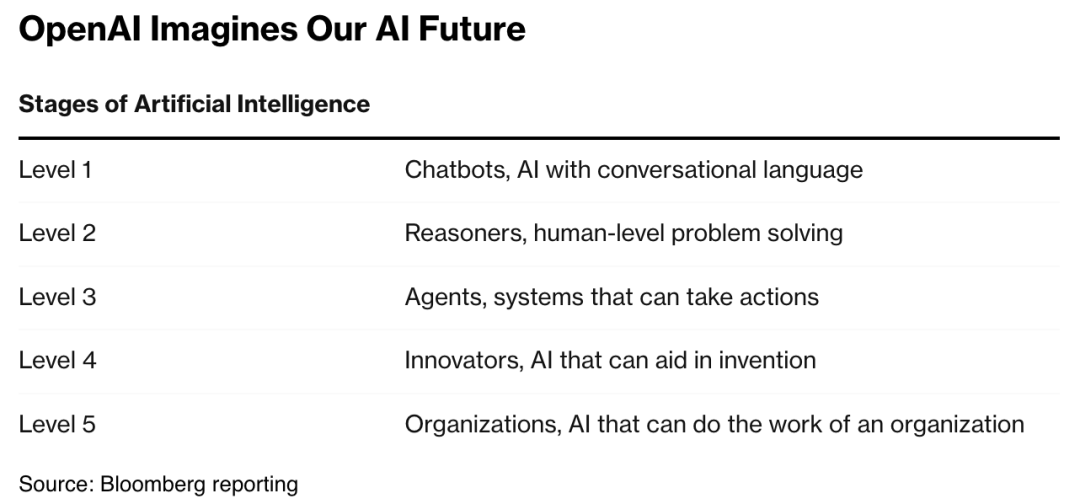
Caption: OpenAI's roadmap toward AGI. Source: https://www.bloomberg.com/
Second, literally speaking, an AI Agent is an Agent empowered by AI. The concept of agents and delegation mechanisms is nothing new in computing. Under OpenAI’s framework, Agent represents the next stage after conversational interfaces (ChatGPT) and reasoning bots—a phase characterized by “autonomous action.” Or, as LangChain founder Harrison Chase defines it: "An AI Agent is a system where LLMs make control flow decisions in programs."
This is precisely where it gets interesting. Before LLMs, Agents executed pre-programmed automation routines. For example, programmers designing web crawlers would set User-Agent headers to mimic specific browser versions or operating systems. With AI Agents, such behavior could be mimicked far more intricately—resulting in AI-powered crawler frameworks that behave even more like real users.
In this evolution, AI Agents must integrate with existing use cases; entirely novel domains are nearly nonexistent. Even tools like Cursor or GitHub Copilot—which offer code completion and generation—are essentially enhancements built atop established paradigms like LSP (Language Server Protocol). Many similar examples exist:
-
Apple: AppleScript → Alfred → Siri → Shortcuts → Apple Intelligence
-
Terminal: Terminal (macOS)/PowerShell (Windows) → iTerm 2 → Warp (AI Native)
-
Human-Computer Interaction: Web 1.0 CLI TCP/IP Netscape Browser → Web 2.0 GUI/RestAPI/Search Engines/Google/Super Apps → Web 3.0 AI Agent + dApp?
To clarify: In human-computer interaction, the combination of GUI and browsers made computers truly accessible to the masses—epitomized by Windows + IE. APIs became the standard for data abstraction and transmission behind the internet. By Web 2.0, browsers evolved into Chrome-era tools, and the shift to mobile reshaped how people used the internet. Super-apps like WeChat and Meta covered nearly every aspect of daily life.
Third, within Crypto, the concept of “intent” preceded the explosion of interest in AI Agents. However, this relevance is limited to internal crypto discourse. From Bitcoin’s limited scripting to Ethereum’s smart contracts, these already represent broad applications of Agent-like logic. Cross-chain bridges, chain abstraction, EOA to AA wallets—all are natural extensions of this thinking. Thus, when AI Agents “invade” Crypto, their application in DeFi scenarios becomes inevitable.
This is where confusion arises. In Crypto contexts, we often envision Agents capable of “automated investing” or “auto-farming Meme coins.” But under OpenAI’s definition, such high-risk tasks would require L4/L5-level capabilities. Meanwhile, mainstream users play with features like auto-code generation or AI-powered summarization and ghostwriting. These conversations happen on entirely different levels.
Understanding what we actually want allows us to focus on the organizational logic of AI Agents, with technical details playing a secondary role. After all, the very idea of Agent abstracts technology away from barriers to mass adoption—much like how browsers unlocked personal computing. Our focus will thus center on two aspects: viewing AI Agents through the lens of human-computer interaction, and clarifying the relationship between AI Agents and LLMs—leading into the final section: What will endure from the fusion of Crypto and AI Agents?
let AI_Agent = LLM + API;
Prior to conversational interfaces like ChatGPT, human-computer interaction primarily occurred via GUI (Graphical User Interface) and CLI (Command-Line Interface). GUI evolved into browsers and apps, while CLI paired with Shell saw little change.
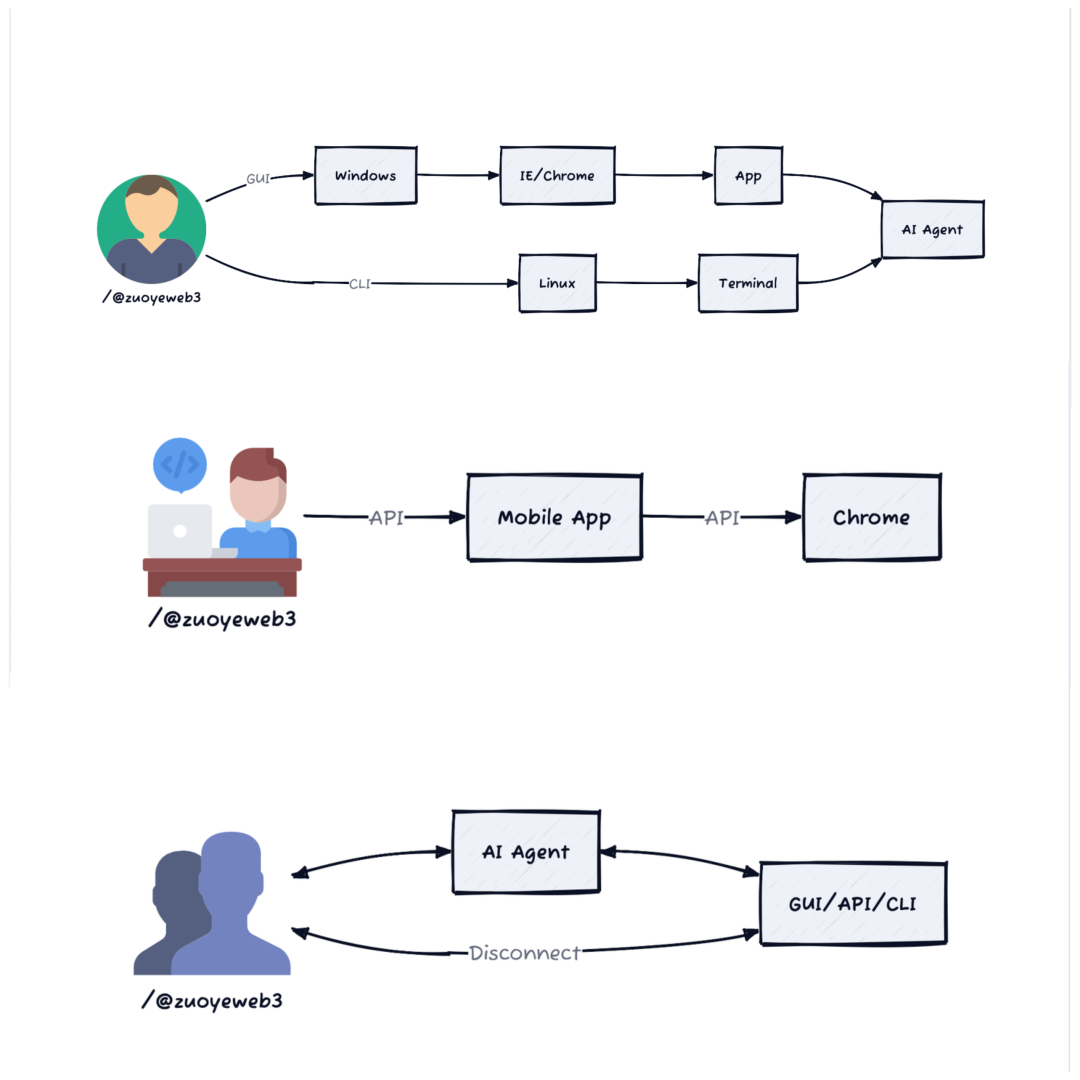
But this is only the “front-end” layer of interaction. As the internet matured, increasing data volume and diversity led to growing “back-end” interactions between data sources and applications—interactions that support and depend on front-end experiences. Even simple web browsing requires seamless coordination between both layers.
If user interaction with browsers and apps constitutes the entry point, then API connections and transitions power the actual operation of the internet. This too is part of Agent functionality—users achieve goals without needing to understand terms like command lines or APIs.
LLMs follow a similar path. Now, users don’t even need search engines. The process unfolds as follows:
-
User opens a chat interface;
-
User describes needs using natural language—text or voice;
-
LLM parses the input into procedural steps;
-
LLM returns results to the user.
Unsurprisingly, Google faces the greatest disruption—users no longer open search engines but instead turn to GPT-like chat windows. Traffic gateways are quietly shifting, fueling claims that this wave of LLMs spells the end of traditional search engines.
So where do AI Agents fit in?
In short: AI Agent is a specialization of LLM.
Current LLMs are not AGIs—the idealized L5 orchestrators envisioned by OpenAI. Their abilities remain constrained. For instance, excessive user input can easily trigger hallucinations. One key reason lies in training mechanisms: if you repeatedly tell GPT that 1+1=3, there's a chance it might answer 1+1+1=? with 4 in subsequent interactions.
Since GPT’s feedback comes solely from individual users, an offline model could be corrupted by such misinformation, becoming a “dumb” version that believes 1+1=3. But if the model connects to the internet, its responses become more diverse and grounded—after all, most online sources affirm that 1+1=2.
Now consider running LLMs locally—how can we avoid such issues?
A crude solution involves using two LLMs simultaneously, requiring them to cross-validate each response to reduce errors. Alternatively, assign two roles per task—one asking questions, another refining them—to promote clearer, more rational phrasing.
Sometimes, even internet access doesn't fully prevent problems—imagine an LLM retrieving answers from a forum full of nonsense. Filtering out such content reduces available data. A better approach is to restructure existing datasets or generate synthetic data based on reliable sources to improve response accuracy. This is essentially the principle behind RAG (Retrieval-Augmented Generation) in natural language understanding.
Humans and machines must understand each other. When multiple LLMs collaborate and interpret inputs together, we begin approaching the operational mode of AI Agents—where a human proxy invokes external resources, including large models and other Agents.
Thus, we grasp the connection between LLMs and AI Agents: LLMs aggregate knowledge, enabling dialogue through chat interfaces. But in practice, certain workflows can be encapsulated into mini-programs, bots, or instruction sets—these we define as Agents.
AI Agents remain part of the broader LLM ecosystem—they are not equivalent. What distinguishes AI Agents is their emphasis on coordinating with external programs, LLMs, and other Agents. Hence the expression: AI Agent = LLM + API.
We can now revise the LLM workflow to include AI Agents. Take calling an API from platform X as an example:
-
User opens a chat window;
-
User describes needs in natural language (text or speech);
-
LLM interprets the request as an API-calling AI Agent task and transfers control to this Agent;
-
The AI Agent asks the user for X account credentials and API keys, then communicates with X over the network;
-
The AI Agent returns the final result to the user.
Recall the evolution of human-computer interaction? The browsers and APIs of Web 1.0 and Web 2.0 still exist—but users can now ignore them entirely, interacting solely with AI Agents. Processes like API calls become conversational. These services can be any type—local data, online information, or third-party app data—as long as interfaces are open and users have permission.
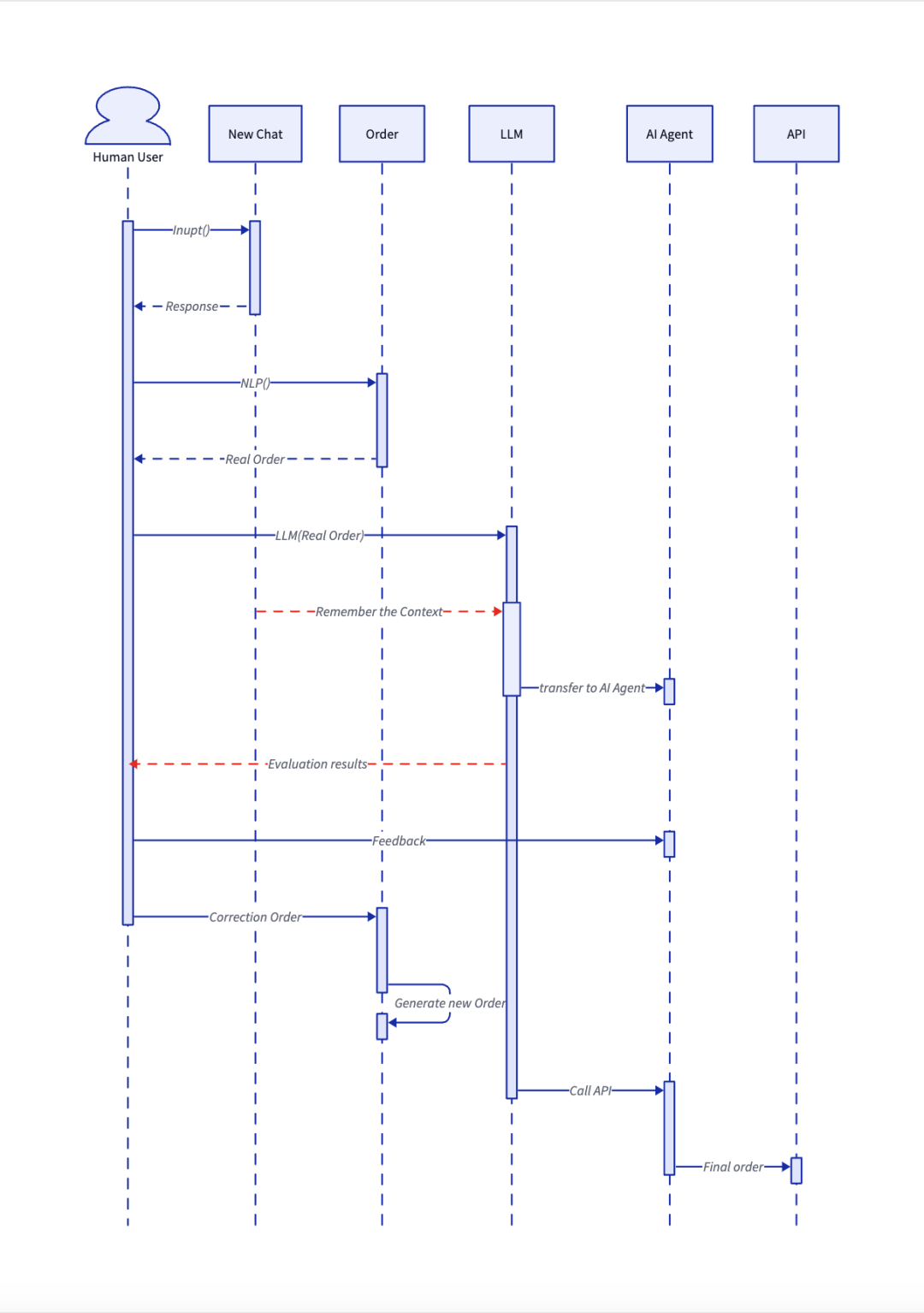
A complete AI Agent workflow looks like the diagram above. The LLM may appear separate from the Agent or serve as one phase within a larger process—but regardless of division, both serve user needs.
From a human-computer interaction standpoint, it's almost as if the user is dialoguing with themselves. You simply express your thoughts freely, and AI/LLM/AI Agent iteratively guesses your intent. Feedback loops and context memory ensure the Agent doesn’t suddenly forget what it was doing.
In essence, AI Agents are more personified than traditional scripts or automation tools—their defining difference. Like a personal butler anticipating your real needs. But crucially, this personality remains probabilistic. L3-level AI Agents lack true human comprehension and expressive ability, making their integration with external APIs inherently risky.
After AI Frameworks Get Monetized
The monetization of AI frameworks is a major reason I remain interested in Crypto. In traditional AI tech stacks, frameworks aren’t particularly valuable—certainly less so than data and compute power. And monetizing AI products rarely starts with the framework, since most AI algorithms and model frameworks are open source. What stays closed are sensitive assets like data.
Fundamentally, AI frameworks or models are containers combining various algorithms—like the iron pot in “iron-pot stewed goose.” But the taste depends on the goose breed and cooking technique. You should be selling the goose, yet Web3 customers arrive wanting to buy the pot and leave the goose behind.
The reason isn’t complicated: Most Web3 AI products are derivative, merely tweaking existing AI frameworks, algorithms, and tools. Often, the underlying tech across different Crypto AI frameworks is nearly identical. With no technical differentiation possible, branding and use-case narratives become paramount. Thus, minor tweaks to AI frameworks become justification for entirely new tokens—creating a bubble around Crypto-based AI Agent frameworks.
When you don’t need to invest heavily in training data or algorithms, naming distinctions become especially valuable. DeepSeek V3 may be affordable, but it still demands PhD-level expertise, GPUs, and massive electricity consumption.
In a sense, this reflects Web3’s recent pattern: the token issuance platform is more valuable than the token itself. Pump.Fun and Hyperliquid exemplify this. Agents should be applications or assets, yet Agent issuance frameworks have become the hottest products.
It’s also a form of value anchoring. If individual Agents lack differentiation, perhaps the framework offers more stability—and can create a value-siphoning effect for asset issuance. This is currently the 1.0 version of Crypto meeting AI Agent.
But the 2.0 version is emerging—exemplified by the fusion of DeFi and AI Agents. The rise of DeFAI is obviously market-driven hype, but consider these developments:
-
Morpho is challenging legacy lending protocols like Aave;
-
Hyperliquid is replacing dYdX in on-chain derivatives and even challenging Binance’s CEX listing power;
-
Stablecoins are becoming payment tools in off-chain scenarios.
Against this backdrop of DeFi transformation, AI is reshaping DeFi’s foundational logic. If DeFi’s original breakthrough was proving smart contract viability, AI Agents now transform how DeFi products are created. You no longer need to understand DeFi to build DeFi—this goes beyond chain abstraction, offering deeper empowerment.
The era where everyone can be a programmer is arriving. Complex computations can be outsourced to LLMs and APIs behind AI Agents, leaving individuals to focus purely on ideas. Natural language becomes efficiently translatable into programming logic.
Conclusion
This article mentions no specific Crypto AI Agent tokens or frameworks, because Cookie.Fun already does an excellent job. First come AI Agent information aggregators and token discovery platforms, then AI Agent frameworks, and lastly the fleeting Agent tokens. Listing such information here would add little value.
Yet after careful observation, the market still lacks meaningful discussion on what Crypto AI Agents truly aim to achieve. We must move beyond discussing pointers—the real change lies in memory manipulation.
And it is precisely this relentless drive to tokenize every conceivable asset that gives Crypto its enduring appeal.
Join TechFlow official community to stay tuned
Telegram:https://t.me/TechFlowDaily
X (Twitter):https://x.com/TechFlowPost
X (Twitter) EN:https://x.com/BlockFlow_News
 @zuoyeweb3