The turning point has arrived amid TikTok's head-on confrontation
TechFlow Selected TechFlow Selected
The turning point has arrived amid TikTok's head-on confrontation
Whether TikTok survives or not, it will bring significant changes to the global internet.
 Navigating Web3 tides with focused insights
By Lian Ran
Edited by Zheng Xuan
Source: GeekPark
This could be the first time in human business history that a company with 170 million users and a valuation of tens of billions of dollars chooses "give me liberty, or give me death."
On January 15, it was reported that TikTok is preparing to shut down its U.S. service immediately on Sunday unless the Supreme Court intervenes to block the "sell-or-ban" order.
According to reports, under this plan, when users attempt to open TikTok, they will see a pop-up message directing them to visit a website for details about the ban. At the same time, TikTok will provide a data download option allowing users to save their personal information.
If implemented, this decision would mark a pivotal moment—from continuous resistance to having no way forward—where TikTok ultimately stands firm, “a hero in life, a legend in death.”
But there may still be hope. The latest news from China Central Television (CCTV) states that insiders have revealed the Biden administration is considering how to allow TikTok to continue operating in the United States, with officials actively “exploring options” to implement the law so that TikTok won’t be banned this Sunday.
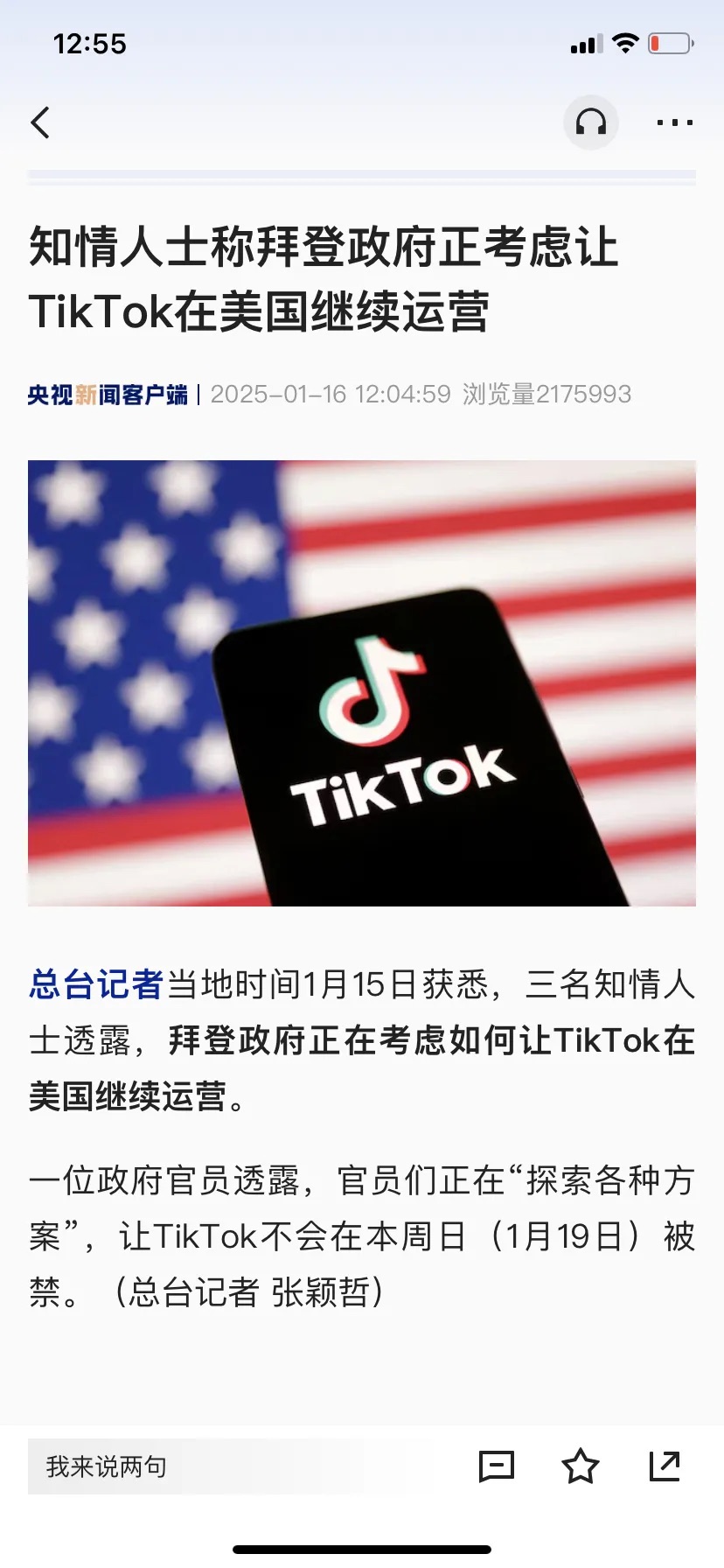
Image source: CCTV News
Since the U.S. government initiated national security reviews in 2019, TikTok has faced relentless pressure.
As the deadline for the "sell-or-ban" mandate approaches, TikTok is willing to take decisive action—shutting down the app entirely—to force all users to confront the impact of the ban head-on. This choice undoubtedly places the world’s largest short-video platform at an unprecedented crossroads.
With only three days left on the countdown, whether last-minute reprieve emerges or not, TikTok's persistence has already demonstrated remarkable resilience and a steadfast defense of its own value.
The story of TikTok is no longer just a simple narrative about how a tech company responds to political and commercial pressures; it has become a microcosm of complex interactions among nations, corporations, and users within the context of globalization.
Just as when it first emerged years ago, TikTok has transcended its identity as merely a short-video platform and become a significant player in global competition.
Now, standing at a life-or-death juncture, TikTok is clearly not acting solely out of commercial interest, but making a historically significant choice of “resilience”—a stance of defiance against power and refusal to easily compromise. Such an attitude might profoundly influence the future landscape of the tech industry’s engagement overseas.
01 TikTok Has Nowhere Else to Retreat
In the past two days, Xiaohongshu (Little Red Book) has been flooded by foreigners. Chinese and international netizens are interacting joyfully on this app, creating a surface-level boom in internet activity. Yet behind this seemingly prosperous digital scene lies a rare and critical moment quietly approaching in business history.
A company with up to 170 million users and a market value in the tens of billions of dollars in the United States now stands at an unprecedented brink of survival—a situation likely unmatched in commercial history.
Last April, the U.S. Congress passed legislation mandating either a ban or forcing ByteDance, TikTok’s parent company, to sell off TikTok. After being signed into law by President Biden, this bill marked the most severe threat yet to TikTok’s fate—TikTok would be banned in the U.S. on January 19 this year unless it severed ties with its Chinese parent company, ByteDance.
However, we know this pressure campaign began back in November 2019, when the U.S. government launched a national security review over ByteDance’s acquisition of Musical.ly, focusing particularly on user data handling and storage practices.
In the following months, the U.S. Senate held multiple hearings pushing for legislative bans on TikTok. By August 2020, then-President Trump signed executive orders requiring TikTok to divest its U.S. operations within 90 days and imposing various restrictive measures. Although these bans did not take immediate effect, the Committee on Foreign Investment in the United States (CFIUS) subsequently launched even stricter scrutiny over TikTok.
In June 2021, while the Biden administration rescinded Trump-era bans, the actual pressure and restrictions intensified further.
TikTok has previously attempted numerous initiatives to resolve concerns: establishing a Transparency and Accountability Center; forming a content advisory council; setting up a dedicated U.S. Data Security Company (USDS) responsible for managing American user data; launching the "Clover" data isolation project and the "Texas" data security initiative—each costing approximately $1 billion annually; hiring executives with U.S. backgrounds; and reaching an agreement with Oracle, which became TikTok’s “trusted technology provider” in the U.S., gaining rights to conduct security audits of TikTok’s U.S. source code.
All these efforts—as well as subsequent campaigns to oppose the legislation, including urging users to contact congressional representatives and running ads shortly before final votes highlighting TikTok’s data security investments—ultimately failed after the U.S. Congress passed the bill.
Yet TikTok hasn't ceased fighting. In May last year, TikTok and its parent company ByteDance filed a lawsuit in a U.S. federal court, seeking to declare the *Protecting Americans from Foreign Adversary Controlled Applications Act* unconstitutional and requesting its overturn.
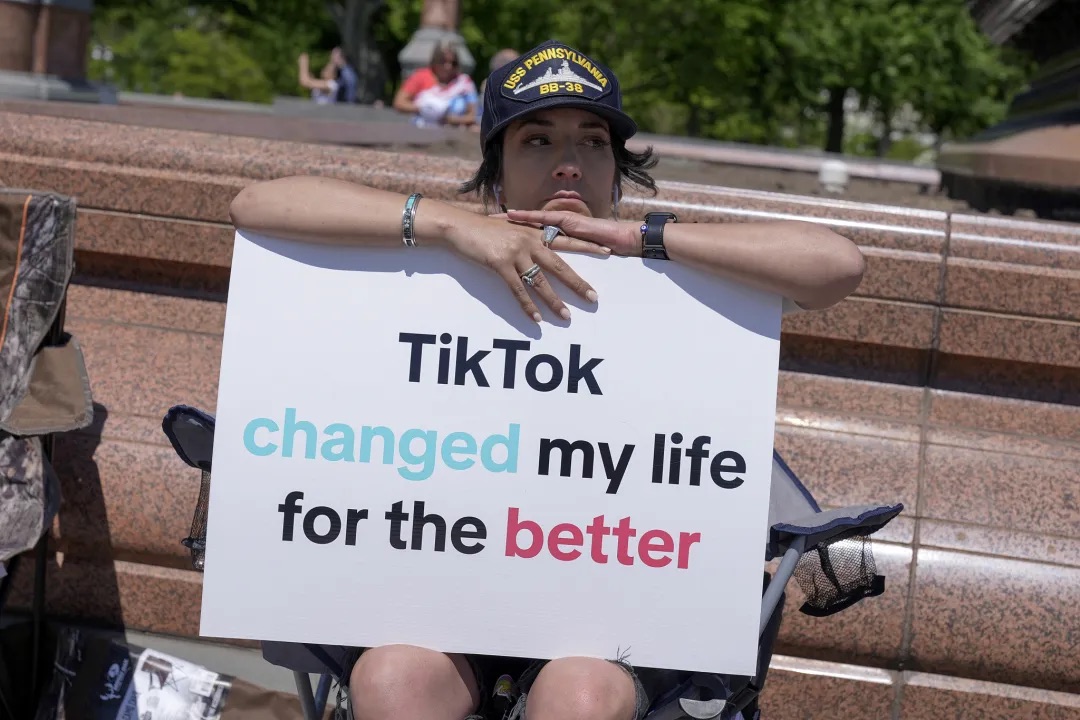
Image source: Visual China
In September, TikTok and its creators’ lawsuit against the U.S. government was formally heard at the U.S. Court of Appeals for the District of Columbia Circuit. TikTok and ByteDance argued that the required “qualified asset divestiture” was impossible to achieve commercially, technically, and legally within the mandated 270-day period. Even if such a conditional sale were feasible, they contended it fundamentally violated constitutional protections for freedom of speech and individual liberties.
In December, the U.S. federal appeals court rejected TikTok’s appeal, upholding the order requiring ByteDance to divest TikTok’s U.S. operations.
Having fought tirelessly along the way, TikTok now finds itself with no room to retreat—perhaps only by going all-in on resistance can there remain any chance of reversal.
Meanwhile, reports indicate that President-elect Donald Trump is reportedly considering issuing an executive order to delay enforcement of the ban by 60 to 90 days. His term begins the day after the ban takes effect, though media reports do not clarify how Trump intends to legally justify such a move.
Additionally, last week, Massachusetts Senator Edward Markey delivered remarks in the Senate and livestreamed them on TikTok. He announced plans to introduce legislation extending the "sell-or-ban" deadline by another 270 days, arguing that enforcing the ban would severely damage American social and cultural ecosystems, depriving millions of Americans of their means of expression and significantly impacting those who rely on the platform for social connection and livelihoods.
But the final deadline looms—only three days remain. Will anything change?
02 Could a Window Open Between Chinese and American Internet Worlds?
Will TikTok shut down outright, keep operating, or receive a temporary stay awaiting Trump’s return to office? Its fate in the U.S. will be decided in three days.
But from today’s vantage point—and especially observing the dramatic events unfolding on Xiaohongshu—we can already begin reflecting on what comes next for the internet worlds of China and the U.S. once TikTok’s fate is sealed.
First, one thing is certain: the idea that Douyin will open international registration after a TikTok ban, prompting American TikTok users to flock en masse to seek refuge in domestic Chinese apps, is largely baseless speculation.
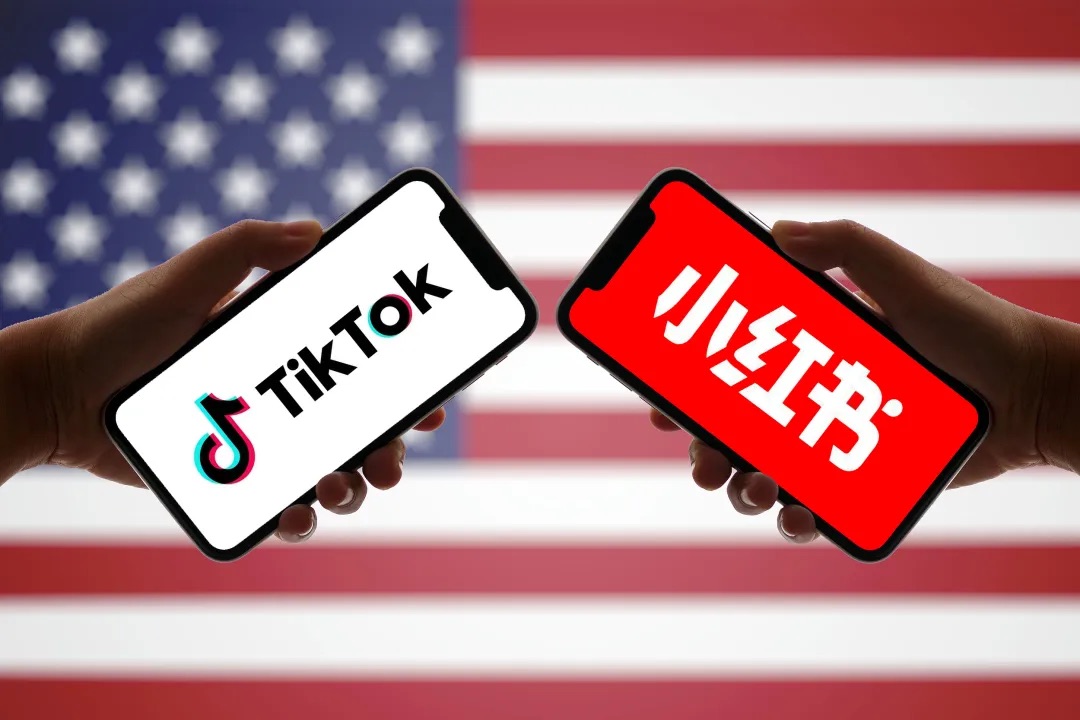
Image source: Visual China
Starting January 15, many videos posted on Douyin showed IP locations in the U.S., UK, Russia, Thailand, and other countries, while the phone number registration page began listing country codes from around the world.
Nonetheless, this does not mean Douyin has opened overseas IP registration. ByteDance has not directly confirmed whether foreign users can now register, while Liang Liang from the Douyin Group responded on Weibo: “Overseas IPs don’t necessarily mean overseas registered users. Moreover, we’ve noticed many people taking advantage of the situation—reposting videos and impersonating foreign users, especially black-market groups trying to gain followers and farm accounts. These fake foreign-user accounts are somewhat difficult to identify, but we’re actively cracking down—we’ve already dealt with more than 10,000 such fraudulent accounts.”
In other words, many of the foreign-looking videos currently appearing on Douyin may actually be reposts from abroad or created domestically by black-market teams using fake identities.
Even ignoring potential regulatory hurdles both domestically and internationally regarding foreign users registering on Chinese platforms, integrating foreign creators and users into Chinese internet communities like Douyin and Xiaohongshu remains a major challenge.
Clearly, Xiaohongshu isn’t ready for globalization. One telling example: unlike global platforms such as X, Instagram, or TikTok, Xiaohongshu currently lacks built-in translation features. With large numbers of overseas users flooding in, cross-border comments still depend on Chinese users writing in English or relying on external translators. Of course, this isn’t a complex technical problem—in today’s AI-driven infrastructure environment, high-quality multilingual translation is readily achievable, and if needed, Xiaohongshu’s product team could roll out such functionality quickly.
The deeper challenge lies in how to operate and engage international users on platforms primarily designed for domestic communities.
The initial motivation for overseas users coming to Xiaohongshu “for refuge” is mostly opposition to TikTok’s potential ban. Their joyful interaction with local users often stems from the novelty of engaging with real Chinese netizens for the first time. The core feature of Xiaohongshu is “sharing authentic life,” albeit sometimes slightly more polished than reality—but for Sino-American users, over 95% of whom have never visited each other’s countries, such exchanges are inherently fresh and exciting.
Whether sharing food, scenery, pets, helping with English homework, or playing international memes like “you show me F-22 cockpit footage, I’ll find you sixth-gen fighter designs,” these genuine interactions offer something novel for both sides.
But for long-term community sustainability, novelty alone cannot maintain engagement. Much like how some foreigners visit China after visa-free policies were introduced, Xiaohongshu has temporarily become a cyber tourist destination for some Americans.
Once the novelty fades, the key will be enabling overseas users to truly “live” here—using the platform daily, consuming content regularly, and encouraging overseas creators to post consistently and earn income. Like every successful global product before it, Xiaohongshu must segment users by region, build localized operations, and develop commercialization systems—an endeavor no different from what ByteDance once did globally, and one that will also require competing directly with Lemon8, Instagram, and similar platforms.
Still, even if it fails to fully replace foreign counterparts, Xiaohongshu could carve out value in specific niches—such as offering overseas audiences a window into real-life China. It may leverage this moment to unlock new possibilities.
In fact, just as international students once used Xiaohongshu as a guide for studying abroad, amidst the current wave of cross-border interaction, practical exchanges beyond mere excitement are emerging. Chinese users help foreigners plan trips to China with detailed travel and food guides; native English speakers assist Chinese students with grammar lessons. This kind of genuinely useful utility has always been the foundation of Xiaohongshu’s community. Combined with the current momentum, this could become the starting point for Xiaohongshu’s international breakthrough.
Regardless, the far-reaching impact of TikTok extends far beyond product-level implications. After January 19, answers will gradually emerge, and the challenges and opportunities triggered by this event will undoubtedly become important topics shaping our thinking for years to come.
Join TechFlow official community to stay tuned
Telegram:https://t.me/TechFlowDaily
X (Twitter):https://x.com/TechFlowPost
X (Twitter) EN:https://x.com/BlockFlow_News
 极客公园
极客公园