How should TikTok, as a Web3 new investment platform, implement operational strategies to achieve growth?
TechFlow Selected TechFlow Selected
How should TikTok, as a Web3 new investment platform, implement operational strategies to achieve growth?
The core of traffic投放 is optimizing key metrics such as views, likes, comments, and completion rate.
 Navigating Web3 tides with focused insights
Author: SunnyZ
In my previous article, I mentioned that I would share insights on TikTok (hereafter referred to as "TK") operations and paid promotion because there has been an overwhelming number of project collaborations coming my way lately. Frankly speaking, the traditional Web3 playbook—task platforms, PR partnerships, AMAs, or KOL promotions—is no longer sufficient. The TON ecosystem's user exchange model has hit a bottleneck, making TikTok, the largest traffic pool available, a strategic battleground for growth. Leveraging TK’s KOLs effectively can sometimes yield far better conversion results than Twitter. To this day, TK remains a massive untapped traffic opportunity. Personally, I believe this year marks the beginning of the integration between Web3 and TikTok. Missing out on this wave likely means missing the next major surge in new user acquisition. Let’s dive into how to operate accounts and deploy strategies to capture this traffic.
Two Key Characteristics of Traffic
Today’s TikTok is equivalent to Kuaishou in 2019. Regarding traffic precision, video data on TK is still insufficient, meaning hashtag systems for creators are not yet mature. Moreover, TK’s content distribution mechanism differs from Douyin’s—it doesn’t prioritize pushing content to private follower pools first but instead pushes directly into shared public pools. As such, when we search for cross-border influencers, the concept of “niche-specific influencers” remains largely theoretical at this stage. In driving traffic conversion, it’s essential to understand two core characteristics of TikTok traffic: precision and immediacy.
1. Precision
We know that in the conversion funnel, traffic must come before conversion. Before considering how to convert users, two questions need answering: how to acquire traffic, and more importantly, how to acquire *precise* traffic. From a precision standpoint, traffic falls into two categories: targeted and non-targeted. Acquiring general traffic isn’t the hardest part—the real challenge lies in attracting precise audiences, which is critical for closing the loop. For most promotional campaigns, precise traffic can be thousands or even tens of thousands of times more valuable than untargeted traffic. When running TK ads or influencer campaigns, Web3 projects should focus on identifying niche-relevant KOLs—even if their follower count is modest—if they deliver strong conversions, you can “spend small to appear big.”
2. Immediacy
Traffic on TikTok is fleeting. Once a video is pushed out to users, they typically only see it during that initial push moment—this is the only time “traffic passes by our video.” The likelihood of users revisiting the same video later is negligible. Thus, the value of system-driven traffic exists solely during that brief window. No matter how many followers a TK account has or how high a short video’s view count climbs, once that traffic wave passes, those numbers become meaningless.
To achieve conversion within TikTok’s vast traffic pool, we must address these two characteristics strategically:
First, learn to filter traffic. Given the importance of precision, mastering traffic filtering is essential for every TK operator. During content distribution, TikTok allocates videos based on content type to relevant users. Therefore, the key method of filtering traffic is optimizing content. Various tools exist for this purpose—language, cultural references, music, etc.—which help control who sees your content. For example, if targeting Thailand, including Thai text in the video significantly increases the chance of filtering out irrelevant regional viewers.
Second, prepare your conversion funnel in advance. Because traffic is immediate, the conversion infrastructure must be ready before traffic arrives—essentially preparing the “pool” to catch it. How can we capture incoming traffic? If aiming to complete a full token conversion journey within TK, influencers can pin a project’s token trading link in their bio, directing users to either a CEX or DEX. Conversion rates can then be tracked via unique referral links. TikTok always values future traffic; past traffic holds almost no residual value. No matter how impressive an influencer’s historical performance—10 million views on a single video—those metrics represent sunk costs. That traffic won’t return for future projects. Hence, from a traffic perspective, what matters is always the next wave.
So where does traffic come from?
TikTok short video traffic originates from multiple sources: recommendation feed, followers, profile visits, search queries, music trends, hashtags, etc. Among them, the most valuable source is undoubtedly the algorithmic recommendation feed—commonly known as the “For You” page. The higher the proportion of For You traffic, the better the platform judges the video quality, leading to amplified distribution and greater potential for virality. When evaluating whether a video’s traffic source is healthy, a general benchmark is that “For You” traffic should account for over 30%. Below this threshold, one should suspect shadowbanning or poor content alignment. [Data source: Sky]
Logic Behind TikTok’s Recommendation Algorithm
Before discussing TK account operation strategies, it’s crucial to understand how TikTok’s short video recommendation algorithm works. Everyone knows TK shows you content it thinks you’ll like—based on your behavior and preferences.
In summary, the core of paid promotion lies in optimizing key metrics: play count, likes, comments, and completion rate. At its heart, optimizing these metrics means improving content. High-quality content that resonates with audience preferences will naturally attract more traffic.
TikTok distributes video traffic progressively through tiered pools. In the first-tier pool, a video receives approximately 200–500 initial views. Upon posting, the platform exposes the video to this small group and evaluates engagement (likes, comments, shares) to assess popularity.
If feedback is positive, the video advances to the second-tier pool, reaching around 2,000 views. Strong performance here leads to entry into the third-tier pool, potentially generating 5,000 to over 10,000 views. This process continues until the video underperforms in a given pool, at which point recommendations halt.
Notably, the first-tier pool primarily targets users in the account’s region. For instance, if the account’s IP and data location are set to the U.S., the initial push focuses on American audiences. However, starting from the second-tier pool, geographic restrictions begin to fade, opening up access to global traffic.
Therefore, even if both the account and first-tier pool are U.S.-based, creating content tailored to Southeast Asian tastes allows the system to recommend it to global users interested in that culture—making it easier to capture traffic from Southeast Asia.
That said, remember: traffic inherently carries randomness. This unpredictability is common across all platforms. Our goal is to minimize randomness and turn uncertain outcomes into predictable probabilities.
Data feedback is key to optimization and iteration. Deep data analysis helps us uncover underlying patterns. In TK account management, analytics are indispensable—they allow deeper understanding of the platform and clearer optimization paths.
TK Influencer Collaboration
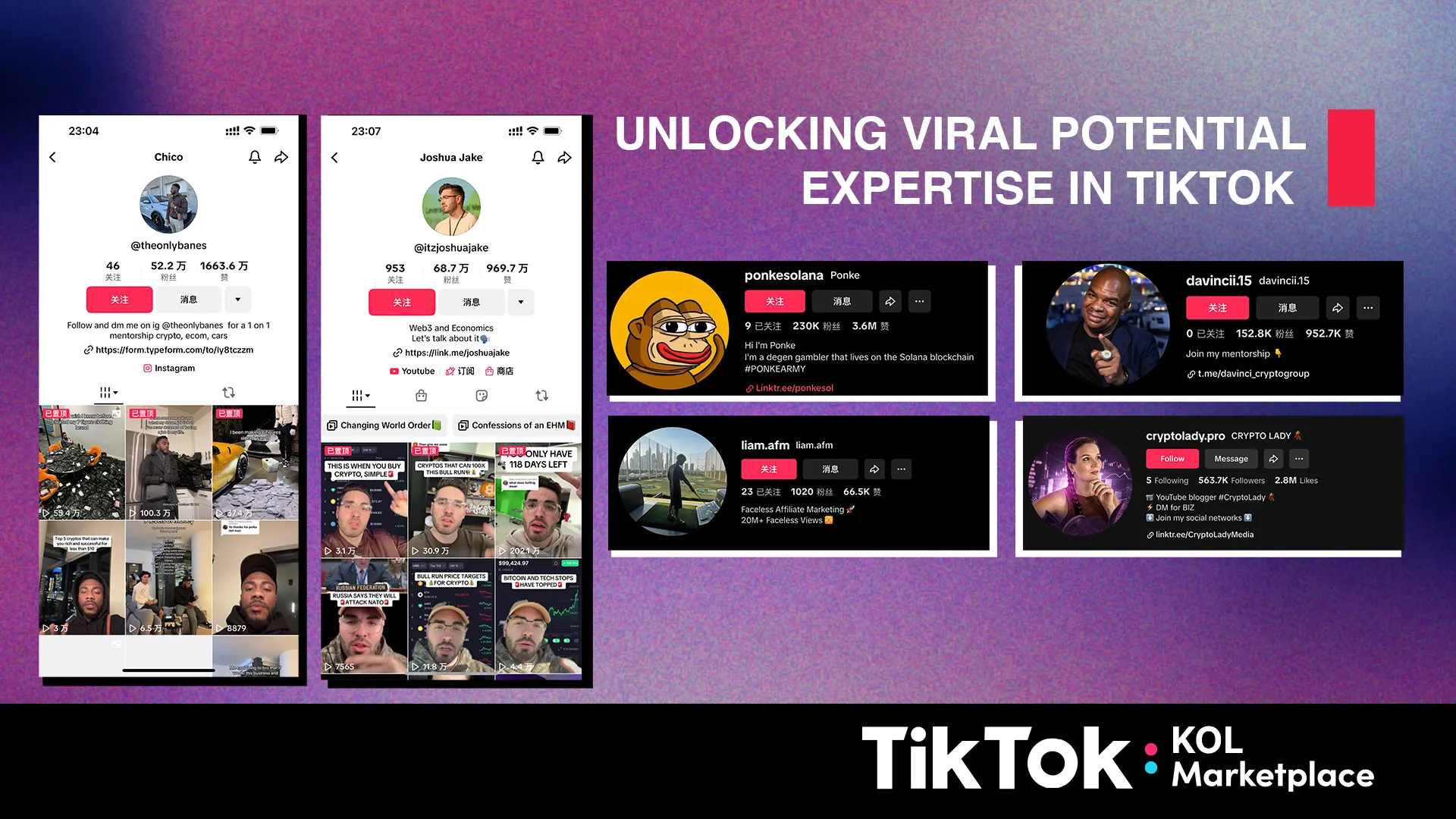
How to select KOLs? Many crypto-focused influencers have large followings but mediocre engagement metrics. Depending on your project strategy, different configurations work best. For major campaign launches, pairing 1–2 top-tier KOLs with several micro-influencers—and using well-chosen hashtags—can easily break through into broader visibility.
Another approach involves targeted blasting of a specific person’s following list—for example, if you know who the top female influencer follows, selecting KOLs from her network could be highly effective.
Where traffic flows, value follows. Since traffic acquisition environments are dynamic rather than static, consistently capturing traffic amid change is both vital and challenging.
The first step in influencer collaboration is identification. We should conduct preliminary screening based on target category, audience demographics, and marketing goals. Here are four primary methods:
1. Search directly via the TK app – One of the most basic yet effective ways is searching TikTok directly using keywords related to your product. After finding relevant videos, identify standout performers (e.g., those with significantly higher views than peers), then visit the creator’s profile to make contact. This method uncovers numerous influencers already established in your niche.
Creator profiles often include contact info: some provide direct business inquiry emails; others may leave landing page URLs where contact details can be found under “About Us” or “Contact Us.” Alternatively, leave a comment in the video section and wait for the influencer to respond.
2. Use TK Creator Marketplace for proactive outreach – More direct and accurate than organic searches, though currently fewer creators are listed on the marketplace.
3. Monitor influencers collaborating with competitors;
4. Partner with Crypto KOL MCNs, who are usually more professional and have closer relationships with creators;
Many projects enter collaborations without clarity—failing to define clear, measurable objectives beforehand. Before working with an influencer, clearly establish the campaign’s purpose: Is it brand awareness, fan growth, increased token trading volume, or acquiring high-quality users? Once the objective is defined, set quantifiable KPIs to evaluate success. Without measurable benchmarks, teams risk misaligned outcomes—such as boosting exposure while failing to increase sales—leading to inefficient efforts.
TK Data Analytics
In TK analytics, we focus on two types of metrics: video-level metrics and account-level metrics.
Video metrics include: completion rate, like rate, comment rate, share rate, traffic sources, total plays, total viewing duration, average watch time, viewer geography, and demographic breakdowns.
Account metrics include: follower-to-like ratio (fan-praise ratio), follower distribution, followings count, total followers, total likes, number of posted videos, date of first post, recent posting frequency, and gender distribution.
Analyzing these metrics enables comprehensive evaluation of any account—whether your own or a competitor’s.
Video Metrics
We now examine video-level indicators individually—what each reveals, standard benchmarks, and how to optimize accordingly. Note that different goals, formats, and niches produce varying data patterns. Some videos excel in likes, others in comments or shares. The standards shared below reflect general norms across most categories—adapt flexibly based on context.
Completion Rate
Completion rate measures the percentage of viewers who watched 100% of the video. It’s one of the most important video metrics and a key driver of overall reach. For Web3 projects, measuring how long users spend engaging with your content is crucial. On TK, completion rate strongly correlates with viewer time investment. A high completion rate signals audience interest, prompting the algorithm to perceive the content as high-quality and promote it further. Based on practical data, e-commerce benchmarks typically set 30% as the minimum acceptable completion rate. Anything below is considered subpar and requires immediate optimization. [Source: Sky]
From the viewer’s perspective, why might someone swipe away early? Common reasons include:
(1) The first three seconds lack impact. Viewer drop-off peaks in the opening moments, so review whether the hook is compelling enough and offers room for improvement.
(2) Revealing everything upfront. Knowing the importance of the first few seconds, some creators dump all key points and highlights immediately, leaving nothing to look forward to. With low anticipation, viewers naturally scroll past.
(3) Poor pacing. On TK, viewer patience per video is limited. If pacing drags or fails to engage the senses, attention fades. Especially for mid-to-long-form videos, maintaining strong rhythm and dense content ensures viewers feel every second spent was worthwhile. If completion rate falls below 30%, revisit these three areas for optimization.
Based on these principles, projects can assess whether an influencer’s follower count aligns with post engagement and like counts to identify truly effective promoters.
Like Rate
Like Rate = Total Likes / Total Plays.
While less impactful than completion rate, like rate still influences visibility and deserves optimization. A rate below 4% indicates room for improvement. Viewers tend to like videos in two scenarios:
(1) The video has收藏 value (note: “收藏” retained due to ambiguity). Many users quickly like and save useful videos to avoid losing them later. Enhancing practical utility encourages saves and repeat views.
(2) The content is entertaining. Humor or novelty drives likes—key factors in boosting like rates. If rates are low, focus on increasing entertainment value. This is where skilled, fluent-content creators shine.
Comment Rate
Comment Rate = Total Comments / Total Plays.
A comment rate below 0.4% suggests optimization opportunities. Here are three ways to boost comments:
Share Rate
Share Rate = Total Shares / Total Plays.
Just like on Twitter, engagement metrics (likes, comments, shares) should align with impressions for a post to be considered successful.
Account Metrics
Fan-Praise Ratio (Follower-to-Like Ratio)
The first key metric at the account level is the fan-praise ratio: Fan-Praise Ratio = Total Followers / Total Likes.
This ratio reflects follower stickiness. A low ratio indicates weak audience attachment—interest stays at the video level, not extending to the creator’s persona or overall account. Generally, a ratio above 1:6 suggests strong engagement and precise followership. Below 1:6, optimization is needed. Ratios reaching 1:15 or 1:20 are classic signs of low engagement and poor audience retention.
Follower Distribution
The second metric is follower distribution, commonly broken down by gender, region, and age. When selecting crypto influencers, tailor your mix according to your project’s target audience.
Acknowledgments
Huge thanks to everyone who provided information and support for this article! As I haven’t personally run many TK operations myself, much of this content draws from Sky’s book and the hands-on experience of Mengmeng, a friend actively managing TK campaigns. I also recommend aspiring TK operators study widely. The KOL case studies cited here come from Wayne. If you’re interested in accessing the TK influencer resources mentioned, feel free to reach out. Let’s connect and exchange ideas—My TG: SunnyZ_Crypto [Please excuse slow replies].
Join TechFlow official community to stay tuned
Telegram:https://t.me/TechFlowDaily
X (Twitter):https://x.com/TechFlowPost
X (Twitter) EN:https://x.com/BlockFlow_News
 @SunnyZ_Crypto