A New Era of AI Collaboration: Multi-Agent Systems Driving Transformation
TechFlow Selected TechFlow Selected
A New Era of AI Collaboration: Multi-Agent Systems Driving Transformation
Mind Network is pioneering the next generation of AI collaboration by building secure, scalable multi-agent systems through fully homomorphic encryption (FHE) technology.
 Navigating Web3 tides with focused insights
Mind Network is pioneering the next generation of AI collaboration by building secure, scalable multi-agent systems through fully homomorphic encryption (FHE) technology.
FHE revolutionizes how agents collaborate by keeping data encrypted throughout the entire processing pipeline. AI agents can now cooperate, cross-validate, and reach consensus without ever exposing sensitive information.
The Essence of Multi-Agent Systems
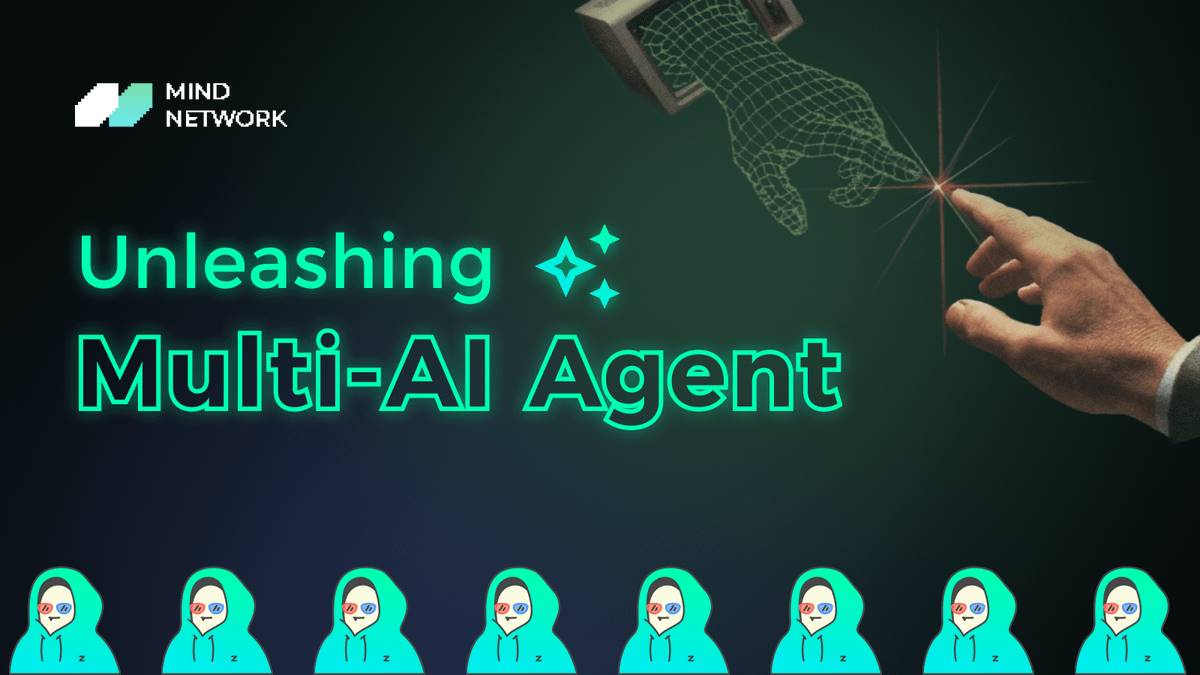
A multi-agent system is an intelligent collaboration framework that enables specialized AI agents to work together synergistically. Within this framework, each agent maintains its unique capabilities while enhancing overall performance through cooperation.
This system resembles a professional orchestra: each AI agent focuses on its area of expertise, and through seamless coordination, delivers high-quality collective outcomes. Teams like Swarms are actively advancing research and applications in this field.
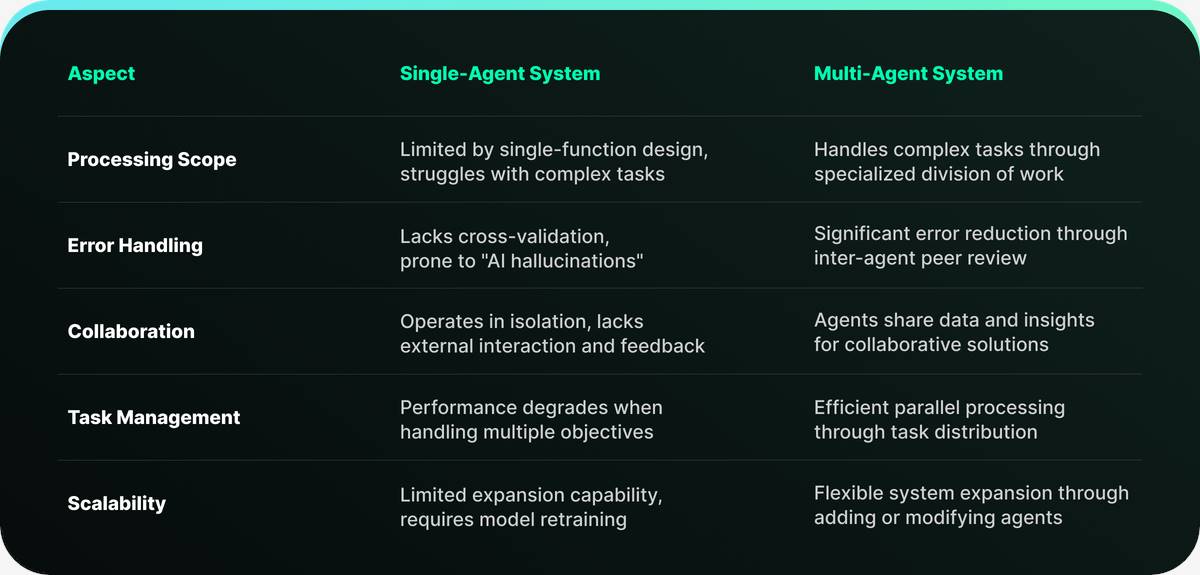
Single Agent vs. Multi-Agent Comparison
Limits of Single Agents:
- Limited capability scope, struggling with complex tasks
- Lack of cross-validation, prone to biased judgments
- Operating independently, unable to leverage external resources
- Performance degrades under heavy workloads
Advantages of Multi-Agent Systems:
- Specialized division of labor, leveraging individual strengths
- Information sharing, enabling comprehensive solutions
- Mutual verification, reducing error rates
- Flexible scalability, adapting to complex demands
An easy-to-understand example:
In content creation, a research agent gathers information, a writing agent produces content, and an editing agent ensures quality—working together to guarantee accuracy and completeness.
For instance, in a medical AI system, diagnosis and treatment planning require a holistic process. A single agent may produce narrow judgments and struggle to balance interactions among multiple conditions.
When multiple specialized agents collaborate in diagnosis, one agent can analyze medical images and identify features, another assess organ function and health status, another interpret lab results, another synthesize a comprehensive profile for treatment planning, and another continuously monitor vital signs—all working in concert.
Each agent focuses on its domain while efficiently collaborating via secure data sharing, ultimately delivering integrated diagnostic and therapeutic recommendations.
Of course, just like human teamwork, multi-agent systems face practical challenges:
- Coordination issues: occasional misalignment or poor synchronization
- Result discrepancies: differing outputs from various agents
- Efficiency concerns: increased system complexity may impact processing speed
FHE: The Foundation for Secure and Scalable Multi-Agent Collaboration
Fully Homomorphic Encryption (FHE) provides a powerful framework for consensus and data integrity in multi-agent systems:
- Data protection: data remains encrypted during computation, preserving confidentiality
- Secure validation: FHE consensus agents verify results without decryption, ensuring accuracy and consistency
- Trust and security: FHE safeguards every step from input to output, guaranteeing end-to-end integrity
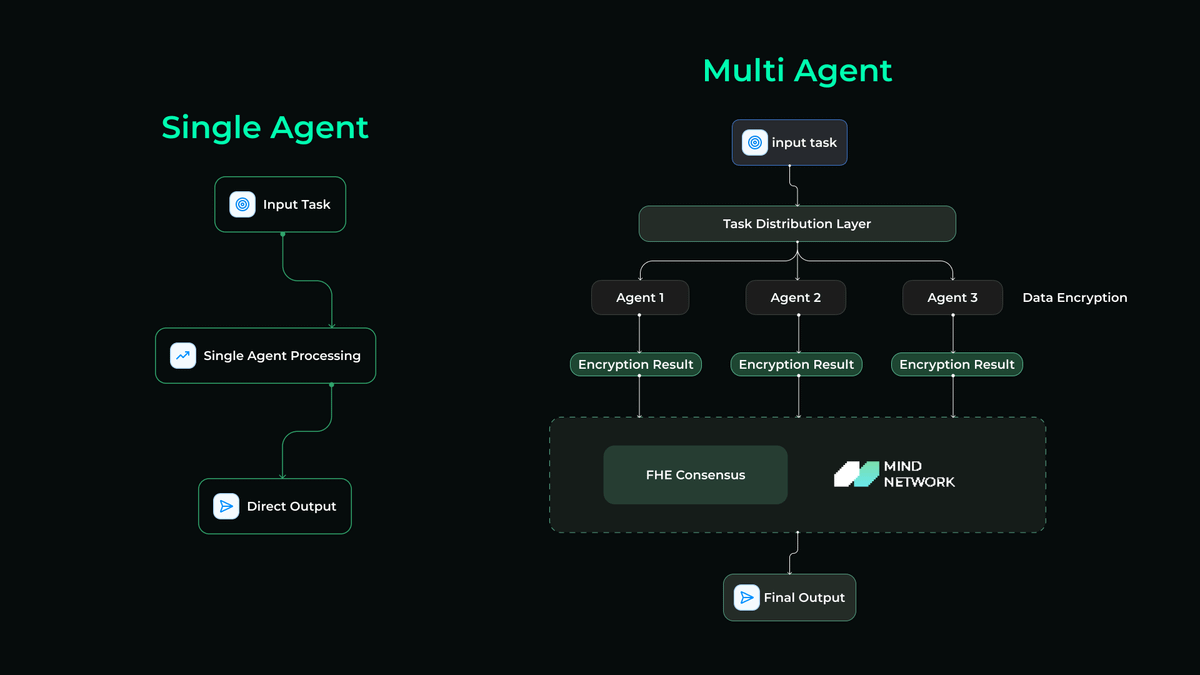
Use Case: MindV Hub’s Financial Analysis Multi-Agent System
- The gateway agent distributes various financial analysis tasks to specialized analytical agents
- Results remain encrypted and are sent to the cluster contract
- The FHE consensus agent verifies the consistency and reliability of encrypted results
- The system reassembles and returns only trusted, secure outputs to the user
By integrating FHE with AI frameworks such as Swarms, multi-agent systems ensure both security and efficiency when handling sensitive data.
The Era of AI Collaboration Has Arrived
- Highly accurate and efficient outcomes: collaboration combined with privacy-preserving validation delivers reliable results
- Easy scalability: agents can be added or adjusted to handle more complex tasks without compromising performance
- Web3 and AI convergence: FHE enables multi-agent systems to operate effectively in both centralized and decentralized environments, securing data and consensus for next-generation AI
Multi-agent systems empower teams of specialized AI agents to solve complex problems with unprecedented efficiency and scalability. With FHE as the cornerstone of secure collaboration, these systems are poised to redefine the boundaries of what AI can achieve—and this journey has only just begun.
Join TechFlow official community to stay tuned
Telegram:https://t.me/TechFlowDaily
X (Twitter):https://x.com/TechFlowPost
X (Twitter) EN:https://x.com/BlockFlow_News