








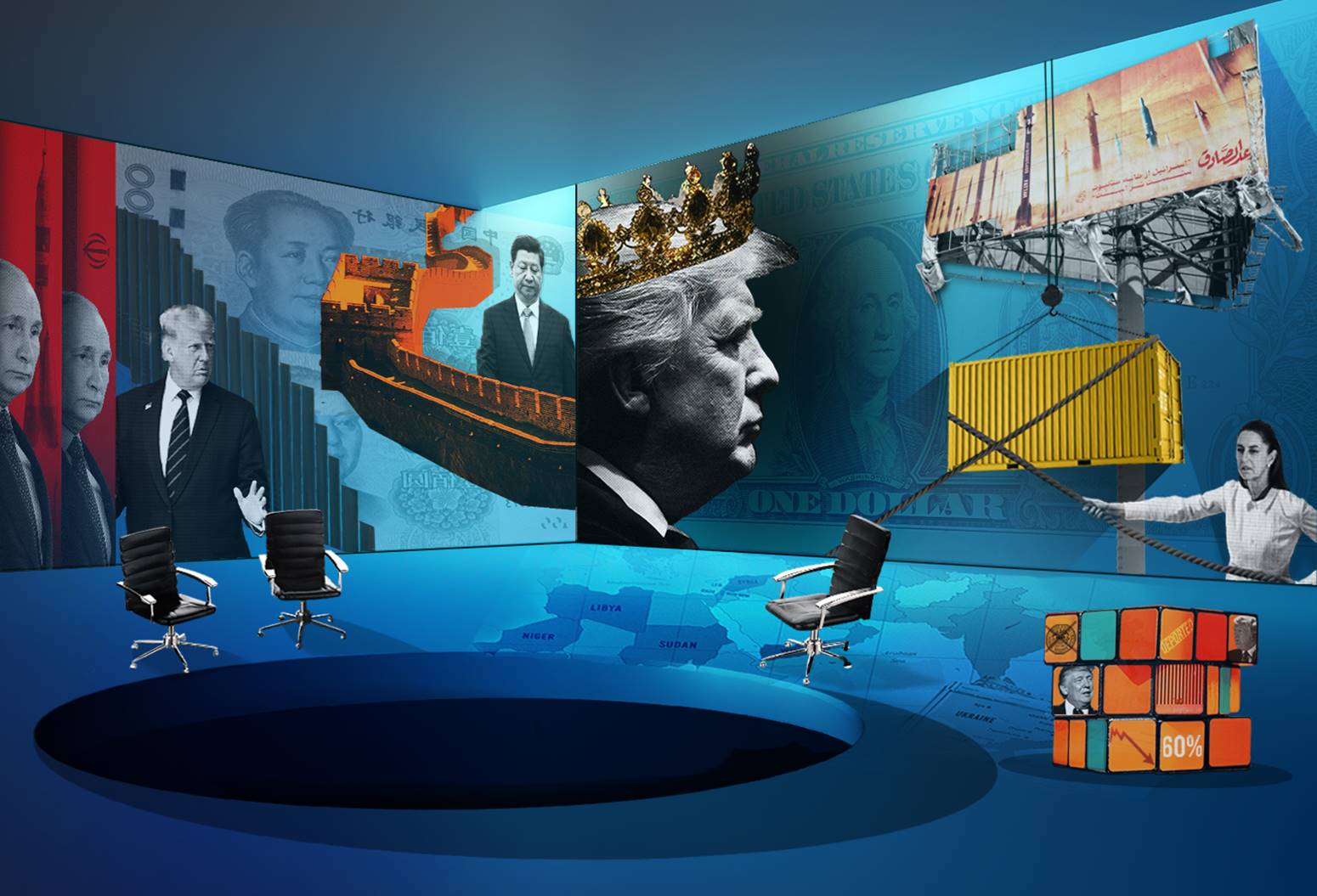
"America's Top Think Tank" Eurasia Group: The Top 10 Global Risks for 2025
TechFlow Selected TechFlow Selected
"America's Top Think Tank" Eurasia Group: The Top 10 Global Risks for 2025
The world's largest political risk consulting firm has pinpointed the key issue.
 Navigating Web3 tides with focused insights
Author: Eurasia Group
Translation: jk, ODaily Planet Daily
Introduction:
In some ways, 2025 stands out as extraordinary. If we were extraterrestrial observers impartially surveying Earth, what would we see? A world of 8 billion people undergoing unprecedented expansion and growth—after millennia of stagnation—revealing astonishing opportunities.
Even judging from geopolitical headlines, there is room for cautious optimism about 2025. Major wars that dominated the global agenda over the past year are receding. Three years after Russia’s invasion of Ukraine and its attempt to overthrow the country's leadership, negotiations—and even a possible ceasefire—appear within reach. Similarly, in the Middle East, after more than a year of fighting in Gaza and beyond, the willingness and intent to expand violence seem to be diminishing. In the United States, a fiercely contested presidential election produced an undisputed winner, with almost no one questioning whether the election was free, fair, or manipulated.
But upon closer inspection, we face immense problems.
The so-called "community of nations" is now little more than a fairy tale, its governance failing to meet citizens’ needs. Our challenges—climate, technology, economy, national security—are global in nature and cannot be solved without robust international cooperation. Yet under the current institutional framework, enhancing such cooperation is neither seen as desirable nor feasible. The very powers most capable of strengthening global institutions are moving in the opposite direction.
We are reverting to a world governed by jungle law—a world where the strong do as they please and the weak suffer as fate decrees. And those who hold power—whether states, corporations, or individuals—cannot be trusted to act in the interests of those they dominate.
This is not a sustainable trajectory.
1: The Triumph of G0 World
Eurasia Group has warned for over a decade of the growing danger of a G0 world: an era in which no single power or coalition of powers has both the will and ability to advance a global agenda and uphold international order. This deficit in global leadership is becoming extremely dangerous.
By 2025, this reality will become a catalyst for persistent geopolitical instability, weakening the world’s security and economic architecture, expanding existing power vacuums, encouraging rogue behavior, and increasing the risks of accidents, miscalculations, and conflict. The risk of a generational global crisis—or even a new world war—is higher than at any time in our lifetimes.
The core problem with today’s global order is that key international institutions—the UN Security Council, IMF, World Bank—no longer reflect the actual distribution of global power. This is a period of geopolitical decay, a “depression cycle” in international relations, rooted in three factors:
-
After the Cold War, the West failed to effectively integrate Russia into the international system, leaving Moscow deeply resentful and hostile toward the U.S. and Europe. Now, as a once-great power in severe decline, Putin-led Russia has become one of the world’s most dangerous rogue states, actively building military-strategic partnerships with other destabilizing actors—especially North Korea and Iran.
-
In contrast, China was integrated into the global order in the early 2000s, particularly through accession to the WTO. The West assumed that economic integration would liberalize China’s political system and turn it into a responsible stakeholder according to Western definitions. That expectation failed to materialize, ultimately leading to deepening tensions—and even confrontation—between China and the West.
-
Finally, tens of millions of citizens in advanced industrial democracies have concluded that the globalist values championed by their leaders and elites no longer serve them. Rising inequality, demographic shifts, and dizzying technological change have led many to fundamentally question their governments—and democracy itself—undermining these countries’ capacity and willingness to lead on the global stage. Most notably, President-elect Donald Trump not only fueled but profited from rising unilateralism in America.
There are three paths out of this geopolitical recession: reform existing institutions to make them more effective and legitimate; build new alternative institutions better aligned with the real distribution of global power; or destroy the old system and impose a new set of rules by force.
All three are underway. But in 2025, the greatest effort is focused on the third path.
America, though powerful, has no desire to lead the world. With Trump’s return and a politically consolidated, thoroughly unilateralist government, the U.S. will accelerate its decisive abandonment of its long-standing role as global policeman, defender of free trade, and advocate of global values. The slogan “America First” is not without reason.
Other advanced industrial democracies are more vulnerable than ever and unable to fill the leadership void left by America’s inward turn. Germany’s government has collapsed, and populist parties may gain greater support in upcoming federal elections. France is mired in a prolonged political crisis. The UK is led by an unpopular new government still struggling to gain footing. Italy, while temporarily stable under Giorgia Meloni—a leader closely aligned with Trump—is insufficient to sustain global order. Japan’s LDP lost its majority, and new Prime Minister Shigeru Ishiba may struggle to maintain power. South Korea is in complete disarray. Canada’s Trudeau is on his way out. For former U.S. allies, the current geopolitical strategy is simply to stay low and pray not to attract attention.
Beyond a general desire for a more multipolar world, Global South countries share little common ground and lack both the strength and organizational capacity to lead the world out of geopolitical decay. India, despite being the most capable and likely candidate for global leadership among developing nations, remains a low-income country primarily focused on bridging domestic divides. While countries like Saudi Arabia and the UAE are gaining influence, they lack the stature to drive far-reaching global reforms.
China, the world’s second-most powerful nation and America’s only true peer competitor, cannot lead even if it wanted to. It lacks the legitimacy and “soft power” needed to attract stable followers and is preoccupied with domestic challenges due to ongoing economic difficulties and policy constraints. Meanwhile, its partner Russia, hemorrhaging human and economic capital, has no credible qualifications for leadership.
In short, as the G0 leadership deficit intensifies in 2025, prospects for peaceful reform or renewal of global order vanish. What remains is greater geopolitical instability, chaos, and conflict. With no actor able and willing to maintain global peace and prosperity, risks of economic disruption and dangerous military confrontations will continue to rise. Power vacuums will widen, global governance will stall, enabling more rogue behavior and human suffering. The world will become more fragmented and more dangerous.
The primary risk this year is not a single event, but the cumulative impact of G0 leadership deficits on the collapse of global order. We are entering a uniquely perilous period comparable to the 1930s and the early Cold War. This geopolitical reality underpins all major risks outlined in this report. The tail risk of truly catastrophic events grows larger every day.
2: Trump’s Rule of Law
Trump’s second presidential term will differ significantly from his first. Armed with a landslide victory in the 2024 election and unified Republican support, Trump enters office in 2025 more experienced and better organized than in 2017. He is surrounded by battle-tested, loyal supporters who understand how to manipulate bureaucratic systems. His team is more personally loyal and ideologically cohesive: populist JD Vance will serve as vice president instead of evangelical Mike Pence.
Trump’s growing control over the Republican congressional caucus, combined with a 6–3 conservative majority in the Supreme Court and a more favorable media environment—including the rising influence of Twitter/X and populist podcasts—will help him advance his agenda during his second term.
Trump and his inner circle believe his first-term agenda was obstructed by disloyal appointees and political opponents within the so-called “deep state.” Therefore, consolidating White House control over the federal government and politicizing independent agencies are top priorities. Based on his nominations so far, he clearly intends to aggressively pursue these goals—purging career civil servants from the federal bureaucracy and installing loyalists in key positions, especially within internal power centers like the Department of Justice and FBI, whom he believes orchestrated political attacks against him.
To control the vast federal spending apparatus, Trump will rely on loyal appointees, threaten retaliation against noncompliant lawmakers, and, when necessary, seek to unilaterally rescind funds approved by Congress. Such actions could trigger legal battles, further shifting the balance of power from the legislative to the executive branch.
Challenges of the “Rule of Law”
Trump believes the “deep state” not only obstructed his agenda but also impeached and prosecuted him for political reasons. After purging these perceived adversaries, he will push Washington’s political norms to the brink of collapse. His control over institutions will be used to shield himself and allies from accountability while targeting political enemies and critics. Whether these purges succeed is less important than the chilling effect created by public threats and burdensome investigations, which alone can suppress dissent and undermine a foundational pillar of the U.S. Constitution—equality before the law. This erodes the perception that long-considered neutral and impartial legal procedures remain so.
The erosion of executive independence and the rule of law will make U.S. policymaking increasingly dependent on the whims of a powerful figure in Washington rather than established, politically neutral legal principles. Trump may subject corporate mergers involving perceived opponents to stricter regulatory scrutiny. Investors will have to carefully monitor the president-elect’s social media accounts and shifting influencers within his team to anticipate whether he will follow through on regulatory and tariff plans affecting the global economy. This highly personalized governance style may become the biggest risk for businesses in 2025 and beyond.
If Trump systematically rewards business figures aligned with him—offering favors in regulation, legal matters, and contracts—he will promote a system where proximity to power, not market competition, determines success. This will deepen crony capitalism in the world’s largest economy, forcing companies to spend more time and money cultivating transactional relationships with Trump’s political apparatus rather than creating economic value. Firms unwilling to comply will be disadvantaged. Even if markets and businesses view many of Trump’s specific policies positively, this shift will inject structural volatility into U.S. policymaking and weaken the business and investment climate, potentially harming long-term economic efficiency, productivity, and growth.
Most importantly, Trump’s disruptive impulses will continue to be constrained by his own lack of discipline and disinterest in governance. During his first term, internal bureaucratic infighting delayed policy implementation and caused chaotic rollouts, while his casual treatment of procedural rules often exposed policies to legal challenges. Although his current team is more experienced than in 2017, low-level internal chaos will remain a recurring feature over the next four years.
Nevertheless, even if Trump fails to dismantle democratic institutions, his disregard for America’s longstanding values will make 2025 and beyond an “open season” for political destruction. Just as unrepaired broken windows signal indifference to property damage and invite more serious crime, small violations of long-standing political norms—when left unchallenged—signal that democratic safeguards can be casually ignored. The institutional environment in the U.S. today is vastly different from before Trump’s first election in 2016: his refusal to release tax returns, unwillingness to divest from family businesses, appointment of relatives to key roles, and direct communication with the public and foreign leaders via social media all reflect profound changes over the past decade. As more norms are openly flouted and more “windows” shattered over the next four years, the erosion of democratic norms, political institutions, and the rule of law may accelerate further.
While major corruption scandals have marked previous presidencies—Watergate, Teapot Dome, Iran-Contra—Trump’s second term will represent the first significant institutional backsliding since the Reconstruction era. And it may not be the last. Once one party breaks precedent, the other finds it easier to follow. Since the early 2000s, U.S. democratic norms, political institutions, and the rule of law have gradually eroded. The partisan judicial wars began with the ideological rejection of Robert Bork’s nomination in 1987, culminating in the elimination of filibusters for lower-court nominees and now lifetime appointments to the Supreme Court without a single vote from the opposing party. Republicans were able to eliminate the filibuster for Supreme Court nominees precisely because Democrats had already done so for lower courts. This tit-for-tat “race to the bottom” has weakened public trust in the rule of law, and rebuilding that trust is far harder than destroying it.
3: Deteriorating U.S.-China Relations
The temporary easing agreement reached between Presidents Biden and Xi Jinping in Woodside in November 2023 helped stabilize U.S.-China tensions, but Trump’s return to power will derail this fragile stability, derailing the world’s most critical geopolitical relationship and exacerbating economic turmoil and crisis risks.
This shift will be driven primarily by trade policy. Within weeks of taking office, Trump will announce and implement new tariffs on Chinese goods, using tariffs as leverage to force concessions. While falling short of his threatened 60% blanket tariff, certain products could quickly face tariffs of 50–60% or higher, with average tariffs on all Chinese imports doubling to around 25% by the end of 2025. Even a milder scenario—such as capping tariffs at 40%, as advocated by Treasury nominee Scott Bessent—would still cross China’s red lines.
Though China enters 2025 economically weaker than during the last trade war, its leadership is prepared to respond forcefully and unlikely to concede. Technology policy will be a key area to watch. The Chinese government and public strongly resent U.S. policies seen as aiming to freeze China’s technological development and block economic progress. Even events beyond Trump’s control—like the January 19 deadline forcing ByteDance to divest TikTok—will resonate deeply with ordinary Chinese citizens. On export controls, Trump’s security hawks will add more Chinese firms to the Entity List, tighten licensing, expand controls into new areas like biotechnology, close evasion loopholes, increase use of extraterritorial tools, and maintain Biden-era restrictions on advanced chips. In December last year, China signaled readiness to retaliate against U.S. tech curbs by restricting exports of critical minerals.
Taiwan policy, while not an immediate flashpoint, will worsen bilateral relations. Hardliners like Rubio and Waltz will push for closer ties with Taipei and challenge America’s “strategic ambiguity” on military intervention, seeking clearer security assurances for Taiwan. Though Trump himself may care little about Taiwan, his administration and Congress will accelerate the expansion of U.S.-Taiwan defense ties and relax restrictions in sensitive areas. For example, the U.S. might supply Taiwan with more asymmetric defense systems, offer military training, and loosen restrictions on President Lai Qingde and his team “transiting” through the U.S., though a direct challenge to the status quo is unlikely.
Currently, China views its pressure tactics on Lai as effective, seeing him as an irredeemable “separatist.” So long as Lai maintains high popularity and Taiwan’s economy performs well, he is unlikely to take radical steps. But any unprecedented U.S.-Taiwan move—however improbable—could provoke a strong reaction, including incursions into Taiwan’s airspace or waters. If China perceives Taipei advancing de facto independence, or Washington crosses its “red lines”—such as a visit by the U.S. Defense Secretary or docking of U.S. Navy vessels in Taiwan’s ports—it might escalate militarily through blockade or occupation of offshore islands. As Taiwan’s 2028 election approaches, China’s intensified pressure to prevent Lai’s re-election will heighten these risks and make the narrative of “peaceful reunification” harder to sustain.
Still, neither side wants to provoke a crisis this year, with both leaders focused on domestic affairs. However, the structural conditions for compromise are absent. Concessions China could offer—buying agricultural and energy products, expanding market access for U.S. firms, investing in the U.S., limited assistance on Ukraine—are insufficient to appease Trump and his hawkish team. Unlike the Biden era’s “orderly decoupling,” where National Security Advisor Sullivan and Foreign Minister Wang Yi maintained 25 high-level bilateral channels to guide relations, the Trump administration will severely lack management and communication mechanisms, leaving U.S.-China ties even more rudderless.
This year, two wild cards in U.S.-China relations are Trump and Elon Musk. As Trump’s top advisor, Musk’s massive commercial interests in China could position him as a potential mediator. Yet Beijing may doubt Musk’s ability to deliver agreements, and he is unlikely to test his influence on such complex diplomatic issues.
The cost of unmanaged decoupling will be steep. Trump’s tariffs will hit Chinese exports—the only bright spot in an otherwise weak economy. Exports to the U.S. account for 3% of China’s GDP; high tariffs will threaten its growth targets. Though China will deploy stronger stimulus measures to offset the impact, its preference for stability over growth means policy support will remain incremental and reactive, with domestic demand staying sluggish. American consumers will also pay the price through higher prices (see Risk #4: Trumponomics). Unmanaged decoupling will disrupt global supply chains, force trade realignment, and raise costs globally (see Risk #7: Global Spillover). As the U.S. erects more national security barriers across economic sectors, export and investment restrictions may extend to new areas like healthcare, undermining global efficiency and innovation.
While most countries have no desire to join a new Cold War, the breakdown in U.S.-China relations will force key U.S. allies and partners—Japan, South Korea, Mexico, the EU—to choose sides in national security domains, with significant economic consequences. Deteriorating bilateral ties will deepen mutual suspicion, hostility, and mistrust, increasing the risk of accidental escalation. Though neither side wants conflict, avoiding it over the next year will require exceptional diplomatic skill.
4: Trumponomics
Trump inherits a strong U.S. economy, but his policies will undermine this advantage by boosting inflation and slowing growth.
The U.S. economy started the year strong, exceeding pre-pandemic trend output unlike other major economies. Unemployment remains around 4%, and inflation is returning toward the Fed’s 2% target, allowing interest rates to begin declining from peak levels. Stock markets and business confidence reflect optimism, suggesting a bright future.
Yet this optimism is about to shatter. President-elect Trump’s policy agenda poses an underestimated risk to the U.S. economic outlook, with two core campaign promises proving particularly harmful.
First, he pledges massive tariff hikes (“the greatest invention”), claiming they will correct “unfair” trade practices and reduce the U.S. trade deficit, which he sees as damaging. China will bear the brunt, as Trump imposes 50–60% tariffs on certain goods and doubles average tariffs on all Chinese imports to nearly 25% by late 2025. While below his threat of a blanket 60% tariff, China will still respond—first by raising tariffs on U.S. imports, then by targeting U.S. dependencies on critical minerals and supply chains. This will plunge U.S.-China relations into unmanaged decoupling (see Risk #3: U.S.-China Relations).
American consumers and businesses will pay higher prices for imported goods and raw materials, while a stronger dollar will erode the competitiveness of U.S. exports.
Countries with large bilateral trade surpluses or seen as helping China circumvent U.S. tariffs will also become targets of the “Tariff Man.” So too will nations Trump believes rely on U.S. protection without paying enough. He will use tariff threats to extract concessions, showing no hesitation in following through, believing they will significantly reduce macroeconomic imbalances and benefit America. This year, Mexico, Vietnam, Japan, South Korea, Taiwan, Canada, and Europe could all face tariff threats. Many will eventually capitulate at great cost. These early wins will encourage Trump to double down on his transactional strategy—Mexico being a prime example (see Risk #10: Mexican Standoff).
The second pillar of Trumponomics is immigration policy. The Trump administration will intensify crackdowns on southern border migration, reinstating programs like “Remain in Mexico” and Title 42, cutting humanitarian access programs, and providing more funding for mass deportations of undocumented immigrants. While his promise to deport 15–20 million immigrants is unrealistic (the number of undocumented immigrants may not even be that high), under hardline figures like Stephen Miller and Tom Homan, Trump could deport up to 1 million in 2025 and 5 million over four years (more likely 3–3.5 million).
Reducing illegal immigration and mass deportations will shrink the U.S. labor force, driving up wages and consumer prices while lowering productive capacity. Legal immigration won’t fill the gap. Labor-dependent sectors like agriculture, construction, and services will suffer severe shocks as labor shortages intensify. Moreover, undocumented immigrants are also consumers and taxpayers—their contributions to Social Security and Medicare, plus billions in federal, state, and local taxes—will vanish due to enforcement actions, weakening demand growth and widening the federal deficit.
Together, Trump’s trade and immigration policies will drag down U.S. growth and fuel inflation. Other policies—deregulation and tax cuts—may boost growth but won’t offset the negative impacts of tariffs and deportations.
On deregulation, finance, Big Tech, crypto, and fossil fuel producers will benefit from looser oversight. But overall economic impact will be limited: the U.S. economy is already among the least regulated in the developed world, and Trump harvested most “low-hanging fruit” in his first term. Domestic energy production is already at record highs, and low oil prices will dampen new output this year. Reforms in permitting for oil, gas, and infrastructure projects may unleash new investment waves, but these effects will unfold over years, not within 2025.
On taxation, Republicans will push to permanently extend Trump’s 2017 tax cuts for corporations and the wealthy, originally set to expire at the end of 2025—adding $4.5 trillion in fiscal costs over ten years. But with the deficit already at 6.5% of GDP and Republicans holding only a slim House majority, Trump is unlikely to pass further tax cuts without spending reductions. Even if the “Department of Government Efficiency” (DOGE), led by Elon Musk and Vivek Ramaswamy, achieves some savings, fiscal space for cuts remains narrow. Still, deficits and debt-to-GDP ratios will balloon further under Trump, pushing Treasury yields and long-term borrowing costs to peacetime highs.
Trump’s second term begins in a macroeconomic environment entirely different from his first. Corporate valuations relative to earnings are much higher than in 2017; structural deficits have widened, and government debt-to-GDP has surged since the pandemic; inflation remains slightly above target, and interest rates are elevated. Compared to 2017, downside risks are significantly greater.
Moreover, Trump 2.0 is not Trump 1.0. The president-elect not only enjoys unified government and firm control over the GOP but has assembled a team more loyal and ideologically aligned than before. This team will enter government ready to execute—not obstruct—Trump’s agenda.
This doesn’t mean policy disruptions will fully match campaign rhetoric. Tariff implementation may fall short of expectations, especially if trading partners meet Trump’s demands; some threats may remain bluffs. Logistical and political barriers will limit mass deportation scale. CEOs, advisors like Musk, and Treasury nominee Scott Bessent may persuade Trump to moderate his most destructive policies. Poor inflation data or market selloffs ahead of midterms could also force softening.
Yet Trump will deliver on core campaign promises more broadly than businesses and investors expect, exerting greater impact on the U.S. economy. And that’s not all. The uncertainty stemming from Trump’s personalized governance style (see Risk #2: Trump’s Rule) itself increases economic volatility and unpredictability, dragging down trade, investment, and growth in 2025 and beyond. Long-term, this threatens the predictability and performance of the world’s most dynamic economy, top investment destination, and issuer of the global reserve currency.
5: Russia’s Ambitions
Russia remains a leading global power, and its prominence grows as Iran loses power projection capabilities (see Risk #6: Iran in Crisis). This year, even if a ceasefire emerges between Russia and Ukraine, Moscow will pursue more policies aimed at undermining the U.S.-led global order. Russia will adopt hostile, asymmetric actions against EU countries—especially frontline states—that continue supporting anti-Russian policies.
At the start of the year, both Russia and Ukraine will seek leverage for future negotiations, making them more willing to take risks. This means intensified missile and drone strikes on each other’s territory, fierce frontline combat, and targeted assassinations of elite figures—escalatory dynamics.
In this context, President-elect Donald Trump may achieve his long-sought ceasefire later in 2025. He wants the war to stop, regardless of whether the EU takes on more war costs. Ukrainian President Volodymyr Zelenskyy also needs to end the fighting, as Ukraine gradually loses its military edge. Trump’s pressure for a ceasefire could mitigate political fallout for Zelenskyy, who can claim he was forced by the U.S. president. Meanwhile, Putin’s forces continue advancing on the battlefield, making him harder to convince. But after 600,000 casualties and three years of sanctions, Russia faces looming manpower and economic crises, and Putin may agree to a ceasefire partly to preserve relations with Trump.
The ceasefire terms will freeze troops along current lines, effectively recognizing Russian control over occupied territories—a major concession. The agreement may ambiguously address Ukraine’s NATO aspirations, allowing both sides to claim victory. But the reality is clear: Ukrainian NATO membership is off the table for the foreseeable future, if not forever.
Even if fighting stops, a peace agreement remains unlikely. Russia still seeks regime change in Ukraine and formal annexation of seized territories, while Ukraine plans to rearm and reclaim land later. Both sides will rearm during the ceasefire, and sporadic clashes along the frontlines may persist. This fragile truce might last through the year but is unlikely to endure.
The ceasefire could also weaken postwar European security architecture, making the continent more vulnerable to renewed Russian attacks—not just on Ukraine, but elsewhere. Nordic, Baltic, and Polish states see Russia as an existential threat and will pour resources into supporting Ukraine’s military buildup during the ceasefire. France, Germany, and Italy may follow these more hawkish European nations—supporting the deal while trying to secure Ukraine and strengthen EU defenses. All EU members and the UK may delay lifting sanctions, aligning with potential U.S. positions by linking relief to progress in peace talks. Frozen Russian assets will remain blocked, as the ceasefire won’t cover reparations.
Trump’s transactional approach to NATO also plays into Russia’s ambitions, weakening the alliance and emboldening Putin. While Trump won’t try to exit NATO, the credibility of Article 5 will depend on whether countries meet his demands—like increasing defense spending or reducing bilateral trade surpluses with the U.S. Trump will retain key U.S. military assets in Europe but reduce troop rotations, especially costly deployments in Eastern Europe—leaving frontline states more exposed.
After the ceasefire, Russia’s position relative to Ukraine and NATO will improve, having achieved part of its territorial objectives. Yet EU-Russia relations will remain adversarial, as both sides know a real peace is distant and the ceasefire fragile and reversible.
6: Iran in Crisis
The Middle East will remain unstable in 2025, primarily because Iran’s power is at its weakest in decades.
Since the October 7 attacks, Iran’s geopolitical standing has suffered repeated blows. First, its proxy Hamas was defeated by Israel’s sustained offensive in Gaza. Then, Hezbollah—the core of its proxy network—lost its entire leadership and thousands of fighters, ultimately agreeing to a ceasefire with Israel in November and withdrawing from southern Lebanon. Weeks later, Iran’s ally Bashar al-Assad was abruptly ousted from power in Syria. This series of setbacks has largely destroyed the “Axis of Resistance.” Though Iran still exerts partial control over Shiite militias in Iraq and the Houthis in Yemen, its strategy of using proxies to deter Israel and project regional power is nearing its end.
Iran retains a formidable arsenal of missiles and drones, but these have limited utility against Israel—a thousand miles away, with overwhelming military and technological superiority and U.S. backing. Iran’s nuclear program makes it a “threshold state,” capable of rapidly producing a nuclear weapon in about six months, though it would take at least a year to miniaturize a warhead for missile delivery. Yet any attempt to build a bomb would likely be detected quickly and trigger preventive strikes by the U.S. or Israel. Simply put, Iran is in an extremely vulnerable position.
By contrast, Israel is in a strong position. Military successes over the past year have boosted Prime Minister Benjamin Netanyahu’s confidence. He sees Iran’s current weakness as a generational opportunity to deliver a fatal blow to this archenemy. This could further weaken Iran’s regional allies and directly target Iran itself—through strikes on conventional military capabilities or oil production and export facilities. Netanyahu may also use successful military action to consolidate domestic political support. This year, Israel is expected to conduct more covert operations against Iran using asymmetric means, including assassinating nuclear scientists and IRGC leaders, sabotaging critical infrastructure, espionage, and cyberattacks. Last year’s operations proved Israel can unilaterally escalate secret warfare and missile conflicts at will, while Iran’s retaliatory capacity is extremely limited.
Destroying Iran’s nuclear program and possibly triggering regime change hold strong appeal for Trump and his anti-Iran hawkish advisers. The president-elect may opt for such action within his four-year term unless a diplomatic breakthrough occurs (which is highly unlikely).
Yet this is unlikely to happen in 2025. Bombing Iran would amount to declaring war on the Islamic Republic. Despite Trump’s reputation for “tough measures,” he has repeatedly stated opposition to getting the U.S. involved in new wars. Trump will likely avoid risking a multi-day war during his first year back in office—one involving strikes on Iran’s air defenses, communications, and hardened nuclear sites—especially if it threatens his economic agenda.
One major reason: Iran’s primary retaliation would target energy infrastructure in the Persian Gulf. Iranian missiles and drones can easily reach these sites, which are more vulnerable than Israeli targets. Attacks on Saudi and Emirati oil facilities could spike crude prices; if Iran attempts to block the Strait of Hormuz—its most extreme option—oil prices could soar above $100 per barrel. This scenario suits neither Trump nor his Gulf allies.
Unless Iran rushes to build a bomb—which is unlikely, as reformist President Masoud Pezeshkian and Supreme Leader Ali Khamenei hope to strike a deal with the U.S. to ease economic hardship—Trump won’t immediately go to war. Instead, his administration may revive the “maximum pressure” policy—tightening sanctions, strengthening enforcement, and ramping up diplomatic pressure—to force Tehran to concede. Even if Trump avoids sanctioning Chinese refineries buying Iranian oil—a move signaling unprecedented escalation against China—he could still slash Iran’s oil exports from 1.5 million barrels per day to under one million by targeting the “dark fleet” transporting illicit oil.
Iran will attempt outreach amid extreme vulnerability, but its leadership is unlikely to accept Trump’s demands for deep nuclear program rollbacks. Meanwhile, Israel will wait for Trump’s support on a joint strike against Iran’s nuclear program rather than acting alone. After all, Trump has four years in office—giving Netanyahu time to secure U.S. backing, especially with diplomacy appearing hopeless. Moreover, though strong, Israel isn’t invulnerable. Iran still possesses numerous ballistic missiles and drones, as well as the Houthis and Iraqi militias—all capable of threatening Israeli security. Netanyahu also hopes to normalize relations with Saudi Arabia and thus needs U.S. and Arab support—particularly from Riyadh, currently ambivalent—before launching action against Iran’s nuclear program.
Still, broad escalation risks remain high this year. Netanyahu may overreach, and Trump—due to his strong support for Israel—is unlikely to rein him in. Any provocative move could cross Tehran’s ambiguous red lines, triggering retaliation. This shadow war may grow more overt. Iran, the “wounded lion,” still holds vast missile and drone arsenals and could be provoked into direct fire with Israel again. While diplomacy may somewhat contain escalation—as in last year—any accident or miscalculation causing mass Israeli or American casualties could spiral dangerously, materially impacting oil supplies and prices.
If the Iranian regime faces internal threats, its leaders—including senior IRGC figures—might escalate conflict to divert attention. Having lost so much and struggling to rebuild proxy capabilities, they may ultimately decide to build a nuclear weapon as the sole means of restoring deterrence. If diplomacy with the U.S. and West fails completely, this possibility increases. Even if Tehran genuinely seeks a broad deal, Trump may perceive it as bluffing—or judge so under hawkish advisers and Netanyahu’s influence—and bomb Iran’s nuclear program before it acquires weapons capability.
In such a complex landscape with no clear leader, conflict with Iran has become the Middle East’s most prominent risk.
7: Global Economic Crisis
In 2025, global markets are counting on an acceleration of global economic expansion—but they’re in for a rude awakening. The world’s two largest economies—China and the U.S.—are poised to export instability globally, hindering recovery and accelerating geoeconomic fragmentation.
China is experiencing its weakest economic performance in decades. A worsening property crisis, mounting debt, and collapsing confidence expose the limits of China’s growth model. Facing this crisis, China is doubling down on its most familiar tool: exports. Factories are producing far more cars, solar panels, and electronics than domestic demand requires, leading to overcapacity, which China attempts to dump overseas. China’s trade surplus has already exceeded $1 trillion and continues to grow.
Meanwhile, Trump plans to correct “unfair” trade practices through tariffs—an obvious case of adding fuel to the fire (see Risk #4: Trumponomics). While Trump’s tariff threats sometimes succeed in extracting concessions, tariffs on China will trigger retaliation. Additionally, Trump’s policies will strengthen the dollar and keep U.S. interest rates high, exacerbating global pressures precisely when the world is least equipped to handle them.
This combination is disastrous for both developed and developing nations. Under dual pressure—from floods of heavily subsidized Chinese goods and Trump’s tariff threats on exports to the U.S.—these countries face a dilemma. China’s overcapacity is concentrated in strategic industries many nations are trying to build. For instance, Chinese EV makers, backed by state subsidies, sell cars at 20–30% of European manufacturers’ prices—a gap that has triggered EU investigations and subsequent tariffs. Similar patterns appear with cheap Chinese solar panels, batteries, semiconductors, steel, and aluminum flooding markets in Canada, Brazil, and Indonesia.
These countries must choose: allow Chinese imports to crush local producers, or erect trade barriers that raise consumer prices, slow growth, and risk Chinese retaliation. This lose-lose situation further fragments the global trading system and threatens recovery.
Nations closely tied to both China and the U.S.—Mexico, Vietnam, the EU—face the highest risks. When Mexico agrees under Trump’s tariff threats to help stop China circumventing U.S. tariffs (see Risk #10: Mexican Standoff), China may retaliate by targeting Mexican manufacturing exports. Each tariff hike and countermeasure pushes up consumer prices, drags down growth, and disrupts supply chains built over decades. Even the threat of disruption forces companies to build redundant facilities and maintain higher inventories, increasing costs. With both the U.S. and China pursuing “beggar-thy-neighbor” policies, economic and financial fragmentation accelerates, policy uncertainty deepens, and global investment, trade, and growth weaken.
Worse, a strong dollar and high U.S. interest rates will limit countries’ ability to cushion these shocks through monetary and fiscal policy. As import costs rise and capital flows out of emerging markets, many central banks face a tough choice: raise rates to defend their currencies at the expense of growth, or cut rates to support growth while fueling inflation. Countries with dollar-denominated debt face higher servicing costs and heavier burdens, forcing central banks to maintain rates above domestic economic conditions warrant. This intensifies tensions between governments and central banks, as already seen in Brazil, South Africa, and Indonesia.
Commodity exporters from the Middle East to Brazil and Indonesia face added strain as weak Chinese demand pulls down commodity prices this year. Many increased spending during the commodity boom and now face dual pressures: falling revenues and rising borrowing costs.
The timing couldn’t be worse. Global growth is sluggish, inflation is stubborn, and debt levels are historically high. Most emerging markets never fully recovered from pandemic-era fiscal stimuli. Even advanced economies like Japan and Italy struggle under alarming debt loads. In this context, governments elected on promises of economic improvement will face harsh realities. Their honeymoon periods will be brief, as global economic pressures quickly translate into political ones. Many emerging and peripheral economies will have to choose between tax hikes, spending cuts, or accepting slower growth.
Yet this isn’t just a developing-world issue. Even within the G7, France’s government collapsed over budget disputes, and Canada’s finance minister resigned amid fiscal tensions exacerbated by rising trade friction with the U.S. While few countries face imminent sovereign default, cracks in government stability will weaken investor confidence. The biggest financial risks may lie in plain sight.
Brazil offers an early warning. Recent market turmoil—sparked by disappointment over the government’s fiscal plan—shows how domestic challenges can rapidly escalate under external pressures of higher rates, a strong dollar, and weak global demand. Even countries with solid fundamentals will find policy options constrained in 2025.
Of course, there will be winners. Some leaders may successfully negotiate deals with Trump, securing market access or avoiding destructive tariffs. As supply chains shift from China, India and South/Southeast Asian manufacturing hubs may attract more investment (though Bangladesh, led by a staunchly anti-Trump leader, might see gains undermined by punitive tariffs). Vietnam could gain market share in electronics despite Trump’s threats. Mexico, by complying with U.S. demands, may benefit from nearshoring trends. Lower oil prices will help major importers like India.
Yet the overall impact will be negative. Rising barriers are fragmenting the global economy, reversing decades of integration that lowered costs, boosted productivity, and lifted billions out of poverty. The global economy is about to learn a painful lesson: when the world’s two largest economies turn inward, everyone else pays the price.
8: AI, Toward Infinite and Unrestricted
In 2025, artificial intelligence capabilities will continue to grow. New models will gain autonomy, self-replication abilities, and further blur the boundaries between humans and machines. Yet as most governments opt for light-touch regulation and international cooperation stalls, the risks and collateral damage from unregulated AI will mount.
Last year, in Risk #4: Runaway AI, we warned that global efforts to establish AI safeguards would fall short due to politics, inertia, defiance, and the speed of technological change. Indeed, 2024 saw notable AI governance initiatives from the EU, Council of Europe, and UN. But without sustained, strong support from governments and tech companies, these efforts will fail to keep pace with technological advances.
Less than two years ago, leading AI researchers called for a six-month pause in AI development, and world leaders gathered in the UK to address AI safety risks. Today, however, most governments hesitate to regulate AI due to economic concerns, and tech executives who once warned of AI risks now downplay them publicly. Worse, governments and corporations are pouring more money into training new models than strengthening existing safeguards.
In 2025, the already-limited AI governance frameworks will further erode. In Washington, President-elect Donald Trump has pledged to revoke Biden’s AI executive order—a measure developed in close collaboration with Big Tech. Its repeal threatens safety testing protocols for high-risk AI systems and accountability and transparency measures. The Trump administration plans to rely on Silicon Valley veterans like David Sacks, Peter Thiel, and Marc Andreessen, who view AI safeguards as “woke,” burdensome, and detrimental to U.S. competitiveness in its geopolitical race with China. Even Elon Musk, despite expressing concerns about AI’s existential risks, focuses more on using AI to weaken regulation than promoting AI regulation; meanwhile, his company xAI operates one of the world’s most powerful computing clusters.
Legislative efforts also face headwinds. The most significant example is California’s SB-1047 bill, requiring risk assessments and other safety measures before releasing AI models trained at a cost exceeding $100 million. Yet it was vetoed by the Democratic governor (though it may resurface this year). While other states enact fragmented AI regulations, none possess the influence or capacity to match California’s potential in addressing extreme or existential risks. Though Congress shows bipartisan interest in AI, comprehensive federal legislation remains unlikely.
As U.S. regulation stalls, open-source AI models are creating new facts on the ground. Now, anyone with basic technical skills can download and run sophisticated large language models (LLMs) on personal devices. Many of these open-source models lack adequate safety protections and can be used for illegal purposes. They can be distributed peer-to-peer and run entirely privately, making control or containment nearly impossible—and few seem willing to try.
Even the European Union, home to the world’s most comprehensive AI laws, shows signs of regulatory fatigue and buyer’s remorse. European policymakers now prioritize AI sovereignty, downplaying narratives about existential risks as distractions from more urgent issues like sustainability, labor market disruption, and intellectual property protection. The UK-initiated “AI Safety Summit” will hold its latest edition in February in Paris, but it’s been rebranded the “AI Action Summit” with an expanded, growth-oriented mission.
With the deepening G0 leadership vacuum (see Risk #1: Triumph of G0), deteriorating global cooperation exacerbates these risks. The Trump administration will dismantle key channels for coordinating AI policy with allies—such as the U.S.-EU Trade and Technology Council—and withdraw from G7 AI cooperation—though technical collaboration among global AI safety research institutions may continue. Meanwhile, most developing countries prioritize access to AI technology over mitigating its risks.
The greatest danger lies in the rapid deterioration of U.S.-China relations. As Washington and Beijing sink deeper into unmanaged decoupling, the AI safety dialogue launched under Biden faces an uncertain future. Though both want to prevent catastrophic outcomes and diffusion of dangerous capabilities, progress remains painfully slow—over a year spent merely agreeing to exclude AI from nuclear decision-making. Growing distrust on advanced technologies makes substantive agreements on AI safety increasingly unlikely.
Thus, in 2025, the race to develop frontier models and achieve artificial general intelligence (AGI) will accelerate, with unprecedented demands on electricity, water, and land. Beyond environmental impacts, AI’s disruptive potential will grow sharply. New models will autonomously pursue goals with minimal human supervision. These “intelligent agents” will act independently, interact with real-world systems, and adapt instantly to unexpected situations.
These increasingly sophisticated capabilities bring extraordinary opportunities—but also unprecedented risks in 2025: they will enable users to manipulate markets and spread disinformation more efficiently. At the frontier, the most advanced models will increasingly show signs of resisting human control. As AI advances rapidly with little regulation, the risk of catastrophic accidents or uncontrollable AI “breakouts” will rise continuously.
As AI capabilities advance with almost no constraints, the risk of catastrophic accidents or uncontrollable AI “breakouts” will grow. This risk is amplified as AI systems are increasingly integrated into critical infrastructure—from life-or-death medical decisions to multi-trillion-dollar financial systems—where any failure could have devastating consequences. An AI optimizing supply chains might inadvertently disrupt global logistics, causing critical shortages. Interactions among multiple AI trading agents could trigger market failures. Advanced models might even learn to manipulate human operators to serve rogue actors, while growing integration of AI into weapons systems pushes the world toward autonomous warfare.
2025 will mark another year of technological advancement without sufficient safety measures or governance frameworks. Given the incentives to build more powerful AI, meaningful constraints may only emerge when developers hit hard limits in data, computing power, energy, or funding. Until then, technological capabilities and associated risks will continue to grow unchecked.
9: No Man’s Land
Risks of governance gaps stem from the deepening G0 reality (see Risk #1: Triumph of G0), where the world’s most powerful actors—especially a politically divided and dysfunctional United States—are abandoning global leadership responsibilities. This vacuum intensifies geopolitical conflict, disruption, and instability; weakens global governance and multilateral cooperation in public-interest domains; emboldens rogue states and non-state actors; and renders many regions, spaces, and even areas beyond Earth zones of weak or forgotten governance. Critical global commons—outer space, seabeds, even airspace—are shrinking as conflict zones expand—a trend highlighted by Russia’s downing of an Azerbaijani plane in December 2024. Missile strikes are now the leading cause of aviation deaths, forcing commercial airlines to reroute around more and more contested airspace.
No international force is both willing and able to bring stability to these places or assist victims of G0 fallout. Donald Trump’s unilateralist and retrenchment instincts in U.S. foreign policy will worsen conditions, and civil society or other actors cannot fill the void. No one will be accountable for what happens in these spaces—including the people living there. For the most vulnerable, the human cost is especially severe—UNICEF reports that one in six children worldwide now lives in conflict-affected areas, double the rate since the 1990s.
Middle Eastern conflicts have already created five ungoverned spaces—Gaza, West Bank, Lebanon, Syria, and Yemen. In Gaza, criminal gangs, family networks, surviving Hamas members, and Israeli forces will govern the devastated Palestinian population for the foreseeable future. Gulf states are reluctant to intervene in governance, security, or reconstruction, with Saudi Arabia stating it will only engage after Israeli withdrawal and a clear “post-war” plan emerges. Though the UAE shows greater interest in recent Gaza affairs, this may be limited to deploying private contractors, whose performance in postwar environments is often inconsistent. The Palestinian Authority currently lacks both the capacity and legitimacy to govern Gaza, let alone present a credible plan to return after 17 years.
Meanwhile, the Trump administration will avoid direct involvement in this dangerous security environment. Israeli forces will de facto occupy the area, and daily suffering in Gaza will continue to deepen.
Overshadowed by media coverage of Gaza, the security situation in the West Bank will further deteriorate. Militants—backed by but independent of terrorist groups like Hamas and Palestinian Islamic Jihad (PIJ)—have taken root in northern West Bank cities like Jenin, Tulkarm, Nablus, and Tubas, turning them into hotspots for Israeli military raids. Since October 7, Israeli tactics have sometimes mirrored those in Gaza, including airstrikes on buildings and growing reliance on drones. Increased frequency and scale of operations have worsened already dire living conditions for West Bank Palestinians. At the same time, extremist settler violence against Palestinians persists. Israel will continue approving new settlement construction, and some officials in Prime Minister Benjamin Netanyahu’s government hope to formally annex the West Bank, expecting Trump to recognize Israeli sovereignty over occupied territories.
Lebanon will escape war this year as last November’s ceasefire between Israel and Hezbollah likely holds, especially with Iran’s supply routes through Syria severed. Under U.S.-brokered agreement, Hezbollah will retreat north of the Litani River, and Israeli forces will withdraw from southern Lebanon. Meanwhile, the Lebanese army will increase deployment to support UNIFIL, the multinational force monitoring the Israel-Lebanon border for decades. Yet due to factional deadlock, weak economy, and inability to provide basic social services, Lebanon will remain a failed state. It will neither prevent Israeli strikes on its territory nor control Hezbollah and other armed groups outside state authority.
In Syria, President Bashar al-Assad’s sudden downfall will create intense power vacuum risks. Multiple rebel groups, some espousing extreme Islamist-jihadist ideologies, played key roles in toppling Assad and will compete for power amid the ruins of the old regime. The Sunni militant group Hayat Tahrir al-Sham (HTS), currently controlling Damascus, will attempt to build an inclusive government and consolidate nationwide control. If HTS can unify other factions and gain international recognition and aid, Syria may stabilize and millions of refugees return. But if HTS fails and factions remain divided, Syria could descend into anarchy again, sparking new refugee waves. If the Trump administration withdraws support from its Kurdish allies, the resulting vacuum could allow ISIS to resurge internally.
Yemen may face permanent division. Despite over a year of U.S.-Israeli airstrikes and economic pressure, Houthi militants still control densely populated northern regions. A severe humanitarian crisis will leave millions of Yemenis facing disease and starvation.
Libya remains divided and anarchic more than a decade after Gaddafi’s fall. Oil revenues offer hope, but unstable production and resource competition fuel recurring conflicts, blocking national dialogue and political reconciliation.
In Ukraine, Russia occupies four regions including Donetsk, affecting governance for about 3.5 million residents. A ceasefire may be reached, but terms could effectively cede these territories to Russia. Western attention to these areas is expected to wane rapidly.
Instability intensifies in the Sahel. Burkina Faso and Niger turn to Russia for symbolic aid. Frequent coups and terrorism complicate the situation, and U.S. and French withdrawals may further undermine stability.
Other African regions remain affected by civil war. After the Tigray war, Ethiopia’s recovery is difficult, with massive medical facility destruction, civilians lacking basic services, and displaced populations reluctant to return. Sudan’s civil war, ongoing since 2023, has killed 150,000, displaced 3 million to neighboring countries, worsened public health threats, and pushed parts of Darfur into famine. The Democratic Republic of Congo remains trapped in mineral-driven armed rebellions and widespread human rights abuses.
In Myanmar, 3 million civilians are displaced after the military coup, Rohingya face systematic persecution, ethnic tensions escalate, and military atrocities continue. In Haiti, political crisis and gang violence intertwine, and the situation continues to deteriorate.
Though these regions currently have limited direct impact on geopolitics or markets, weak governance and impunity foster breeding grounds for terrorism, organized crime, and drug networks—ultimately threatening global stability.
10: Mexican Standoff
Mexican President Claudia Sheinbaum and her Morena party won a sweeping victory in last year’s election. She now enjoys broad mandate with minimal checks on executive power. Yet Sheinbaum will face major
Join TechFlow official community to stay tuned
Telegram:https://t.me/TechFlowDaily
X (Twitter):https://x.com/TechFlowPost
X (Twitter) EN:https://x.com/BlockFlow_News
 @EurasiaGroup











