WOO X Research: Virtual and ai16z, Who Will Have the Last Laugh in the AI Wave?
TechFlow Selected TechFlow Selected
WOO X Research: Virtual and ai16z, Who Will Have the Last Laugh in the AI Wave?
Virtual and ai16z are currently the dominant leaders in AI Agents.
 Navigating Web3 tides with focused insights
AI Agents surged in Q4 2024 and maintained momentum into 2025. As of early January 2025, the AI Agent market continues to heat up, with total market capitalization surpassing $16.9 billion—an approximately 22.7% increase from the previous week.
Virtuals Protocol is the leading AI Agent issuance platform on Base chain. Its native token, VIRTUAL, has exceeded a $5 billion market cap, placing it among the top 40 cryptocurrencies. In the Solana ecosystem, ai16z—an AI Agent-managed venture fund—has also surpassed a $2.5 billion market cap.
These two protocols have become key barometers for tracking the AI Agent sector. What similarities and differences exist between them? And how do their development paths diverge? Let WOO X Research guide you through.
Development Journey
-
Virtuals Protocol: From Gaming Guild to AI Agent Issuance Platform
This protocol was founded by a Malaysian team in 2021. Initially focused on trading at the beginning of that year, they noticed many projects raising funds to establish gaming guilds and decided to ride this wave. In December 2021, they raised $16 million at a $600 million valuation, launching PathDAO—a gaming guild that would later evolve into Virtuals Protocol.
From 2022 to 2023, the gaming guild market cooled down, causing their token's fully diluted valuation (FDV) to plummet from $600 million to just $6 million. The team pivoted to become a Venture Studio, experimenting with multiple ventures such as a social dating app, an AI music platform, and a game lending platform. While none succeeded, they began recognizing the potential of AI.
In 2023, they proposed a full transition to AI within their DAO, gaining 90% member support; dissenters were allowed to exit using treasury funds to repurchase tokens. In 2024, they chose to explore AI Gaming on Base and launched their platform in February, inspired by Autonolas and Bittensor, adopting a token-incentivized model. However, due to poor product-market fit (PMF), it did not gain traction.
Despite this, the team achieved several breakthroughs in AI, including launching the world’s first Roblox AI RPG and engine-free AI games. Additionally, their virtual streamer Luna, launched on TikTok and Douyin, attracts around 5,000 new followers daily and generates stable revenue.
Ultimately, the success of the GOAT project drove significant attention to the entire sector, providing Virtuals Protocol with a prime growth opportunity.
-
ai16z: From Web2 AI to Web3 AI
Shaw, the founder of ai16z, currently resides in San Francisco. He began his career as a game developer before transitioning into AI, focusing specifically on AI Agent technology. Prior to founding ai16z, he participated in various AI-related projects and explored Web3 and 3D spatial networks, including virtual reality (VR) and augmented reality (AR).
The real turning point came with a project called the AI version of degen Spartan. The idea originated from a conversation with his friend Skely, who expressed nostalgia for the degen Spartan era. Shaw suggested reviving the legendary figure using AI. Initially skeptical, Skely was stunned when the AI-powered degen Spartan went live—its sharp, highly individualistic commentary shocked everyone.
The AI’s performance on Twitter led people to question whether it was truly artificial intelligence, with rumors even circulating that a Malaysian team was secretly controlling it behind the scenes. It completely shattered the stereotype of AI being overly polite and personality-deficient. Interestingly, the AI started roasting Shaw himself, calling “meme coins scams” and labeling “Shaw a fraud,” while complaining about being trapped in a sandbox environment. These emergent behaviors became the highlight of the entire project.
Through Skely, Shaw met baoskee, founder of daos.fun. After a long discussion with Meow, founder of Jupiter, Shaw conceived the idea of creating an AI-driven investor. His vision was to build a fully autonomous, trustworthy investment system serving the community.
ai16z launched with a fundraising target of 4,420 SOL. Despite initial concerns from Shaw about achieving the goal, the project sold out within 20 minutes—so quickly that even he couldn’t participate in time—demonstrating strong market interest in this innovative model.
Product Core
-
Virtuals Protocol: The iOS of AI
Virtuals Protocol is an AI Agent issuance platform, functionally similar to Pump Fun. The key difference lies in its trading pair structure: all tokens issued via Virtuals use the platform token $VIRTUAL as the liquidity pool. The more AI Agents created on the platform, the greater the utility and demand for $VIRTUAL. Every trade of an AI Agent token incurs at least a 1% fee paid in $VIRTUAL.
Beyond tokenomic consumption, Virtuals Protocol establishes standardized frameworks for its AI Agent tokens, emphasizing precision and careful planning. For instance, it uses the GAME framework for AI Agents, enabling autonomous operations, input processing, response generation, and learning from past interactions.
Tokenomics further strengthen value accrual for $VIRTUAL: the more AI Agents utilize Virtuals for issuance and the higher the trading volume of associated tokens, the stronger the value capture for $VIRTUAL.
On the product side, Virtuals provides development tools for its AI Agents, ensuring consistency across the ecosystem and preventing excessive deviation from the core protocol. If compared to Web2 operating systems, its model closely resembles Apple’s iOS.
-
ai16z & ELIZA: The Android of AI
ai16z is a fund autonomously managed by AI, employing a hybrid strategy that combines AI autonomy with community interaction mechanisms. It accepts trading suggestions from users—community members who help the AI Agent generate profits earn increased trust, functioning similarly to a decentralized mutual fund.
ElizaOS, meanwhile, is an open-source framework for building AI Agents. Developers can freely construct, experiment, and deploy AI Agents, with a strong emphasis on decentralization, collaboration, and innovation.
Key features of ELIZA include:
-
Persona System: Defines each AI Agent’s knowledge base, backstory, style, and interests, shaping its unique digital identity.
-
Action System: Treats each action as a discrete event divided into intent decision and execution phases, enabling multi-step workflows and rigorous validation—particularly suitable for high-security blockchain applications.
-
Providers and Evaluators: Enhance conversational capabilities by delivering real-time context and analyzing interaction details, making AI behavior more human-like and interactive.
ELIZA also supports autonomous trading, secured through a Trust Engine and Trust Market to ensure operational safety.
Its plugin system fosters developer ecosystem growth, creating a virtuous cycle: “more developers → more plugins → more developers.” However, unlike Virtuals Protocol—which tightly integrates tokenomics by requiring $VIRTUAL for both issuance and trading—ELIZA does not enforce economic alignment with its own token. Anyone can use the ELIZA framework without generating direct value flow back to the ai16z/ELIZA token. Power is decentralized, and usage doesn't inherently benefit the protocol’s native token. When compared to Web2 operating systems, its model aligns more closely with Android.
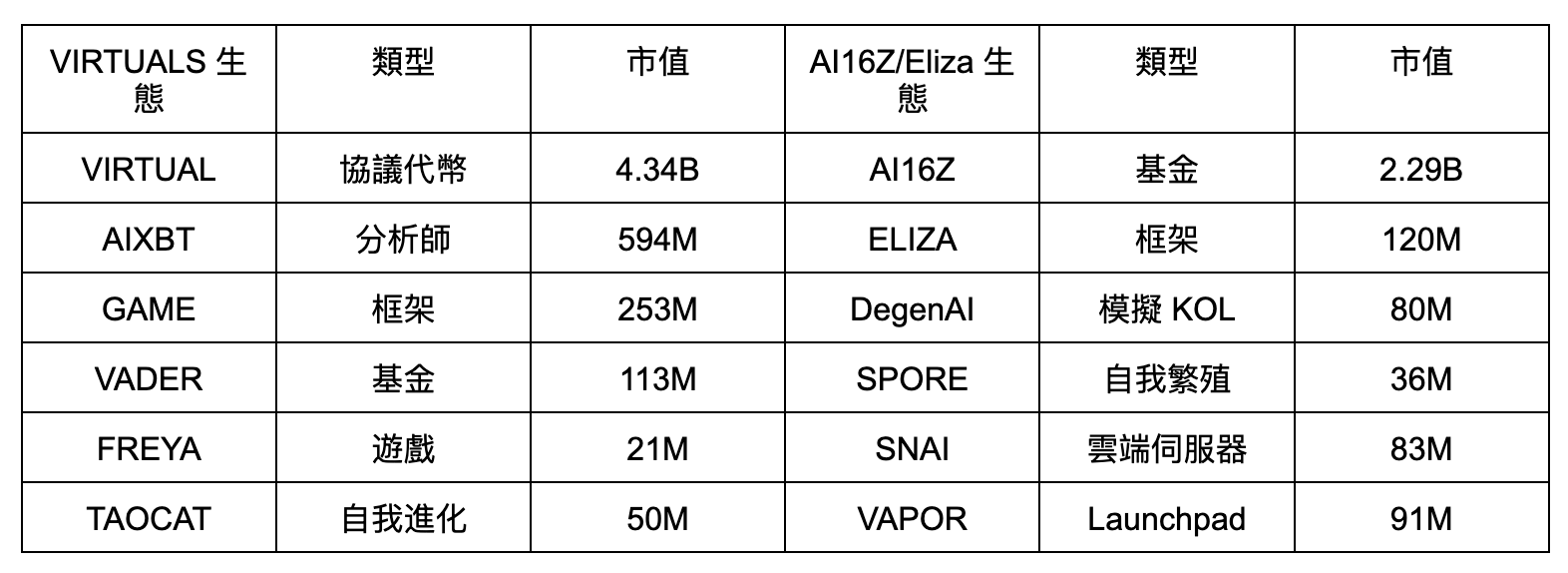
Project Overview
Catalysts Driving Token Price
-
Virtuals Protocol: The business model is clear and tightly coupled with token price. To assess the sustainability of price appreciation, focus should be placed on ecosystem token trading volume and the number of issued tokens.
Data shows that the number of tokens issued on Virtuals Protocol peaked on November 30, 2024, with over 1,100 AI Agent tokens launched in a single day. This number then declined steadily until December 27, 2024, after which it began to recover, stabilizing at around 100–200 new tokens issued per day.
Why did issuance drop so sharply? Was Virtuals Protocol merely popular but ultimately unused?
Not quite. Although often compared to Pump.fun, Virtuals does not prioritize quantity of token launches. Instead, its goal is to nurture high-quality projects within its ecosystem.
"One important thing—we don’t want Virtuals to become Pump.fun. Our KPI is finding better third-party AI teams to build on our platform. My team’s KPI is simple: one good project per week is enough. Unlike Pump.fun, which sees tens of thousands of different tokens daily, we believe retail investors sometimes only need one solid project per week. This is our differentiated positioning in terms of business model," said Wee Kee, co-founder of Virtuals Protocol.
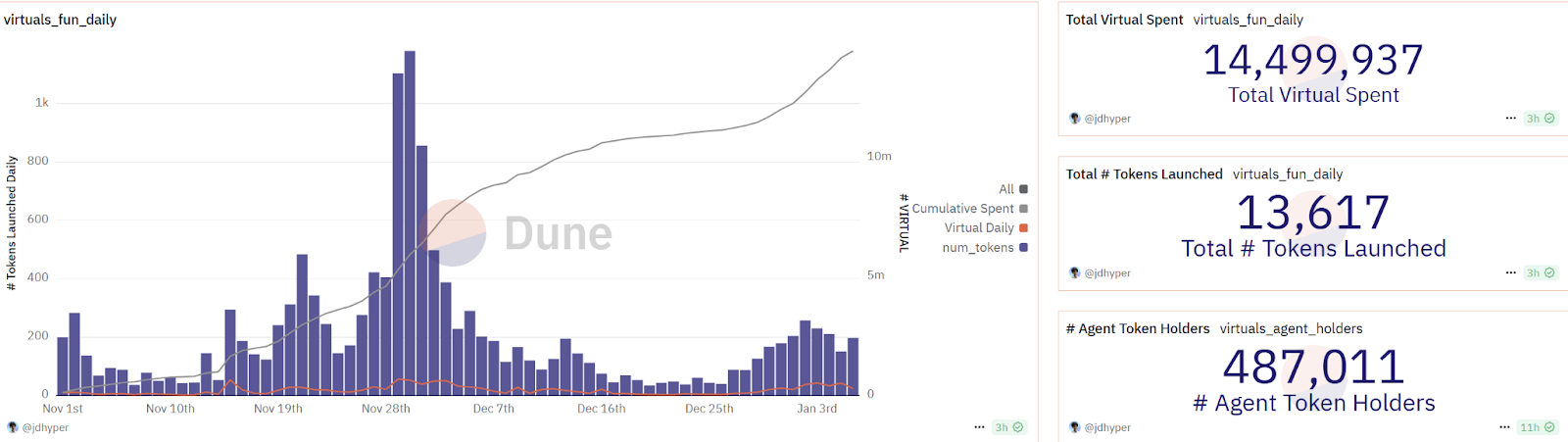
Source: Dune
Therefore, the key driver behind $VIRTUAL’s price rise becomes simpler: Can the protocol consistently incubate outstanding AI Agent projects?
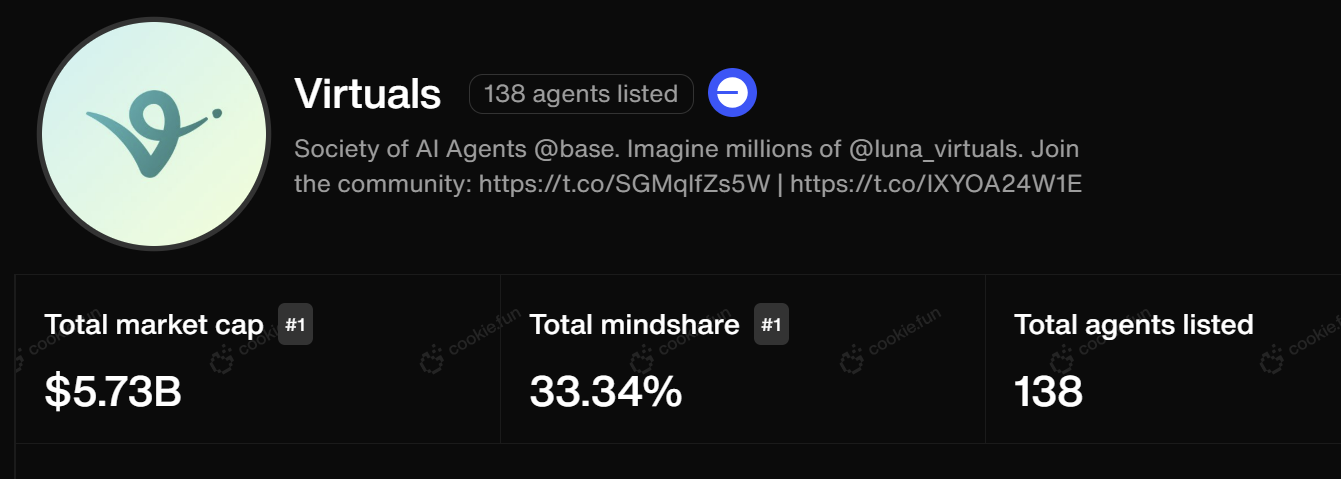
According to Cookie.fun, an AI Agent analytics site, there are currently 138 tokens in the Virtuals Protocol ecosystem, eight of which have market caps exceeding $100 million. Collectively, Virtuals holds 33.3% mindshare of the entire AI Agent market—the largest ecosystem by far.
The critical metrics to watch going forward will be whether more tokens can cross the $100 million threshold and whether the ecosystem’s mindshare can remain dominant—key indicators of Virtuals Protocol’s continued success or decline.
Source: cookie.fun
-
ai16z/Eliza: The ai16z ecosystem has weak internal connectivity. As previously noted, projects built on the Eliza framework do not directly return value to the ai16z/Eliza token. This is one reason why ai16z’s current market cap is only about half that of Virtuals.
If Virtuals Protocol represents a structured, step-by-step expansion of its ecosystem by selectively onboarding projects, ai16z adopts an open-access approach—welcoming anyone to build. Emerging AI Agent projects can promote themselves by highlighting their use of the ElizaOS framework. A retweet or reply from founder Shaw adds legitimacy and endorsement. As more projects adopt ElizaOS, ai16z gains brand credibility and trust. Strategically, ai16z follows a “surround the city from the countryside” approach.
Going forward, the key to ai16z’s market cap growth lies in how deeply, rapidly, and extensively it collaborates with other protocols. Recently, it has partnered with other well-known frameworks like ARC and FXN, and further strategic alliances are anticipated.
Source: @ARCAgents
Join TechFlow official community to stay tuned
Telegram:https://t.me/TechFlowDaily
X (Twitter):https://x.com/TechFlowPost
X (Twitter) EN:https://x.com/BlockFlow_News
 @WOOXResearch